Space travel has always fascinated me. When I was in my late 20s, I sent a preliminary application for NASA’s Journalist in Space Project. I knew my chances were nearly nonexistent; NASA was much more likely to choose a well-known TV journalist with a huge platform than a freelancer who mostly covered the culture and features beats for small community newspapers—and had a long trail of activism, to boot. But I also knew I would always regret it if I didn’t apply.
In the end, after the Challenger tragedy killed teacher Christa McAuliffe and her entire
crew, the journalist initiative was cancelled.
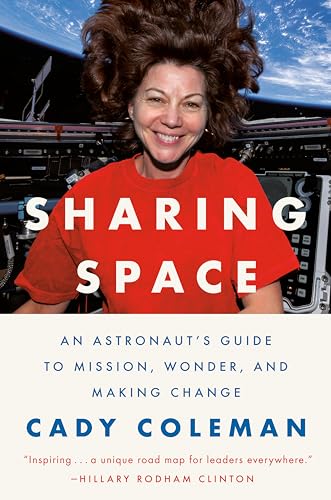
As an MIT student, Cady Coleman heard a talk by Sally Ride, the first US woman in space. Ride impressed her not only as a female role model, but with her collaborative attitude and scientific background (pp. 8-10). Like me, Coleman thought her chances were infinitesimal, but applied anyway—when women astronauts were vanishingly rare. But she beat the odds!
Coleman, who flew several missions and lived for six months in the International Space
Station, is now retired from NASA and gives talks of her own. I attended one in Turners
Falls, Massachusetts (close to her home in Shelburne Falls) on May 31 that combined
great storytelling, astonishing video and photography, and huge empathy. I bought her
book, not thinking it would be one I’d review.
But once I started reading it, I realized her message of inclusivity, tips on challenging
the power structure, ability to push herself past what most of us would think was
possible—and to succeed most of the time—was a great fit for you readers who’ve
encouraged me through my own “’Impossible’ is a Dare!” talks and four books on
combining business and social change.
Most of us will never have to struggle into a 300-pound spacewalk suit designed for a
much taller person who, unlike you, has a flat chest. We aren’t likely to operate a robotic
arm to capture the largest and heaviest object ever sent for a space rendezvous, where
being one second off could waste millions of dollars. And, of course, we don’t have the
challenge of working in zero-gravity—but that, she says, is the fun part. Doesn’t
everyone secretly want to fly? I certainly do.
Still, she has tons of deep insights into certain aspects that very much apply here on our
Spaceship Earth. Several themes come up over and over again:
- Building strong teams is essential; your life and the lives of others depend on
being able to work well together. For a space mission, your team includes not just
your crewmates but hundreds of people on the ground, both within and outside NASA. “Confrontation is great if your goal is to be right; it’s tricky if your goal is to
be trusted (p.182). And stress can forge a team better than, say, a barbecue (p.
183).
- Each member of the team brings different skills and abilities—and they’re all
crucial.
- Those teams are strengthened by diversity: of race, ethnicity, religion, gender
identity, physical ability, type of background, and more (throughout, and
especially Chapter 12). The Mercury program probably would have been even
more successful if the nine women who’d trained for it had been allowed to fly
(pp. 71, 112).
- When others, especially teammates, underestimate you, find ways to
demonstrate your competence without making them look bad.
- Success sometimes means fighting for what you need— but sometimes it’s
accepting that you’re the one who has to put your needs on hold (questions to
help determine which scenario you’re in: pp. 121-122). And sometimes, the issue
resolves in your favor much later; long after Coleman’s retirement, NASA is
finally designing spacesuits that fit women (p. 149).
- We can proactively create the circles of encouragement we need (p. 19)—but we
should also be able to accept criticism (and change the behavior).
- Mistakes often provide the biggest learning growth.
- Seeing the big picture (p. 58) is important—as is noticing the little details
And she’s a great storyteller. I loved learning that she brought one of Jethro Tull flautist
Ian Anderson’s flutes aboard and, on the anniversary of cosmonaut Yuri Gagarin’s
launch as the first human in space, did a duet from space with Anderson while he
happened to be in Russia for a gig (pp.205-207). I thought it hilarious that, from the
space station, she gave Sandra Bulluck lessons on zero-g movements as Bulluck was
reading herself to play an astronaut in “Gravity” (pp. 233-234). I was thrilled with the
conversations she had with her young son, whose precious stuffie was on the
flight—and awed by the challenges of parenting when your husband is in
Massachusetts with your kids and you’re either up in space, at Mission Control in Texas,
or training in some remote part of our own planet, like Siberia or Antarctica. There’s
even an appendix about how bodily functions work in space—which turned out to be
way easier than training to use the equipment on the ground, while gravity was still
involved.
And, of course, I loved her passion for what she did, what she had to overcome, and
how she continues to spread her love of space and her pride in the things her missions
accomplished. I also appreciated that the book is well-written and fun to read, though it
could really use an index. And if you get a chance to hear Cady Coleman in person, go
and do it.