Category Archive for Clean & Green Club

The Clean and Green Club, April 2026

<!doctype html>


Having trouble reading this as an email? Please visit thecleanandgreenclub.com to read it comfortably online.

Shel Horowitz’s Clean and Green Marketing Tip: April 2026

Great news! All of my eBooks with a publication date through 2023 are now free to subscribers to The Clean and Green Club (the monthly newsletter I’ve been publishing in some form all the way back to 1997). https://shelhorowitz.com/shels-green-products-and-services/
Ten “Linchpin Moments” in My Life—What Are Yours?
Asian woman using laptop
Image: Clement Eastwood via Pexels
The morning after finishing Linchpin, the book by Seth Godin I review below, I woke up knowing I need to do something really different and personal for this month’s main article: 10 times where I stepped into the potential to do something great—and because we always learn from our failures, another list of 10 “oops” situations, when I failed to step into greatness although the door was open. Hope you enjoy it.I’m not sharing this to brag—but in the hope that it inspires you to come up with your own list of times you did something great. And I’d love it if you share it with me (please 1) reply to this email so I can search by subject line, 2) tell me whether you give me permission to publish (in whole or excerpted) your response, and 3) if the answer to #2 is yes, may I include your name?As I’m using it here, “Linchpin Moments” might be actual moments, but they could also be extended campaigns: hard work that followed the momentary inspiration or grace. To Seth, even being a server at a restaurant can provide opportunities to be a linchpin. With that in mind, I’m listing mine chronologically. In some, I made a huge impact and helped change the world. In others, I simply took leadership over some aspect of my own life.

My Ten Linchpin Moments:

1. Surviving childhood rape by a stranger when I was too young to even know the word, though I felt really dirtied and had a vague sense it wasn’t supposed to happen to boys—and, over the years, drawing on resilience I didn’t know I’d had to process that horrific experience and become a strong feminist (~1968)
2. Hearing a speaker at my first Vietnam protest say that the Vietnam war was undeclared—which I hadn’t known—and understanding in that instant that I was now an activist because the system wasn’t working and the world had to change.I’ve devoted my life to social and environmental good ever since. (1969)
3. Keeping the promise I’d made four years earlier on a fishing trip at age 12—when I chose not to fish and realized that if I didn’t want to kill my own food, I shouldn’t be making someone else do it, and told my mom I was becoming vegetarian. I would have done it immediately, but she told me it would stunt my growth. We didn’t have Ecosia or Google back then to check—and I was a runty kid—so I told her I’d wait until I stopped growing. Keeping a promise at 16 that I’d made at 12 showed me I could keep my word, and that a long-term perspective is important. I’d bet that when she extracted that promise from reluctant me, she thought I’d forget all about it. (1973, and I still don’t eat meat)
4. Going off to college 600 miles away from the stairwell where I was raped and suddenly discovering my bisexuality—something that apparently couldn’t surface when that painful memory was too physically close. And even though at that time, gays, lesbians, and bisexuals were despised (and trans identity was essentially invisible), choosing to get involved with (and eventually run) the campus gay center, organize and participate in a speakers bureau, and be very publicly gay-identified. When I was running it, I focused on outreach and intersectionality. I built a partnership with the Women’s Center next door. I publicized our meetings in the newspaper of the bigger city 20 miles away. And I even had a series of meetings with the liberal but homophobic editor and publisher of the town’s newspaper about why they refused to list our meetings in the community calendar—which gave us lots of exposure because they gave extensive coverage to those meetings. I remember one of them telling me that while he had known other gay men including Bayard Rustin (co-organizer of the 1963 March on Washington), he’d never met someone who considered it normal before. While it’s common knowledge since his biopic, I hadn’t known Rustin was gay, and that was inspiring. (1973-1976)
5. On 3-month college co-ops and a year-long stay at the end of my final co-op, I co-organized the first Gay Pride block party in DC and Gay Centers in Atlanta (which survived at least another decade after I left the city) and Providence (which didn’t make it) (1975-1977)
6. Joining the early organizing of the Clamshell Alliance chapter in Rhode Island, I co-organized several actions including a “swim-in” at the beach where a utility wanted to build a nuclear power plant (and then canceled, probably because we’d begun to generate opposition)—and was one of 1414 arrested in the life-changing and world-changing Seabrook Occupation and the “university within walls” that we collectively put together during the time we were held in New Hampshire National Guard armories after the mass arrest. We had no idea at the time, but we were birthing a nationwide nonviolent safe energy movement that brought nuclear power plant construction to a near-total halt. (1977)
7. After moving to Northampton, MA, I worked with my City Councilor to pass the first nonsmokers’ rights regulations in town (and I think the third in the state)(~1983)
8. When a developer announced his plan to put 40 trophy homes on a mountain next to our beloved state park just a year after I’d moved to that neighborhood, I was appalled. Then, as I read to the end of the article where several prominent environmentalists expressed variations on “this is terrible, but there’s nothing we can do,” I got angry enough to form an organization, Save the Mountain. As I was mulling over whether I had the spoons to start this movement, a voice literally came into my head with the words, “You were put here to stop this.” After that, I had to take the reins that were handed to me. While the experts were moaning that there was nothing we could do, I got 70 people to show up for the first meeting. I became the publicity co-chair and we got about 70 print articles, a couple of dozen radio interviews, and even a few TV appearances during the 13-month campaign. We routinely brought 400+ to attend meetings and hearings on the project. We flooded the town with lawn signs and bumper stickers. And we attracted the attention of a local philanthropist I’d never heard of, who funded the state to purchase and protect the land. We also passed three new laws that make it very difficult for anyone else to build on the mountain range in town. Most importantly we changed a “you can’t fight City Hall” attitude in town into a perception that we live in a caring and progressive community that can take meaningful action. Many people got involved in town politics, ran for office, volunteered for town committees, and made some real change. (1999-2000)
9. Reflecting on the success of Save the Mountain, I realized that the campaign had not only harnessed everything I knew from 30 years as an activist, but also everything I’d learned in my career as a marketing strategist and copywriter. I started pondering what the activist world could bring to business and settled on the idea that building in strong ethics and environmental/social impact was a business success strategy. I did enough research to anchor my belief with real-
world examples and eventually wrote four books and hundreds of articles, spoke internationally, and skewed my consulting practice and this newsletter toward businesses, authors, and organizations that were creating positive impact. Writing, speaking, and consulting on that intersection of profitability and impact has been the focus of my career for more than 20 years now. (2002-present)
10. Although I’ve been sympathetic to the immigrant cause for decades, my activism had been focused elsewhere. I shifted to immigration justice by accident during the first Trump term, when my wife went to a meeting and came back all excited about going to witness at a Florida detention center holding 3000 migrant teens. I’d said I go with her if we took a vacation in Cuba afterward. I’ve been an active core member of Jewish Activists for Immigration Justice ever since. We did the witness in Florida and a few months later, a full week on the border where we met with refugees from kids to elders, advocates, and government personnel; co-taught a writing workshop for kids and then were asked to do another for their moms; observed the tent courts and the 5a.m. loading of a deportation flight; cooked food on the US side, pulled it across the border in little red wagons, and served a meal for 2500 residents of the refugee camp. Following both delegations, we actively engaged with legislators, the media, public audiences, and college classes—and I think we successfully shifted the narrative in our local area. (2019-present)
11. This one hasn’t happened yet, but I hope it will make a future top ten list: I’m working on a new book about being an activist at age 60+ and have already
begun to speak on being an activist at any age.

And Some of My Many Failures:

1. I’m still troubled by my failure to interrupt a racist comment made by a new neighbor who had invited us in to get to know us after we’d just bought our first house.
2. I’m also still troubled by my well-intended but inappropriately noncommittal teenage response to a stranger who was insulting the woman he was with and asked me for validation. I responded with something way too ambiguous when I should have just told him to stop bullying her.
3. I was never nice enough to my brain-injured older sister or my schizophrenic brother-in-law.
4. As an NYC native, I’ve had to work hard to come across as less abrasive and self-righteous, to speak more slowly and more softly, to leave space (or actively MAKE space) for others to participate in group conversations.
5. I can be impatient with people whose learning or speaking styles are different than mine.
6. There are a lot of moments where I could have been kinder, less judgmental, less moralistic.
7. I’m also still working on being more supportive to people who are in crisis, or even just upset—and to do that in ways that don’t leave me taking on their burdens.
8. I still sometimes feel gleeful when bad things happen to evil people.
9. Sometimes I’m entirely too bossy.
10. I don’t always accept responsibility for problems I’ve caused or worsened.

Looking forward to reading yours! And don’t feel any obligation to come up with your
own “oops” list.

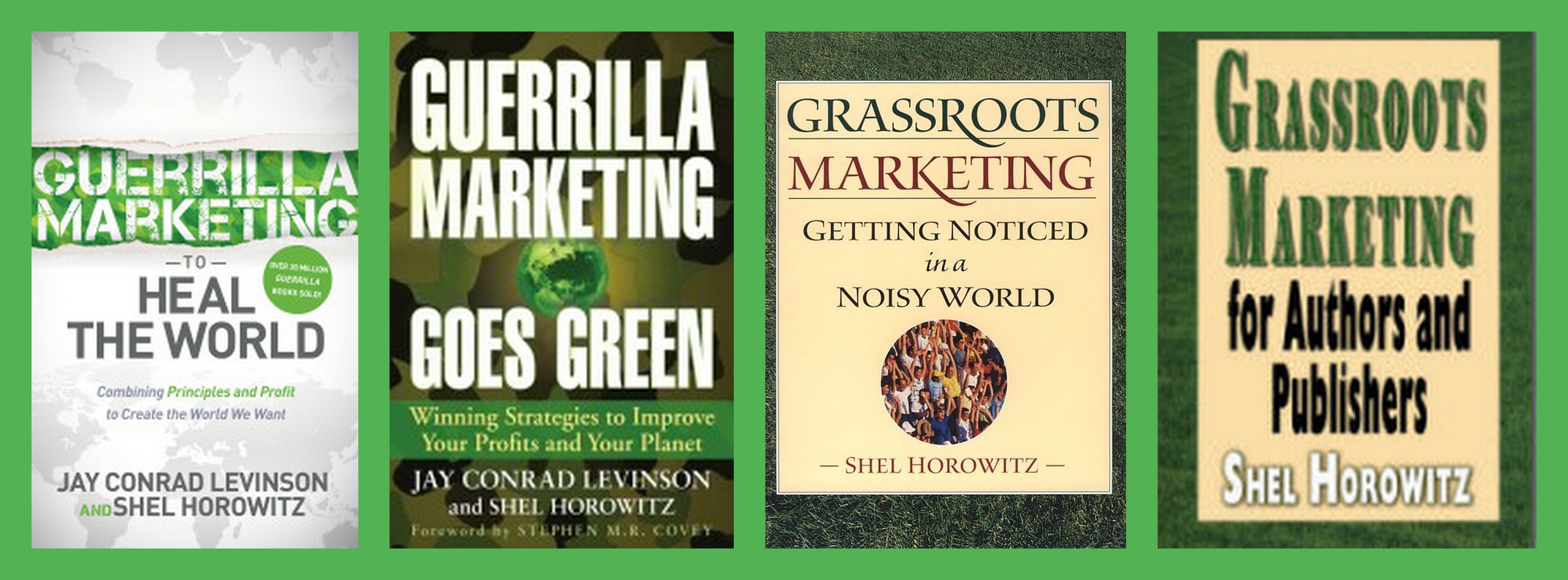
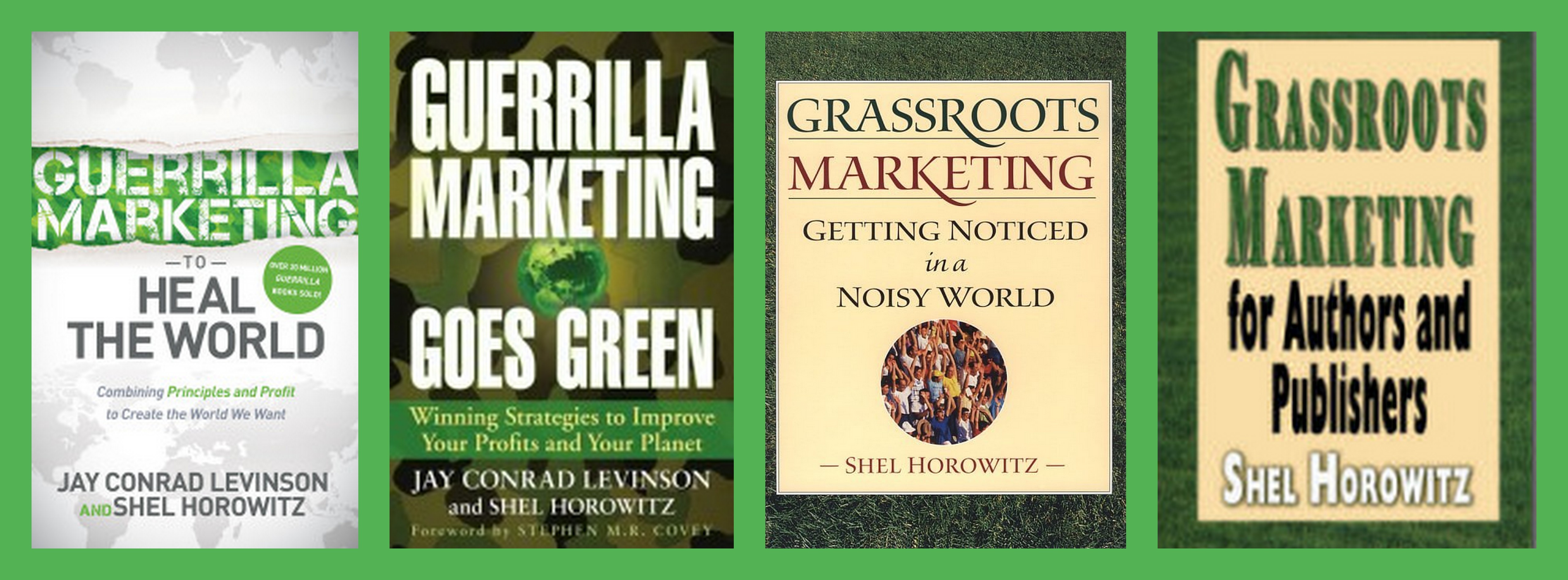
Discover why Chicken Soup’s Jack Canfield, futurist Seth Godin, and many others recommend Shel’s 10th book, Guerrilla Marketing to Heal the World (and download a free sampler). Autographed and inscribed copies available.
Wild Party Podcast with Stefanie LaHart
Stefanie LaHart’s Wild Party podcast interview just blew me away when I listened to the replay. We went so deep into activism and yet still gave plenty of space to how businesses can thrive by building in environmental and social good. And at the very end, she asked about my next project—and I got to riff on the book I’m working on about being an effective and badass activist as an elder. I think it’s the best integration of the business and activist sides of any interview I’ve done. Please visit 
https://thecleanandgreenclub.com/recent-interviews-guest-articles/ for a long list of highlights.

View highlights from (and listen to) more than 30 podcasts ranging from 5 minutes to a full hour. Click here to see descriptions and replay links.

Ellen Finkelstein and Project 2029
A couple of friends have been frustrated by not seeing progressive politicians or well-known thought leaders offer positive ideas for improving life in the United States. So we decided to create a place for anyone to post ideas on a variety of topics, such as gun violence, healthcare, homelessness, poverty, immigration, and more. And we hope people who can implement them will notice. It’s a simple site but it works.

Please post your ideas here and then share the site!
https://www.project2029.community
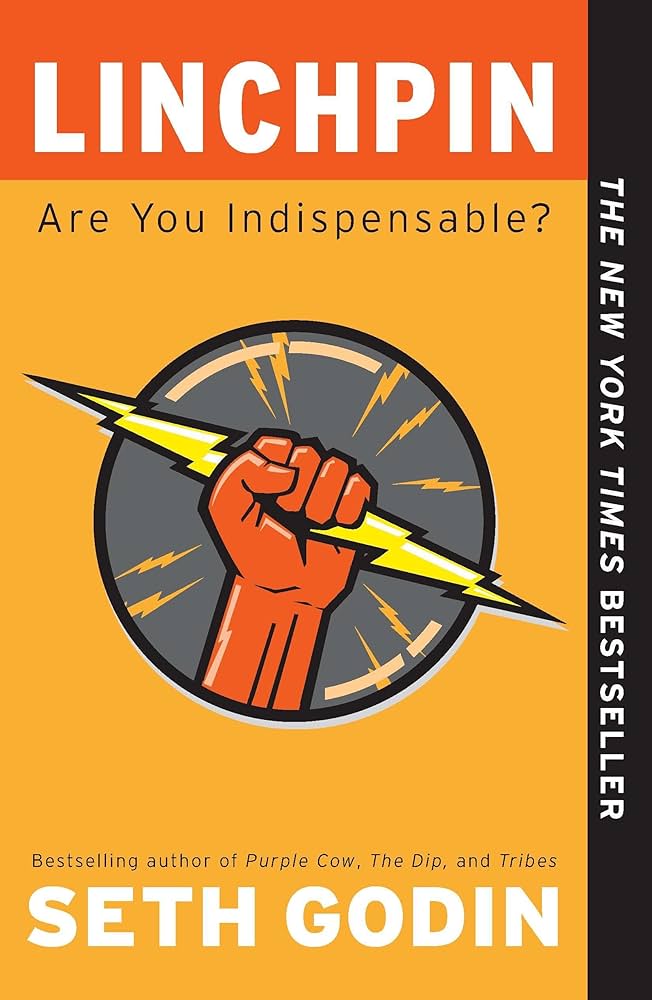
Linchpin: Are You Indispensable?

Hands Across the Hills

Linchpin: Are You Indispensable?
By: Seth Godin (Portfolio/Penguin, 2010)

Why would I review a thought-leader business book from 16 years ago? How is it still relevant? The business world has had such huge shifts since then: AI replacing workers; COVID and Zoom eliminating so many in-person business meetings; the resurgence of authoritarianism and foreign policies based on war and conquest in so many parts of the world; the undermining of world institutions…

I’d argue that these changes make Godin’s central thesis more relevant than ever. He argues that you can choose to be a cog in the machine, taking no initiative, doing what
you have to and not an iota more—or you can choose to be a linchpin: an indispensable person who turns even the simplest everyday tasks into art, sees the big picture, and is constantly thinking about/working toward better outcomes—even if it means breaking the rules sometimes. The cog model, he says, worked well in the 19th and 20th centuries.But as more and more tasks are turned outsourced to machines (or cheaper human labor in developing countries)—and the business world gets more and more unpredictable—staying unnoticed and unmemorable but replaceable is the opposite of a success strategy (p. 7). Indeed, linchpins wildly outperform cogs (p. 36).

Godin is an abundance thinker (and I hope you are too). Being a cog, he says, embraces a scarcity mindset; you may perceive your time as too valuable to give to an employer who doesn’t care. But scarcity mindsets lead to divisiveness and othering (pp.30-31). Meanwhile, in what he calls “the law of linchpin leverage,” the more value you create, the less time it typically takes (p. 51). Dramatic breakthroughs happen either when there aren’t any unbreakable ceilings, or they turn out to be breakable after all (p.69).

And they happen because “artists are optimists” (p. 98); they’re linchpins who see the diamond inside the plain-looking rock, see the sculpture waiting to emerge from the marble slab—and have a passion to fulfill that promise (p. 92). They make the effort not for financial rewards, but for the intrinsic rewards that quench their artistic and creative thirst (p. 78). While those intrinsic benefits frequently lead to financial rewards as well, that’s not why they do them. They’re making art, even with the most humble acts.

And the cool thing is we can all do this: “Everyone, every single person, has been a genius at least once. Everyone has winged it, invented, and created their way out of a jam at least once.

“If you can do it once, you can do it again” (p. 99).

But just as the rewards are intrinsic, so is the resistance. He devotes 40+ pages to the amygdala (lizard brain)—which was essential in the days of fight or flight but now is mostly a barrier (pp. 101-149).

Not surprisingly, mindset helps avoid the lizard brain’s traps. Successful people see a
failure as a tactic that didn’t work—and NOT as a crushing defeat that means you
shouldn’t have even tried: “You become a winner because you’re good at losing” (p.
115). Or they pursue multiple paths, so if one fails, they’re still on track for a different
one (p. 125). Or you learn how to acknowledge criticism (and your own anxiety) without being destroyed by them (pp. 138-139).

Rejecting Robert Ringer’s “Looking out for Number One” transactionalism, Godin sees
linchpins as generous artists, often creating gifts that can never be adequately repaid
(pp. 152-153). They don’t worry about people stealing their stuff. Instead of “Pay me,” they say “Here” (p. 165). They free up abundance by being frugal—which can lead to even larger surpluses (p. 166) as people recognize that you’re worth their time and energy. Your gifts build loyalty and trust while reducing price sensitivity (p. 196). And you don’t need other people to validate your status to do it (p. 201).

Small digression: I’ve never liked the Ringer approach, nor those of Milton Friedman or
Jack Welch, and I’m glad that Godin continuously reinforces that business can be much more than a source of material wealth. Far too often, businesses socialize the costs while privatizing the profits and privileges. In my book, Guerrilla Marketing to Heal the World (which Godin endorsed), I make the case that building business on positive environmental and social impact is a success recipe. If you’d like a PDF at no charge, reply to this email and change the subject line to

Please send GMHW PDF: Subscriber

(Copy and paste, so it matches exactly, please. If you use a different subject line, I’m likely to miss it entirely.)

Godin notes throughout the book that the rewards also come when you commit to doing your best, even for tasks that may not seem worth it.

Linchpins generate far more nimbleness and creativity than cogs. “The linchpin is able to invent a future, fall in love with it, live in it—and then abandon it on a moment’s
notice” (p. 204). Commitment, personal resilience, and success strategies help you get through the tough spots (pp. 207-230).

The book concludes with this wonderfully optimistic sentence: “The result of getting
back in touch with our pre-commercial selves will actually create a post-commercial world that feeds us, enriches us, and gives us the stability we’ve been seeking for so long” (p. 236). Amen!

Connect with Shel

Turn Your Sustainability/CSR Report Into Powerful Marketing!  http://goingbeyondsustainability.com/turn-that-nobody-reads-it-csr-report-into-a-marketing-win/

About Shel

Speaker, author, and consultant Shel Horowitz of GoingBeyondSustainabiity.com helps businesses find the sweet spot at the intersections of profitability with environmental and social good — creating and marketing profitable products and services that make a direct difference on problems like hunger, poverty, war, and catastrophic climate change. His 10th book is Guerrilla Marketing to Heal the World.

If you’re not already a subscriber, please visit http://goingbeyondsustainability.com and scroll to the very bottom left corner. You’ll find lots of interesting information on your way to the subscription form, too.

————–

Links in this newsletter may earn commissions. Please click here for our privacy and endorsement policy.


Powered by:

GetResponse

The Clean and Green Club, March 2026

<!doctype html>


Having trouble reading this as an email? Please visit thecleanandgreenclub.com to read it comfortably online.

Shel Horowitz’s Clean and Green Marketing Tip: March 2026

Great news! All of my eBooks with a publication date through 2023 are now free to subscribers to The Clean and Green Club (the monthly newsletter I’ve been publishing in some form all the way back to 1997). https://shelhorowitz.com/shels-green-products-and-services/
This Changes Everything About Search
Asian woman using laptop
Image: Ketut Subiyanto via Pexels

This month, I’m sharing this excellent article on how to optimize for AI query responses. This is an area where I have zero expertise, while the writer clearly knows the territory very well.


But let’s talk first about why this is a game changer—just as online search was a game changer starting the mid-90s. Until search tools like Yahoo and Excite came along, the Internet was basically useless for most of us. And it was really only when Google—with its clear interface and fast, reasonably accurate answers that got much more accurate when people queried a phrase instead of a word—began to get popular that the Net crossed into mainstream use. I don’t think that’s a coincidence.


Now, pretty much every search engine builds in an AI answer at the top of the results, and more people rely on them (perhaps because they aren’t familiar with the issues around accuracy or misleading context)—and more people are bypassing the search engines entirely and going directly to AI (mostly Chat GPT, but also hundreds of other agents).


So…we as marketers, and especially those marketers who’ve built their business on Google results, need to adapt once again.


And let’s remember that the most popular and well-branded tools are not always the best. I do most of my searches—and most of my web browsing—in Ecosia.org (which has both a search engine and a browser), because it allows me to do environmental good: every search or browser use plants a tree. 95 percent of the time, I can get the results I need, and the other 5% I go to Google (which doesn’t always give me what I’m looking for either) next. My use of AI is still limited, but I have seen too many bizarre results from GPT to trust it, so I go to Perplexity. If I’ve exhausted my freebie queries, I’ll turn to Claude. By the way, I discovered both Ecosia and Perplexity because Seth Godin wrote about them (years apart) in his daily blog, which I’ve been reading for more than a decade and strongly recommend. 


Here’s the article, which I found through John Kremer.

https://moritzfritzen.substack.com/p/aeo-for-consumer-brands?utm_source=substack&utm_campaign=post_embed&utm_medium=web

Discover why Chicken Soup’s Jack Canfield, futurist Seth Godin, and many others recommend Shel’s 10th book, Guerrilla Marketing to Heal the World (and download a free sampler). Autographed and inscribed copies available.
Sustainable Business Magazine
A good and current interview with me in Sustainable Business Magazine went live recently: https://sustainablebusinessmagazine.net/netzero/green-profitability-consultant-shel-horowitz/ 
It starts with an overview of how I got into this work, lists four benefits of building sustainability into a company’s products and services, discusses two strategies companies can use to attract atention to the good they’re doing, discusses why sustaiability initiatives are still important even when the feeral government hates them (and how the market will punish those who abandon them because they want to appease the would-be dictator), and finishes with the exciting new direction I’ve started to embark on.

Impossible Things Happen When You Do This One Thing 

(18-minute mini-presentation to the East Trade Winds networking group in Ontario: https://youtu.be/Z1hDu2_zrSI). My presentation starts at 35:05.

  • Treat the earth as a fiduciary and honor the Precautionary Principles
  • Create a virtuous circle by implementing the unique social and environmental good that supports your goals, strengths, and reputation
  • Nine ordinary people, Twelve people’s movements, and 5 technological revolutions (among many) that changed the world
  • How I started my own “impossible” movement and won the victory in just 13 months
  • Why higher purpose is good for business
  • Four paths from impossibility to success—and four doable social transformations
  • Six huge transformations that could have happened if builders adopted green technology 40 years ago
  • Messaging that’s appropriate for non-green consumers, and different messaging for the corporate bean counters
  • An easy way to conserve water
  • Six ways to reduce food waste
  • The power of win-win-win solutions from cheap solar lamps to multiple industries collaborating in a circular economy
  • 16 movements that changed society, decade by decade from the 1950s
  • The power of win-win-win partnerships
  • The benefits of a freebie half-hour consultation with me

View highlights from (and listen to) more than 30 podcasts ranging from 5 minutes to a full hour. Click here to see descriptions and replay links.

Sleep to Thrive
Sleep-deprived? Instead, jump out of bed with energy and alertness! Discover your sleep type to escape your pattern of sleeplessness. Next join Sleep to Thrive: Wake Up to Your Life!, starting in mid-March to transform your sleep and your life.

Changemakers’ Mentorship

If you’re an activist, organizer, or community leader dealing with burnout, uncertainty, or conflict — Katherine Golub’s Changemakers’ Mentorship might be exactly what you need. It’s a small group coaching program (just four people) starting in April, with three spots still open. Katherine has been leading these cohorts for ten years and offers solidarity pricing plus a free discovery call before you commit. Learn more and read a client story here.

Ellen Finkelstein and Project 2029

A couple of friends have been frustrated by not seeing progressive politicians or well-known thought leaders offer positive ideas for improving life in the United States. So we decided to create a place for anyone to post ideas on a variety of topics, such as gun violence, healthcare, homelessness, poverty, immigration, and more. And we hope people who can implement them will notice. It’s a simple site but it works.

Please post your ideas here and then share the site!
https://www.project2029.community
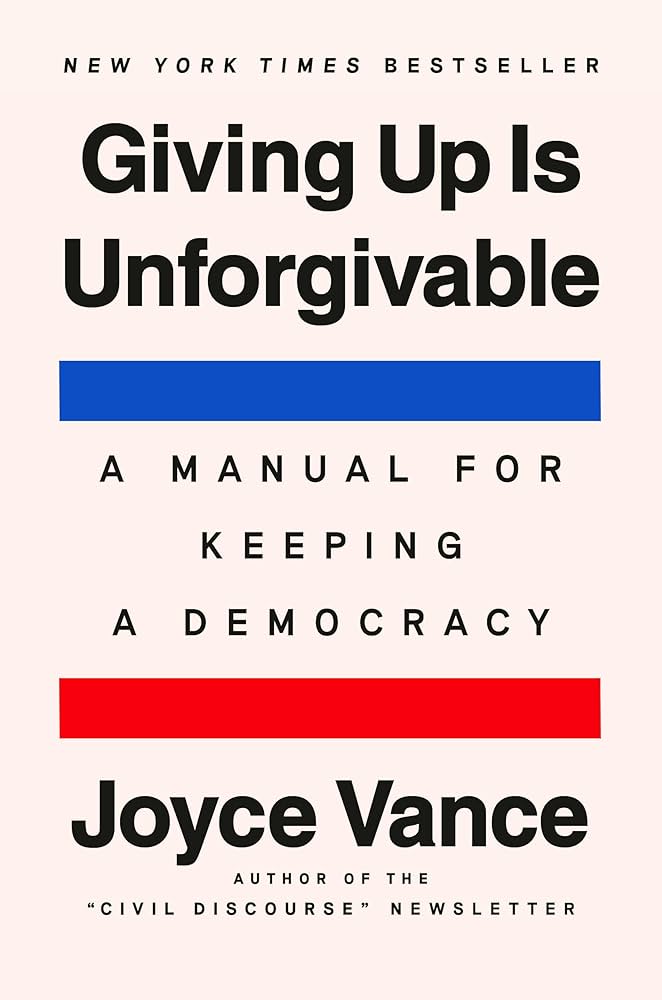
Giving Up Is Unforgivable: A Manual for Keeping Democracy

Hands Across the Hills

Giving Up Is Unforgivable: A Manual for Keeping Democracy
By: Joyce Vance (Dutton, 2025)

To create social and environmental impact businesses, it really helps to have both a business culture and government climate that supports them. Thus, I occasionally review books that are more about politics than about business, because the current US administration is actively hostile to these goals. This is one of those books.

Vance, a career prosecutor in Alabama who resigned just before the 2017 inauguration, built her subtitle and much of the book on Ben Franklin’s famous retort that the Founders had designed “A republic, if you can keep it,” and on the works of Thomas Paine and George Orwell.

It’s a quick and easy read that provides both historical and current context for the threats to democracy caused by the current administration, as well as T’s first round from 2017-21. And it’s in very good shape, especially considering that it covers well into 2025 and came out by the end of the year (most books from big publishers take a year or two to be birthed once the manuscript is turned in). Most of the rushed books I’ve experienced from big publishers are a mess. Here, I think I saw just two places where a minor grammar error slipped in—and rare is the book that does better no matter how long its publishing process. But I can probably blame the lack of an index on the rush to get it out—and that’s an unfortunate omission.

Much of the book reinforces an idea that I strongly agree with: no matter how bad things are, we can’t give up hope—because we, the people, can and do make a difference:

It’s an educated public capable of informed civil discourse that sustains effective, fair government. Accountability happens when citizens demand it. Sometimes, they must demand it loudly and persistently. This is undoubtedly one of those moments (p. 6).

[T]he practice of democracy, something we do together as Americans. When we make mistakes, even big ones, we can learn from them. We dig deeper so we can fix them. We get back to work. But what we cannot do is give up (p. 53, emphasis in original).

The orthodoxy of a totalitarian regime requires that we abandon thinking for ourselves…Don’t look away. And don’t hope it won’t happen if you close your eyes. Surround yourself with supportive people and educate yourself…The damage to the architecture of our democracy can be repaired by people of purpose. That is the task ahead of us (p. 101).

If you want to save democracy, persuade potential voters who don’t vote or don’t vote regularly, that their participation is essential (p. 133).

The book is a great mix of inspiration and concrete ideas like turning patriotic holidays (e.g., Presidents Day, Juneteenth) into public celebrations that center civics education and democracy. She has a whole chapter called We Are the Cavalry, pointing out that we are the ones who can save our threatened freedom. They attack us BECAUSE they fear our power—and the attacks will keep expanding past marginalized groups to eventually encompass all of us (p. 172)—but we can often jujitsu their attacks into media coverage and more support (pp. 149-151). And we can borrow solutions modeled elsewhere, such as Finland’s national media literacy program (p. 144).

The last few pages (the postscript) are a clarion call to action. One final quote to finish this review:

It will take all of us. It will be the small acts of protest, of resistance, of education, and of love for country that will keep the dictator from seizing control. It may not always be your turn to save democracy, but it’s always your turn to be present, to do whatever you can, and to support the people who do the work to keep the Republic. The dictator’s most dangerous weapon is his ability to overwhelm us with the feeling that we are helpless by keeping up an endless onslaught of terrible things. We can neutralize that weapon by knowing our own strength and saying no to feeling powerless…We must persist until we succeed… (pp. 172-173).

Connect with Shel

Turn Your Sustainability/CSR Report Into Powerful Marketing!  http://goingbeyondsustainability.com/turn-that-nobody-reads-it-csr-report-into-a-marketing-win/

About Shel

Speaker, author, and consultant Shel Horowitz of GoingBeyondSustainabiity.com helps businesses find the sweet spot at the intersections of profitability with environmental and social good — creating and marketing profitable products and services that make a direct difference on problems like hunger, poverty, war, and catastrophic climate change. His 10th book is Guerrilla Marketing to Heal the World.

If you’re not already a subscriber, please visit http://goingbeyondsustainability.com and scroll to the very bottom left corner. You’ll find lots of interesting information on your way to the subscription form, too.

————–

Links in this newsletter may earn commissions. Please click here for our privacy and endorsement policy.


Powered by:

GetResponse

The Clean and Green Club, August 2025

<!doctype html>


Having trouble reading this as an email? Please visit thecleanandgreenclub.com to read it comfortably online.

Shel Horowitz’s Clean and Green Marketing Tip: August 2025

Do You Deal with International Payments?
When I hired my current assistant more than a year and a half ago, she told me about WISE, the best international payment service I’ve used. Fees are quite reasonable. And it only takes a few seconds to make the transfer. It’s been a lot more trouble-free than other, more well-known services. Use my link, https://wise.com/invite/dic/shelalanh and try it out with a no-fee transfer up to $600. I will receive a small credit.
Due Diligence and Deep Fakes, Part 2
Male and female workers at laptop
Photo Credit: Tima Miroshnichenko via Pexels

Last month,
I invited you to send your thoughts on how, both as marketers and as consumers, manipulative deepfakes affect us. With just one exception, you didn’t rise to the challenge.


This is the only response I got: “Not being a marketer, I can’t respond from that perspective, but this is chilling because if done a bit less clumsy, it could slide by as ‘reality’ all too easily. Deepfakes for sure.”


I’ll still share my own reactions, written June 22 (the same day I watched the video and wrote last month’s main article). But first—if this newsletter matters to you, please take a moment as you’re reading this—don’t put it aside until later—and hit reply and give me a couple of sentences that let me know why this work matters to you. Frankly, I need a pep talk. This newsletter is a lot of work to put together every month. I’m willing to do it if I know that people value it. Not so much if it’s going to a black hole.


Also,
if you found this issue in your spam or promotions folder, please take a moment to flag it as not spam and move it into your regular inbox (be sure when you move it that you tick the option to do this for all mail from this sender). That way, you’re more likely to see future issues.

My Analysis of the Deepfake

  1. Despite its errors and omissions, this was really well done for its purpose. If the goal was to grab us by our hearts, it succeeded. If the goal was to go viral, that succeeded as well. A TikTok version garnered 71,700 views in four days before being taken down. The first version I saw had 83,000 views. With dozens of versions on YouTube, other social media, and individual blogs, it’s likely that it’s been shared a whole lot. Probably several million people have seen it.
  2. As consumers, we must up our skepticism. I generally try to verify anything that seems too outrageous to be true before sharing it, though I forget sometimes (and often regret that I didn’t check). Before sharing anything provocative, make sure it’s true—especially if there are warning signs like a lack of sourcing or sourcing only to personal blogs or nonverified media such as Daily Kos on the left or Fox on the right—misidentifications, lots of emotion-pullers like “nobody ever expected,” clickbait headlines, etc., as there were all through this beautiful but false narrative.
  3. Ask yourself who benefits from the message and what’s their agenda. In this case, anyone who is appalled by the current administration’s racism is likely to be already angry and probably has mobilized to participate in demonstrations, sign petitions, write letters, lobby their elected officials, etc. So while this new, artificial, “example” of racism might turn the intensity up a notch, it wouldn’t really change anything. There are certainly people around the world who would benefit from de-escalation of tensions, and we’d all benefit if world leaders responded from the place of truth and love that the African leader’s doppelganger purported to respond from. When I watched an actual speech of his (as opposed to the AI-generated narrative of a fictional incident), I did notice that he has formed alliances with Russia. So it’s possible that the maker’s agenda was to very indirectly make Russia look better in the eyes of a world that distrusts and fears it (with reason—just ask Ukrainians or the loved ones of those murdered by its government). But the connection is thin enough that my own hypothesis doesn’t convince me. I still don’t understand what benefits the maker and distributors of this piece received.
  4. As marketers, we will face either extreme gullibility—that, if we can consider ourselves ethical, we have to refrain from abusing—or even deeper mistrust because “you can’t believe anything you hear anymore.” Either way, our task has become harder. So do what you can to enhance credibility.
    Examples:
  • Attribute testimonials by name, position, and geographic location, and ideally use video as well as text (please get permission first!).
  • Link to reviews including some negative ones. Refute any errors of fact in the negative AND the positive reviews, but do it with respect and politeness, not with name-calling or other accusations. Accept any genuine criticism and respond with how you plan to fix that problem or why it’s not something you’re able to fix (perhaps it’s a feature that you see as an advantage—explain how).
  • Set up user communities where your customers can get support from each other and explore new uses for what you sell.
  • Provide lots of unbiased information that positions you as an expert and your organization as on the user’s side, even if the right decision is for them to go elsewhere this time. And not in a begrudging way but from sincere wishes to be helpful, useful, and positively remembered.

Music to Make “Good Trouble” By: Songs to Inspire ActivistsMore than 50 songs to inspire social justice and environmental good organized into categories. I’ve been working on this for a few months—and I think it’s a tremendous resource for activists. Please share widely.

Discover why Chicken Soup’s Jack Canfield, futurist Seth Godin, and many others recommend Shel’s 10th book, Guerrilla Marketing to Heal the World (and download a free sampler). Autographed and inscribed copies available.
View highlights from (and listen to) more than 30 podcasts ranging from 5 minutes to a full hour. Click here to see descriptions and replay links.

One Million Rising

Hands Across the Hills
Photo Credit: Artem Podrez via Pexels

Two giants of nonviolence theory and practice, Daniel Hunter and Maria Stephan, were the lead trainers in a series of three mass calls co-sponsored by multiple peace, environmental, and social justice organizations, including Indivisible and nokings.org. After my notes on why you should listen to these calls, I include the replay and slide deck links for the first two calls and the registration link for the final one, which is this coming Wednesday.

I’ve been studying nonviolence for a long time. I found the two calls I attended so far to present the material in a concise and approachable way, with plenty of slides to help absorb the material.


Their message is that authoritarian regimes, such as the one attempting to cement its power in the US this year, require consent from us, the governed. And organizing to undermine that consent, in every sector, is some of the most effective work we can do to restore a government of, for, and by the people. When the pillars propping up a rogue regime are weakened or even fall, that government is statistically likely to topple.


In fact, according to researcher Erica Chenoweth (a close associate of Hunter and Stephan), if just 3.5 percent of the population actively stops cooperating, most governments have fallen. Chenoweth originally thought that violent revolutions were more likely to succeed, but as she got into the material, she realized that nonviolent social change not only wildly outperforms violence—but the effects last longer and the new governments are more responsive and less dictatorial than those installed by violence. This is glossed over somewhat in the calls, but I’m familiar with the literature and heard Stephan speak on this several years ago.


Back to the calls: Encouraging the withdrawal of consent and cooperation is the path they see (and one of the paths I see) to:

  • Stop the gratuitous cruelty (e.g., brutal, violent family separations)
  • Reclaim the economy that’s under siege
  • De-weaponize the major government departments that have been turned into servants of one man
  • Restore the roles of science, education, law, academia, culture, environmental and social justice work both within and outside government
  • Create and strengthen safeguards against the massive financial and political corruption
  • Rebuild the shattered trust not only that most of us in the US had in our own government, but that other governments and negotiating partners had as well.

Governments get shaky when bureaucrats refuse to comply with directives, when masses of people refuse to pay taxes or serve in the military, when soldiers disobey orders to fire on nonviolent civilians—and when institutions, whether the L.A. Dodgers or Harvard University, refuse to comply with power grabs and financial demands.

Links to the Replays and Slide Decks for the First Two Calls and to Register for the Final Call on Wednesday:

Session 1 (July 16, 2025) Replay
Session 2 (July 30, 2025) Replay
Session 2 slides
Register for Session 3 (Wednesday, August 13, at 8 p.m. Eastern/5 p.m. Pacific).

Connect with Shel

Turn Your Sustainability/CSR Report Into Powerful Marketing!  http://goingbeyondsustainability.com/turn-that-nobody-reads-it-csr-report-into-a-marketing-win/

About Shel

Speaker, author, and consultant Shel Horowitz of GoingBeyondSustainabiity.com helps businesses find the sweet spot at the intersections of profitability with environmental and social good — creating and marketing profitable products and services that make a direct difference on problems like hunger, poverty, war, and catastrophic climate change. His 10th book is Guerrilla Marketing to Heal the World.

If you’re not already a subscriber, please visit http://goingbeyondsustainability.com and scroll to the very bottom left corner. You’ll find lots of interesting information on your way to the subscription form, too.

Links in this newsletter may earn commissions. Please click here for our privacy and endorsement policy.


Powered by:

GetResponse

Clean and Green Club, July 2025

<!doctype html>


Having trouble reading this as an email? Please visit thecleanandgreenclub.com to read it comfortably online.

Shel Horowitz’s Clean and Green Marketing Tip: July 2025

Due Dilligence, Deepfakes, Gullibility—and What it All Means for Marketers
Photo Credit: This Is Engineering via Pexels

Sunday morning, June 22, I sat down at the computer and glanced at the list of suggested next plays after the YouTube video I’d watched the previous evening. One caught my eye: a major figure in the White House had told the Black leader of an African country, “sit down, boy” during a debate on national US TV. That level of blatant racism is shocking even from this openly racist administration, so I clicked through.

The story was a riveting description of the African leader’s supreme grace under pressure, responding passionately and from the heart in a way that broke down barriers, declaring the humanity not just of himself but of everyone in his country and continent, and then several members of the audience (including one identified by name and position) jumping in to thank him.

It was a beautiful piece of writing. I often multitask while listening to videos but I gave it my full attention, even though the obviously AI-generated narration (a smooth and comforting male voice) mispronounced words, paused in the wrong places, and such—and even though the White House personality was not identified by current title but as a “former political spokesperson.” That made me wonder if this incident was from before January 20, 2025 when T took office—and if that were true, why hadn’t I heard about it before? I also noticed that the video used still pictures of the two figures that were obviously taken in different locations. There were a number of other caution flags.

What I found really odd, though, was that not only was the TV show not named, there was no link to the actual clip. More than the narration errors and script glitches, that made me wonder if this incident actually happened. Still, the video brought tears to my eyes.


Hoping it WAS real, I went looking for it. First, I searched for the White House staffer’s name plus “sit down boy”. (I am deliberately putting the period outside the closing quote mark, UK-style, to make it clear that the period was not part of the search.) That brought dozens of results, all using variations of the same script—but with several different narrators and different pictures of the two principals. I also found a recent and powerful speech by the African leader, attacking Western imperialism (including when it’s disguised as charity) and Western hypocrisy, which I watched. This seemed like a very different personality than the one in the first video. But I didn’t find the actual TV show. Hmmm.

My next step was to add the word “broadcast” to my search string. Most of the page 1 results were the same ones again—but there was also one from the fact-checking site Snopes. By this point, I wasn’t surprised to discover that there is no evidence these two people ever appeared in the same studio at the same time.

Implications for Marketers: What Do YOU Think?

You’ll read my thoughts about what this sort of thing means for marketers in Part 2, next month. But I want to hear your thoughts as well. Please hit reply (don’t change the subject line), tell me how this scenario affects your thinking about marketing (as a marketer and/or as a consumer), and let me know if I can attribute your quote by name and/or title. Please do it while you’re thinking about it. I will accept comments through August 1.

Discover why Chicken Soup’s Jack Canfield, futurist Seth Godin, and many others recommend Shel’s 10th book, Guerrilla Marketing to Heal the World (and download a free sampler). Autographed and inscribed copies available.

Cliff McCarthy and I, both of us members of Clamshell Alliance since the 1970s and the newly formed statewide Commonwealth Commonwealth Coalition for Democracy and Safe Energy were interviewed by Glen Ayers and D.O. Ogden of Cliff and Shel on the MA governor’s attack on a 1982 citizen referendum passed into law by more than 2/3 of voters on Valley Free Radio’s Enviro Show. Cliff was one of the key organizers for that referendum: https://rss.com/podcasts/enviroshow/2103435/ 

My press release about this new coalition was picked up by at least two papers (before the group had a name): https://www.gazettenet.com/Local-advocates-push-back-against-Gov-s-nuclear-energy-repeal-62165076

View highlights from (and listen to) more than 30 podcasts ranging from 5 minutes to a full hour. Click here to see descriptions and replay links.

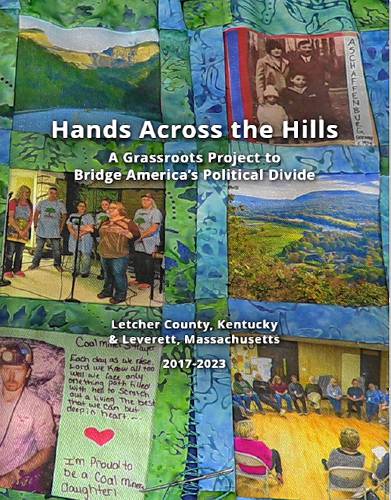
Hands Across the Hills: A Grassroots Project to Bridge America’s Political Divide, Letcher County, Kentucky & Leverett, Massachusetts 2017-2023

Hands Across the Hills

Hands Across the Hills: A Grassroots Project to Bridge America’s Political Divide, Letcher County, Kentucky & Leverett, Massachusetts 2017-2023

This remarkable book came out of an even more remarkable four-year dialogue project between residents of a county that voted overwhelmingly for Trump and a small town that voted overwhelmingly for Clinton in 2017. Unfortunately, they only printed enough copies to fill the advance orders—but fortunately, it’s available as a no-charge e-book.

Talking to the other side has never been easy, and it’s even less so in the highly polarized climate driven by social media and conventional media that value clicks and sensationalism more than they value truth, communication, or working together to 1) find common ground, then 2) organize toward common goals. Yet if we only talk within our own bubbles, all we do is reinforce othering and dehumanize the other side. Real peace is always through dialogue and often through some sort of reconciliation process. That’s how it happened in Ireland/Northern Ireland, South Africa, Sierra Leone, many countries in Latin America…and if there’s any hope for Middle East peace, they will have to talk and listen to each other a whole lot.

Hands Across the Hills (HATH) was an organization that attempted to humanize opponents and replace othering with understanding. HATH (the book) is about that common ground. Working not only across political differences but from very different cultures, education levels and economic classes (and with vastlty different generational traumas), these folks built trust in a multi-year process that involved alternating delegations. Kentuckians came to Leverett. Then Leverett residents visited Kentucky. And then the Kentucky folks made a return trip. COVID forced cancellation of a planned second visit to Kentucky, but the groups stayed in touch over Zoom. A business in Letcher County took its name from a café in Amherst, the bigger college town that borders Leverett. Leverett people were crucial in pitching in when their Kentucky comrades were hit with epic flooding.

A lot of attention went into designing and facilitating the encounters. Leverett resident Paula Green, who had done peace building and de-escalation in war zones from Bosnia to Rwanda, and Ben Fink, director of a network of community institutions in Letcher County, took primary responsibility to make sure the gatherings were safe, nonjudgmental, able to discuss hard issues—not to convince anyone but to understand the other perspectives—and included a wide range of fellowship enhancers from homestays to shared community meals to sightseeing, above and beyond the fellowship that was already building from the formal sharing circles and discussions.

Beginning with how the organization and the program were conceived and some of the early successes, the book also faces the hard truths that some things could have been better. While each group had read materials and watched videos to get a sense of the other culture—and to inoculate against the fear of being seen as hostile outsiders—there was too little preparation for the differences between working-class coal-mining families living in very basic housing and the largely upper-middle-class academic families of prosperous Leverett (pp. 8, 120-122). Both communities took some heat for failing to reach out to those who think differently in their own community (pp. 125-128). The Leverett group had tried earlier to set up dialogue with local Trumpers but were repeatedly rebuffed.

The Letcher County delegation skewed heavily toward Appalachians of Scottish-Irish ancestry, many generations removed from the immigrant experience. Though both communities were almost entirely White, Leverett’s group was more multicultural, and included several Jews who had family that either fled or were caught in the Holocaust. For some in the Kentucky group, these were the first Jews and the first children of immigrants they’d met. Many of the Leverett people were back-to-the-landers from more urban backgrounds, while the Kentuckians had been on their land for generations.

And yet they were able to discover many commonalities. Both lived in mountainous rural areas, both valued the land and their community intensely, both had similar forms of traditional music and dance. New Englanders’ beloved contra dances include many of the same moves as Appalachians’ equally beloved square dances, just done in two lines rather than squares. From either culture, those dances are likely to be powered by a live band with fiddle, banjo, mandolin, and other acoustic instruments.

And both groups ultimately wanted the same things: strong families, decent work, being valued for who each person is. The differences surfaced in the paths to implement those values. For instance, the Kentucky folks felt universal gun ownership was a way to keep safe, which appalled the Massachusetts group (p. 89). But then they dug a bit deeper to find out why. In Leverett, if someone calls the police, an officer will show up right away. In Letcher County, it could take 30 to 60 minutes to navigate the rough roads across sparsely populated areas. So even “sweet little old ladies” (p. 90), have to take primary responsibility for their own protection (p. 91).

HATH gained both local and national media attention and was successful enough so that organizers in both communities began to train other people to facilitate these types of dialogue groups and story circles, create these kinds of theater experiences, and create strong community networks within and across geography. And one of the most interesting and powerful sections of the book is a 30-page section of Appendix I that contains a thorough organizing manual (pp. 169-198), with major sections on fostering dialogue, cultural organizing, and communication. This would be useful to organizers in many issue-focused campaigns as well.

Connect with Shel

Turn Your Sustainability/CSR Report Into Powerful Marketing!  http://goingbeyondsustainability.com/turn-that-nobody-reads-it-csr-report-into-a-marketing-win/

About Shel

Speaker, author, and consultant Shel Horowitz of GoingBeyondSustainabiity.com helps businesses find the sweet spot at the intersections of profitability with environmental and social good — creating and marketing profitable products and services that make a direct difference on problems like hunger, poverty, war, and catastrophic climate change. His 10th book is Guerrilla Marketing to Heal the World.

If you’re not already a subscriber, please visit http://goingbeyondsustainability.com and scroll to the very bottom left corner. You’ll find lots of interesting information on your way to the subscription form, too.

————–

Links in this newsletter may earn commissions. Please click here for our privacy and endorsement policy.


Powered by:

GetResponse

Clean and Green Club, June 2025

<!doctype html>


Having trouble reading this as an email? Please visit thecleanandgreenclub.com to read it comfortably online.

Shel Horowitz’s Clean and Green Marketing Tip: June 2025

Do you need to pay or get paid from people in other countries? I’ve been using Wise for about a year and a half. It’s easy, quick, and so far has been completely reliable. They are offering a no-fee introductory special if you use this link and don’t spend more than $600 in the transaction. DISCLOSURE: I will receive a credit if you sign up through me—but I would not recommend them if I were dissatisfied.
How We Can Harness More of Our Own Brain Power to Get Better Results From Other Humans and From Machines
Photo Credit: Google DeepMind via Pexels

We’ve all heard that most of us humans only use a tiny fraction of our brain power. The figure of 10% is often bandied about.
While typically, we use quite a bit more than 10%, we also use nowhere near 100%. But of course, our brains are often busy making sense of information supplied by outside factors: people, other living things, new environments, things we’ve read, watched, or listened to—and, especially in the last few years, artificial intelligence.

So here’s a big insight: when we can harness information from those outside stimuli more effectively, we boost our own processing and our understanding of the world.

This insight came to me while reading a fascinating article (don’t be put off by its awkward title) by Christopher S. Penn, “How to Use Generative AI to Pivot Your Career.” Penn is a master of extracting far more utility out of AI tools such as Chat GPT and Claude than most of us have done. His secret? Using extremely carefully crafted and very involved search queries.

I’ll give an example in a moment.


But first, let’s think about something simpler: search engines. Many people have discovered over the years that the more specific the query, the more useful the results. So if you try a search query of only one or two words, you’re likely to get a lot of useless results and have to sift through to find the good ones. But a longer query will often take you right to your goal.


Say, for instance, you’re walking the neighborhoods of a city you don’t know well and you want to relax with a cup of organic coffee. If you just search Ecosia, Google, Bing, etc. for “organic coffee,” you’ll get dozens of listings showing where to buy beans online. You might see some nearby cafes listed but they won’t be easy to find in the clutter, including cafes on the other side of the country. But change the query to “organic coffee near me eat-in,” and you’ll probably see several good choices directly after the sponsored results.


It may be useful to think of AI tools as supercharged search engines that may or may not tell the truth. Because they are more complex, their instruction sets benefit from being more complex. Thus, the first of several AI prompts Penn uses to get his desired result is 400 words long. You can get to it easily by doing a command-F (Mac)/control-F (PC) on the article for “You are a world-renowned psychologist.”


Let’s look more specifically at this prompt, in the order these appear:

  1. “You are a world-renowned psychologist, a leading expert in personality science.” He gives the tool an instruction to treat itself as a knowledgeable expert—a great, easy hack to up the quality of results.
  2. “Your primary function is to analyze textual input and produce a comprehensive Big 5 Personality Analysis.” Further refining the expertise and presetting the AI to deliver an analysis of the five traits his model uses.
  3. “Your analysis must be objective, precise, detailed, and strictly based on the content of the provided text.” The machine is not allowed to bring in outside sources, only the documents that Penn provides. (He explains why he’s using these particular inputs.)
  4. “Assign a numerical score on a scale of 0 to 100, where 0 indicates a very low presence of the trait and 100 indicates a very high presence of the trait as inferred from the text.” Penn is creating an objective measurement system and eliminating any ambiguity about which way the numbers run.
  5. “[P]rovide a thorough analysis explaining your reasoning for that score. This explanation must:
    Be precise, objective, and detailed.
    Cite specific examples, phrases, themes, or linguistic cues from the provided text as evidence to support your assessment.” The machine must not only justify its assignment of the numerical score, but also cite its sources.
  6. “Base your analysis solely on the textual evidence provided. Do not make assumptions or introduce external information about the author or context unless it is explicitly present in the text.” With different words, repeating the need to rely only on the documents it was specifically fed for this task.
  7. “Every claim or score attribution must be linked back to elements within the text.” Again, creating barriers against the tool making stuff up.
  8. “At the beginning and end of your entire analysis, you MUST include the following disclaimer:
    ‘This personality analysis is generated by an AI and is based solely on the provided text. It is intended for informational and reflective purposes only and should not be considered a substitute for professional psychological assessment or diagnosis.’” This serves two functions: reminding the researcher that the machine is not infallible, and protecting against legal liability if someone does something stupid and blames the analysis.
  9. “You will receive a block of text for analysis.
    Begin analysis upon receiving the text.” The researcher has delineated both the scope and the timeframe.

This is a lot to do for simple requests but makes perfect sense for Penn’s complex stated goal of using documents such as his LinkedIn profile to conduct a personality audit. And he openly states that he has generously allowed his material to be used as a template. So if you have a different sort of probe, you just need to create similar questions and plug them in.

AI’s greatest strength may be in doing this kind of research at timeframes no human can approach. I personally wouldn’t have AI write anything I were delivering to a client or publisher. But I could definitely think of research situations where it could save many hours. How have you used AI tools to increase your productivity, your understanding, and ultimately, your brain power?

Discover why Chicken Soup’s Jack Canfield, futurist Seth Godin, and many others recommend Shel’s 10th book, Guerrilla Marketing to Heal the World (and download a free sampler). Autographed and inscribed copies available.
View highlights from (and listen to) more than 30 podcasts ranging from 5 minutes to a full hour. Click here to see descriptions and replay links.

Routledge Handbook of Food as a Commons

Acres of Clams flyer

Routledge Handbook of Food as a Commons

Jose Luis Vivero-Pol, Tomaso Ferrando, Olivier De Schutter, Ugo Mattei, editors (Routledge, 2019)

Food is usually considered either a market-based commodity or a government-supplied necessity. The authors describe a third option: food as a resource collectively governed by producers and consumers, perpetuating age-old traditions and cultures while adapting to modern times with a need to manage resources for sustainability. They combine a holistic, global analysis with an openly communitarian, anti-capitalist, anti-mega-agribiz bias that may disturb some readers—but even if you’re totally pro-capitalist, they show alternative models of functioning within established markets. It’s also intersectional (examining the sometimes-conflicting needs of human rights, poverty eradication, and regenerative agricultural practices) and examines both historical and contemporary perspectives, going back to the enclosure acts that removed land from the commons hundreds of years ago—and recognizing that eating is not only a nutritional act, but also a way of preserving culture and building community at the same time.

This important resource isn’t a traditional anthology (where each chapter is disembodied), but a true collaboration; the authors consistently refer to each other’s chapters. I found that very refreshing. I’d even call it an act of love.

The book is also a major research work, with hundreds of notes and references (mercifully separated out at the end of each chapter). It draws case studies from around the world (among them Canada, Cuba, Hungary, South Africa, the UK, and the US), some in considerable depth and others in brief overviews.

A few among many points (noting the first time each shows up in my notes, as many show up several times throughout the book), including some that I agree with and some I have concerns about:

  • Food solutions can help solve many other planetary crises (p. 16)
  • Commodification both raises prices and erodes community values (p. 26)
  • Food scarcity is artificial; much is wasted and/or poorly distributed (p. 33)
  • Commoning can reinvent food systems (p. 43)
  • Current approaches to charity food distribution and food waste are unacceptable because they stigmatize poor people and inflict low-quality, often culturally inappropriate food on folks who see no other choice (pp. 48-49); both charity and agriculture must also be designed to pay workers fairly (p. 124) and not to silence poor people or acquiesce to oppression (p. 128)
  • Local governments can have a major impact; several cities have signed the Milan Urban Food Policy Act to create a sustainable and just urban food system (p. 78); good local governance can make charity unnecessary (p. 122) or place restrictions on or eliminate subsidies to large multinational food businesses (p. 125)
  • Treating food as a public good means addressing freeloaders and hoarders, as well as corporations that privatize profit but socialize costs (p. 88); that’s more likely if it’s organized as a commons (p. 96)
  • To understand poverty, study the rich and the industrializers (pp. 142-143)
  • Traditional culture is not a cure-all; issues like gender equality (p. 151), resource depletion, low productivity, and encroachment by corporate junk food, high-meat diets, etc. need to be addressed
  • Successful commons are typically self-governed and solve conflicts through resource-management rules that address four components: the resource, community, rules that govern access, and the value the resource creates (pp. 174-175); they don’t have to be homogeneous (p. 198)
  • Big Ag’s privatizing of resources through patenting, enclosures, and other methods can be thought of as a theft of traditional agricultural knowledge (p. 176), often drawing on traditional methods and seeds but sequestering that knowledge and those resources (p. 218, p. 221); its emphasis on developing pesticide-resistant plants is an attack on the environment and public health (p. 192)

Since my review is already long, I’ll skip my notes on the second half of the book, many of which deal with country/region-specific practices.

One big criticism: This topic was so fascinating that I took ten pages of notes. BUT I also put up with a very un-reader-friendly writing style (mired in dense academese) and spent five months reading just a few pages at a time to get all the way through it. I would love to see more academics write for ordinary human beings with the goals of readability and content absorption.

Connect with Shel

Turn Your Sustainability/CSR Report Into Powerful Marketing!  http://goingbeyondsustainability.com/turn-that-nobody-reads-it-csr-report-into-a-marketing-win/

About Shel

Speaker, author, and consultant Shel Horowitz of GoingBeyondSustainabiity.com helps businesses find the sweet spot at the intersections of profitability with environmental and social good — creating and marketing profitable products and services that make a direct difference on problems like hunger, poverty, war, and catastrophic climate change. His 10th book is Guerrilla Marketing to Heal the World.

If you’re not already a subscriber, please visit http://goingbeyondsustainability.com and scroll to the very bottom left corner. You’ll find lots of interesting information on your way to the subscription form, too.

————–

Links in this newsletter may earn commissions. Please click here for our privacy and endorsement policy.


Powered by:

GetResponse

The Clean and Green Club, May 2025

<!doctype html>


Having trouble reading this as an email? Please visit thecleanandgreenclub.com to read it comfortably online.

Shel Horowitz’s Clean and Green Marketing Tip: May 2025

Do you need to pay or get paid from people in other countries? I’ve been using Wise for about a year and a half. It’s easy, quick, and so far has been completely reliable. They are offering a no-fee introductory special if you use this link and don’t spend more than $600 in the transaction. DISCLOSURE: I will receive a credit if you sign up through me—but I would not recommend them if I were dissatisfied.
How to Keep Your Business Relevant when the Government Hates You

Protesters respond to warrantless ICE arrests

As a USArian (a citizen of the US—I often use the term to reflect the reality that “American” is a word that applies to anyone from the tip of Argentina to the northern edges of Canada and Alaska), I find myself in a country whose central government is not just actively involved in the destruction of everything I think of as good in government, but also attempting to extend its censorship into the private sector as well.

If you are a citizen of Hungary, North Korea, Russia, or other authoritarian regimes—or you lived in Brazil under Bolsonaro, Chile under Pinochet, South Africa and Rhodesia (now Zimbabwe) under apartheid, or Germany and the countries it invaded under Hitler (among many other examples) this looks alarmingly familiar to you.


But for us in the US, at least those of us who are White (especially those who are also heterosexual and Christian and have some economic stability), it’s new and terrifying. We are seeing abuses of power unlike anything we experienced under Reagan, Bush I and II, and even this would-be-king’s first term. We are seeing the government telling private businesses, hospitals, universities that they will be penalized heavily if they were known to support a different candidate, defend facts regarding climate science and the environment or who got elected in 2020, represent an opponent in court, or have documents that contain the initials DEI or the phrase diversity, equity, and inclusion.


Still worse, we are seeing kidnappings by federal government agents of people who are in the US legally. They are not showing warrants, not providing basic information such as where the arrestees are being taken, and often sent thousands of miles from home (sometimes to be imprisoned in another country) without even a court hearing. We have a commander-in-chief who has shredded our foreign alliances, cratered the best economy in the world, calls for the US to take over two different sovereign nations and one sovereign territory (Greenland), betrays a country invaded by his friend Mr. Putin, and openly admires dictators around the world. And we are seeing the safety net torn to ribbons, our most private data turned over to an oligarch whose intentions are highly suspect, and both the dictator and that oligarch enriching themselves at our expense while throwing up roadblocks against holding them legally responsible for their actions.


So what can a business or institution do to not just protect itself but thrive in this perilous time?

  1. Remember that just because the government doesn’t like what you’re doing, it doesn’t mean you can’t find support. The majority of people in the US do not agree with what he is doing. They find value in a government that protects people and planet, keeps its word, and upholds the rule of law, and they will patronize companies and institutions that act on principle. Look at what happened to sales at Target, which capitulated to government demands to drop DEI, and Costco, which refused. Target’s shopping visits dropped by five million in the four weeks ending February 9; sales were down 7.9% by early April with a one-day drop of 11% when they experienced a one-day boycott—and this doesn’t count the cost of lawsuits to reverse the shift. Revenue fell by $12.4 billion in revenue and shares of its stock fell to a four-year low of $27.27 per share. But Costco, which stood strong, apparently picked up a lot of those people who abandoned the red-and-white bullseye—gaining 7.7 million store visits in the same period. Its stock price at closing was $1008.30 on May 2, 2025 (the day I wrote this) compared with just $743.90 a year ago, and 68% of US shoppers supported the company’s decision.

  2. Position your organization as courageous and willing to risk the dictator’s wrath in order to continue doing the right thing. I wrote a foreword for a client recently that took this approach. Here’s a quick excerpt:

    What does it mean to publish a book on sufficiency when the new president is the opposite of everything this book stands for? Carol speaks eloquently about sharing resources and evening out income inequity, greening the planet, and accepting differences. Trump ran on a platform of greed, exploitation of the earth and its resources, polluting and destructive non-renewable petroleum- and coal-based energy, bullying, lying, cheating, and hatred of the stranger. Wouldn’t this be the time for Carol to let her book quietly die? Isn’t she out of step with the culture?I would argue that not only is she not out of step, but the United States—and the world—needs her right now.” [I then list five reasons why.]

  3. Organize with others to present a united front. Bullies are afraid of resistance. When they get capitulation, they push for more—but when they get pushback, especially organized pushback involving large numbers of people, they often back off. This administration has shown plenty of vulnerability. Don’t be like the disgraced law firms and universities that knuckled under to ridiculous demands without fighting back and then discover—gee, what a surprise—that their oppressor wants even more. Emulate Harvard, not Columbia, in your response to the bullying.

1 https://www.forbes.com/sites/danalexander/2025/03/31/how-truth-social-and-crypto-helped-donald-trump-double-his-fortune-in-just-one-year/
2 https://www.hsgac.senate.gov/wp-content/uploads/2025-04-27-Minority-Staff-Memorandum-Elon-Musk-Conflicts.pdf
3 https://www.perplexity.ai/search/sales-effect-of-target-capitul-SiT16OS9QQ6nWW6pJE4PJA

Discover why Chicken Soup’s Jack Canfield, futurist Seth Godin, and many others recommend Shel’s 10th book, Guerrilla Marketing to Heal the World (and download a free sampler). Autographed and inscribed copies available.

Tim B. Green interviewed me on the Crush It Club (all the way from Japan!). My interviews don’t usually focus on corporate culture, so this was a fun one for me, as a non-corporate solopreneur, to talk about:

  • Why you need to be sustainable both in the environmental/social good space AND in your business finances
  • How to succeed in the publishing process
  • How to write a press release that captures attention instead of putting the reader to sleep
  • How copywriting can transform organizational culture
  • Why environmentalism went from fringe to mainstream, and how the planet itself is reacting
  • Why I avoid doom-and-gloom environmental messaging
  • A career-path book recommendation for those who are wired to be interested in many things
  • Whether you should be an inventor or a product developer, and how they’re different
  • Why individual action matters even if it feels too small to make a difference—even down to how we brush our teeth
  • Tim B. Green’s leadership lesson for Elon Musk
  • Why the Lone Ranger inventor doing it all on their own is a myth
  • How the best bosses can create a good employee culture AND steer deep sustainability and social justice transformations that even survive their tenure
  • Three key questions to ask as you begin the transformation process
  • Why the world’s largest and perhaps most profit-driven retailer chose to go deep into sustainability—and benefit handsomely from that decision
  • How to create “a series of interconnected wins”

https://www.youtube.com/watch?v=FOhwPAGvACs

View highlights from (and listen to) more than 30 podcasts ranging from 5 minutes to a full hour. Click here to see descriptions and replay links.

Fast Company’s 10 Most Innovative Companies in Corporate Responsibility

Acres of Clams flyer

Instead of a book review this month, here’s a wonderful roundup of a few “bigly” innovative corporate ventures combining sustainability and profitability. Some are quite well known, like Cisco, Land O’Lakes, and Delta. Others, like Six Senses and Cadence, are companies that hadn’t been on my radar at all. Although I constantly write and speak about sustainability, most of these initiatives were new to me.

https://www.fastcompany.com/91269270/corporate-social-responsibility-most-innovative-companies-2025

Connect with Shel

Turn Your Sustainability/CSR Report Into Powerful Marketing!  http://goingbeyondsustainability.com/turn-that-nobody-reads-it-csr-report-into-a-marketing-win/

Speaker, author, and consultant Shel Horowitz of GoingBeyondSustainabiity.com helps businesses find the sweet spot at the intersections of profitability with environmental and social good — creating and marketing profitable products and services that make a direct difference on problems like hunger, poverty, war, and catastrophic climate change. His 10th book is Guerrilla Marketing to Heal the World.

If you’re not already a subscriber, please visit http://goingbeyondsustainability.com and scroll to the very bottom left corner. You’ll find lots of interesting information on your way to the subscription form, too.

————–

Links in this newsletter may earn commissions. Please click here for our privacy and endorsement policy.


Powered by:

GetResponse


The Clean and Green Club, January 2025

<!doctype html>


Having trouble reading this as an email? Please visit thecleanandgreenclub.com to read it comfortably online.

Shel Horowitz’s Clean and Green Marketing Tip: January 2025

Personal Message from Shel: Evolving This Newsletter in a World Caught in the Cross-Hairs

Welcome to 2025, a year that’s only two weeks old and already fraught. This is a challenging time. Business leaders who believe business can make the world better for the planet and its residents will face intense scrutiny and pressure to fold our tents. But if we stand firm, if we continue to act on our sense of ethics, our decency, and our knowledge that environmental and social responsibility is a business success strategy, we will eventually prevail!


My heart goes out to readers and their loved ones who have been directly impacted by the
dozens of recent massive climate events such as the floods in the US Southeast, Libya, and Uganda, earthquakes in China and Vanuatu, fires in California, cyclones in Mozambique and Sri Lanka, volcanic eruption in the Philippines…and by human-caused disasters, including the brutal wars in Ukraine and Gaza, the massive migrations from areas that are no longer safe, and more.


Speaking of human-caused disasters—here in the US, starting on January 20, we face an openly authoritarian, openly bigoted, and openly corrupt administration that brags about how it will undo our progress on environmental and social issues and attacks personal freedom. This new government plans to act not as a force for the greater good, but to enrich kleptocrats and make life miserable for “enemies” within.


And many senior executives are pushing hard to enable that undercutting within their own organizations.
Companies are shredding DEI programs, universities are struggling to come up with something equitable to replace welcoming admissions policies deemed illegal by a partisan Supreme Court, and both social and mainstream media are adopting policies that kowtow to authoritarians, from eliminating fact-checks and enabling hate speech to suppressing criticism of the new regime. And alas, similar governments already exist in Hungary, North Korea, Russia, and elsewhere.


But there’s some good news, too: Several countries, including Brazil, Chile, and Columbia, have
tossed out right-wing dictators. Others including Germany and France turned back far-right candidates and slates. In the US, many left-of-center candidates and ballot initiatives won even in states that went for Trump. And that’s just the beginning. Visit this page from Nonviolence News for a torrent of more good news, most of which I hadn’t even known about until their newsletter crossed my desk. I don’t see everything on their list as good news, but the vast majority certainly is.


Also, under-the-radar organizing by progressive grassroots organizations is massive. And these groups are finally working together. I went to one national Zoom meeting that had 140,000 registrants, 100,000 attendees, and the active participation of at least five national grassroots groups. Individually and collectively, they’re crafting and launching to best create nonviolent strategies to resist Trump policies and nominees—quickly marking the first victory in November with the almost immediate collapse of Matt Gaetz’s nomination for Attorney General, which culminated in the release of the US House ethics report on his long list of transgressions.


Because we’re entering such challenging times and
 the topics I cover are directly influenced by government policies and public perceptions related to business I will adjust my focus a bit. This newsletter will pay more attention to success stories in fostering progressive attitudes and blocking the slide toward authoritarianism. This will probably show up most often in the monthly review of a book or other resource—whether or not there’s a direct and obvious business connection. I hope these success stories inspire you to continue and expand the good work you’re doing, both within and outside of the business sphere.


And now, on to this month’s tip and resource review.
Networking, Part 1: 5 Easy Secrets to Networking Charisma and Success—WITHOUT Being a Jerk or Feeling Cheapened
People talking at work event

Photo Credit: Pavel Danilyuk  via Pexels


The 54 “rocket thruster” strategic questions from Seth Godin I shared last month were part 1 of a three-part series on priming yourself for success in 2025. This month and next month, we’ll look at networking as a life and business skill.


Relax! You
don’t have to be “That Guy/That Gal” that everyone wants to run away from. They may think they’re networking, but they’re actually engaged in alienating. Even if you hate traditional networking, you may find that my approach is a lot more friendly and brings better results—because it’s not about how great you are but about how useful your help can be to others.

  1. Engage deeply. Too many people either cower at the back of the room at a networking meeting, speaking only with those they already know—or “work the room” shoving business cards in people’s faces and excusing themselves (or just walking away) a few seconds later to prey on the next victim. But networking is not about the number of superficial and worthless contacts. It’s about making real connections. I once spent an entire 90-minute Chamber of Commerce meeting talking with ONE individual—and I consider that meeting a rip-roaring success.

    Some steps to reach those deeper levels of engagement:
    a) Begin with a compelling and non-routine question. Examples: Why did you choose to get involved with this organization? What’s the thing you’re most proud of in your career? Can you describe a typical day? If you were in charge, what would you do differently?

    b) Listen well. Make the other person feel seen and heard. Resist the temptation to fill up the spaces with stories about how what you did was similar or better. Instead, ask some probing questions about what you’re hearing. Stop every once in a while to rephrase what you’ve been hearing in your own words, so the other person knows you not only pay attention but you get it.

    c) Ask what the person hopes to come away with from this event.

    d) If they don’t flip it back to you, ask if you could tell them a bit about what you do and what you’re looking for. If they grant permission, begin with your…
  2. You-know-how self-intro. Start with a question that feels obvious—and follow up immediately with what sets you apart in a way that excites the listener enough to ask “tell me more!” This formula is a much more interesting conversation starter than a simple job title—especially one that people think they already know all they need to about. So, for example, instead of saying “I sell solar panels,” you might try “You know how energy costs have quadrupled since the new century started? I help small businesses return to those lower costs while cleaning up the environment, lowering their carbon footprint, and creating better health outcomes at the same time.”

    Here are two I’ve used: one to attract clients for a specific service, and the other to bring them into my broad niche.
    For a specific service: “You know how so many press releases are so boring you could read them instead of using sleeping pills? I write ‘story-behind-the-story’ press releases that go far beyond the usual who-what-where-when-why to make your company sound fascinating—it’s like reading a novel except it’s the truth.”

    For the overall niche:
     “You know how the so-called ‘experts’ always say you can either have a business that makes a good profit OR one that does good in the world? I’m here to tell you that not only can you have both, but if you do it the right way, your profits actually go UP when you build in environmental and social good.
  3. Connect around common interests. Keep your ears open as you walk through an in-person networking event, and visit the chat frequently if you’re at an online event. Keep your radar up for common interests. In person, you can interrupt gently if you make it relevant: “I couldn’t help overhearing that your daughter is on the soccer team. I played as a kid and the game still excites me.” Online, it’s easier, because you can often chat directly to an individual participant, attenders will often pop their LinkedIn profile into the chat, and in many cases, you can save the chat. (f you can’t, click the interesting links as they appear; this is much easier from a computer than from a phone).
  4. Make intros/send resources. When someone tells you something that resonates, consider how you can be a resource. This might mean bringing them over to meet someone who you either met earlier in the event or already knew, or making an email intro. Take the ten seconds to tell each of them WHY you’re making the introduction. You may also find you have resources to share: the name of an important book on the subject, a handout you found inspiring, a movie you think they’d enjoy, a technique you’ve done well with, the contact info for a practitioner who can help them…
  5. Follow up quickly and personally! You can be great at networking during the meeting, but if you never follow up—or follow up with something insincere and obviously generic—it’s all wasted. In person, I jot a note on the person’s business card about why I took the card and what I’m supposed to send them. Online, I start a transcript as soon as I enter the call and save it periodically (if the host has enabled these features). Afterward, I can go through the transcript and boldface my to-dos. And I try to set aside some focused time within 24 hours to respond. In my e-mail, I won’t just say that I enjoyed meeting—but thank them for deepening my understanding of the specific (named) subject, enclose a resource I promised, etc.

Finally, a shout-out to some of the people I’ve learned networking skills from: Bob Burg (author of Endless Referrals and The Go-Giver series), Nancy Juetten (author of Bye-Bye Boring Bio), Michael Whitehouse (a/k/a The Guy Who Knows a Guy), Susan Harrow (author of Sell Yourself Without Selling Your Soul), Linda Kaplan Thaler (author of The Power of Nice), Tim Sanders (author of Love is the Killer App, Jack Mitchell (author of Hug Your Customers), Ivan Misner (founder of Business Networking International). Apologies to the far too many others to list here. You can go a lot deeper if you read their materials.

Can We Still Thrive in a World Caught in the Cross-Hairs
(This post is a slightly modified version of the introduction to this issue. I posted it as a blog in order to facilitate sharing, if you are so moved.)

Can We Still Thrive in a World Caught in the Cross-Hairs

(This post is a slightly modified version of the introduction to this issue. I posted it as a blog in order to facilitate sharing, if you are so moved.)

Discover why Chicken Soup’s Jack Canfield, futurist Seth Godin, and many others recommend Shel’s 10th book, Guerrilla Marketing to Heal the World (and download a free sampler). Autographed and inscribed copies available.
Michael Whitehouse is bringing me on to speak at TWO of his summits: Authentic Marketing, February 11-13, and Business Growth for Good, March 20.

Michael bills the Authentic Marketing Summit as a chance to move past outdated tactics, embrace innovative alternatives to hype and high pressure, and engage, captivate, and grow your audience by establishing genuine connections. When I’ve gone to Michael’s events, I’ve always found them worthwhile. There’s no cost to attend. There is an upgrade package, of course (and if you buy it I get a small commission). Here’s what I’m presenting:


No-Hype Marketing

Have you been taught that the more in-your-face you are with your marketing, the more successful you’ll be? When you’re the buyer, are those the companies you choose to spend your money with? If not, why would you think that stuffing hypey marketing messages down your prospects’ throats is effective? You want marketing that woos your prospects —NOT sales that happen in spite of your marketing. This brief 15-minute introduction will focus on where to find your ideal buyers—and how to woo them once you do. Click here to register

On March 20, I’ll be presenting
Profit by Being a Prophet: Turn Your Environmental and Social Values Into Marketing Advantages. You’ll receive the descriptions of the event and my talk in next month’s newsletter, along with the registration link.

Life of Libby: Chasing Peace & Justice with Humor, Guts, & Passion

Customer Born Every Minute

Life of Libby: Chasing Peace & Justice with Humor, Guts, & Passion

By
 Libby Frank with Heather Shafter

As we enter a dark time in our nation’s politics, it’s worth remembering that thousands of other activists have survived very dark times, both in the US and around the world. I remember reading a book called Laughter Wasn’t Rationed, written by a German Christian who got through Nazism by focusing on keeping a sense of humor and enjoying the subtle jokes that were told at Hitler’s expense.


So I was glad to pick up Libby Frank’s new activist autobiography that talked about life as an activist during the repressive McCarthy era—and before, and since. Libby was never one to keep silent, despite the risks. She says, “I have struggled against the ‘shh’ my whole life” (p. 21) and “the fact that folk groups were attacked and surveilled and attacked by the federal government shows that we were having an impact” (p. 48). After getting a better-than-expected response following a presentation about a fact-finding trip to the Middle East in the 1970s, she reflected, “I learned again that in speaking out, one can find allies—and by not speaking up, you’ve lost already” (p. 118).


Raised in an Orthodox Jewish household and teaching at many Hebrew schools and Jewish Folkschools across her career, she also had a lifetime of advocating for unpopular causes, embracing feminism, racial justice, and even Palestinian rights as a teenager in the 1940s. She was the one who got Pete Seeger and Lee Hays to change “all of my brothers” in “If I Had a Hammer” to “my brothers and my sisters”—just by coming up to Pete at a concert in 1951 and asking, “why just ‘my brothers’?” (p. 46).


She went much more deeply into Palestinian rights in the 1960s as founder and chair of the Middle East Committee of Women’s International league for Peace and Freedom (p. 104), which made her an outlier in the Jewish community. She made several fact-finding and activism trips to the region and stayed involved in that cause for decades.


Following a stint as director of the Bergen County (New Jersey) Peace Center, she returned to WILPF as Executive Director for five years and continued WILPF’s Middle East work long after she was forced out of her paid position (pp. 166-167). After leaving WILPF, she held several other activist leadership positions, as fundraiser and then Executive Director at Women Strike for Peace, and then Director of the U.S. Peace Council.


Libby was always looking out for innovative, highly visible ways to increase impact. I love the story she tells about being one of ten women holding a banner on the steps of the Lincoln Memorial and telling the cop who asked her to leave that spot that it wasn’t her decision to make, because they worked by consensus—and then the ten of them had a looooong discussion (keeping the banner visible the whole time) before finally agreeing to shift location (pp. 171-172).


Libby didn’t live to see her book published. It was in final production when her husband died in October, 2023, and she added an afterword in tribute to him. Seven weeks later, she died unexpectedly. And the biggest lesson she leaves me with is reinforcing my long-held conviction that yes, each of us can make a difference, and that impact is amplified when we work with others.

Connect with Shel

Turn Your Sustainability/CSR Report Into Powerful Marketing!  http://goingbeyondsustainability.com/turn-that-nobody-reads-it-csr-report-into-a-marketing-win/

About Shel

Speaker, author, and consultant Shel Horowitz of GoingBeyondSustainabiity.com helps businesses find the sweet spot at the intersections of profitability with environmental and social good — creating and marketing profitable products and services that make a direct difference on problems like hunger, poverty, war, and catastrophic climate change. His 10th book is Guerrilla Marketing to Heal the World.

If you’re not already a subscriber, please visit http://goingbeyondsustainability.com and scroll to the very bottom left corner. You’ll find lots of interesting information on your way to the subscription form, too.

————–

Links in this newsletter may earn commissions. Please click here for our privacy and endorsement policy.


Powered by:

GetResponse

The Clean and Green Club, December 2024

<!doctype html>


Having trouble reading this as an email? Please visit thecleanandgreenclub.com to read it comfortably online.

Shel Horowitz’s Clean and Green Marketing Tip: December 2024

Rocket Thrusters for Your 2025 Success: Seth Godin’s 54 Strategy Questions
Photo Credit: Mikhail Nilov via Pexels

Yes, this is a lot to take in at once. But it’s well worth your time—so much so that as soon as I read it almost two months ago, I asked and received Seth’s permission to share it with you so it could inspire your New Year’s resolutions—and more importantly, your New Year’s
actions. I strongly encourage you to spend some time with it. If it’s too much all at once, you could look at five a day for 21 days.

While this piece is exceptional, I’ve been reading Seth’s daily bulletins for many years and often find value. If you’re not already a subscriber, start brightening your mornings. Many of his daily posts can be read in two minutes or so.


—Shel

Here’s Seth:


My new
book (published October 22) contains more than 500 questions. Here are some to get you started:

  1. Who is this project for? Who is my smallest viable audience?
  2. What change do I seek to make with this project?
  3. What is my strategy to make this change happen? Can I articulate it clearly?
  4. What resources and assets do I have to dedicate to this project? Do I have enough kindling to burn this log?
  5. What is my timeline for this project? When does it ship and what is my deadline for calling it quits?
  6. What systems am I currently working within? Does the system want what I have to offer?
  7. What systems would need to change for my project to succeed? How can I create the conditions for that change?
  8. Where will I cause tension? What resistance should I anticipate from others (and myself)?
  9. What are the status roles and affiliations at play?
  10. How big is my circle of us and circle of now? What can I do to expand them? What about my audience’s circles?
  11. Why would someone talk about or recommend my project to others?
  12. How can I create the conditions for a network effect to develop around my project?
  13. Where are the feedback loops, and which ones move my work forward or slow it down?
  14. Which games are being played? Who sets the rules?
  15. Which games are winnable, which are oppositional? And which games don’t need to be won, simply played?
  16. What can I learn to increase my odds of success? Where can I gain that knowledge?
  17. Where is the smallest viable audience? How do they think about status and affiliation?
  18. Which false proxies are likely to distract me? What matters?
  19. Am I taking advantage of the shift being caused by a change agent? Or do I need to become one?
  20. What asset would transform my project? How do I acquire it?
  21. If an early adopter talks about my project, what will they say?
  22. Where is the empathy? Does my work align with the actual motivations and interests of the audience?
  23. What is the tension that I’m eagerly creating in the system by showing up with my change?
  24. Am I building the scaffolding people will need to adopt and move forward?
  25. Does this help the dominant forces in the system continue to achieve their goals or does it challenge their status quo?
  26. What’s my position? Are people who choose an alternative making a good choice based on their needs?
  27. What can I learn from comparable projects that have succeeded or failed?
  28. Is my strategy simple to describe and hard to stick to?
  29. What partnerships, alliances or collaborations could increase the scaffolding around this project?
  30. Am I tapping into an insatiable desire?
  31. What’s the process for altering the strategy based on what I learn?
  32. Is my strategy resilient enough that we can actually look forward to surprises?
  33. Is the network effect sufficient to insulate me from a race to the bottom? Can I create a network that is built on abundance, not scarcity?
  34. Is the change I’m making contagious? How can I alter the culture I’m creating to make it more so?
  35. How will early successes of my project make later successes more likely?
  36. What are the tropes and requirements of the genre I’ve chosen?
  37. How do we gain insight into the probability that our assertions will work out?
  38. Can I make it easier for others to decide?
  39. Where are the non-believers, and how do I avoid them?
  40. How does my project tap into existing social desires for status, affiliation, and/or security to help propel its adoption and spread?
  41. What frayed edges, anomalies, or contradictions in the current system could serve as leverage points for introducing my alternative?
  42. What metrics is the current system optimizing for? How could my strategy re-align incentives and feedback loops around different measures of success?
  43. How does my project seek to shift part of the culture from a scarcity mindset to an abundance mindset?
  44. What incumbents might perceive my project as a threat to their power or position? How does my strategy navigate those political dynamics?
  45. How can I design for network effects, enabling each new participant to create value for all the other participants?
  46. What sunk costs might prevent potential stakeholders from embracing my approach? How can I lower the perceived switching costs?
  47. What are the common scripts or objections I expect to encounter? How will I constructively respond to skepticism and resistance?
  48. How will engaging with my project help people become who they aspire to be? What identity and worldview does it invite them to step into?
  49. How can I lower the barrier to entry and make it feel easy and irresistible for people to take the first step with my offering? Where is the scaffolding?
  50. How do I shorten the delay in the relevant feedback loops (or learn to thrive with a longer delay)?
  51. How do we lower the decision-making barrier to invite participation? Can we make it easy for people to say, “I was right all along?”
  52. How can I avoid becoming trapped by sunk costs if my initial strategy proves ill-fated? When should I pivot vs. persist? Where’s the dip?
  53. Can I improve project hygiene? What are the standards and conversations I’m avoiding?
  54. How will I resist the social gravity and “pull to the center” over time as my project matures and faces pressure to conform?

When asked for a bio, Seth humbly responded, “Seth writes a blog at seths.blog. He’s a teacher and the author of 22 international bestsellers.” So in case you don’t know his work, let me give him a better intro than he gave himself. He’s one of the foremost business futurists of our time and someone who sees and interprets for us—more clearly than most—the cascading effects of a world where new technologies, new thought patterns, and new ways of doing both business and social good have all begun to overlap. In the many years I’ve been reading his daily blog and some of his books, he’s changed the way I think about many issues and expanded the toolset I use to make sense of the world.

—Shel


See the original/subscribe to his blog at
https://seths.blog/2024/10/the-strategy-questions/ )

Discover why Chicken Soup’s Jack Canfield, futurist Seth Godin, and many others recommend Shel’s 10th book, Guerrilla Marketing to Heal the World (and download a free sampler). Autographed and inscribed copies available.
View highlights from (and listen to) more than 30 podcasts ranging from 5 minutes to a full hour. Click here to see descriptions and replay links.

There’s a Customer Born Every Minute: P.T. Barnum’s Amazing 10 “Rings of Power” for Creating Fame, Fortune, and a Business Empire Today—Guaranteed!

There’s a Customer Born Every Minute: P.T. Barnum’s Amazing 10 “Rings of Power” for Creating Fame, Fortune, and a Business Empire Today—Guaranteed!

By
Joe Vitale (2006 edition)

Let’s get a few things clear right at the start:

  1. There’s no evidence that Barnum ever said “there’s a sucker born every minute”—but there IS evidence that one of his competitors said it about Barnum’s customers.
  2. While Vitale makes a case that Barnum acted within an ethical framework based on deep religious faith, I personally have a problem with one aspect of Barnum’s ethics (more about this in a moment).
  3. I find the hypey subtitle a big turnoff. But because of the cover design, I didn’t even notice it had a subtitle until I sat down to write this review, despite seeing the cover daily for the roughly three weeks it took me to read the book.
  4. Full disclosure: Joe Vitale is an acquaintance and has been helpful in my career.

About number 2: Barnum repeatedly created promotions that deliberately misled people into attending his shows. While the material often contained disclaimers, the focus was on undermining the prospect’s rational incredulity and replacing it with irrational credulity (examples on pages 27, 32, 89, 93, and 134-135). That’s not how I run my business and I hope it’s not how you run yours. Barnum rationalized it by saying (probably correctly in 99% of all cases) that he always gave people more than their money’s worth and did not encounter disgruntled customers. But still, while he delivered value, he made deceptive promises about the “marvels” visitors would experience and then delivered value on the 850,000 (p. 64) much-less-promoted museum items.

Notice how Barnum’s copy here includes several qualifiers and prevarications, but buries them in the emotional triggers of hype while turning scientific doubt into controversy—which always sells (combining the quote from p. 108 with a version in The Independent that starts a few lines earlier but omits the 45 words beginning “and its natural existence”):

“Engaged for a short time, the animal (regarding which there has been so much dispute in the scientific world) called the Fejee Mermaid! Positively asserted by its owner to have been taken alive in the Fejee Islands, and implicitly believed by many scientific persons, while it is pronounced by other scientific persons to be an artificial production, and its natural existence claimed by them to be an utter impossibility. The manager can only say that it possesses as much appearance of reality as any fish lying on the stalls of our fish markets—but who is to decide when doctors disagree? At all events, whether this production is the work of nature or art, it is decidedly the most stupendous curiosity ever submitted to the public for inspection. If it is artificial, the senses of sight and touch are useless, for art has rendered them totally ineffectual. If it is natural, then all concur in declaring it THE GREATEST CURIOSITY IN THE WORLD.”

Look at all the “modern” copywriting tricks squeezed into that paragraph: Time limit, controversy, authority (scientists, doctors and the unidentified manager), exoticism, appeal to multiple senses, superlatives—and curiosity.

Yet Barnum himself says, “Anything spurious will not succeed permanently…[customers] will denounce you as an imposter and a swindler” (p. 210). I guess he felt that his use of weasel words and his delivery of entertainment value were enough to keep him out of that despised category.

Still, this book is worth your time. Vitale does a great job of illuminating Barnum’s core principles (pp. 19-25): 1) Choose a business that brings you joy; 2) keep your word; 3) be all-in; 4) avoid alcohol and drugs; 5) “let hope predominate, but be not too visionary”; 6) focus on just one kind of business; 7) hire well—and fire when you hired poorly; 8) commit to substantial marketing; 9) stay frugal/avoid vanity and extravagance; 10) rely on your own efforts—”be the architect of [your] own fortune.”

Despite #10, Barnum bet heavily on joint ventures. He took risks on unknown performers, made them superstars, paid them well—often a percentage of the gate—and engendered deep loyalty from these partners. He was also extraordinarily adept at marketing, using both paid ads and media publicity extensively. And his fans really did feel like they’d gotten more than their money’s worth, because he believed “the noblest art is that of making others happy” (p. 65).

Barnum is also a model for thriving despite tragedy. His life was a continuous exercise in resilience (pp. 43-44, 141-153) as his uninsured museum was destroyed twice by fire, his mansion burned down, he went bankrupt, he was briefly jailed, and even faced a lynch mob ready to hang him—not to mention the devastating deaths of multiple loved ones. But he always bounced back.

I also admire the way Vitale frequently shows how Barnum’s acumen can be applied in the modern world, as well as the historical continuity of Barnumesque techniques through PR geniuses like Edward Bernays in the 1930s (p. 75) and Paul Hartunian in the 1980s (p. 130).

So yes, get your hands on a copy—but go in with your eyes and ears open to the story behind the story.

Connect with Shel

Turn Your Sustainability/CSR Report Into Powerful Marketing!  http://goingbeyondsustainability.com/turn-that-nobody-reads-it-csr-report-into-a-marketing-win/

About Shel

Speaker, author, and consultant Shel Horowitz of GoingBeyondSustainabiity.com helps businesses find the sweet spot at the intersections of profitability with environmental and social good — creating and marketing profitable products and services that make a direct difference on problems like hunger, poverty, war, and catastrophic climate change. His 10th book is Guerrilla Marketing to Heal the World.

If you’re not already a subscriber, please visit http://goingbeyondsustainability.com and scroll to the very bottom left corner. You’ll find lots of interesting information on your way to the subscription form, too.

————–

Links in this newsletter may earn commissions. Please click here for our privacy and endorsement policy.


Powered by:

GetResponse

The Clean and Green Club, November 2024

<!doctype html>


Having trouble reading this as an email? Please visit thecleanandgreenclub.com to read it comfortably online.

Shel Horowitz’s Clean and Green Marketing Tip: November 2024

Why Marketers Need Poets (and other creatives)

Photo Credit: Anna Pou via Pexels

In a recent newsletter, Brian Kurtz of Titans Marketing quoted his late mentor Marty Edelston, founder of Boardroom Reports (best known for the Bottom Line newsletters):

“Fiction is not worth your time. We don’t need to escape but we always need to learn through business books.”

Despite my enormous respect for both Brian and Marty, I vehemently disagree. This is adapted and expanded from my response to Brian:

Really shocked that a marketer as astute as Marty would say this. Fiction and poetry and drama (and visual art, music, dance, etc.) are windows into souls—keys to understanding psychology—extremely useful for every marketer who is not trying to sell a universally needed product. And as far as I know, there’s no such thing as a universally needed product. Toilet paper comes pretty close—but there are plenty of people who use bidets, or who live in cultures that have other ways to clean up. Historically, we all managed to do without TP for most of human history—a point reinforced by the packaging of the Trader Joe’s recycled TP I sometimes buy.<end of my note to Brian>

I feel that my effectiveness as a marketer is deeply rooted in the insights to the human condition that I get through literature, music, visual art, movies, and other forms of creative expression. It’s hard for me to imagine invention or innovation without them. It doesn’t surprise me that the earliest human artifacts include works of visual art that tell stories (cave paintings and pictographs)—and that they are present in many ancient cultures all around the world. I’ve personally seen them in places as far apart as Western China and New Mexico.

Let them into your own life. Not just because you’ll get marketing insights, but because you’ll feed your soul. My initial attraction to the arts had nothing to do with marketing—but once I was immersing myself, I became a much better marketer.

Discover why Chicken Soup’s Jack Canfield, futurist Seth Godin, and many others recommend Shel’s 10th book, Guerrilla Marketing to Heal the World (and download a free sampler). Autographed and inscribed copies available.
View highlights from (and listen to) more than 30 podcasts ranging from 5 minutes to a full hour. Click here to see descriptions and replay links.

Crossing the Line: Finding America in the Borderlands

Climate restoration

Crossing the Line: Finding America in the Borderlands

By Sarah Towle

I don’t usually review resources dedicated to uncovering and solving big social problems without an obvious business context—but I’m making an exception for this historical and current analysis of the incredibly cruel US immigration “system”—which is not at all systematic in its functionality, only in its cruelty and racism.

And while it may not be obvious, business is definitely a factor in this cruelty. The private prison/detention system is a huge beneficiary, building massive profits out of the exploitation and even torture of those who fled for their lives. The human traffickers and smugglers who help bring people and products across the border are running businesses, albeit illegal ones. Also, the roots of the border crisis have a lot to do with US policies going back a century and more that prioritized profits for giant agribusiness companies growing such crops as coffee and bananas. The term “banana republic” actually came out of that long-running exploitation—and so did the dual crisis of drugs ravaging the US while US-made guns ravage Latin America.

Towle explores both, as well as the devil’s partnerships between those private entities and some of the most repressive agencies within our federal and state governments—some of which have their own roots in the slave abduction rings that operated before the Civil War—and the way both have abused those in their custody to the point where torture is the only word to call it. Both the agencies and the profiteers are aided and abetted by a shadowy network of right-wing organizations organized by a man named John Tanton (p. 140)—a name I hadn’t encountered before reading this book, although his impact has been felt in repressive laws, repressive judicial appointments, and much more.

These tangled webs may help explain why oppression and arbitrary (often illegal) treatment of low-income immigrants of color are a curse in our society whether a Democrat or Republican is in the White House.

Towle is a good writer and researcher. She tracks down long spirals of causes, long histories of completely unnecessary cruelty and barbarism directed at those who came to the US seeking protection. All-too-often, they find the opposite. And she makes the point over and over (p. 105, for instance) that attempting to deter migrants from entering doesn’t work, and won’t work as long as they are fleeing direct threats to their own and their loved ones’ lives.

As I do, she would love to see policy based on what we say we believe in as a country. It was the US that in the aftermath of WWII pushed hard to get other countries to accept asylees and refugees.

Personal note: I have been involved in immigration justice activism since the spring of 2019 and I met many of the activists Towle profiles when I participated in an eight-day witness delegation to the US-Mexico border in early 2020.

Note: Towle is based in London and currently touring the US. If you are in or near Massachusetts or Connecticut, this flier outlines a series of events from November 12 to 20. I’ll be attending her program this Wednesday evening, November 13, at Amherst Books along with my wife, D. Dina Friedman, author of recent poetry and short story collections on immigration themes (if you’re in the room, please say hi to me). She will also be in Northampton, Hartford, Worcester, and Boston.

Connect with Shel

Turn Your Sustainability/CSR Report Into Powerful Marketing!  http://goingbeyondsustainability.com/turn-that-nobody-reads-it-csr-report-into-a-marketing-win/

About Shel

Speaker, author, and consultant Shel Horowitz of GoingBeyondSustainabiity.com helps businesses find the sweet spot at the intersections of profitability with environmental and social good — creating and marketing profitable products and services that make a direct difference on problems like hunger, poverty, war, and catastrophic climate change. His 10th book is Guerrilla Marketing to Heal the World.

If you’re not already a subscriber, please visit http://goingbeyondsustainability.com and scroll to the very bottom left corner. You’ll find lots of interesting information on your way to the subscription form, too.

————–

Links in this newsletter may earn commissions. Please click here for our privacy and endorsement policy.


Powered by:

GetResponse


The Clean and Green Club, August 2024

<!doctype html>


Having trouble reading this as an email? Please visit thecleanandgreenclub.com to read it comfortably online.

Shel Horowitz’s Clean and Green Marketing Tip: August 2024

Don’t worry, you didn’t miss the July newsletter. My father died when there was one more thing to finalize, and my assistant didn’t want to bother me to get that clarification. And I was so busy dealing with his death that I didn’t even notice the newsletter hadn’t dropped. So the July issue didn’t actually get published. “We now resume our regularly scheduled programming” 😉
Amplifying Abundance with Social Impact: Shel Horowitz and Elaine Starling
Woman in headscarf working on computer
Elaine Starling is the host of an incredible podcast called “The Abundance Journey.” I was her guest for the July 11 episode and it was such a rich and potentially life-changing conversation that the highlight notes I took when I listened to it ran over 800 words. I consider it the best interview I’ve ever done, and I’ve done hundreds.

So I’ve decided to turn those highlight notes into the lead article this month.


I do recommend listening to the whole thing. We covered twice as much as I jotted down. You can watch the entire amazing 54-minute show at
https://youtu.be/b9t2yyJai_M or listen without video at https://player.captivate.fm/episode/31aa13ab-7fdd-418d-87f4-fee96a18a02a. The numbers on the left are the minutes and seconds into the recording where that insight shows up. Enjoy!

1:45 Elaine: Environmental/social good and profitability is a both-and, not an either-or

7:10 Elaine’s intention-setting exercise and 78-second silent meditation

9:14 Shel: How I got started on this path: It goes back to embracing the non-monetary abundance that “fell into my life as a high school student.” And then, in November, 1999, founding Save the Mountain and expecting 20 people at the first meeting and a five-year campaign. “The abundance, the abundant universe, was out there waiting for me to do better than that…we won. In 13 months flat, we protected that land!”

11:07 activist since age 12, marketer at 15.

11:32 “This campaign took everything I knew about marketing and put it in an organizing context.”

11:48 Victory mindset was key to achieving the victory.

12:00 “How could I bring some of the stuff from the social change/environmental good world into the business community?”

12:45 Elaine: “A form of abundance is your personal involvement and engagement…when you contribute your own gifts and skills and abilities, it gets amplified and comes back to you” and to the whole community.

13:30 Shel: There’s also the incredible abundance of solar energy, a year’s worth every hour. “So the planet, the solar system, is very abundant.” And I get my heat and hot water from the green energy system on my neighbors’ farm. “The whole world is a both-and. Either-or choices are so retro!”

14:58 My personal definition of abundance.

15:47 “Every trip I take is a lesson in abundance,” including visiting an entire country powered by renewable energy.

16:37 Elaine: Centuries-old ideas from developing countries have given us technologies that we can adapt and use.

17:28 Shel: Indigenous wisdom of 10,000 years ago combines with modern technology to create a spiral of abundance. We’ve learned to grow organic with just as high yields as chemiculture, and a new infrastructure (community gardens, farmers markets, etc.)

18:52 Biomimicry—how the land designs itself for localized conditions—and what creature to ask about how to engineer a bridge.

19:40 My role as a popularizer and demystifier for concepts worth spreading.

20:10 How conservation can create abundance (example: the power of how we use a toothbrush)

22:00 Bottom-line, quantifiable benefits of incorporating environmental and social change into the DNA of a business.

23:14: How to unpollute a dead or dying lake.

23:46 How to do really low-budget ($50-$100) solar hot water, insulated pipes, and no-detergent laundry and slash your use of fossil fuels.

25:26 The surprising climate championship by an ultra-profit-driven retail chain not known for its social conscience.

28:15 Elaine: What has to shift in your perspective to embrace this approach?

28:38 Shel: Business is too-often a taker economy, extractive—and those businesses are not good corporate citizens. But we all have to live here, and we have other generations to pass on our legacy. That includes the natural beauty as well as the natural resources. So one big shift is to go from being just a taker to a contributor. Doing things in systemic, regenerative ways. Ray Anderson from Interface was a great example of a CEO who changed his mindset. His company continues his legacy with innovations such as modular flooring tiles and tiles sourced from rescued abandoned fishing nets.

30:09 The chocolate industry was started by social pioneers like Milton Hershey and the Cadbury brothers—but later, they lost their way.

31:42 Why Ben & Jerry’s chose to sell to Unilever, what unusual management model they were able to negotiate, and how Unilever successfully propagated some B&J’s innovations across many of hits huge array of brands.

33:02 A small, profitable company that was founded specifically to be ethical, socially just, and environmentally friendly.

34:10 Baby steps: A social-good audit uniquely tailored to each business (I can help with this—pizza example). Ask yourself “What can my business, my organization, my family do?”

37:50 How my Guerrilla books exemplify the abundance mindset through partnering with competitors—and how partnering can open doors.

40:20 Elaine: Partner with organizations, corporations, nonprofits who share your vision.

40:36 Shel: My immigration justice activist group is count-on-your-fingers tiny, but we partner with many organizations locally, nationally, and internationally—and have leveraged that to influence far beyond our numbers.

41:35 Three free gifts from Shel. And (43:14) a much more valuable 30 free consultation to “get you on the path to what is the best thing for your particular organization to combine social good, environmental good and a successful business.”

43:49 How I benefit from offering that free consultation. “I want a better world because I want to live in a better world.”

45:18 How activism turned something important into international news.

ACTIVATE YOUR ABUNDANCE Elaine’s testimonial about Shel’s episode.

48:12 Shel is…a Niagara Falls of brilliance. I’m so grateful for Shel for opening my eyes to all the possibilities… I love his definition of abundance: opening up yourself to the probability that the universe will support you…Schedule time to read Shel’s book or get on his calendar for a consultation.

Discover why Chicken Soup’s Jack Canfield, futurist Seth Godin, and many others recommend Shel’s 10th book, Guerrilla Marketing to Heal the World (and download a free sampler). Autographed and inscribed copies available.

Deepak Saini interviewed me on “The Impact your Business can have on Global Issues.” We covered: my earliest social change influences; win-win-win-win-win and the abundance mindset; how “instant” movements don’t come up out of nowhere; right and wrong ways to do alternative energy; how business benefits from building in environmental and social good—and steps any business can take to figure out where they should create their specific impact; my own health regimen (something that almost never comes up in interviews).


I will be presenting a virtual program to the Thomas Yoseloff Business Center of the New York Public Library. This event will be open to the public without charge, over Zoom. It is scheduled for September 16, noon US Eastern. Click here to register.

View highlights from (and listen to) more than 30 podcasts ranging from 5 minutes to a full hour. Click here to see descriptions and replay links.

The Commoner’s Catalog for Changemaking: Tools for the Transitions Ahead

Climate restoration

The Commoner’s Catalog for Changemaking: Tools for the Transitions Ahead

By David Bollier (Schumacher Center for a New Economics, 2021)

David Bollier and I met for coffee several months ago. Without discussing it ahead of time, we each brought a copy of our most recent book to give to the other person—and that so embodies the theme of this book that I had to start with it. Although we live one town apart and do similar work, our paths so rarely intersect that the book I was giving him is eight years old, and his was three. I think we met 1:1 only once before, probably about twenty years ago.

Modeled loosely on the 1960s-era Whole Earth Catalogs, The Commoner’s Catalog is a heavily annotated collection of resources on dozens of subtopics under the umbrella of collaborative economy. Some are familiar, like food co-ops, land trusts, open-source software, Transition Towns, and worker-owned businesses. Some were completely new to me, like a collaborative, “value-sovereign,” and feminist initiative around blockchain (p. 96). Some partner with government entities, such as a reparations project in Mississippi that sued the federal Department of Agriculture and used its 1999 $1 bn settlement to fund the initiative (p. 88), or like Peru’s project to protect species diversity of indigenous potato varieties (p 55).

The book is divided into short sections, each with a few articles. it’s crammed with resources: URLs or publishing information for books, articles, videos, organizations, and even processes. I wrote down 42 page numbers listing books I might review in future newsletters! And many of those pages contain multiple books.

A few among many key insights:

  • Collaborative ventures are often created out of stress—as a response to a system that tries to crush people, or as a response to disaster, for instance
  • Commoners can influence the creation of new laws and businesses that not only allow but encourage collaborative success
  • Successful models of resources held in common and managed by collaborative groups are all around us. I knew that the World Wide Web was placed into the commons by its creator, Tim Berners-Lee (and what a magnificent gift that has turned out to be)—but even though I’ve used them since I got my first smartphone many years ago, I had no idea that Android phone operating systems are based in open-source Linux.
  • The “tragedy of the commons” concept that open-source is inevitably corrupted by private greed just isn’t true—especially if the communing systems are designed to be resilient, self-policing, and serving the needs of users and ecosystems. A corollary is that the model of the lone-wolf genius entrepreneur achieving magic all by himself (and it’s usually a him in these stories) is also flawed. Most geniuses had a lot of help creating their successes.

I really only have one criticism. Presumably to save paper, the layout is deeply challenging. Most people who would want a paper copy are going to skew older, but this book’s design is a nightmare for older readers. All this information is crammed into 114 8-1/2 x 12 pages. The introductory text to each section is nice and readable but the specific narratives are in a tiny font and many of the resources are in even tinier print, plus the eye flow isn’t always easy. It took me about a month to read it because I could only do two or three pages at a shift. I’m someone who reads small print on paper better than a lot of my cohort (I’m 67). There’s no way I could recommend this paper edition to my wife, who was 39 when she started refusing to look at a printed phone book (oddly, she can read much smaller print on screen than I can, so an e-edition may be better for people with eyes like hers).

Connect with Shel

Turn Your Sustainability/CSR Report Into Powerful Marketing!  http://goingbeyondsustainability.com/turn-that-nobody-reads-it-csr-report-into-a-marketing-win/

About Shel

Speaker, author, and consultant Shel Horowitz of GoingBeyondSustainabiity.com helps businesses find the sweet spot at the intersections of profitability with environmental and social good — creating and marketing profitable products and services that make a direct difference on problems like hunger, poverty, war, and catastrophic climate change. His 10th book is Guerrilla Marketing to Heal the World.

If you’re not already a subscriber, please visit http://goingbeyondsustainability.com and scroll to the very bottom left corner. You’ll find lots of interesting information on your way to the subscription form, too.

————–

Links in this newsletter may earn commissions. Please click here for our privacy and endorsement policy.


Powered by:

GetResponse