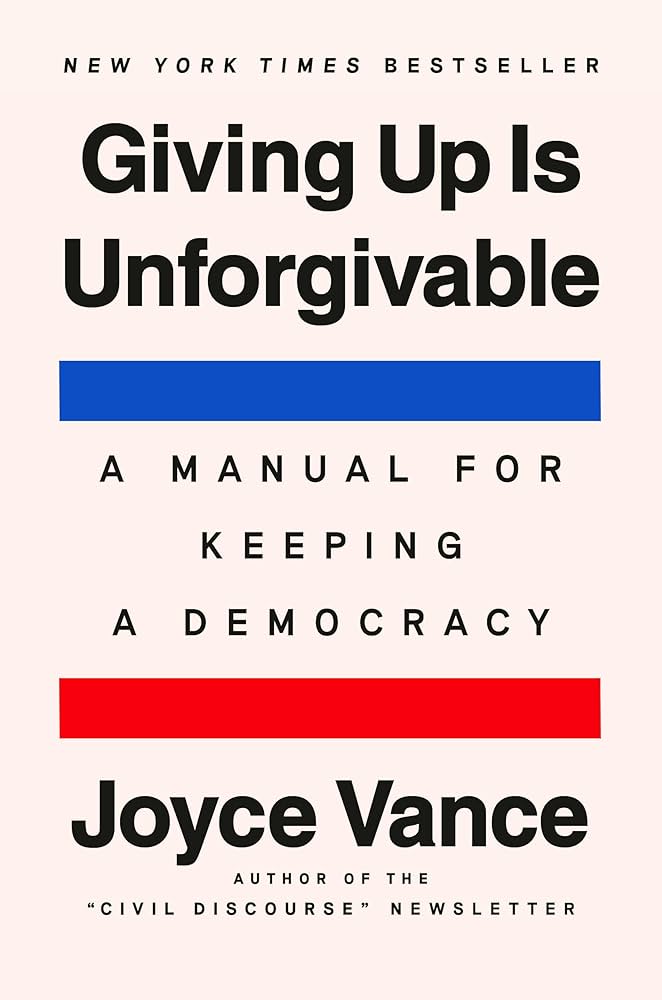
To create social and environmental impact businesses, it really helps to have both a business culture and government climate that supports them. Thus, I occasionally review books that are more about politics than about business, because the current US administration is actively hostile to these goals. This is one of those books.
Vance, a career prosecutor in Alabama who resigned just before the 2017 inauguration, built her subtitle and much of the book on Ben Franklin’s famous retort that the Founders had designed “A republic, if you can keep it,” and on the works of Thomas Paine and George Orwell.
It’s a quick and easy read that provides both historical and current context for the threats to democracy caused by the current administration, as well as T’s first round from 2017-21. And it’s in very good shape, especially considering that it covers well into 2025 and came out by the end of the year (most books from big publishers take a year or two to be birthed once the manuscript is turned in). Most of the rushed books I’ve experienced from big publishers are a mess. Here, I think I saw just two places where a minor grammar error slipped in—and rare is the book that does better no matter how long its publishing process. But I can probably blame the lack of an index on the rush to get it out—and that’s an unfortunate omission.
Much of the book reinforces an idea that I strongly agree with: no matter how bad things are, we can’t give up hope—because we, the people, can and do make a difference:
It’s an educated public capable of informed civil discourse that sustains effective, fair government. Accountability happens when citizens demand it. Sometimes, they must demand it loudly and persistently. This is undoubtedly one of those moments (p. 6).
[T]he practice of democracy, something we do together as Americans. When we make mistakes, even big ones, we can learn from them. We dig deeper so we can fix them. We get back to work. But what we cannot do is give up (p. 53, emphasis in original).
The orthodoxy of a totalitarian regime requires that we abandon thinking for ourselves…Don’t look away. And don’t hope it won’t happen if you close your eyes. Surround yourself with supportive people and educate yourself…The damage to the architecture of our democracy can be repaired by people of purpose. That is the task ahead of us (p. 101).
If you want to save democracy, persuade potential voters who don’t vote or don’t vote regularly, that their participation is essential (p. 133).
The book is a great mix of inspiration and concrete ideas like turning patriotic holidays (e.g., Presidents Day, Juneteenth) into public celebrations that center civics education and democracy. She has a whole chapter called We Are the Cavalry, pointing out that we are the ones who can save our threatened freedom. They attack us BECAUSE they fear our power—and the attacks will keep expanding past marginalized groups to eventually encompass all of us (p. 172)—but we can often jujitsu their attacks into media coverage and more support (pp. 149-151). And we can borrow solutions modeled elsewhere, such as Finland’s national media literacy program (p. 144).
The last few pages (the postscript) are a clarion call to action. One final quote to finish this review:
It will take all of us. It will be the small acts of protest, of resistance, of education, and of love for country that will keep the dictator from seizing control. It may not always be your turn to save democracy, but it’s always your turn to be present, to do whatever you can, and to support the people who do the work to keep the Republic. The dictator’s most dangerous weapon is his ability to overwhelm us with the feeling that we are helpless by keeping up an endless onslaught of terrible things. We can neutralize that weapon by knowing our own strength and saying no to feeling powerless…We must persist until we succeed… (pp. 172-173).