|
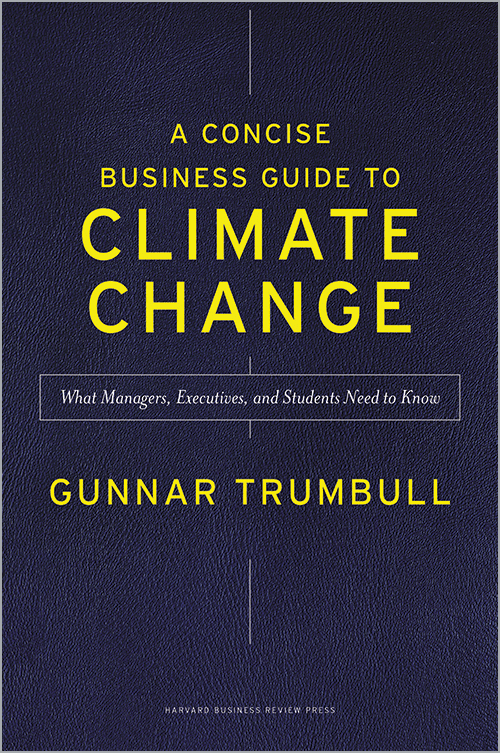
A Concise Business Guide to Climate Change: What Managers, Executives, and Students Need to Know
By: Gunnar Trumbull (Harvard Business Review Press, 2025)
You’ve probably already read this month’s main article, where the entire piece riffs off one data point in this book. If not, please go back and read it, as I won’t be repeating it here. But this book has much more.
Aimed largely at smokestack industries and larger corporations, Trumbull’s book is a fact-filled and necessary update of the literature. Many of the “climate change classics” were published between the turn of the millennium and the Covid epidemic—which means they aren’t looking at new demand centers such as AI and crypto, the data centers that power them, the massive leap in affordability of solar and wind, and the push to electrify sectors like transportation and heating/cooling. And few include the range of modeling formulas within this book, among them ACCESS (p. 10), Energy Balance and General Circulation Models for solar radiation (pp. 37-38), and various models for measuring carbon.
You’ll get clear definitions of Scope 1, Scope 2, and Scope 3 remediations (p. 27): terms that are frequently thrown around but rarely defined. You’ll learn about different types of fossil fuels and what terms like “light sweet crude oil” actually mean.
He notes that many of the companies who have caused the most damage have also had the most incentive (and the most resources) to make it right. Maybe not for the reasons we have—and from my perspective, certainly not doing enough—it’s still important that companies like automakers, steel and concrete manufacturers, and utilities are actively developing mitigations. I saw this as far back as 2017, when I moderated two panels at the international Responsible Business Summit in Brooklyn. About 2/3 of the attenders and 80 percent of the presenters were from corporate giants like Toyota, Coca-Cola, Nestlé, and Timberland.
For Trumbull, one reason these behemoths are involved is that they understand the enormous potential markets in the developing world—which face the challenge of increasing living standards without buying into the environmental catastrophe that we in the developed world created while raising our own living standards. With an explicitly social justice lens, he sees that clean energy could “drive economic dynamism in regions that were left behind during the first, fossil-fuel-driven industrialization…a new green economy might provide a pathway to rectify historical injustices…” (p. 7)
For me, that’s augmented by cost-saving and turning waste into profit centers.
Trumbull has an obvious strong background in holistic macroeconomics and gets into the weeds of issues like how electricity is priced, carbon taxes and trading, and how output from different power sources is measured and can be compared. The quick summary: Nuclear is by far the most expensive, with coal next. Solar and wind are already competitive with natural gas and becoming cheaper all the time (pp. 96-99).
He also looks at complex issues such as predicting trends e.g., is it better for a gas station chain to make a major investment in charging stations or in hydrogen pumping stations (p.125)? EVs are riding high right now, but if the company bets on them and then the industry quickly pivots to hydrogen—or if the company chooses hydrogen but the industry doesn’t pivot—that’s millions of dollars in stranded assets.
If you run an industrial operation such as manufacturing or you’re part of the sustainability team at a large organization, this book will likely be quite useful.
If, like me, you run a one-person consultancy, it’s less useful, unless you consult larger companies on how to cut carbon footprint.
Despite the copious research he’s obviously done, he has some surprising blind spots—especially his listing nuclear power as one of the “climate-friendly energy sources” (p. 114), and his repetition of the industry’s unverified claim that Small Modular Reactors (SMRs) “could be built in large quantities and at relatively low cost” (p. 93). He qualified his stance in his responses to my email (see below) but most people will not take the time and trouble to track down an address and write a note. He also mentions wood-fired biomass (p.94) and pumped hydro storage (p.95) as climate-friendly solutions, with zero critical examination of the many environmental and social justice issues these technologies intensify.
Q & A With Gunther Trumbull
I sent Trumbull several questions and comments. Here they are, with his responses:
1) Your book came out at the very beginning of the second Trump term. What advice do you have for a political climate when the administration withdrew from the Paris Accord, attacks green energy and especially large-scale wind, fast-tracks fossil and nuclear projects, and attacks companies, universities, and media entities for even mentioning DEI—while at the same time, an awake, aware consumer base continues to hold corporations’ feet to the fire, demanding real progress and publicly attacking perceived greenwashing and purposewashing?
Wow, what a frustrating time. Now that, finally, green technologies outperform the 19th C fossil fuel and industrial technologies that we have relied on for so long, we are trying to pull back from them. What companies understand is that these are the competitive technologies of the future, and that if you can’t compete in them, you can’t compete at all. I fear we have just lost our auto sector, for example, since new EVs are increasingly undercutting even the cheapest ICEs on price and performance. And we are still early in the EV technology curve. Similar stories have played out for wind/solar and storage, which is going through a technology/price revolution right now. The current administration is fighting against the economic advantage of these new energy and industrial processes. It is a rear-guard action.
The answer for firms is to take a longer-term strategic view of these technologies. If you are not keeping up, you will not be competitive in a decade. For consumers, also, they should follow the economics of green technologies as they evolve. Subsidies are important to accelerate adoption, but the underlying economics of many green technologies are already superior. In terms of influencing policymakers, everyone I know in the green tech sector is linking their technologies to energy security. It’s a reminder that there are features of green technologies that are highly attractive apart from their superior unit economics.
2) In your analysis of relative costs of different energy production methods, nuclear was (not surprisingly) the most expensive. Did your analysis consider the additional hidden costs of nuclear (e.g., mining, milling, fuel processing, waste storage, taxpayer subsidies of insurance, and end-of-life decommissioning costs—many of which have significant carbon impact as well) or was it just the actual reactor operation, or some mix?
Ah, nuclear. A decade ago I thought SMRs were going to take off. Today, the drop in alternative energy sources has really raised the bar for nuclear, and public sentiment has, if anything, deteriorated. SMR startups are still receiving a lot of funding from family offices, and they certainly see a use case in the data center world. But even that application depends on standardized factory production with accelerated permitting timelines, the latter of which at least seems unlikely. Communities are already unhappy to have local data centers – now tell them it will be powered with nuclear! (Sorry, you know all of this.) One advantage they have today is that AI data center developers are not really price sensitive for the power they are contracting for. This means very stable green sources may be attractive even at relatively high LCOEs [levelized costs of electricity]. Of course, betting on the future of data center development is risky.
The other exciting technology is fusion – again, you know this, but Commonwealth Fusion is on track to turn on their demonstration plant within the next couple of years, they have secured a generous offtake contract from Google for the follow-on commercial plant, and they have worked hard to make sure that fusion is regulated differently from fission. These are all exciting technologies, but I suspect they are going to have a hard time going up against the “new coal” of the green transition, aka wind/solar/storage.
3) Your book is geared toward an audience within large corporations and institutions. What advice would you have for very small business owners (1-50 employees)?
Absolutely, and that is an unfair bias. That just happens to be the primary audience I teach, and this book is intended to help them. The critical point for small business owners is that the marginal abatement cost curve has changed dramatically in the past decade, and that there are real economies/profit to be found in green technologies, including energy efficiency, cheaper/more reliable energy sources, and organizational efficiencies related to supply chains and other logistics. Do this because it will make you a more competitive firm.
Two comments riffing off your book:
1) If I could say more about nuclear: My first book was on nuclear power and I’ve kept up to some degree with the research. Nuclear fission is a disastrous technology, a complete violation of the Precautionary Principle, a boondoggle for the utilities (at least those whose profit structures are cost-plus), and a high-risk enterprise for the rest of us. Analyses typically don’t factor in, for instance:
- The taxpayer and property owner costs of the subsidized limited-liability insurance, which means taxpayers and ratepayers shoulder the burden of the premiums, and that little or no loss will be compensated when an accident destroys whole communities.
- The catastrophic costs of an accident, despite at least five major accidents (the three we’ve all heard of plus the Enrico Fermi breeder reactor accident in 1966 and the Browns Ferry, Alabama accident in 1975) and more than 100 potentially serious accidents since 1952 (ref: https://en.wikipedia.org/wiki/List_of_nuclear_power_accidents_by_country ). The land around Chernobyl, 40 years after the accident, remains quarantined for 20,000 years—taking productive farmland, manufacturing, and housing offline. As of last year, at Fukushima, “current indoor radiation level was as high as 0.3?Sv/h, five to ten times higher than the levels before 2011” and former residents who faced financial loss were not made whole (ref: https://beyondnuclearinternational.org/2025/03/09/difficult-to-return-zones/ )
- The costs of storing a toxic stew of mixed waste, much of it radioactive, for more than 200,000 years—including the costs of replacing storage as it wears out, translating instructions into new languages and data formats as the old ones become obsolete (we have no languages older than a few thousand years old, and data even 20 years old requires specialized conversion equipment, as new computers don’t include floppy or CD drives and operating systems as well as word processors don’t always support old formats), completely isolating these wastes from shifting water tables, etc.
This is a great set of points, and the LCOE calculations don’t include any of these costs which means that nuclear is far more expensive than the base cost, which is already the most expensive power technology]. I’m actually really supportive of the new generation of “physics safe” nuclear designs – I just don’t think the economics is ever really going to work out.
Fusion is a different technology and potentially much more viable. But it’s been “just around the corner” for my entire life. I would expect it to be at least 50 years out from commercialization. And as you know, solving the climate crisis can’t wait that long. Currently, most fusion experiments consume more power than they produce and the ones that do produce a positive power ratio last only nanoseconds.
It’s worth looking again at what advances in high-temperature superconducting tapes have done for the physics of tokomaks today. Still risky, but it feels within range … maybe. One interesting difference with past energy transitions is that those transition, or rather additions, were addressing typically a single new technology: coal, petroleum, nuclear, gas. Today we have such a wide range of new technologies emerging at the same time—green fuels, geothermal, etc.—that I think we are likely to see a real patchwork of adoption that maps specific advantages of the different technologies to different use cases. This kind of technological diversification will ultimately lead to a stable, reliable, decentralized (dear I say democratic) energy system. That will be an exciting time,
As best as I can hypothesize, the national and global rush to re-embrace nuclear—including the false trust in untested Small Modular Reactor designs that have fewer safety bulwarks and less economy of scale, despite many planners expecting to deploying them in series that would produce a full-scale nuke’s worth of power—is based on perceived needs for massive expansion of electrical power to fuel data centers, AI, crypto, and EVs.
Agreed. That’s the only scenario I think that makes it make sense. I’m just skeptical it will happen.
2) Fortunately, as you note, true green energy has dropped dramatically in price and is present in abundance. You note that our planet receives far more solar energy than it releases. In my own research, I’ve seen data that we get 100 years worth of human energy use from every hour of sunlight. Your data says it’s 120 quadrillion watts of inbound solar, vs. 0.15 quadrillion watts used for all human purposes. (What’s the time frame for this, BTW?) I did the math, and that means we receive 8000 times more than we use. You raise this as a problem in controlling climate change.
Those are the most recent decade, from (I’d need to look back for the exact range) I believe 2010-2020. Of course it is going up.
I’m not a scientist, though I’ve been in the environmental movement since the first Earth Day in 1970 (when I was 12) and have a pretty decent layperson’s understanding of climate issues. But to me, it’s an enormous ray of hope. What if we were to think of it this way:
- Switching to green energy can be done much faster than even I’d thought. 2) We absolutely don’t need to rely on either fossil or nuclear, both of which are poisoning our planet. 3) We can eliminate hunger and poverty worldwide, and do it quickly, by electrifying unserved areas. 4) Instead of spending so much time and effort fighting data centers on environmental grounds, we can demand that they be size-limited to limit local impacts, and fully green-powered, using some of that green energy to recycle the water rather than drawing down local supplies.
(One note on this – the main problem I see with data centers is that in the rush to build quickly and lock in secure energy contracts, they are ignoring the cost of power. If they were just to pay more attention to cost, green sources would already make sense. My guess—a wild one—is that we see a backlash and drop off in investment, then a new wave that is much more economically sound and that therefore relies almost entirely on renewable sources.)
We already know how to do all of this. 5) We can harness some of this energy to retrofit old buildings with solar, wind, geothermal, and small-scale hydro, insulate them properly, and turn them from fossil fuel burners to net energy producers. 6) We could, within a decade, switch every farm from chemiculture to organic/biodynamic. 7) And we could reverse catastrophic climate change by spending a chunk of this huge energy dividend on mitigation, new ways to keep the earth from overabsorbing, and powering yet another technological revolution—this time built on principles that serve all of humanity, not just line the pockets of billionaires.
Mostly, though, yes. I agree with all of these conclusions. However, we still critically need governments to support this process. Firms can only make the billion-dollar investments they need to make in green technologies if they can be sure that demand for those products will be sustained, and governments are uniquely positioned to ensure that demand, whether through technology standards, renewable portfolio standards, carbon taxes, fix-price offtake contracts, or production subsidies. This is now the key challenge for accelerating decarbonization.
Thank you for providing the data point that led to my exciting scenario.
BTW, I’m also in Massachusetts, in the farm town of Hadley (between Northampton and Amherst). We get heat and hot water in our 1743 farmhouse from our dairy farmer neighbors’ methane digesters. (Such a great technology. They are not sexy, but incredibly effective if you have the byproduct to feed into them.)
And I serve on the Commonwealth Coalition for Democracy and Safe Energy, which is trying to protect our state’s very good law requiring guardrails for new nuclear fission plants (passed by 67% of the voters as a citizen referendum in 1982).
|