|
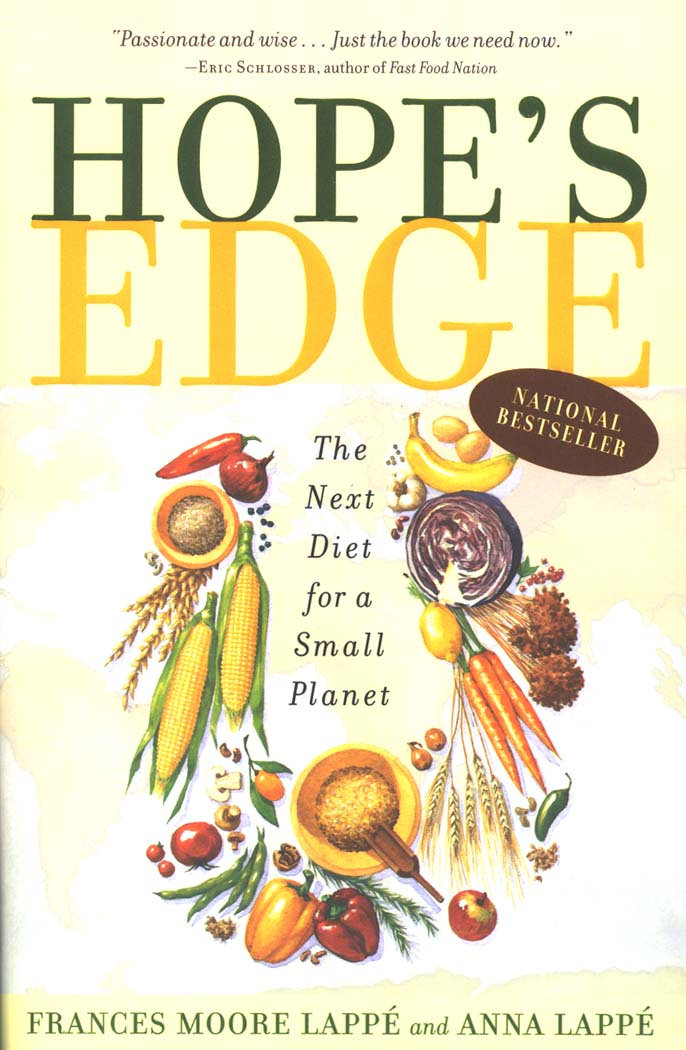
Hope’s Edge: The Next Diet for a Small Planet
By: Frances Moore Lappé and Anna Lappé (Tarcher-Penguin, 2003).
You may remember a slim book from the 1970s called Diet for a Small Planet, advocating eating less (or no) meat to make a difference on world hunger, noting that raising beef is far less resource-efficient than raising grains, legumes, and veggies (p.254). That was Frances Moore Lappé’s first of many books on food, hunger, and/or democracy. She’d done 12 others by the time she wrote Hope’s Edge, and several since.
Thirty years later, in collaboration with her daughter Anna, she revisited those issues, spending nearly a year traveling together around the world, interviewing leaders in food justice movements from legendary figures including Muhammad Yunis in Bangladesh (founder of the Grameen microcredit and many related enterprises), Wangari Maathai in Kenya (originator of the tree-planting Green-Belt movement), and Alice Watters in Berkeley (creator of Chez Panisse, probably the first vegetarian restaurant to gain a national reputation for fine cuisine)—to farmers whose names are known only in their own communities.
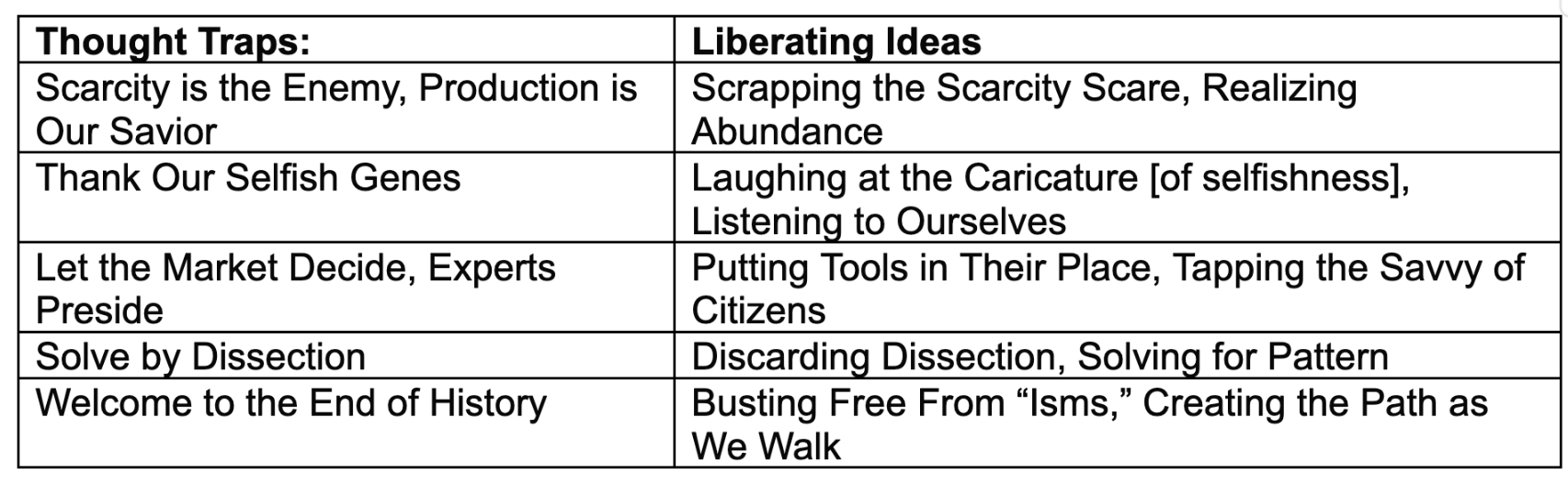
Of course, all the dollar figures are way too low today—but so are many of the indications of real progress (such as percentage of land being farmed organically or through deeper green methods such as permaculture, amount of renewable energy, and money diverted from traditional to socially and environmentally conscious investing)—often by orders of magnitude. And all the principles are still totally sound, including the Five Thought Traps (pp. 22-29) and Five Liberating Ideas (pp. 283-310), summarized in pairs on pp. 328-329 and recopied in their exact words here. Much of the book is expansion and extrapolation of these ten key concepts:
|
|
|
|
If I were the one giving this book a title, I would make my perspective more obvious, calling it something like “Finding Hope Among Dreamers and Doers: How Practical Visionaries Are Nurturing a Food and Democracy Revolution.” This is one of the most enjoyable business or activism books I’ve read in a while—and yes, this book has a foot planted firmly in each of those camps. The real-people stories, interviews with the movers and shakers, and personal observations/experiences as they taste their way through this exciting new world are well-written and deeply inspirational.
One huge improvement over the original Diet for a Small Planet, if I remember correctly (my copy fell apart years ago and I didn’t replace it) is the quality of the recipes. The original book included recipes for the kind of early-70s-style bland vegetarian cooking that sent would-be vegetarians running back to their hamburgers. Another cookbook author even stepped up to the rescue with a spin-off book called Recipes for a Small Planet. Later, gourmet vegetarian cookbooks became easy to find. The recipes in Hope’s Edge, by contrast, are taken from some of those excellent vegetarian cookbooks and from the personal recipe stacks of celebrated vegetarian restaurant chefs and some of the food activists the Lappés met in their year of research around the world. My mouth was watering pretty much every time I looked at any of them.
One huge improvement over the original Diet for a Small Planet, if I remember correctly (my copy fell apart years ago and I didn’t replace it) is the quality of the recipes. The original book included recipes for the kind of early-70s-style bland vegetarian cooking that sent would-be vegetarians running back to their hamburgers. Another cookbook author even stepped up to the rescue with a spin-off book called Recipes for a Small Planet. Later, gourmet vegetarian cookbooks became easy to find. The recipes in Hope’s Edge, by contrast, are taken from some of those excellent vegetarian cookbooks and from the personal recipe stacks of celebrated vegetarian restaurant chefs and some of the food activists the Lappés met in their year of research around the world. My mouth was watering pretty much every time I looked at any of them.
I took eight pages of notes, but I really want you to read this book, so I’ll only share just a few insights and quotes:
- “How can we build communities in tune with nature’s wisdom in which no one, anywhere, has to worry about putting food—safe, health food—on the table…whose voice gets heard in matters of land, seeds, credit, trade, food safety?” (p. 17)
- Yunus on open hiring in a corrupt society: “If I reject him, he may find another job, like with the police. He’ll become a policeman, a corrupt policeman. If I had recruited him, he would have become an honest Grameen Bank staff member, dedicated to poor people—the same person.” (p.128; emphasis in original)
- While sustainable farming may sometimes have lower yields, it also may have vastly superior yields (p.259)—and the costs to the farmer are much less because they’re not paying for all the chemicals, the patented hybrid or GMO seeds, the large amount of waste, and more—not to mention the additional secondary costs, like health care, soil depletion, pollution, and loss of genetic diversity leading to disease susceptibility (p.247 and woven throughout the book).
The Lappés see globalized capitalism attempting to make us into conformist, isolated, and selfish beings toiling toward the goals of producing more for them, cramming one-size-fits-all models into places where they don’t fit, and grinding those in poverty under its thumb. They chronicle the huge agribiz companies that control so much market share as they allow traditional varieties to go extinct in favor of high-production, low-nutrition monocultures, inflict untested GMOs and toxic chemicals, and squeeze farmers who make too little to live on.
But, because they also chronicle the wellspring of innovation mixed with recapturing lost or dying traditions, creating higher yields and lower costs for organic farmers, forming circles of cooperation across every endeavor and in so many different types of political and business structures, empowering landless farmers and disenfranchised women, the dominant feeling is, indeed, hope.
That kind of systemic, holistic approach has become far more obvious in the intervening 20+ years. This is a pioneering work that may have influenced some of those wonderful trends. Go and read it. Take notes.
|
|
|