The Clean and Green Club, May 2026

<!doctype html>


Having trouble reading this as an email? Please visit thecleanandgreenclub.com to read it comfortably online.

Shel Horowitz’s Clean and Green Marketing Tip: May 2026

Great news! All of my eBooks with a publication date through 2023 are now free to subscribers to The Clean and Green Club (the monthly newsletter I’ve been publishing in some form all the way back to 1997). https://shelhorowitz.com/shels-green-products-and-services/
Finding the Balance
Asian woman using laptop

Image: Vitaly Gariev via Pexels

Time Off and Exercise

In December of 1982, when my brand new business was nearly 100% a term paper typing service, I worked 31 days without a break, and was on the verge of collapse. My wife peeled me out of my typing chair and into the car, and we had a couple of days of rest in Vermont. That brought home to me the importance of taking time off.

Since then, I don’t do client work on weekends. I take a lot of vacations. I also try to get 2 hours of exercise every day—and usually exceed that. While not all of that is high-intensity cardio, usually between 30-60 minutes is. Most days, my wife and I do either a cardio or yoga class and either walk in the woods or bike on the bike paths and country roads in our area, plus do an indoor bike ride in the morning, and some freeform rock dancing.

Daily Gratitude Practice

Another way I bring balance into my life is the daily gratitude journal I’ve been posting on Facebook since March 2018. I’ve chronicled every single day since then. It might be less than 200 words, or more than 2000, or anywhere in between. It’s a significant time commitment, sometimes as much as two hours—but it’s worth it to me because it forces me to go through life looking for things to be grateful for, so I have something to post that night and the Gratitude Journal fans have something to look forward to. I’ve done this even on the really hard days, like the day my stepfather was killed by a distracted driver. That day’s journal entry focused on the impact this remarkable man had on me over 50 years. The post, like most of my Facebook feed, is open to all, even if you don’t have a Facebook account.

The gratitude project has also made me a better photographer, because I take photos to remind myself of what I’m grateful for, so I remember it at the end of the day when I’m writing it down and can provide some visual interest. I noticed that people liked the photographs, paid attention to which ones they like, and I got better at it, because I take more shots like that, and fewer of the blurry ones I used to take, and more arty ones that highlight both the naturescape and the humanscape (architecture, industrial works, etc.).

Food

Eating well is another big component of a balanced life. Yes, there are vegetarian foodies, and I’m proud to be one of them. I haven’t voluntarily eaten meat since 1973. I love to cook and I find it therapeutic when I’m having a tough day and an outlet for my creativity at any time. And we’re members of a CSA farm, have our own garden, and visit area farmers markets, so my diet is heavily tilted toward local, organic, super-fresh foods. Most weeks, my wife and I more-or-less alternate who cooks dinner (with some adjustments for our schedules), so neither of us burn out on it.

Scheduling

A good time-management tool is a big help, too. After resisting electronic calendars for probably a decade, I switched to Google Calendar several years ago. While I’m not generally a fan of Google products—I use Ecosia.org as my primary search engine mostly because of privacy concerns with Google—but the calendar’s great. I love being able to automatically put buffers in. I have the buffer set for half an hour, so if I have an appointment that ends at 2 o’clock, nobody can book me till 2.30. That gives me time to pee, to get a drink of water to just kind of relax and process whatever just went on.

I also love being able to see my wife’s calendar in the same window as my own (only on the computer, not on the phone), which helps a lot with scheduling and reducing car trips into town. And for in-person events, I block out not just the event time but the travel time and put the actual start time in the event title. We also note on the calendar if one of us is using our shared Zoom account, so we don’t double-book. And it syncs with Calendly so when someone books an appointment, it goes right into my calendar automatically. (In fact, I warn everyone that a meeting isn’t confirmed unless they hear back from me, not just the Calendly bot, with a Zoom link.) Also, I miss a lot fewer meetings because Google Calendar reminds me a half an hour ahead so I can quickly plan for a meeting I may have forgotten about.

Communications and Delegation

Managing email and social media are challenging. I limit my time in both. I’m usually on Facebook and LinkedIn combined for 1-2 hours a day. Mostly, I’m responding to comments and messages, but I do try to engage with a few posts every day.

Alas, with 300 messages arriving on a typical day, I’ve long since given up on keeping up with email, and I just warn people, if you email me and you don’t respond, I probably didn’t see your email, you might want to send me a text to go look at the email. I would love to delegate in my inbox. I don’t feel like I can, because my interests are too diverse and I’m just going to get asked, “well, do you need this? Do you need that?” So I just open my own mail, and most of it I don’t open. That’s not ideal. I will be first to admit that my productivity would be a lot better if I had a better system for dealing with email.

But delegating is crucial. If I’m not an expert in something I see who I can hire to do it for me. While I keep income and expense spreadsheets, I turn them over to a tax preparer. I don’t change the oil on my car but bring it to a garage. And I have a Virtual Assistant who formats my monthly newsletter from content I supply. She also sends out birthday messages from me to my Facebook community. I write the message each year and I respond when someone replies, but she finds the people celebrating their birthday and sends the prewritten message from my account.

Keeping Learning Absorbable

For summits and conferences, take what you need. If you’re going to a 3-day virtual summit and it’s 7 hours a day, pick two or three sessions you really want to attend and add in others if you’re in the mood when that time arrives. If I’m speaking, I try to be there for the session before and the session after, because it’s kind of rude to parachute in and out. But if I’m not speaking, I look at who is offering content that’s useful to me. Who do I think is going to be a good offerer and presenter? What times are convenient,and do I have access to the recording later?

What are YOUR favorite ways to achieve balance?
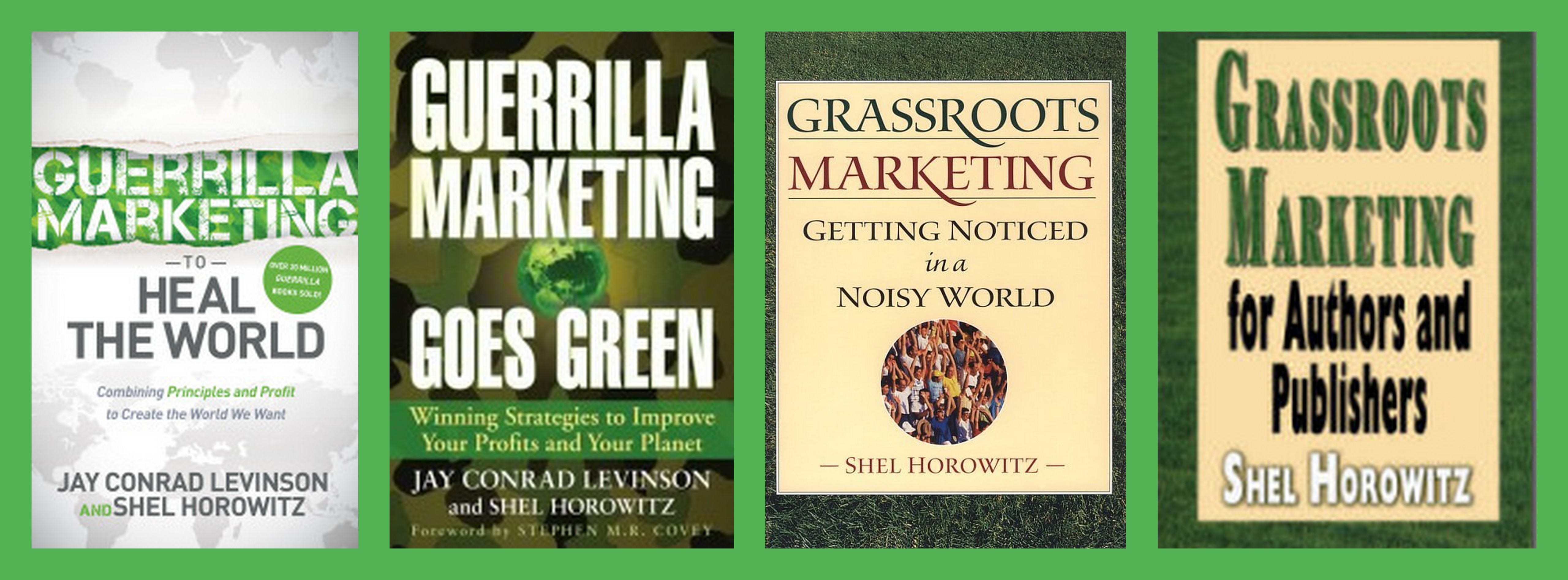
Discover why Chicken Soup’s Jack Canfield, futurist Seth Godin, and many others recommend Shel’s 10th book, Guerrilla Marketing to Heal the World (and download a free sampler). Autographed and inscribed copies available.
View highlights from (and listen to) more than 30 podcasts ranging from 5 minutes to a full hour. Click here to see descriptions and replay links.

Ellen Finkelstein and Project 2029
A couple of friends have been frustrated by not seeing progressive politicians or well-known thought leaders offer positive ideas for improving life in the United States. So we decided to create a place for anyone to post ideas on a variety of topics, such as gun violence, healthcare, homelessness, poverty, immigration, and more. And we hope people who can implement them will notice. It’s a simple site but it works.

Please post your ideas here and then share the site! https://www.project2029.community

Beaverland: How One Weird Rodent Made America

Hands Across the Hills

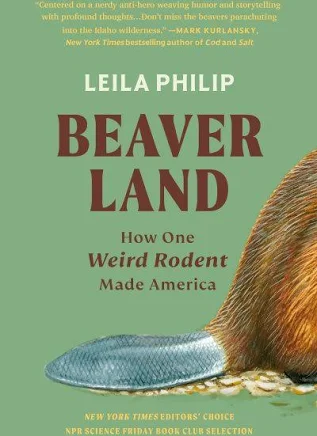
Beaverland: How One Weird Rodent Made America
By: Leila Philip (Twelve-Hachette, 2022; review based on 2024 updated paperback edition)

You’ve probably heard of the Butterfly Effect: the idea that a single butterfly flapping its wings in one part of the world may create changes in weather and climate in an entirely different place. You may also be familiar with the Precautionary Principle, which tells us not to muck around with natural systems unless we fully understand what we’re doing and understand/can deal with even the unintended consequences. And you may have come across the idea that every living thing has a role to play in the ecosystem, even the creatures we detest.

Keep that in mind as we discuss beaver: an animal that was nearly hunted to extinction to make hats, that has caused billions of dollars in damages to human-constructed objects—and that turns out to have a crucial place in maintaining a habitable planet.

That last part is only recently becoming common knowledge. Beavers, it turns out, create vast and productive positive effects: creating habitat for hundreds of other species, modulating climate change by recharging areas that are drying out and by generating underground rivers of cooler water, preventing calamitous wildfires, and cleaning the water when a fire does happen (p. 131, p. 264).

And this is why I’m reviewing this book, even though it seems way outside my focus on business profiting through environmental and social good. Because, first, it’s an object lesson in interconnectedness, and in the hidden power of the planet to regenerate itself despite human behavior that has undermined our ecosystems. And second, it shows us that pretty much everything has an environmental impact—and environmental impacts in turn create social impacts.

But, according to Philip, society is still mostly stuck in the old paradigm. “Our survival now depends on our ability to control our attempts to control nature” (p. 221). Even many ecologists see beavers as something of an enemy, raising the temperatures of ponds, diverting water sources, killing trees for food and construction materials. So humans continue to trap these animals, destroy their dams and lodges, etc.

She begins her book with a few of the many Indigenous American beaver stories and legends, then dives into a look at the colorful characters who’ve researched—and sometimes lived with—beavers. One stands out: Dorothy Richards, who had beavers living in her house and siting at her dining table (Chapter 6 and throughout the book).

Then a long, deep look at the fur trade from the 17th century to today, including a mini-biography of John Jacob Astor’s beaver-driven rise to the One Percent (Chapter 3)—as well as many long hours with people who are still active in trapping and fur trading.

Next, a few chapters hanging out with beaver researchers and summarizing their findings.

The dark secret of beaver history that I certainly had never heard about was her own research into how 18th- and 19th-century settlers interacted with the beavers—and how a racist enslavement of Native people probably emerged out of those interactions (pp.214-218).

She concludes with an unobvious hypothesis from Dr. Chris Thomas that maybe we Anthropocene humans can put our talents to work together with beavers and other creatures in the ecosystem to create real, sustainable, solutions that respect nature and Indigenous traditions while bringing science into the mix (p. 280). But this hypothesis is less surprising given the considerable space she’s given to human efforts at helping beavers recreate their past greatness, such as with human-constructed Beaver Dam Analogs (pp. 162-163, 236-237), which encourage beavers to move in, build on them and incorporate them into their own real dams.

  • By looking at beaver life before the industrialization of the last 300 years, Philip discovered that beavers’ nocturnal pattern is an adaptive behavior! Before the trappers and hunters showed up, beavers were largely diurnal (p. 47).
  • Areas dammed by beavers are more likely to survive forest fires (final photo before page 143)
  • Beavers don’t just make ponds. The effects of “beaver meadows,” extended non-river, non-marsh wetlands that we can’t even see until our feet get wet, may be more significant (pp. 164-178). And our whole concept of rivers is warped by not realizing how beavers used to direct them before humans started massively interfering.

Connect with Shel

Turn Your Sustainability/CSR Report Into Powerful Marketing!  http://goingbeyondsustainability.com/turn-that-nobody-reads-it-csr-report-into-a-marketing-win/

About Shel

Speaker, author, and consultant Shel Horowitz of GoingBeyondSustainabiity.com helps businesses find the sweet spot at the intersections of profitability with environmental and social good — creating and marketing profitable products and services that make a direct difference on problems like hunger, poverty, war, and catastrophic climate change. His 10th book is Guerrilla Marketing to Heal the World.

If you’re not already a subscriber, please visit http://goingbeyondsustainability.com and scroll to the very bottom left corner. You’ll find lots of interesting information on your way to the subscription form, too.

————–

Links in this newsletter may earn commissions. Please click here for our privacy and endorsement policy.


Powered by:

GetResponse

Leave a Comment

Name: (Required)

E-mail: (Required)

Website:

Comment: