Guest Tip: The Power of 3rd-Party Gifting

Shel Horowitz’s Book Marketing Tip of the Month, Vol. 1 #4, October 2007

Guest Columnist:  Don McCauley

One of the techniques I teach in my book. . .

Why not give away a free gift? Or better yet, have someone ELSE give
them away. Here is how . . .

Since you have published a book, it might take just an hour or two to
create an e-book using already written excerpts FROM your book. Then
just print up some gift coupons for a FREE E-BOOK. The example I use in
my book is a book of recipes. Approach a local bakery and have the
owner give out YOUR gift coupons as THE BAKERY’s gift to THE BAKERY’s
patrons.

This accomplishes a number of things:

*Your free ebook serves as a ‘taste’ of the book, much the same as a
trailer provides a ‘taste’ of the full movie to come.

*The bakery gives a ‘gift’ to the bakery’s patrons at NO COST to the
bakery.

* The gift coupon has the effect of providing ‘third party’ influence
from the bakery, much the same as a referral FROM the bakery

* As the customer must visit your website to redeem the coupon, you now
have them in YOUR store. This gives you the opportunity to add this
person to YOUR mailing or newsletter list. They will most likely do
this, as they are certainly an INTERESTED prospect.

* The bakery is actually advertising for YOUR BOOK …. for FREE.

The end effect is that you win (getting an interested party to your
site for practically no cash layout) the bakery wins (gives a valuable
gift to the patrons) and the customer wins (gets a free gift). As
compared to using a flyer sent to potentially uninterested parties (1/2
of 1% return is the norm) there is simply no comparison.

The gift certificates will cost pennies to print compared to
potentially hundreds of dollars to print flyers.

Try this simple technique and track the results. Wow! Of course it goes
without saying that you will have to partner with a business in your
genre . . .

Don McCauley ICM, MTC, CH
Author-Top Ten Secrets To Getting Free Publicity
For Your Business Or Organization
Free Publicity Focus Group
www.freepublicitygroup.com

Another Recommended Book: Getting a Grip, by Frances Moore Lappé

Another Recommended Book: Getting a Grip, by Frances Moore Lappé
Reviewed by Shel Horowitz

Positive Power of Principled Profit, Vol. 5 #2, October 2007

Near the end of Getting a Grip, Lapp’e–whose name may be most familiar as author of the groundbreaking Diet for a Small Planet back in the 1970s–notes that 80 percent of all Americans  “say they’re likely to switch brands to help support a cause when price and quality are equal.”

This book is intended as a manual for social and environmental change activists, and not as a business book. Nonetheless, it’s quite applicable to the world of business, and draws on a number of business principles and ideas, including the recently popular Law of Attraction. Lapp’e doesn’t use that term, but her emphasis is clear: what you pay attention to becomes bigger and more real. Also, what I have for several years called the Abundance Principle: that there is plenty to go around, but a big maldistribution of resources. No one needs to be hungry or lack fuel once this imbalance is addressed.

Lapp’e’s central thesis is that large corporate and government entities have robbed consumers of their citizenship, by substituting what she calls “Thin Democracy”–I’d call it “Pseudo-Democracy” for the involved and active citizen participation that comprises true democracy–and that we, the people, can take back our rightful heritage as citizens–as people who participate in the decisions that affect us–and initiate true change.

The book is full of inspiring examples of individual people with simple actions that turned injustice into justice–most strongly, the story of an African minister whose pro-democracy efforts brought a visit from the goon squad on a mission to torture and kill. His compassion, humor, and lack of fear in the face of the attack won over the attackers, who, after inflicting significant harm, stopped the attack and brought him to a hospital.

A key insight that I’ve long believed but not often seen elsewhere is that there are two concurrent social trends: a concentration in corporate and government power and wealth that is threatening to ordinary citizens as well as the environment—and at the same time, an energizing, a democratization based in the actions of ordinary people. This second trend is the Living Democracy, a powerful antidote to Thin Democracy.

To bring Lapp’e’s points back to a business context: she notes that even the biggest companies respond to pressure from their customers, and that what she calls “entry points” allow those consumers (and other stakeholders, such as neighbors) to address–and effect change in–some pretty big issues. In Sweden, for instance, McDonald’s serves organic milk, because its customers wouldn’t tolerate anything less.

Positive Power Spotlight: Armstrong Capital

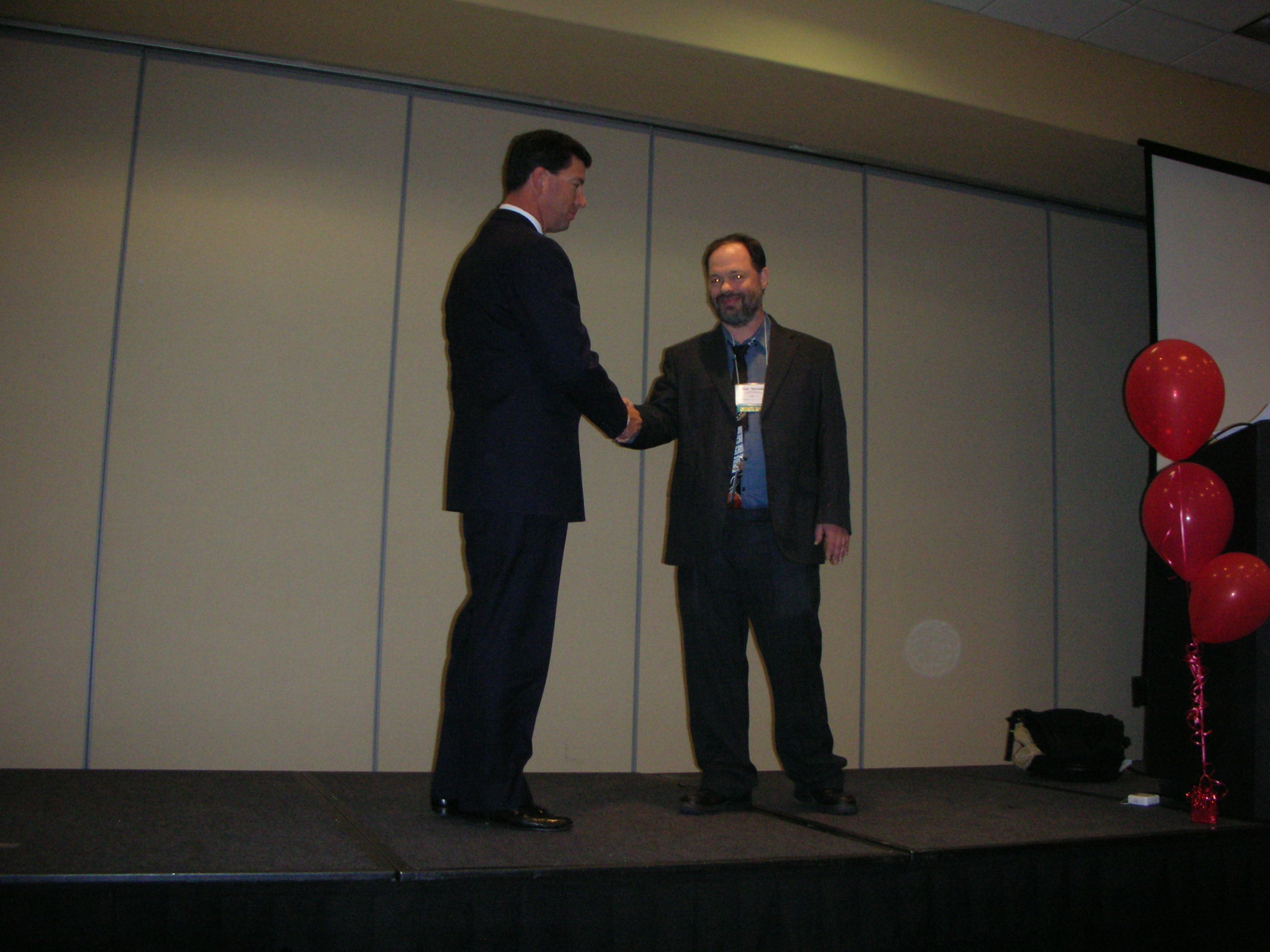
Jeff Armstrong (Left) greets Shel Horowitz at Noteworthy USA Convention

Photo: Jeff Armstrong (left) greets Shel Horowitz following Shel’s keynote address at the Noteworthy USA convention, Las Vegas, October 5, 2007.

Shel Horowitz’s Positive Power of Principled Profit, Vol. 5, #2, October 2007

When you deal in other people’s money, you very quickly butt up against the perception that your company is likely to be crooked. Through his actions in his own business and his education of his peers, Jeff Armstrong of Armstrong Capital is doing what he can to change that. Starting with the very first line of his website: “Straightforward, Honest, Fair….The Way It Should Be.”

Armstrong, based in the Los Angeles area, deals in real estate notes—for example, buying an owner-financed mortgage from a seller who needs an immediate large infusion of cash, and selling it at a profit to a securities company that can convert it into stock and offer it to its investors.

An early supporter of the Business Ethics Pledge, Armstrong came to my attention because he consistently generates new signers of the Pledge through the link on his website. Most of the people who have generated a larger-than-average number of signatures for me have done so through a single newsletter article–but with Armstrong, it’s ongoing, year after year. It turns out he’s been buying my books since the 1990s, starting with Marketing Without Megabucks, and he told me this is because even before I wrote a book about it, he sensed my strong commitment to ethics in marketing from those earlier works.

He also happens to edit the newsletter for NoteworthyUSA, his industry association, and consistently uses this “bully pulpit” to advance an ethics agenda. And when I heard him address the 300 attenders at Noteworthy’s conference, he stressed both the practical and the moral imperatives of being ethical. He’s not ashamed to admit that he has self-interest as well as altruism as his motives; if enough honest people crowd out the crooks, it’s less likely that government regulators will choke off his industry.

If the group I met when I was hired to keynote Noteworthy’s conference is any indication, Armstrong is having a significant impact. I got a lot of thank-yous from people who said I was reinforcing what they already knew was the right way to run their business, and giving the marketing ammunition necessary to help them prosper with it. Others told me my strategies for attracting and keeping clients through ethics are already working well in their business. And I met a few who are in the business specifically to advance a social change agenda: one woman works to provide capital to women fleeing abusive relationships and starting their lives over; a retired professor couple use their note business to fund water development projects in developing countries. All in all, an impressive group.

It does not surprise me in the least that Jeff Armstrong is quite successful in his own business.

Armstrong Capital: https://www.armstrongcapital.com
NoteworthyUSA: https://www.noteworthyusa.com

Pay-Per-Click, Part 3: Copywriting The Ad

Shel Horowitz’s Frugal Marketing Tip – October 2007

Mark Twain once apologized to one of his correspondents for writing a very long letter, noting that he didn’t have time to write a short one.. Anyone who’s had to write copy for a very tiny format such as pay-per-click ads can certainly relate.

Pay-per-click offers one of the smallest workspaces of any advertising medium. It’s like a small classified ad. You get a headline, a few words of text, and a web address (which I’ve left out of the examples). Yet fortunes have been made with pay-per-click campaigns.

I went to a random page on one of my own sites to grab the largest and smallest ads I saw. It happened to be the page on the speeches I have available; these are two of the four ads shown at that moment (they will rotate as Google’s inventory and displaying formulas dictate).

Effective Presentations
Learn How To Overcome The Ten Myths Of Public Speaking. 1 Day Seminar.

The body text is just 13 words (the first two words are a headline, in bigger type).

Speeches
Looking for speeches? Find exactly what you want today.

That’s a one-word headline, nine words of body copy.

Is that enough to say *anything* useful?

Yes, actually. This ad showed up on my frugal fun ideas page:

Creative Romantic Ideas
New Romantic Ideas Added Weekly. Easy To Search And Completely Free!

It’s easy to see where someone who was surfing around looking for something different than the usual dinner-and-a-movie might be curious enough to click. And it’s only 11 words.

In my case, I didn’t click because I didn’t want Google to think I was pumping up my commissions (grounds for terminating the program). But Google ads always display the URL, so I simply typed it into my menu bar.

Just as in writing any short-form copy, your goal is to grab the reader’s attention and pull that person to take an action–in this case, the action you want is a click on the link.

Let’s say I wanted to write an ad for my sixth book, Principled Profit: Marketing That Puts People First. The book is about the idea that ethical businesses are well placed on the road to success, if they understand how to harness the marketing advantages that this position opens up.

I might start with a grabber headline like
Ethics Equals Profits
Ethical Biz is Profitable
Ethics Equals Success
Forget Market Share–It’s Profit You Want

The nice thing about PPC is that I could test each of those before settling on one. And some researchers report that something as simple as changing one word, or flipping the position of a word, can make enormous differences in the return. If you authorize enough clicks, you can have meaningful results in hours. Also, nothing prevents you from running several different ads if they all pull well.

Similarly, I’d test variations on the body copy. But you want to measure not only clicks but also conversions: people who take the next desired action once they get to your landing page. An ad that pulls a lot of clicks but few conversions will waste vast sums of your money very quickly, whereas an ad that gets clicked enough to stay prominent in Google’s rotation but attracts a much greater percentage of actual prospects could be one of the most effective forms of paid advertising you can create.

In my case, the first thing I want to do is discourage non-readers. So I say right in the body copy that it’s a book. So these are some variations I might test:

Award-winning 160-page book, Principled Profit, shows how. (seven words)

Chicken Soup Co-Creator Jack Canfield praises Principled Profit book. (nine words)

Chicken Soup Co-Creator Jack Canfield praises Principled Profit book. Find out why. (twelve words)

Jack Canfield, Jay Levinson, Mark Joyner, 76 others all say, read this book. (fourteen words–but at 76 characters, it might be over Google’s character limit. If it is, I could change “all say,” to a colon.)

The last headline above is going for a different market segment than the others, so for that variation, my copy might read:

Profit when customers just have to tell friends. Award-winning book explains. (11 words)

As you might guess from a careful reading of this article, I haven’t actually tried PPC ads for this book. In fact, I’m kind of a greenhorn at the whole thing. I did a PPC campaign many years ago on GoTo, now known as Yahoo–before Google even took ads.

But it’s something I’ve wanted to try for PrinProfit for a while, and writing this series will move me closer to it. It takes time that I don’t have at the moment–to write the ads and landing pages, test, track the results, and analyze what’s working, and then repeat the cycle as you refine your campaign–but when I get caught up, I’ll experiment–and I’ll let you know the results. I’m planning to redesign the Principled Profit website, and as I do this, I’ll be looking at how to set it up so it’s friendly to PPC campaigns.

Of course, you do have the option to pay an expert to run your PPC campaign for you–but that’s more than I want to invest.
Why Seek Publicity for Your Books?

Shel Horowitz’s Book Marketing Tip of the Month – Volume 1, #3, September 2007

Publicity is getting the word out about your product, service, and/or ideas. It brings visibility, credibility, opportunity, and sales.

Publicity provides the seal of approval of a trusted outside source: a journalist. Like testimonials and awards, this third-party validation helps the buyer choose your book in the crowded marketplace. It also means that a lot more people hear about your book.

When you get free publicity rather than pay for advertising, you give up control over the content. But you have the added legitimacy of being chosen to represent your field. Because news coverage at least pretends to be unbiased, it is more valuable than advertising; you get, in a sense, a testimonial—a disinterested, credible party who thinks you’re worthy of positive attention. Many people take news coverage more seriously than advertising—and may be more likely to be influenced by it than by a paid ad.

And sometimes, publicity leads to more contacts that advance your career: a meeting planner contacts you to see about doing a speech, a different journalist sees the story and wants to cover you as well, a company president sees the article and decides you’re the perfect consultant to get that company out of a rut. In short, the book becomes a doorway to ar more lucrative ventures.

Oh yes, and don’t forget that sometimes, an article or a TV or radio interview can actually motivate people to go out and buy that book! Especially if you make it easy by including your website, your phone number (toll-free is ideal), and some kind of special offer.

(Portions of this tip were taken from Grassroots Marketing for Authors and Publishers, and other portions from Grassroots Marketing: Getting Noticed in a Noisy World–and some is original, just for you.)

Another Recommended Book: The Organic Entrepreneur: Cultivating the Conscious Capitalist by Maxine Hyndman

Failure as compost–I think that may be the best business metaphor I’ve ever come across! If you’re a non-gardener–compost is all the rotting bits of old food scraps, spoiled vegetables, and so forth. It’s not very appealing in its early stages, but as it ages, it turns into the most fertile soil imaginable. It also works well with her philosophy of reaching for the truth, even when it’s not pleasant.

While that’s my favorite metaphor in The Organic Entrepreneur, there’s plenty more: the entrepreneur as alchemist, the business as a habitat.

Other gardening principles Hyndman incorporates into her business philosophy–the book is organized into psychological business “seasons”–include patience, integrity, and a Green sensibility. Plus seven principles for “spirits seeking human experiences”–a nifty reversal–along with more principles for understanding business as Tao, and for finding abundance in your core principles.

This book is very much in tune with the philosophy I express in Principled Profit: Marketing that Puts People First–though it’s more about the overall business concept and less hands-on. A very nice complement to Principled Profit, and recommended for anyone struggling to find and express their values within business.

Click here to get your copy.

The Organic Entrepreneur: Cultivating the Conscious Capitalist

by Maxine Hyndman

Insomniac Press, 2007

Positive Power Spotlight September 2007: Inkjet Solutions

I’ve known about inkjet and toner cartridge recycling businesses for more than a decade, and never paid them much mind. But when I met Karl Tur, of Inkjet Solutions, at a Chamber of Commerce mixer, I was impressed that the first thing this young man said to me, before he knew anything about my background, was about the positive environmental impact we could all have by recycling our cartridges–before he even mentioned the price benefits. His reasons for starting this business, with locations in Amherst and Northampton, Massachusetts, are all about doing something right for the earth.When I walked into the store he’s just opened in Northampton, I was once again impressed with this small company’s commitment to the environment, as that was the key message of many of the posters and other point-of-sale marketing materials. Also, the website not only has a page about the environment as its third link, but devotes most of the space on the who-we-are page to its environmental mission as well.

And again, when I had him as a guest on my one-hour radio show, he spent at least half the time talking about the environment.

At my current age of 50, I find it very exciting to find 20-somethings who are starting businesses with a wider social agenda, and not just to get rich. I’d expect him, as the old Quaker saying goes, to “do well by doing good.”

Pay-Per-Click, Part 2: Keyword Analysis and Selection (Shel Horowitz's Frugal Marketing Tip, Sept. '07)

OK, now that you read the July main article and understand the concept of pay-per-click (PPC) advertising, the next step is figuring out what keywords to bid on.

Your goal: very affordable but very targeted traffic, and enough of it to keep your ads active (and your cash registers humming).

The way to get it: highly specific keywords–or, more accurately, key phrases.

Let’s take an example: I’m a copywriter. If I bid on writing, an extremely general term, I discover on Google that there are 319,000,000 results–yikes! Changing “writing” to “copywriting” brings it down to a still-unmanageable 11,600,000 results, and there are so many sponsored ads that they don’t even fit on one page! There are eight sponsored listings on the first page, and ten more on the second page (two form the same companies). You can guess that a top five position is going to cost several dollars per click.

But the more specific we make it, the better we’ll do. If I type in “book jacket copywriting” (in quotes, for an exact match), Google only finds 49 pages in natural search–quite a difference from the 11 and a half million for just plain copywriting. And only five paid ads show up–of which three are about securing copyright (a completely different animal), one is one of the general copywriting ads from the previous example, and one is four a copywriting course.  So I could absolutely own this category with a carefully worded ad about book jacket copywriting.

But we’re not done yet. We’ve got to find out if anyone is actually searching for this phrase. So I sign in to my Google Adwords account, and I discover that yes, I could dominate this category, and pay just pennies–four to ten cents per click. But there’s only one problem: This phrase gets so little traffic that Google can’t even estimate the volume, placement, or cost per click! Same thing if I just search for “book copywriting.”

So I wouldn’t get enough clicks to keep my ad active, and there’s no point. I decide not to buy the ad (as usual when I play with this stuff), and am out nothing except a few moments of my time. Isn’t this better than running a pricy magazine ad that turns out to be a lead balloon?

And you? What key phrase can you find that meets these criteria?
* Low cost to bid and get decent placement
* Enough people searching that you get at least a few clicks per day
* Key phrases targeted to attract buyers, and not tire-kickers (very important when you pay every time someone clicks)–and that’s what we’ll talk about next month

Recommended book to supplement this article: Grassroots Marketing: Getting Noticed in a Noisy World, which has nine full chapters on Internet/online marketing, with lots of cost-effective strategies you may not have come across elsewhere.

Coming in parts 3 & 4:

October: PPC Copywriting

November: Fast And Effective PPC Testing Strategies

Never Stop Chasing Coverage:Book Marketing Tip, August '07

Book Marketing Tip, August ’07–Volume 1, No. 2
Never Stop Chasing Coverage

If you talk to big publishers, you’ll hear a lot of malarkey about the brief, tiny window for news coverage on a new book–measured in months.

This is absolute garbage, and they should know better. After all, they’ve invested many thousands of dollars in each book. It’s in their interest to succeed, although sometimes it seems they don’t realize this. What it does mean is that if you’re a big-publisher author who believes in your own book, you can continue to breathe life into it long after the publisher’s publicity department has given up.

Several of my books have gotten significant coverage long after publication. In one case, a book I published in 1995 (on having fun cheaply) was mentioned in both Reader’s Digest and the MSN home page in one month–eight years after publication and after the book was already out of print and converted to an e-book! Four years later–12 years after publication–that book still gets me print, radio, blog, and other coverage. I do get a kick when radio hosts introduce me as “author of the new book” (and yes, I correct them, quickly and gently: “the book’s actually been out for some time”–I don’t want to mislead people).

In another case, Bottom Line (an extremely popular newsletter) did an extended three-page feature on my marketing methods, featuring the marketing book I had published with Simon & Schuster six years earlier. No help from S&S’s publicity department on that one, of course, but I just follow the methods I discuss in Grassroots Marketing for Authors and Publishers.

And I don’t have some kind of magic secret sauce; I’ve heard from many other authors who routinely get publicity for books that are five, ten, even fifteen years old. Of course if your book is something like “How to Survive the Coming Y2K Crisis,” you’re out of luck. But for most of the rest of us, there will always be topical angles, fresh pitches, perennial tie-ins, and plenty of publicity if we just reach out for it.

Next month: why publicity builds legitimacy.

Book marketing consultant and copywriter Shel Horowitz is the author of Grassroots Marketing for Authors and Publishers and six other books.

Even Fiction Can Have News

Shel Horowitz’s Book Marketing Tip of the Month
Volume 1, Number 1, July, 2007

Welcome to the first edition of this newsletter and thanks for being one of my very first subscribers We’ve reached our minimum number of subscribers and we’re ready to go. I will publish every month on or about the 25th of the month, either with a tip of my own or guest tip. Sometimes it’ll be just a couple of paragraphs sometimes a full-length article.

This Month’s Tip: Treat Fiction as News

Since book marketers are often accused of neglecting fiction, let me start with a tip that especially applies to novelists and short story writers:

When you publicize your book, you can find a number of news angles to focus that can help you get coverage in the media. Here are three to start:

  1. The situation or problem your protagonist faces. As an example, I know a novelist who wrote a book featuring a woman who discovers her husband is gay. She gets tons of media coverage, positioning herself as an expert on the issues that straight spouses of gays face.
  2. The place where you the author live–but also the places your characters live in or travel to in your book.
  3. Any charitable connection or cause. I’ve done a couple of press releases for Imaginator Press, highlighting the funds its young adult fantasy novels raise for butterfly protection and research.

Shel Horowitz’s award-winning seventh book, Grassroots Marketing for Authors and Publishers, offers 280 pages of great book marketing advice. Click here for a detailed preview.