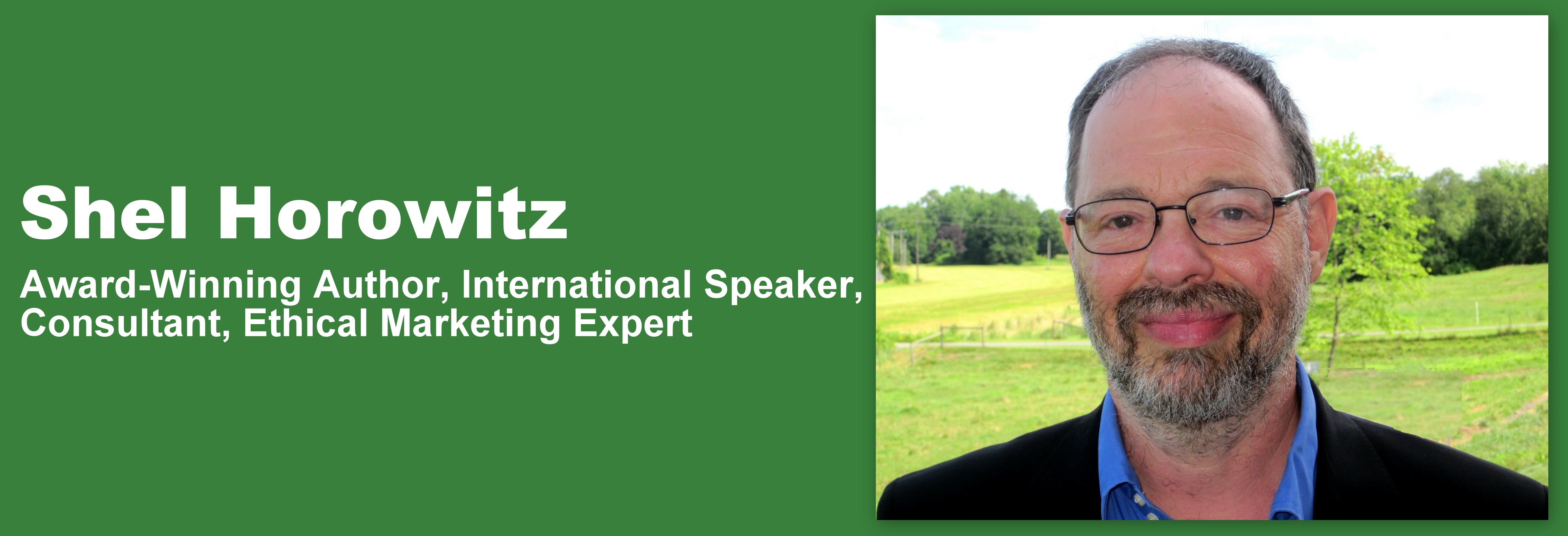
Category Archive for Hear and Meet Shel

The Clean and Green Club, October 2018

Having trouble reading this as e-mail? Please visit www.thecleanandgreenclub.com to read it comfortably online.
Like Twitter Pinterest GooglePlus LinkedIn Forward
Shel Horowitz’s Clean and Green Marketing Tip, October 2018
Friends Who Want to Help 

What a Magnificent Group of Smart Teachers—No Cost
Want to create positive change in your own life and in the world? Listen to the 9th Annual Global Oneness Day Online Summit on Wednesday, October 24th (with replays running the 24th through 26th). Zero cost but you need to register.
Theme: “Living Your Life for the Benefit of All.” A super-timely message people need to thrive in these challenging times.

You’ll hear from: Dr. Jean Houston, Bruce Lipton, Marianne Williamson, Gregg Braden, Barbara Marx Hubbard, Neale Donald Walsch, Marci Shimoff, Thomas Hubl, Steve McIntosh, Gangaji, Joan Borysenko, Matthew Fox, and many others. I’ve spoken there in the past.See the Speaker Schedule and Learn More About Global Oneness Day

By living in Oneness, we can harness our deepest shared connections to co-create new education, media, governance, and economic systems.

See the Speaker Schedule and Learn More About Global Oneness Day

By living in Oneness, we can harness our deepest shared connections to co-create new education, media, governance, and economic systems.

Three Freebie Calls with the Amazing Barbara Marx Hubbard
Also, one of my favorite teachers, Barbara Marx Hubbard, is doing three freebie calls:
This Month’s Tip: How to “Vaccinate” Yourself Against Mental Subversion by Fake News
Like Twitter Pinterest GooglePlus LinkedIn Forward
Last month, I shared a video of a dolphin rescuing a dog, asked whether you thought it was real or fake, and then told you my answer, with seven reasons why. If you missed it, please click on this paragraph to read it.

Why the Dolphin Video Matters: A Metaphor for Something Much Deeper

Why am I going on about this? Why does it matter? Isn’t it just some people having fun making a feel-good film?

Answer: I do marketing and strategic profitability consulting for green and social change organizations, as well as for authors and publishers–and I’m also a lifelong activist. This combination of activism and marketing gives me another set of lenses to filter things, as well as a magnificent toolkit to make the world better. My activism also brings a strong sense of ethics into the marketing side.

Both as a marketer and an activist, I pay careful attention to how we motivate people to take action–to the psychology of messaging. (You may want to visit the psychology category on my blog, where a version of this article first appeared, to get posts going back many years. I worry deeply about our tendency as a society to crowd out facts with emotions. (I also worry about another tendency, to crowd out emotions with facts, but that’s a different post.)

And this is an example of crowding out facts with emotion. While this particular instance is innocuous as far as I can tell, we see examples of overreach on both the Left and Right, and they work to push us apart from each other, talk at each other instead of seeking common ground, and push real solutions farther and farther out of reach.

My inbox is full of scare-tactic emails from progressive, environmental, or Democratic Party organizations. Because I’m in the biz and understand what they’re doing, I leave most of them unopened. I just searched my unread emails for subject lines that contain the word “Breaking” and came with hundreds, including this one from a group called Win Without War:

Subject: Breaking: Trump ordered tanks in D.C.

From this subject line, you’d expect some horror story about peaceful protestors facing American military might. It could happen. It has happened in the past–for example, the 1970 Kent State massacre that left four Vietnam War protesters dead and nine more injured by Ohio National Guard soldiers’ bullets. (The shootings at Jackson State College in Mississippi 11 days later were committed by police, not soldiers.) And protestors in countries with totalitarian governments have often faced tanks; if you want to see courage, watch the video of a man stopping tanks with only a flag, in Beijing’s Tiananmen Square in 1989–WOW!)

It’s a clear attempt to generate hysteria, to have people perceiving tanks in the streets with their guns pointed at dissenters.

Only in the body of the email do we find out what’s really going on:

Shel —

Last night, the Washington Post broke the story that Donald Trump has ordered a giant military parade with tanks, guns, and troops taking over the streets of our nation’s capital. [1] This is the kind of parade that dictators around the world use to intimidate their enemies and, more importantly, their own citizens.

This is what authoritarian dictatorships look like.

But Trump can’t change the fact that we still live in a democracy — which means Washington, D.C.’s local government gets to have a say before Donald Trump’s tanks roll down its streets.

Note the use of mail merge software to appear personal. Does that really fool anybody anymore? But OK, even when you know it’s a mail merge, it still generates at least a small warm fuzzy.

More importantly, note that the actual content is totally different from the expectation in the headline. We can argue the foolishness of Trump wanting a military parade (I think it’s foolish, and an expensive attempt to stroke his ego, and even he has since canceled the parade)–but in no way is this the same as attacking demonstrators in the streets of Washington, DC.

The right wing is at least as bad. I don’t subscribe to their e-blasts, but I found this juicy example (with an introduction and then a rebuttal by the site hosting it) in about ten seconds of searching.

And then there are DT’s own Tweets, news conferences, and speeches, both during the campaign and since he took the oath to uphold the constitution as President of the United States (an oath he has been in violation of every single day of his term). They are full of lies, misrepresentations, name-calling, bullying, and fear-mongering. They are hate speech. I will not give them legitimacy by quoting them here; they’re easy enough to find.

As a country, we are better than this.

How You Can “Vaccinate” Yourself Against Sensationalist Fear-mongering

Before sharing any news story or meme, run through a series of questions to help you identify if it’s real. And if it passes that test, pop on rumor-checking site Snopes and check its status. For that matter, go through a similar questions for advertising claims.

The questions will vary by the situation. Here are a few to get you started:

Does the post link to documentation? Are most of the linked sites reputable? If they advance a specific agenda, does the post disclose this? (Note that THIS post links to several reputable sites, including NPR, New York Times, history.com, Wikipedia, Youtube, Google, CNN, Snopes, and my own goingbeyondsustainability.com and greenandprofitable.com. Yes, I am aware of the issues in using Wikipedia or Youtube as the only source. I am also aware that Google gives them a tremendous amount of “link juice” because on the whole, they are considered authoritative. For both those citations, I had plenty of documentation from major news sites.) Strong documentation linking to known and respected sources is a sign to take the post seriously.

Does the post name-drop without specifics? See how the Win Without War letter mentions the Washington Post but leaves out the link? Remember that ancient email hoax citing longtime NPR reporter Nina Totenberg? Name-dropping to buy unsusbstantiated respect is not a good sign.Are the language and tone calm and rational, or screaming and sensationalist or even salacious?

Is the post attributed? Can you easily contact the creator?

And last but far from least, the most important question: Who benefits from the post’s point of view? What are their relationships to the post’s creator? (Hello, Russian trollbots!). Don’t just follow the money. Follow the power dynamics, too.

I could go on but you get the idea.

New on the Blog
Hear & Meet Shel

This showed up just at press time and I haven’t had a chance to listen and write down the highlights–but I remember that this interview with Mira Rubin was excellent. I’ll run it again next month with the proper description: https://player.fm/series/sustainability-now-exploring-technologies-and-paradigms-to-shape-a-world-that-works/ep-009-guerrilla-marketing-to-heal-the-world-with-shel-horowitz
 
Also quoted in this article on climate change in Playboy, of all places:
 
I’ve been taping several other podcasts lately, and will post the links in future newsletters as I get them. In the meantime, you can browse the list of the more-than-30 podcasts I’ve done; they range from 5 minutes to a full hour. Click here to see descriptions and replay links.  

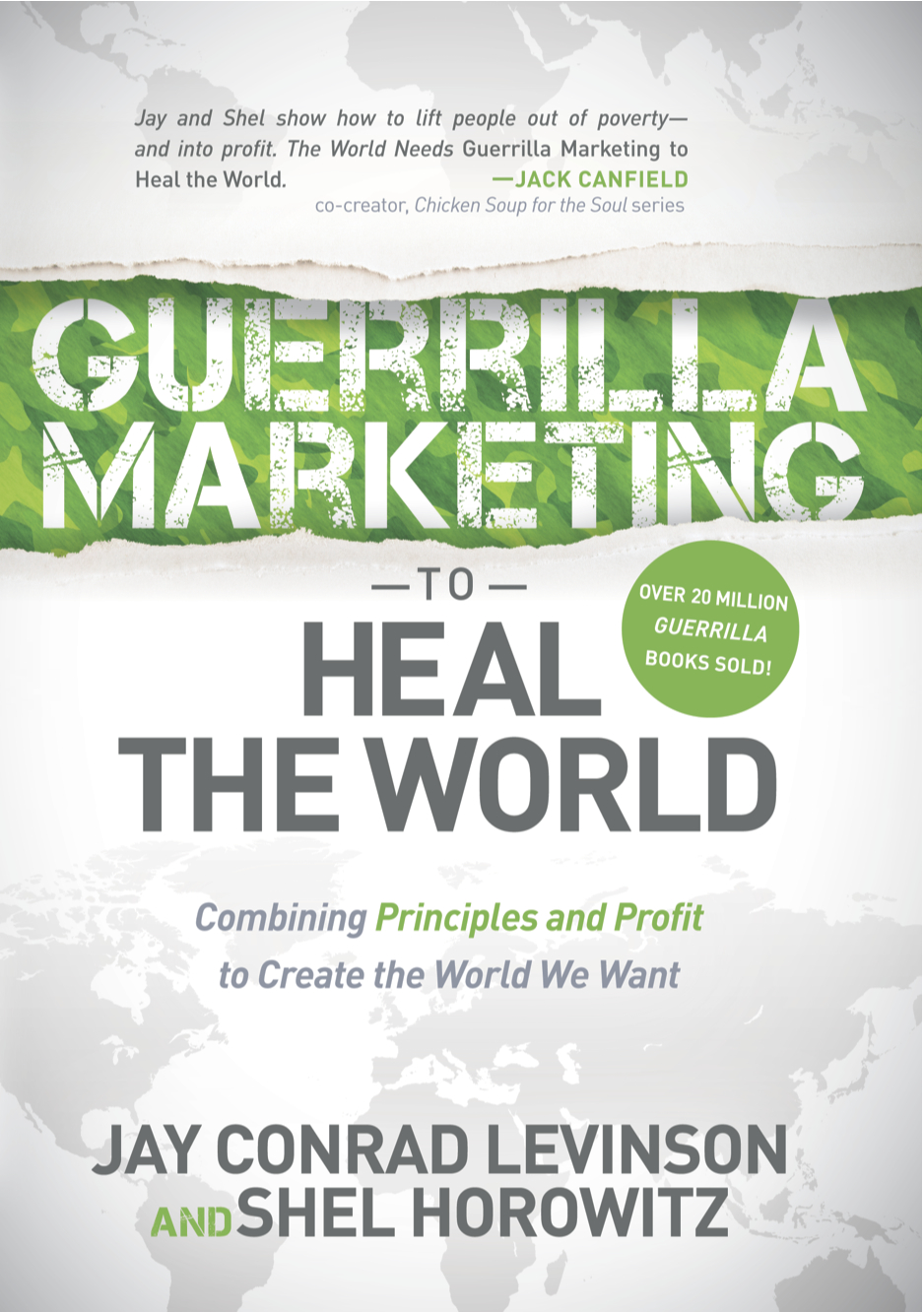
Order your copy of Shel’s newest book, Guerrilla Marketing to Heal the World

Learn how the business world can profit while solving hunger, poverty, war, and catastrophic climate change (hint: they’re all based in resource conflicts). Endorsed by Chicken Soup’s Jack Canfield, business blogger and bestselling author Seth Godin, and many others. Find out more and order from several major booksellers (or get autographed and inscribed copies directly from me). https://goingbeyondsustainability.com/guerrilla-marketing-to-heal-the-world/
Download a free sampler with several excerpts, the complete Table of Contents and Index, and all the endorsements.

Is Anyone REALLY Reading Your Sustainability or CSR Report?

Repurpose that expensive content, without using any staff time. I will extract the key items and turn them into marketing points that you can use immediately: https://goingbeyondsustainability.com/turn-that-nobody-reads-it-csr-report-into-a-marketing-win/

Another Recommended Book: Our Search for Belonging
Like Twitter Pinterest GooglePlus LinkedIn Forward

Our Search for Belonging: How Our Need to Connect is Tearing Us Apart, by Howard J. Ross with Jonrobert Tartaglione

Ross sees the need to be part of community as essential; we are hard-wired to demand it, to form community in numerous ways. He sees two kinds of communities, though: inclusive and exclusionary. Exclusionary communities bond internally but create barriers outside their in-group: they see themselves as “us” against “them”—while inclusive communities build bridges (pp. 16-17).

While those divisions have always existed, Ross sees them escalating dangerously: “People are no longer merely disagreeing; instead they are disavowing each other’s right to an opinion” (p. xi). It’s much harder to forge coalitions across these divisions now, or even friendships. And we surround ourselves with bubbles of like-minded people, who reinforce our prejudices. And that kind of social isolation.

The barrier(s) could be cultural, racial, religious, class-based, gender, sexual orientation, etc.—but they also could be ideological. If we demonize the “enemy,” if we treat them as a batch of stereotypes and not as human beings with the best interests of the world in their hearts, we create that “us versus them.” But because we create it, we can undo it.

How we define our bonding communities shifts situationally. A conservative Muslim woman or a progressive gay Christian might bond with one set of people over politics, another through religion, and a third as part of the sisterhood of women (a majority group that still experiences discrimination) or within the gay community (a minority subculture)—and some of these communities would see membership in the others as anathema.

And sometimes, others put you in the category. When the news media identifies someone as a radical Islamic terrorist but doesn’t identify the Oklahoma City bombers or the man who shot up the concert in Las Vegas as Christian terrorists, that creates a false identification of Islam with terrorism, and that demonizes Muslims but not Christians (p. 19).

One key piece of identity politics is the difference in perception between members of the dominant and non-dominant groups: members of dominant groups typically don’t often think about the experience of those in non-dominant groups. Yet, a person of color or a woman or someone who identifies as another type of minority experiences daily reminders that society puts up physical, psychological, economic, and other barriers.

That difference in perception seems especially relevant during the Kavanaugh Supreme Court nomination process, which was still going on as I wrote this earlier this month. Ross says we’re all heroes of our own stories (p. 55); certainly, both Kavanagh and Ford presented themselves that way.

I blogged about some of the parallels at: https://greenandprofitable.com/kavanaugh-and-the-culture-of-belonging/ Please read it. This review doesn’t duplicate that post. Here, I talk much more specifically about the book, which has relevance to so many situations in society, the workplace, the community.

There’s a lot of good stuff in the book, including a few specific ideas for defusing conflict and forming community across those “them” barriers. I will say, though, that I expected more of that. I didn’t really feel I’d been given a toolkit—but perhaps that’s because I’ve been doing bridge-building work for decades. As long ago as 1977, when I and 1413 other safe energy activists were incarcerated in New Hampshire’s National guard armories following a protest at the Seabrook nuclear plant construction site, I was one among many of the protestors who reached out to the young, conservative Guardsmen overseeing our captivity. I was only 20. Since then, I’ve met with and even stayed with Muslims (I’m Jewish), Evangelical Christians, conservatives (I identify as progressive), and others on the other sides of those us-them mental fences.

Ross presents 10 specific ideas to become more inclusive, pp. 53-58. While I wish he had included more, what he does include shows great wisdom. Examples:

  • Look for places you can partner with the other side: where does the right-wing goal of personal liberty [I’m not sure that’s as universal a concern as he says it is, but that’s a different discussion] intersect with the left-wing goal of justice [again, I see many on the right wanting justice; they just define it differently] (p. 53)?
  • Don’t confuse voting for a candidate with supporting all that candidate’s positions or actions (p. 55). If you’re talking to a Trump voter, you may feel that person is enabling racism, bullying, lying, etc. But you may discover that person is not acting out of racism, but perhaps economic issues or ending abortion. Similarly, if you’re talking to a Hillary Clinton voter, you may go deep enough to find that this voter didn’t support Clinton’s hawkishness or her tone-deaf and entitled campaign, but wanted to keep an openly racist and mean-spirited “loose cannon” away from the most powerful job in the world. It’s worth remembering that both candidates were caught up in multiple corruption scandals, and the media was not sensitive to the vast differences in degree of corruption. So a lot of people voted as they did to vote against what they saw as someone even worse, rather than voting for a future they really wanted.

Ross notes that having situational privilege, being part of the dominant culture and mindset in a particular interaction, doesn’t mean you don’t face challenges. But the nature of the challenge is different; you don’t have to prove that what you wear or where you travel or how you speak meets society’s standards; if you’re found wanting, it won’t reflect badly on your entire subgroup (p. 91). You may not even notice that members of different subgroups often don’t share that good fortune. And you’re very unlikely to feel negative physical effects from being marginalized, if you never experience being marginalized (p. 113).

But note the word “situational.” A gay white male will experience situational privilege when the focus is on race or gender, but will be the marginalized minority in other ways. And those who hold the power typically face far lesser consequences when they stereotype and marginalize (p. 152). Members of the dominant religion or ethnic group in one country may see other religions as not only not sacred, but even heretical (p. 130)—while in a different country, the positions might be reversed. At its extreme, the consequences of marginalization include death; I happen to be reading a poetry collection dedicated to a martyred white gay man, Matthew Shepherd (October Mourning, by Leslea Newman).

All of this affects how we communicate, and how we communicate also affects bias behavior. Language creates thinking and believing patterns (pp. 124, 126, 184). Inuit languages include dozens of words for snow, while corporate English has dozens to describe different strata in management. In Hebrew or Spanish or German, every noun has a gender. In English, that’s not true. How do we think differently as a result? How does social media, which can organize both positive and hateful movements, and which can amplify (go viral) and distort (fake news) messaging very quickly (pp. 164-165), shift the dynamics?

The good news: we can overcome the conditioning. Peru and Ecuador managed to settle a 175-year-old border conflict in just 77 days in the 1970s, by using a “process-oriented mentality” to really listen to each other (p. 173). The two presidents won the Nobel Peace Prize for doing so, because they were able to treat the other’s point of view as just that, a point of view (p. 179).

Interestingly, this kind of inclusive thinking works better, even when it’s not easy. “Belonging has to include the uncomfortable” (p. 180). He lists eight factors in effective diversity training (pp. 196-197), notes that “breakdowns can be the source of breakthroughs” (p. 213), and stresses the importance of staying civil when you and the other person disagree (p. 214). At its best, as in Nelson Mandela’s leadership in post-Apartheid South Africa, idealism and practicality come together to create something amazing (p. 215).

Accurate Writing & More
14 Barstow Lane
Hadley, MA 01035 USA
https://goingbeyondsustainability.com/contact/
Connect with Shel


Find on Facebook


About Shel & This Newsletter

As a green and social change business profitability/marketing consultant and copywriter…award-winning author of ten books…international speaker and trainer, blogger, syndicated columnist – Shel Horowitz shows how green, ethical, and socially conscious businesses can actually be *more* profitable than your less-green, less-socially-aware competitors. His award-winning 8th book Guerrilla Marketing Goes Green: Winning Strategies to Improve Your Profits and Your Planet was a category bestseller for at least 34 months (and is now available exclusively through Shel), his newest book, Guerrilla Marketing to Heal the World, has already won two awards and is endorsed by Jack Canfield and Seth Godin. Shel also helps authors/ publishers, small businesses, and organizations to market effectively, and turns unpublished writers into well-published authors.

Shel Horowitz’s consulting firm, Going Beyond Sustainability, is the first business ever to earn Green America’s rigorous Gold Certification as a leading green company. He’s an International Platform Association Certified Speaker and was inducted into the National Environmental Hall of Fame in 2011.
He began publishing his monthly newsletter all the way back in 1997, making it one of the oldest marketing e-zines (it’s changed names a few times along the way).
“As always, some of the links in this newsletter earn commissions—because I believe in the products and services enough to promote them (I get asked to endorse lots of other programs I don’t share with you, because I don’t find them worthy).”
Privacy Policy: We Respect Your Privacy

We collect your information solely to let our mailing service send you the information you request. We do not share it with any outside party not involved in mailing our information to you. Of course, you may unsubscribe at any time—but we hope you’ll stick around to keep up with cool developments at the intersections of sustainability, social transformation, and keeping the planet in balance. Each issue of Shel Horowitz’s Clean and Green Newsletter has a how-to or thought-leadership article and a review of a recommended book. We’ve been doing an e-newsletter all the way back to 1997, and some of our readers have been with us the whole time.

The Green and Clean Club, September 2018

If you’re here to make a comment on this month’s article, please scroll all the way down to leave your comment, then scroll up again to read my answer and the reasons. Thanks!

Like Twitter Pinterest GooglePlus LinkedIn Forward
Shel Horowitz’s Clean and Green Marketing Tip, September 2018
Like Twitter Pinterest GooglePlus LinkedIn Forward
This Month’s Tip: Let’s Play Detective with this Internet Dog Video (and get some marketing and psychology lessons)
Screenshot from the video of a dolphin rescuing a dog
Do you have seven minutes to watch a sweet film about a dolphin rescuing a dog who is swept off a boat in shark territory? (If you don’t, you can skip some great dolphin footage and start 2 minutes, 20 seconds in, as the dog goes over the stern, and cut off at 4:45, after the animals have made their sweet farewells. Surely, you have 2 minutes and 25 seconds you can spare. And feel free to turn off the sound. It’s just music, and repetitious music at that.) Makes you feel warm and fuzzy all over, right? Personally, I love videos about interspecies friendship, and I’ve seen a bunch of them over many years.

Now: do you think this is an actual event, a recreated actual event, or fiction? Why? Please share your thoughts in the comments below before reading further.


Here’s my take on it:

I’m pretty sure it’s fiction. And I’m concerned that there’s no text with this film, and no credits at the end–in other words, no accountability. I have no objection to filming heartwarming works of fiction. I love that sort of thing, from Frank Capra’s “You Can’t Take it With You” to “Fried Green Tomatoes” to “Life Is Beautiful” and “Jude”. But all of these are clearly marketed as story, not fact.

In my opinion, this film is specifically designed to make most viewers believe this was a real event.

And I have trouble with that. I feel its “story-ness” should be disclosed, and we should also know who produced the film. I’ll tell you why in a moment, but first, here’s how I reached my conclusion.

Why You Can’t Necessarily Trust Your Eyes

Because I’m trained in journalism and have worked for decades in marketing, I ask hard questions about what is and isn’t real, what people’s motivations or agendas are, and how to filter information based on what’s really going on versus what the speaker or writer or photographer or filmmaker is trying to get you to think is going on.

If you watch any crime movies from the 1930s through 1950s, there’s a pretty good chance that the detective will turn to the suspect and shout, “photos don’t lie!” But here’s the thing: THAT is a lie. Photos can lie in what they choose to include or not. A famous example: the close-ups of a statue of Saddam Hussein being felled by a jubilant (and apparently huge) Baghdad crowd were discredited by wide-angle shots showing only a couple of hundred people, many of them US soldiers rather than locals. The close-ups were propaganda, not truth, even though the photos themselves were real and unretouched. And even in the 1950s–for that matter, even in the 1850s–there was a whole industry around photo alteration. This was true in film as well; ever hear the expression “left on the cutting room floor”? The technologies of photo editing and film editing go back to the earliest days of photography and filmmaking.

In today’s digital world, tools like Photoshop and video editors have transformed those doable but difficult tasks into something incredibly easy, and only an expert will be able to tell. So in this era, we can never trust that a picture or a movie is accurate unless we were there when it was shot. Thus, unfortunately, we need to bring a certain amount of critical analysis when we view any video, any photograph.

And through this lens (pun intended, I confess), when I watch this video, I immediately discard any idea that we’re watching real-time true-story footage.

Why?

7 Reasons Why I Think It’s a Fake

  1. It’s waaaay too slick. This is professionally shot and carefully edited, by a skilled camera operator using high-resolution equipment, tripods, and lighting to produce footage as good technically as anything coming out of Hollywood. In real life, this would have been shot on a cell phone, held in a hand that shook at least a little. It’s on a moving boat, after all.
  2. Much of the footage is underwater or behind the boat the dog was riding, yet no other boats are visible.
  3. When the dog slips off the deck into the water, no people are around. If anyone were filming an actual event, we’d see some kind of rescue attempt, and we certainly would not see the boat blithely continuing away, stranding the pet. At least the crew of the videography boat would get involved.
  4. It’s just too convenient that cameras happened to focus on all the key places. And yes, that’s a plural. There was one camera focused on the boat deck and later on the swimming dog, and at least one other one focused underwater at the dolphin and shark.
  5. If the shark were really close enough to attack the dog, it would have gone after the dolphin too. Giant sharks don’t care much about “collateral damage.”
  6. It strains credulity that the boat would be waiting, unmoving, in still water, just when the dolphin deposits the dog on the tailgate, considering there are plenty of waves in the dolphin-carries-dog footage.
  7. I’m suspicious of the site it’s on, something called TopBuzz, which I’ve never heard of. I didn’t notice at first when I clicked the link from a Facebook message that it had a monstrously complex tracking URL, too. Uh-oh! I’ve stripped those tracking codes out of the URL as it’s posted here. To its credit, it doesn’t try to get me to watch all sorts of salacious videos, and a search for complaints brought up only questions about its relationships with content creators, not viewers. And I checked for viruses after having the page open for several hours while writing this, and it came up clean.

I’m also skeptical that this is a later recreation of a true event, although I’d grant that maybe a 10 percent chance. Why? Because much of the footage “documented” events with no witnesses. Unless one of the human crew is fluent in either dog or dolphin language, neither party could have told the story. And the dog might not even know about the shark threat. Certainly, the humans in the boat that drove away would have no idea. Since we don’t know who produced this or how to get in touch with them, we have no way of knowing.

New on the Blog
Hear & Meet Shel
Quoted at some length in Playboy, of all places, on individual actions we can all take to avert climate catastrophe. https://www.playboy.com/read/what-cli-fi-gets-right-about-our-environmental-doomsday-1

I’ve been taping several other podcasts lately, and will post the links in future newsletters as I get them. In the meantime, you can browse the list of the more-than-30 podcasts I’ve done; they range from 5 minutes to a full hour. Click here to see descriptions and replay links.

Order your copy of Shel’s newest book, Guerrilla Marketing to Heal the World
Learn how the business world can profit while solving hunger, poverty, war, and catastrophic climate change (hint: they’re all based in resource conflicts). Endorsed by Chicken Soup’s Jack Canfield, business blogger and bestselling author Seth Godin, and many others. Find out more and order from several major booksellers (or get autographed and inscribed copies directly from me). https://goingbeyondsustainability.com/guerrilla-marketing-to-heal-the-world/
Download a free sampler with several excerpts, the complete Table of Contents and Index, and all the endorsements.

Is Anyone REALLY Reading Your Sustainability or CSR Report?

Repurpose that expensive content, without using any staff time. I will extract the key items and turn them into marketing points that you can use immediately: https://goingbeyondsustainability.com/turn-that-nobody-reads-it-csr-report-into-a-marketing-win/

Three Recommended Movies about Empowerment
Like Twitter Pinterest GooglePlus LinkedIn Forward
I’m nowhere near finished reading the book I’d planned to review this month. Yes, I actually read all the books I review here in full.

So instead, I’ll encourage you to hunt up three movies I’ve seen about people who gained power—and used that power to empower others. I saw these over a period of months, and not with the idea that I’d be reviewing them here. So these are mini-reviews.

“RBG,” the movie about “Notorious” Supreme Court Justice Ruth Bader Ginsburg, covers her amazing backstory using law to promote women’s rights. I hadn’t known much of this history and am in awe of what she achieved long before she was on the Court. I also really like it that she could be friends with superconservative Justice Antonin Scalia; they were opera buddies. I believe that we make peace in part by reaching out to those who think differently than we do.

“Won’t You Be My Neighbor,” the Mister Rogers movie, Watching the show occasionally with my daughter in the late 1980s, it was obvious that he was totally committed to children’s empowerment and acceptance of diversity. But I didn’t know what an activist he was, or about his own background, or about how the show format was shaped by a mix of serendipity and very deliberate choices. I loved discovering his passion to make a difference AND his choice to have as much fun as possible in the process. Fred Rogers was a remarkable man, and many of his messages resonate especially loudly in the past year and a half, to get our country back on track in an era where civility and respect seem to be very little valued.

“The Judge” may be hard to track down but it’s worth the effort. Wonderful documentary (in Arabic, with subtitles) about the first woman family law judge in the Arab world, a Palestinian. Not an easy role for any woman, even in Palestine, where attitudes about women’s education are more enlightened than in some other countries. She had very powerful opponents and even lost her ability to try cases for a while. It was interesting to me that the “courtroom” she presides over is really an office suite, where she meets with individuals and small groups and works out equitable arrangements for alimony, spousal rights of women, etc., all in conformance with Islamic law.

Two of these three are big releases and are getting traction at the box office. These movies proof films with a positive social agenda and without sex or violence can be commercially successful—and I celebrate that. I have no particular objection to sex in movies, but it should be integral to the story and shouldn’t be the reason to go see a film. And I do object to violence, of which there’s far too much on the big screen. If we want people to act positively in the world, our entertainment needs to model that! So it’s great that I can’t think of any violent scene in these three movies at the moment. If there was any, it was mild and in-context enough that it didn’t stick in my memory.

Accurate Writing & More
14 Barstow Lane
Hadley, MA 01035 USA
https://goingbeyondsustainability.com/contact/
Connect with Shel


About Shel & This Newsletter
As a green and social change business profitability/marketing consultant and copywriter…award-winning author of ten books…international speaker and trainer, blogger, syndicated columnist – Shel Horowitz shows how green, ethical, and socially conscious businesses can actually be *more* profitable than your less-green, less-socially-aware competitors. His award-winning 8th book Guerrilla Marketing Goes Green: Winning Strategies to Improve Your Profits and Your Planet was a category bestseller for at least 34 months (and is now available exclusively through Shel), his newest book, Guerrilla Marketing to Heal the World, has already won two awards and is endorsed by Jack Canfield and Seth Godin. Shel also helps authors/ publishers, small businesses, and organizations to market effectively, and turns unpublished writers into well-published authors.

Shel Horowitz’s consulting firm, Going Beyond Sustainability, is the first business ever to earn Green America’s rigorous Gold Certification as a leading green company. He’s an International Platform Association Certified Speaker and was inducted into the National Environmental Hall of Fame in 2011.

He began publishing his monthly newsletter all the way back in 1997, making it one of the oldest marketing e-zines (it’s changed names a few times along the way).

“As always, some of the links in this newsletter earn commissions—because I believe in the products and services enough to promote them (I get asked to endorse lots of other programs I don’t share with you, because I don’t find them worthy).”
Privacy Policy: We Respect Your Privacy

We collect your information solely to let our mailing service send you the information you request. We do not share it with any outside party not involved in mailing our information to you. Of course, you may unsubscribe at any time—but we hope you’ll stick around to keep up with cool developments at the intersections of sustainability, social transformation, and keeping the planet in balance. Each issue of Shel Horowitz’s Clean and Green Newsletter has a how-to or thought-leadership article and a review of a recommended book. We’ve been doing an e-newsletter all the way back to 1997, and some of our readers have been with us the whole time.

The Clean and Green Club, August 2018

Having trouble reading this as e-mail? Please visit www.thecleanandgreenclub.com to read it comfortably online.
Like Twitter Pinterest GooglePlus LinkedIn Forward
Shel Horowitz’s Clean and Green Marketing Tip, August 2018
Like Twitter Pinterest GooglePlus LinkedIn Forward
This Month’s Tip: Three Principles to Grow New Markets

Watch the 3-minute video at the top of Expand Furniture’s Smart Space-Saving Ideas page. Don’t multitask; you need to see people going through the few seconds of converting a piece of furniture from one use to another, or storing it in tiny spaces when it’s not needed.

I found three takeaways for you in this short video:

1) Many FunctionsThis entire product line is an excellent example of the principle of one part, many functions (which I discuss in Guerrilla Marketing to Heal the World, BTW). If you want to create a green business, one of the planet-saving tricks is to build for multiple uses. It’s also an example of miniaturization; when not needed, these chairs, tables, sofas, and storage units take up almost no space.

Think of the all-in-one printer/scanner/fax as one example that’s gone mass-market. A smartphone is an even better example because it’s far more universal AND and embraces miniaturization.

When I was a kid growing up in the 1960s and 1970s, portable communication existed in concept and showed up in comics, science fiction, etc. (Maxwell Smart’s shoe phone, Dick Tracy’s walkie-talkie). And so did the idea of all-powerful computers that contained the world’s knowledge.

But combining those two concepts into one device that fits in a pocket—WOW! I don’t think I came across anything that even hinted at this until the introduction of early PDAs like the Apple Newton and the Palm Pilot in the 1990s, and I don’t think either of those had Internet access. Now, I even have a client about to introduce a line of portable multipurpose solar lamps about the size of a smartphone (and one model even has a phone charging port).

2) “Deep Kaizen”
Now, think about the video. Most of the furniture ideas are not really a new concept. William Murphy received his first patent for a “disappearing bed” in 1912 (and the concept predated him); modular sectional sofas and tables with self-contained expansion leaves have been on the market for decades.

The one really new product is that miraculous looking couch that seemed to pull out of a twisted piece of foam. It’s actually paper, and you can get a better look at it here and in this post’s photo.

Yet this gets only a few seconds in the video. The rest of it is simply doing more with ideas that have been around forever.

Some of the other designs could also be called “deep Kaizen.” Kaizen is the Japanese concept of continuous improvement. It got very popular in the US business world a few decades back. So yes, we’ve had Murphy beds forever—but have you ever seen a Murphy bunk bed before? An ottoman that holds a set of five padded folding chairs? A coffee table that can transform in under a minute into a full-size dining room table? And look at what I just did there. I used deep Kaizen to come up with the phrase, “deep Kaizen.” Okay, so I’m not the first to come up with that phrase—but I only found that out when I Googled it after I came up with it on my own.

3) Repurpose
And that Googling process—which I use whenever I’m helping a client name a business, product, service, book, or idea—brings up the third principle: repurposing. Just as I came up with a new way to use the phrase, ask yourself what do you already make or sell that could be used differently? I ask my consulting clients this question regularly, and it opens up many conversations about new markets and new ways of marketing to them. Expand has identified several target markets: condo dwellers and people living in Tiny Houses, among them. But some of the marketing photos and videos deploy the pieces in massive, spacious living rooms, too. The company understands that a photo like that changes the way people think about its products and make it attractive to a whole different sector.

How will you take these insights into your own business?

New on the Blog
Hear & Meet Shel

I’ve been taping several other podcasts lately, and will post the links in future newsletters as I get them. In the meantime, you can browse the list of the more-than-30 podcasts I’ve done; they range from 5 minutes to a full hour. Click here to see descriptions and replay links.  
 
New on that page this month:
  • Alex Wise–Sea Change Radio
  • Carole Murphy–HeartStock Radio

Order your copy of Shel’s newest book, Guerrilla Marketing to Heal the World

Learn how the business world can profit while solving hunger, poverty, war, and catastrophic climate change (hint: they’re all based in resource conflicts). Endorsed by Chicken Soup’s Jack Canfield, business blogger and bestselling author Seth Godin, and many others. Find out more and order from several major booksellers (or get autographed and inscribed copies directly from me). https://goingbeyondsustainability.com/guerrilla-marketing-to-heal-the-world/
Download a free sampler with several excerpts, the complete Table of Contents and Index, and all the endorsements.

Is Anyone REALLY Reading Your Sustainability or CSR Report?

Repurpose that expensive content, without using any staff time. I will extract the key items and turn them into marketing points that you can use immediately: https://goingbeyondsustainability.com/turn-that-nobody-reads-it-csr-report-into-a-marketing-win/

Another Recommended Book: The Age of the Platform
Like Twitter Pinterest GooglePlus LinkedIn Forward

The Age of the Platform by Phil Simon (Motion Publishing, 2011)
 
The Internet is constantly changing. And yet, this book that was written (and rushed into print) seven years ago is still remarkably current. Some of the specifics have changed, certainly. Twitter doubled the maximum size of a Tweet about a year ago. Facebook abandoned API support for posting by third-party applications just this month.

But most of the principles remain the same, and all companies in his “Gang of Four”—Amazon, Apple, Facebook, and Google—not only remain robust but have continued to expand. And each also shows some significant problems.

Even in 2011, Simon saw Amazon as a company offering integrated shopping across many categories, far beyond books. Many people still thought of Amazon as a bookstore back then; now it’s a retail giant more akin to Sears; it even owns Whole Foods. Jeff Bezos, Amazon’s founder, personally owns the Washington Post. Yet anticompetitive practices and less-than-friendly labor policies continue to show up.

Several years after Steve Jobs’ death, Apple continues to innovate—and develop non-price-sensitive markets—in computers, telephony, music, and other areas. It’s now the most highly valued company in the world. Yet that value could tumble at any time. Simon discusses why companies like Microsoft and MySpace have lost the competitive edge. Apple, especially on the hardware side, is a company I personally see as vulnerable.

Facebook has grown its user base enormously and competes with Google not only as an advertising venue but also in video (Facebook Live), images (Instagram), and chat. But as in 2011, it still faces privacy scandals, and now, content scandals like trollbots as well.

Google, in turn, has a social network (Google Plus) very similar to Facebook, although nowhere near as popular. And Google also has moved outside the computer world. While continuing to dominate search and (via Youtube) online video, it’s also gone into such wildly divergent technologies as driverless cars. You could argue that this is a logical extension of products like Google Maps and Google Earth. But it’s a pretty big leap from GPS to vehicle operation. The driverless vehicle project has had its share of pitfalls, too—including a fatality. It wouldn’t shock me if Google bought Tesla at some point; I see many parallels between these two companies.

In the 2011 book, Simon is enthusiastic about open APIs that allow outside developers to easily build new utility into the platforms. Since I was reading his book just as Facebook was restricting posting access from third-party apps such as HootSuite, I wrote to him and asked what he thought of the changes. He directed me to a blog post he wrote in 2012: https://www.philsimon.com/blog/platforms/the-gradually-closing-platform-strategy/

But enough about what’s changed since this book came out. Let’s discuss the content that remains relevant.

Simon argues that these four giants—three of which were recent startups (mid-1990s to mid-2000s)—got their preeminence because they switched from one-trick ponies (Amazon=books, Apple=computer hardware, Facebook=seeing what friends were up to, Google=Internet search) to much broader capabilities integrated in a “platform”: an “ecosystem” of interrelated applications and capabilities that allows a user to perform many and diverse functions without leaving…that can add new capability simply by adding “planks” either developed internally or integrated from outside providers (pp. 22-23). Successful platforms keep raising the bar on technology, both to create more powerful user experiences and to scale up; they’re happy to build more capacity than they need now, so that it’s ready when they need it—and until then, they can use the excess to charge other companies for services (e.g., pp. 134-135).

Key to this model is the concept of “prosumer” (p. 6): a person who both produces and consumes. The Gang of Four have made us all into prosumers; each of us creates lots of content, and consumes even more. And every time we do something in either of those roles, at least one of these four companies is likely monetizing it somehow. Even if there’s no cost to the user (and that’s often the case), someone is collecting marketable data…selling ads…and integrating those two functions to serve ads directly related to that user’s activity patterns: searches, clicks, photo tags, downloads, video views, etc. (e.g., p. 122). For me, as a business writer and consultant, and for my wife, as a novelist, this often has humorous results; we’ll see ads for things we have no direct interest in. But for the average consumer, the computer can seem scarily prescient, serving ads for a new freezer after mentioning on social media that you had no room in your current one, for instance.

Another key is the network effect: the more people use certain technologies or platforms, the more useful they are to other users. If you had email in the early 1990s, you had a tiny circle of contacts—and you needed different email addresses to connect with people on different systems. And you did this from a desktop computer in a fixed location, over slow and balky dial-up phone lines. I got my first email address in 1987: a long string of numbers running over Compuserve. I gave up my account within a few months and didn’t try again until 1994. By that time, AOL made it easy to do email. And then the original Netscape browser made it just as easy to explore the nascent Internet. And then there was enough critical mass to pursue broadband, which in turn made it possible to do far more online.

One thing Simon doesn’t really discuss but fits in very well with his concept of platform is the interrelationship between number of users and ease of use. The whole idea of the platform is to make it easy and comfortable for users to stay within the system, as Google and Facebook do so well (e.g., pp. 113-117)—and as AOL tried to do but failed once Netscape opened up the rest of the online world (pp. 181-183). When the system is easy to use, more people use it. When a user base reaches critical mass, developers make it easier. Thus, with more users, developers figured out how to send email across different networks, and most people could get by with just one email address. And as email became the standard, and more people turned to the Internet for information, more websites sprang up, and ways to exchange information over the Net became more sophisticated. You could send documents! You could FTP videos and other large files! You could check your email from a remote location! And as first Apple and then Google built a user base for smartphones while the cloud allowed off-site data storage, suddenly you could do all this on a device that fit in your pocket, creating another revolutionary wave.

Much of this is because of something he does discuss, in some detail: successful platforms innovate constantly. Google even requires employees to spend up to 20 percent of their time on non-core projects (p. 120)—and that’s led to many new products. Simon shows 78 different Google application icons (p. 117), a number that’s probably much higher now.

Why are these platforms so successful? They make things easier for the user, who has to master far fewer interfaces. They encourage collaboration and build community. They put a lot of resources into both technology infrastructure and technology innovation. They’re willing to try things that fail in order to get to things that win big (p. 200)—and are preparing for Web 3.0, the “semantic web” (p. 239).
He also looks at why some other companies didn’t achieve this type of success, and what the risks are to these four giants as they become larger and more bureaucratic.

No matter what type of business you’re in, you’re likely to find this book useful in understanding how business in the first quarter of the 21st century is different than even the last quarter of the 20th.

Accurate Writing & More
14 Barstow Lane
Hadley, MA 01035 USA
https://goingbeyondsustainability.com/contact/
Connect with Shel


Find on Facebook


About Shel & This Newsletter

As a green and social change business profitability/marketing consultant and copywriter…award-winning author of ten books…international speaker and trainer, blogger, syndicated columnist – Shel Horowitz shows how green, ethical, and socially conscious businesses can actually be *more* profitable than your less-green, less-socially-aware competitors. His award-winning 8th book Guerrilla Marketing Goes Green: Winning Strategies to Improve Your Profits and Your Planet was a category bestseller for at least 34 months (and is now available exclusively through Shel), his newest book, Guerrilla Marketing to Heal the World, has already won two awards and is endorsed by Jack Canfield and Seth Godin. Shel also helps authors/ publishers, small businesses, and organizations to market effectively, and turns unpublished writers into well-published authors.

Shel Horowitz’s consulting firm, Going Beyond Sustainability, is the first business ever to earn Green America’s rigorous Gold Certification as a leading green company. He’s an International Platform Association Certified Speaker and was inducted into the National Environmental Hall of Fame in 2011.
He began publishing his monthly newsletter all the way back in 1997, making it one of the oldest marketing e-zines (it’s changed names a few times along the way).

“As always, some of the links in this newsletter earn commissions—because I believe in the products and services enough to promote them (I get asked to endorse lots of other programs I don’t share with you, because I don’t find them worthy).”
Privacy Policy: We Respect Your Privacy

We collect your information solely to let our mailing service send you the information you request. We do not share it with any outside party not involved in mailing our information to you. Of course, you may unsubscribe at any time—but we hope you’ll stick around to keep up with cool developments at the intersections of sustainability, social transformation, and keeping the planet in balance. Each issue of Shel Horowitz’s Clean and Green Newsletter has a how-to or thought-leadership article and a review of a recommended book. We’ve been doing an e-newsletter all the way back to 1997, and some of our readers have been with us the whole time.

The Clean and Green Club, June 2018

Having trouble reading this as e-mail? Please visit www.thecleanandgreenclub.com to read it comfortably online.
Like Twitter Pinterest GooglePlus LinkedIn Forward
Shel Horowitz’s Clean and Green Marketing Tip, June 2018
Like Twitter Pinterest GooglePlus LinkedIn Forward

No-Cost Resources from Ryan Eliason’s Visionary Business School

It’s been at least 10 years since I first encountered Ryan Eliason. He has perhaps been the most successful person at combining entrepreneurial profitability with social change. He’s “walking the talk” that I’ve been advocating for years. It’s been a while, but I’ve mentioned him to you several times.

Ryan ALWAYS puts out a lot of value. Starting today and for the next couple of weeks, he is releasing a whole series of training pieces to make you a more skilled and successful social entrepreneur. Each piece is time-limited, so if you want the full collection of goodies starting with the manifesto and opening video, do yourself a favor and do it right away.

I know you’re an intelligent person who doesn’t need to be beaten over the head with offers of new content every day or two. Because this is only a monthly newsletter, I’m relying on YOU to take initiative and get the gifts. I will send one more note near the end of the cycle but not a constant stream. I benefit by knowing that YOU will benefit from the high-quality information and refreshing perspective he always provides. (And yes, if you sign up for the paid program, I earn a commission.) You will find him inspiring, I’m sure. I certainly do!

DOWNLOAD: The Revolutionary Entrepreneur Manifesto

You’ll learn a far more satisfying (even revolutionary) approach to business including:

  • The 4 essential foundations of all highly successful revolutionary entrepreneurs.
  • The unexpectedly simple way to build a lucrative career rooted in profound service.
  • Why you must avoid the deathtrap of isolated techniques!
  • The system used by over 6,200 of Ryan’s clients to collectively generate tens of millions of dollars while contributing to the greater good of the world.

Ryan spent the last 25 years coaching and training thousands of socially conscious entrepreneurs from 85 countries.

So if anyone’s qualified to teach you about this, it’s Ryan.

Go get a copy here to see for yourself 🙂

If you want to revolutionize your life, you definitely want give this a read today.

Enjoy!
Shel

P.S. When you download the manifesto you’ll also get instant access to Ryan’s video training on Revolutionary Success — How To Make A Lucrative Career Out of Profound Service. Be sure to check out minutes 5:18 to 19:02. Ryan’s personal story is captivating.

This Month’s Tip: Grow Your Business with the RIGHT Public Speaking
I was 12 or 13 when I gave my first speeches to 3 consecutive assemblies of several hundred junior high school students each (I ran for school office), and I’ve been speaking ever since. While most people have been programmed to be scared of addressing an audience, I really enjoy it. I love delivering an important message in an accessible format, even to people who might not read my books. And I love being able to grow my business just by opening my mouth.

  1. Practice to the point where you’d still be comfortable if you lost your slides (which happens sometimes—I’ve seen power failures bring down PowerPoint at least twice, including one of my own presentations).
  2. Keep text on slides pretty minimal, and NEVER stand there like an idiot reading them verbatim to the audience.
  3. At least some of your practice should be with a live audience, even if it’s five friends gathered over pizza. You need to know how people react to your material, and more importantly, how you react when people are in the room. Tweak what isn’t working and keep doing what is.
  4. Get to the room early, scope it out logistically, and MEET some of the early arrivals. Chat with them a bit, and if you’re feeling brave, feed off what they tell you: “Mary told me earlier that she struggles with ________ because __________. She’s not alone in that…”
  5. Control the introduction. Give the emcee something you’ve scripted out. Make the print really big, like 32 points. Keep it brief (1 to 2 minutes, maximum) but salient.
  6. If there’s a podium and the tech people allow it, stand to the side of it and not behind it. You can see your notes/computer screen but you don’t build a wall between yourself and the audience.
  7. Consider having your question period BEFORE your finale, so you don’t have the wind knocked out of your big finish and you leave them with the strongest reinforcement of your message.
  8. Unless there are legal compliance issues, don’t script out every word. Know the points you want to cover but use the natural language of the moment to cover them. But don’t ramble. I find PowerPoint helps me stay on track; I use it as my outline in the presentations where I use it (some of my talks, particularly on book marketing, don’t even use PowerPoint; I give the audience choices about what to cover, and I cover what they want to hear).
  9. Be your authentic self. Use approachable language. Smile. Make eye contact. Act like someone who not only has great information, but would be fun to go out to coffee with.
  10. Enjoy the perks but keep your ego in check. As a speaker, you can start a conversation with anyone in the room, so network away. You’re in demand as a meal partner, you get to go to the VIP events, you’re seen as important and having a message to share. As long as you are authentic and not arrogant, and not a prima donna, you have far more opportunities than most attenders to meet the key people (including other speakers), expand your network, offer informal advice, and build your client roster. You get more of these opportunities if you participate actively in the whole or most of the event. Fly-in/fly-out “helicopter” speakers get a lot less benefit.
  11. Remember that they are in the room because they want to hear what you have to say—and they want you to succeed. Be relaxed and have fun.

I won’t go into detail here about how to get speaking gigs, but I will give you two tips.

1) More than anything else, you need a “sizzle reel”: a quick video showing highlights of your talks. This is something that will evolve over time as you speak more often. My current (third) version is at https://www.youtube.com/watch?v=tooSVbHQ5Ik&feature=youtu.be (and presented in context on my speaking page, https://goingbeyondsustainability.com/social-change-business-profitability-speaking-and-presentation/ ) The decision to stay authentic and somewhat homespun, rather than glitzy was deliberate. Authenticity is a key component of my brand, as is the message that ordinary people can change the world.

2) I also pay commissions to people who bring me paid speaking gigs. It helps to have other people bragging about how great you are.

New on the Blog
Hear & Meet Shel

 
Carole Murphy of Heart Stock Radio interviews me live June 15, 6 p.m. ET/3 p.m. PT (the previous interview didn’t record due to technical failure). Carole has a very interesting green business of her own, making purses of wild-collected Indonesian rattan, which grows among the rainforest trees and makes them too valuable to log. KBMF 102.5 FM, Butte, Montana, on Facebook, iTunes, and elsewhere.
I’ve been taping several other podcasts lately, and will post the links in future newsletters as I get them.
Friends Who Want to Help

Looking for a Job? Visit Our Job-Finding Widget
If you’re looking for a job in marketing, visit the home page of https://frugalmarketing.com. If you’re looking for a job in some other field, try the widget on the home page of https://accuratewriting.com

Order your copy of Shel’s newest book, Guerrilla Marketing to Heal the World

Learn how the business world can profit while solving hunger, poverty, war, and catastrophic climate change (hint: they’re all based in resource conflicts). Endorsed by Chicken Soup’s Jack Canfield, business blogger and bestselling author Seth Godin, and many others. Find out more and order from several major booksellers (or get autographed and inscribed copies directly from me). https://goingbeyondsustainability.com/guerrilla-marketing-to-heal-the-world/
Download a free sampler with several excerpts, the complete Table of Contents and Index, and all the endorsements.

Is Anyone REALLY Reading Your Sustainability or CSR Report?

Repurpose that expensive content, without using any staff time. I will extract the key items and turn them into marketing points that you can use immediately: https://goingbeyondsustainability.com/turn-that-nobody-reads-it-csr-report-into-a-marketing-win/

Another Recommended Book: Purpose
Like Twitter Pinterest GooglePlus LinkedIn Forward

Purpose: The Starting Point of Great Companies by Nikos Mourkogiannis

This book surprised me. I’m a big believer in purpose as a tool of business success, but Mourkogiannis defines purpose rather more broadly than I do. He identifies four distinct categories of business purpose, based loosely on the work of four major schools of philosophy:
  • Choice (Existentialist: including themes such as choice, innovation, freedom, authenticity, and commitment)
  • Virtue (Aristotelian: including themes like excellence, quality, courage, and character)
  • Compassion (Humean, as in David Hume: focused on themes of compassion, altruism, well-being and happiness of others, and promoting the general good)
  • Power (Nietzschian: devoted to the individual’s triumph over others and not typically concerned about the impact on those less fortunate—think Ayn Rand, and descriptors like heroism, self-mastery, strength)

In his framework, I’m clearly a Humean first (with elements of the others, especially choice and virtue). When I think of business purpose, I think about how business can profitably identify, create, and market profitable offerings that turn hunger and poverty into abundance, war into peace, and catastrophic climate change into planetary balance. I don’t put Nietzschian values like maximizing personal wealth in the category of business purpose. If that were someone’s only business purpose, they might as well just learn how to be a successful casino gambler.

Of course, I understand that business has to make a profit. I teach that it is possible, and in some ways easier, to profit by running a socially and environmentally conscious business that is actively working for a better world. But I see purpose-driven businesses as looking well beyond their income statements—looking first and foremost at their impact. And thus I found some of his key examples puzzling because he seems to be conflating purpose with an industry-agnostic, impact-agnostic desire for excellence. Thus, he sees banker Siegmund Warburg as having a purpose, but the purpose he describes is simply to be the best at banking. Writing, most likely, in 2004 or 2005 for his 2006 copyright, he sees Warren Buffet’s purpose simply as to be the best investor—note that this was before Buffett pledged almost his entire fortune to the Gates Foundation, in the summer of 2006.
Despite my disagreement with his model, I found much wisdom and took four pages of notes. To name a few:
  • I like the construct of building purpose around one or more of his four bases: New, Excellent, Helpful, and/or Effective—and the six traits of purpose that immediately follow that idea (p. 16).
  • I love the idea of putting executives, including CEOs, in the front-line trenches of a business (p. 84), so they can gain both direct feedback and deep intuitive understanding about what motivates—or fails to motivate—employees, customers, and other stakeholders.
  • I think the idea of communities of expertise that integrate business folks and academics is terrific (pp. 144-145).
  • I totally agree that it’s cheaper (and more profitable) to create a genuine purpose than to try to fake one (p. 148).
  • I’m fascinated by the concept that a purpose can only continue to motivate if it is not achieved, and thus a true purpose is never fully achieved (p. 172).
  • And I’m thrilled to see acknowledgment that quarterly profits are often the wrong metric; that we need a much longer-term focus, which purpose can steer us toward (p. 189).

And those are just a few of my takeaways.

One gripe I do have is the way Mourkogiannis ignores historically marginalized constituencies. This was a book published only 12 years ago, but reading with a gender or race lens, you’d think it was from the 1950s. All five of his key exemplars are white males, and only Buffett is still alive. I don’t remember the words “she” or “her” appearing in the book. The vast majority of the extensive list of sources are written by people with male names. I do remember a passing reference to Katherine Graham of the Washington Post but don’t recall any other women even being mentioned, at least not by the time I started consciously looking for them, struck by their absence. It is unconscionable to do a book on corporate leadership that not only can’t find other examples but still pretends anyone worth even a mention is white and male.
Recent Interviews & Guest Articles: 

Shel’s done more than 30 podcasts recently, ranging from 5 minutes to a full hour. Click here to see descriptions and replay links.
Accurate Writing & More
14 Barstow Lane
Hadley, MA 01035 USA
https://goingbeyondsustainability.com/contact/
Connect with Shel


Find on Facebook


About Shel & This Newsletter

As a green and social change business profitability/marketing consultant and copywriter…award-winning author of ten books…international speaker and trainer, blogger, syndicated columnist – Shel Horowitz shows how green, ethical, and socially conscious businesses can actually be *more* profitable than your less-green, less-socially-aware competitors. His award-winning 8th book Guerrilla Marketing Goes Green: Winning Strategies to Improve Your Profits and Your Planet was a category bestseller for at least 34 months (and is now available exclusively through Shel), his newest book, Guerrilla Marketing to Heal the World, has already won two awards and is endorsed by Jack Canfield and Seth Godin. Shel also helps authors/ publishers, small businesses, and organizations to market effectively, and turns unpublished writers into well-published authors.

Shel Horowitz’s consulting firm, Going Beyond Sustainability, is the first business ever to earn Green America’s rigorous Gold Certification as a leading green company. He’s an International Platform Association Certified Speaker and was inducted into the National Environmental Hall of Fame in 2011.

He began publishing his monthly newsletter all the way back in 1997, making it one of the oldest marketing e-zines (it’s changed names a few times along the way).

“As always, some of the links in this newsletter earn commissions—because I believe in the products and services enough to promote them (I get asked to endorse lots of other programs I don’t share with you, because I don’t find them worthy).”
Privacy Policy: We Respect Your Privacy

We collect your information solely to let our mailing service send you the information you request. We do not share it with any outside party not involved in mailing our information to you. Of course, you may unsubscribe at any time—but we hope you’ll stick around to keep up with cool developments at the intersections of sustainability, social transformation, and keeping the planet in balance. Each issue of Shel Horowitz’s Clean and Green Newsletter has a how-to or thought-leadership article and a review of a recommended book. We’ve been doing an e-newsletter all the way back to 1997, and some of our readers have been with us the whole time.

The Clean and Green Club, May 2018


Having trouble reading this as e-mail? Please visit www.thecleanandgreenclub.com to read it comfortably online.
Like Twitter Pinterest GooglePlus LinkedIn Forward
Shel Horowitz’s Clean and Green Marketing Tip, May 2018
Like Twitter Pinterest GooglePlus LinkedIn Forward
This Month’s Tip: Practical Visionaries, Part 3: Why You Should Think of Mother Nature as Your Chief Engineer (an excerpt from my 10th book, Guerrilla Marketing to Heal the World)

I want to share with you some of the amazing people—I call them “practical visionaries—profiled in my award-winning 10th book, Guerrilla Marketing to Heal the World. These folks are doing incredibly exciting work in bringing about a regenerative, thriving world. By the time this series is over, I can safely guarantee that you’ll be glad you’ve “met” a few of them. After each excerpt, you’ll find a brief comment from me, adding more context since you haven’t read the whole book yet.

Think about this: Whatever engineering challenge we face, nature has probably already solved it.

Imagine the fortunes awaiting companies that can roll out a construction material as strong and lightweight as spider silk…a desalination process as cheap and effective as the one that mangrove roots use…a water collection method as powerful as the one used by the Namib desert beetle. John Kremer talked about “biological marketing”—so why not biological engineering, also known as biomimicry? It’s just as miraculous—and just like biological marketing, the results can be outsized. Nature has figured out Zero Waste, and figured out how to do pretty much anything that humans feel a need to do: housing, transportation, flood resistance…

These technologies have been around for thousands, maybe millions, of years, and they outperform what we humans have come up with.

Meet Janine Benyus, TED speaker and author of several books on biomimicry. When she walks you through Lavasa, India, where native vegetation has not grown for 400 years, and tells you that the area gets 27 feet of rainfall during the three-month monsoon season and basically nothing the rest of the year, you know that maintaining a thriving city here will be challenging.

Yet, immediately abutting this city, she finds proof that nature knows quite well how to handle this environment: a hilly wilderness area that, despite the alternating torrents and droughts, experiences zero erosion. As she walks us through this wilderness, she shows us adaptations like an anthill built with curves and swales, so that it doesn’t get washed away in the flood. She walks us through a sacred grove there, cool and delightful even in the dry season, and lets us understand that our cities could be just as pleasurable to live in.

She shows us a 1500-year-old live oak tree in Louisiana that has designed itself to withstand hurricanes, and points out that only four of New Orleans’s hundreds of live oaks were killed in Hurricane Katrina.

And whether it’s in India, Louisiana, China, or New York City, she captures metrics like carbon sequestration, energy and water use from those neighboring wilderness areas—things no one has bothered to measure in the past—and then cheerfully announces, “Because this is happening in the wild land next door, no one can say it’s impossible. A city that does this, that’s generous in its ecosystem services, is going to be great to live in.” She describes ecosystems in terms like “generous” and “competent,” and reminds us that the human species, at 200,000 years old, is still a baby, and we can learn much from our “elders” in the plant, animal, insect, fungal, and bacterial realms.

Her approach combines human-built infrastructure and nature-built ecostructure together to provide “ecological services” that contribute to meeting per-acre and per-block metrics, carried in part by the buildings and in part by the landscapes.

Species adapt and evolve over time, growing more able to influence their environment while being influenced by it in turn—and most of these adaptations are positive both for the organism and the ecosystem. Maladaptations create room for better-adapted species to move in. Species that fail to provide these ecological services are maladapting, and will be replaced by those that do contribute, she says. She remains optimistic that humans will learn to positively adapt, and be welcomed by other species.

A lot of her work is based on the idea that because each place is unique, the technologies we use should be matched to each place, as they are in nature. In nature, organisms ensure the survival of the species by protecting the survival of their habitat; they can’t directly take care of offspring many generations in the future, but they can protect the place where those future generations will live.

How can biomimicry change our patterns of design and construction? Thousands of ways. Here are just a few projects Benyus and other biomimicry researchers are working on:

  • Concrete that sequesters CO2 rather than emits more of it (Bank of America did a building this way, and the exhaust air was three times as clean as the intake air)
  • Altered wind patterns through urban rooftops, modeled after the reverse-hydraulics of an Indian forest
  • Artificial leaves that—just as real leaves do—convert sunlight to energy far more efficiently, and using far less expensive inputs, than today’s solar panels
  • A robot hand with more agility and dexterity, because it was inspired by cockroaches’ spring-like feet
  • Desalination systems that not only create drinking water from the sea at a fraction of the energy requirement, but can green the desert at the same time.
  • GeckSkin, an ultra-powerful adhesive developed at the University of Massachusetts after studying the way gecko lizards climb walls
  • The Biomimetic Office Building, whose designers encourage starting not with reality, but with the ideal, and then seeing how close they can come to it. They “found inspiration from spookfish, stone plants and brittlestars for daylighting; bird skulls, cuttlebone, sea urchins and giant amazon water lilies for structure; termites, penguin feathers and polar bear fur for environmental control; and mimosa leaves, beetle wings and hornbeam leaves for solar shading.” [End of excerpt]
If you want to know more about this amazing work, the full citations for most of the examples are in Guerrilla Marketing to Heal the World. Put into practice on a wide scale, biomimicry could revolutionize not just the business world, but the way we build structures, grow food, collect energy, move from place to place, and more. Imagine a world in harmony with itself!
New on the Blog
Hear & Meet Shel

Last fall, I recorded a brand new keynote, “Terrific Trends for Enlightened Capitalists,” for the Enlightened Capitalist Virtual Summit, and it came out great. The online event was rescheduled to May 16-18–yep, that means it starts TOMORROW. Sorry, I didn’t have the dates yet as of last month. Listen to all 20 sessions; they promise to be excellent. I’m especially looking forward to hearing Jeff Golfman, Donna Lendzyk, and Ravinol. I’m one of just two of those speakers giving a keynote; my session kicks off the final day. This is one series you’re really going to want to dip into: https://shelhorowitz.com/go/EnlightenedCapitalist/
 
Carole Murphy of Heart Stock Radio interviews me live June 15, 6 p.m. ET/3 p.m. PT (the previous interview didn’t record due to technical failure). Carole has a very interesting green business of her own, making purses of wild-collected Indonesian rattan, which grows among the rainforest trees and makes them too valuable to log. KBMF 102.5 FM, Butte, Montana, on Facebook, iTunes, and elsewhere.
I’ve been taping several other podcasts lately, and will post the links in future newsletters as I get them.
Friends Who Want to Help

Looking for a Job? Visit Our Job-Finding Widget
If you’re looking for a job in marketing, visit the home page of https://frugalmarketing.com. If you’re looking for a job in some other field, try the widget on the home page of https://accuratewriting.com

Is Anyone REALLY Reading Your Sustainability or CSR Report?

Repurpose that expensive content, without using any staff time. I will extract the key items and turn them into marketing points that you can use immediately: https://goingbeyondsustainability.com/turn-that-nobody-reads-it-csr-report-into-a-marketing-win/

Order your copy of Shel’s newest book, Guerrilla Marketing to Heal the World

Learn how the business world can profit while solving hunger, poverty, war, and catastrophic climate change (hint: they’re all based in resource conflicts). Endorsed by Chicken Soup’s Jack Canfield, business blogger and bestselling author Seth Godin, and many others. Find out more and order from several major booksellers (or get autographed and inscribed copies directly from me). https://goingbeyondsustainability.com/guerrilla-marketing-to-heal-the-world/
 
Download a free sampler with several excerpts, the complete Table of Contents and Index, and all the endorsements.
Another Recommended Book: Love Let Go
Like Twitter Pinterest GooglePlus LinkedIn Forward

Love Let Go: Radical Generosity for the Real World by Laura Sumner Truax and Amalya Campbell (Eerdmans, 2017)
You might remember that although I did recommend it, I was quite annoyed by my review choice last month, Doing Good Better (DGB).

DGB took a very clinical, engineer-like approach to deciding which charities to support and what activities to do—even what career to choose—for maximum impact but neglected many of the human factors. While I was still reading it, I went to an author talk by Amalya (“Ami”) Campbell and I thought her book Love Let Go would be the perfect antidote to my frustration.

Love Let Go, unlike DGB, is a very free-spirited approach to giving (DGB’s author would think it’s too free-spirited). It chronicles a church that had invested just USD $1000 into a mixed-income community affordable housing project in its Chicago neighborhood, back in the 1970s. All of a sudden, when that housing project was sold off, the church found itself with a $1.6 million windfall.

After long deliberation, the church leaders decided to tithe. They’d give 10 percent to their congregants, with only five words of direction: “Do good in the world.” This is introduced on page 8. Most of the rest of the book follows one of three strands:

  • What the parishioners did with their individual checks (with a side story of how the media treated this story and what happened as a result)
  • How the church—which had been struggling to get enough money for its own infrastructure— wrestled with what they’d do with the remaining $1.4 million (revealed, after teasing us all the way through, on pp. 183-184)
  • Sharing the research and various philosophies on generosity that they sifted through during their long and very deliberative process

The impact from this one church and its congregants was quite impressive, but it’s only the beginning. Enabling a generosity mindset could be huge; in his Foreword, Richard Stearns of World Vision says that if every Christian gave an extra 60 cents per day (which works out to $219 per year), we could eliminate poverty in a single generation (p. xi). And yes, this is an overtly Christian book, probably the first I’ve ever reviewed. I don’t happen to be Christian, but I see no reason why this process couldn’t be replicated in non-Christian houses of worship and in non-religious organizations.

Generosity, say the authors, is our neglected superpower (pp. 3-4); using it involves the simple five-step process outlined on page 4. And we help ourselves when we get generous, opening ourselves up to all sorts of little miracles—and generosity begets more generosity (p. 95). People who give are as happy as those who double their income (p. 7). Even the bottom-income congregants, people whom no one would have criticized for using the $500 for themselves (including homeless Stephen Martin, pp. 106-107 and debt-ridden Kristen Metz, pp. 108-110, among others), found deep meaning in their giving. Of course, even a homeless man in the US is far wealthier than many people around the world; in 2015, a net worth of just $3210 was enough to put someone in the top 50 percent worldwide (p. 188).

All of this is based in something I’ve been teaching for years: an attitude of abundance. When you know the world will provide, it gives you the freedom to experiment. And while not every congregant’s $500 experiment was successful, most of them were—and several inspired even larger acts of generosity. The ones that failed were sometimes recast, for instance bringing in an established social service agency better suited to the mission (pp. 150-152). Another failure (according to the way most of us measure things) involved donating to the medical expenses of someone in need, who died nonetheless—but even this experience, which removed the money from circulation, offered many blessings.

Generosity has a twin, according to the authors: gratitude (pp. 153-166). Like generosity, gratitude improves with practice. When theologian Mary Daly says “you learn courage by couraging,” this church creates a corollary: we learn thankfulness by thanking (p. 161). And sometimes the most charitable thing you can do is to receive charity with grace, creating the freedom for others to feel the abundance of giving (p. 105, for instance). For the authors, this abundance mentality is embodied in the opening chapters of Genesis (pp. 43-44) and in the story of Jesus feeding the multitude with five loaves and two fish (pp. 143-144), as long as we don’t let fear get in the way—something even the usually abundant-thinking Abraham was not immune from (pp. 51-52).

And here, abundance is coupled with awe (pp. 132-134). That’s something most of us rarely experience, but the process of giving away money to individuals who in turn gave it to others, as well as the much longer process of deliberating over the remaining money, created numerous moments of awe.

The book ends with a chapter-by-chapter reading guide that opens discussion of larger issues and how this kind of giving program can make a difference. The very last page (p. 195) notes that individuals, not foundations or corporations, make an astounding 81 percent of charitable contributions. Then it asks three questions, and I particularly love this one: “What causes you to be optimistic about the ability of one individual to make a difference in the world? How can you increase your exposure to these sources of optimism?

Recent Interviews & Guest Articles: 

Shel’s done more than 30 podcasts recently, ranging from 5 minutes to a full hour. Click here to see descriptions and replay links.
Accurate Writing & More
14 Barstow Lane
Hadley, MA 01035 USA
https://goingbeyondsustainability.com/contact/
Connect with Shel


Find on Facebook


Choose image
 

About Shel & This Newsletter

As a green and social change business profitability/marketing consultant and copywriter…award-winning author of ten books…international speaker and trainer, blogger, syndicated columnist – Shel Horowitz shows how green, ethical, and socially conscious businesses can actually be *more* profitable than your less-green, less-socially-aware competitors. His award-winning 8th book Guerrilla Marketing Goes Green: Winning Strategies to Improve Your Profits and Your Planet was a category bestseller for at least 34 months (and is now available exclusively through Shel), his newest book, Guerrilla Marketing to Heal the World, has already won two awards and is endorsed by Jack Canfield and Seth Godin. Shel also helps authors/ publishers, small businesses, and organizations to market effectively, and turns unpublished writers into well-published authors.

Shel Horowitz’s consulting firm, Going Beyond Sustainability, is the first business ever to earn Green America’s rigorous Gold Certification as a leading green company. He’s an International Platform Association Certified Speaker and was inducted into the National Environmental Hall of Fame in 2011.
He began publishing his monthly newsletter all the way back in 1997, making it one of the oldest marketing e-zines (it’s changed names a few times along the way).
“As always, some of the links in this newsletter earn commissions—because I believe in the products and services enough to promote them (I get asked to endorse lots of other programs I don’t share with you, because I don’t find them worthy).”
Privacy Policy: We Respect Your Privacy

We collect your information solely to let our mailing service send you the information you request. We do not share it with any outside party not involved in mailing our information to you. Of course, you may unsubscribe at any time—but we hope you’ll stick around to keep up with cool developments at the intersections of sustainability, social transformation, and keeping the planet in balance. Each issue of Shel Horowitz’s Clean and Green Newsletter has a how-to or thought-leadership article and a review of a recommended book. We’ve been doing an e-newsletter all the way back to 1997, and some of our readers have been with us the whole time.

The Green and Clean Club, April 2018


Having trouble reading this as e-mail? Please visit www.thecleanandgreenclub.com to read it comfortably online.
Like Twitter Pinterest GooglePlus LinkedIn Forward
Shel Horowitz’s Clean and Green Marketing Tip, April 2018
ONE deep-discount ticket to the Guerrilla Marketing Summit in Orlando, May 3-5. I bought two tickets in December at the Early Bird rate of $199. Right now, it costs $797 for a pair, and that’s going to keep going up until the last-minute rate of $1497 for a single ticket. But the person I thought would use the other ticket has decided not to go. If you’d like to buy it from me for $99 (slightly below my cost), please write to me. Include a couple of sentences about what you do and why you’d like to go. And if you’re a nonsmoker, let me know if you’re interested in keeping costs down by sharing a room.
Like Twitter Pinterest GooglePlus LinkedIn Forward
This Month’s Tip: The Perils of Victory

What happens next if you win your biggest battle?

Whether you’re in business, running a nonprofit, or spearheading a community campaign, you need to know the answer to that question.

I speak from personal experience. In 1999, I started Save the Mountain, a citizen campaign that I expected to win—and I thought it would take about five years. But it was so successful that we won near-total victory in just 13 months (just over one year—a fifth of the time I thought it would take). We had near-total agreement in our town of 5000 that a mountain abutting a famous mountaintop state park was no place for the massive real estate development that a local builder announced—but what we needed to change was the very strong idea that people in town were powerless to stop the project. Once that changed, after just four months, our victory was in motion. After that, it was just a mater of lining up all the pieces in the right way.This was a very exciting campaign. We had dozens of people actively working to save this mountain, bringing expertise in science, water resources, lobbying, fundraising, and other areas. I brought my own expertise in marketing and community organizing and helped to secure about 90 stories in local print, radio, and TV, social media as it existed in the pre-Facebook era of 2000, and even a story in the Boston Globe, the paper of record in the large city 100 miles away.

We were consistently able to bring out more than 400 people to public hearings, pass several pieces of legislation to regulate mountaintop development in town—and most important, change the consensus from “this project is terrible but there’s nothing we can do” to “which of the numerous arrows in our quiver will put the final nail in the coffin of this unwanted project?”

But the biggest mistake we made was not having a Plan B for what would happen to Save the Mountain once we achieved our big victory. We were organizationally unprepared to win. And thus, all the momentum that we could have harnessed in a future campaign dissipated rapidly.

This organization could have morphed into a permanent force for environmental improvement in our local area. Yes, most of our thousands of supporters joined specifically to accomplish the immediate goal—but many of them would have been happy to keep improving our area’s beautiful environment. Once we won, though, we had nothing for them to do, no other project to harness that incredible energy. The organization crumbled.

So we saved the mountain—but we let the organization wither and die, when it could have gone on to many other victories.

It’s worth pointing out that other organizations have evolved far from their original purpose. Tesla has moved from focusing on transportation to putting big tentacles into solar power production and storage, and even space travel. MoveOn.org, the massive petition site, started as an organizing effort to get Republicans to stop wasting tax dollars trying to impeach President Bill Clinton. Save the Mountain could have at least taken a role in trail maintenance and park cleanup, once we added the threatened acreage to the adjoining state park. At best, it could have taken a leadership role in redefining appropriate land use in our county. But we had no organizational way to take those steps.

In my consulting, my organizing, and in running my own business, I will not make that mistake again. I urge you to think about how—in your own business, in the community projects or nonprofit causes you’re involved with, even in your family—to think about how your next victory will create the energy and direction you need to achieve the victory after that. Do that thinking now, before you need it.

New on the Blog
Hear & Meet Shel
Carole Murphy of Heart Stock Radio interviews me live Friday, April 20, 6 p.m. ET/3 p.m. PT. Carole has a very interesting green business of her own, making purses of wild-collected Indonesian rattan, which grows among the rainforest trees and makes them too valuable to log. KBMF 102.5 FM, Butte, Montana, on Facebook, iTunes, and elsewhere.

Have you ever been to a Pecha Kucha? It’s 20 seconds each for 20 slides. I’m one of several speakers presenting one on
April 24, for the Family Business Center of the Pioneer Valley, in Holyoke, Massachusetts—and I’m working as hard on this as I did for my TEDx talk back in 2014. If you’re interested I attending, I can bring one more guest who owns a business in or near Western Massachusetts. Respond to this newsletter and tell me you want to come on April 24.Guerrilla Marketing Summit May 3-5 in Orlando. I’m doing a 50-minute solo talk on social entrepreneurship as the next big thing for guerrilla business success, and also moderating a panel of several Guerrilla Marketing co-authors, each with their own subject expertise.Mature Preneurs Talk with Diana Todd-Hardy.

  • Why I got into marketing (through activism)
  • How activism led me into writing books
  • When I figured out what I wanted to be when I grew up (not so long ago)
  • How you can design to solve multiple problems at once (for instance, poverty, environment, and safety)—and to build in circular (no-waste) resource use
  • The difference between old-style social responsibility and thinking really big
  • The biggest challenge I have found in this new work
  • The most exciting parts for me personally of the new social change work
  • The difference between marketing and advertising
  • How to write sexy, attention-getting press releases (and other marketing materials) that DON’T fit the 5W formula
  • Where to look to surmount almost any engineering challenge—the surprising key
  • 2 key questions to green your business and profitably address social issues
  • How the Empire State Building changed its thinking about energy to save $4.4 million per year

Profitability Revolution with Ruth King

  • How even a very small business can get involved in healing the biggest problems of our time
  • The key questions to ask in developing a profitable approach to social change within business
  • An unrehearsed brainstorm about how a consultant can make an impact in developing countries and find people to pay for it
  • The key to solving war
  • Positive versus negative motivation
  • How the most famous skyscraper in the world got a 33 percent return when it went deep green

Watch for This One! I’ve got a taping date but not an air date for:
Mark Struczewski Podcast, focused on productivity

Friends Who Want to Help

Looking for a Job? Visit Our Job-Finding Widget
If you’re looking for a job in marketing, visit the home page of https://frugalmarketing.com. If you’re looking for a job in some other field, try the widget on the home page of https://accuratewriting.com

Is Anyone REALLY Reading Your Sustainability or CSR Report?

Repurpose that expensive content, without using any staff time. I will extract the key items and turn them into marketing points that you can use immediately: https://goingbeyondsustainability.com/turn-that-nobody-reads-it-csr-report-into-a-marketing-win/

Order your copy of Shel’s newest book, Guerrilla Marketing to Heal the World

Learn how the business world can profit while solving hunger, poverty, war, and catastrophic climate change (hint: they’re all based in resource conflicts). Endorsed by Chicken Soup’s Jack Canfield, business blogger and bestselling author Seth Godin, and many others. Find out more and order from several major booksellers (or get autographed and inscribed copies directly from me). https://goingbeyondsustainability.com/guerrilla-marketing-to-heal-the-world/
 
Download a free sampler with several excerpts, the complete Table of Contents and Index, and all the endorsements.
Another Recommended Book: Doing Good Better
Like Twitter Pinterest GooglePlus LinkedIn Forward

Doing Good Better: How Effective Altruism Can Help You Make a Difference by William MacAskill (Gotham/Penguin Random House, 2015)

I don’t usually recommend books that annoy me as much as this one did, but I do recommend it. MacAskill raises crucial questions for anyone in the nonprofit or social responsibility spaces: how are our time and money best spent to make the world better? I agree that we have to be willing to dive deep enough to discover that sometimes, things that seem terrific at the macro level crumble in our hands when we look closely.

Yes, we want our resources to make the maximum impact—to hold our social impact projects and charity partners responsible for their actions AND their outcomes. And seeking fact-based answers about which of our actions do the most objective good is well-worth the effort. He’s an advocate of a scheme called QALY, which imposes a quantitative framework on decisions by looking at the outcomes. In theory, QALY should tell us whether it’s better to increase lifespan or increase quality of life, whether we best serve a greater number in less depth or a lesser number in greater depth, and how to measure costs and benefits of any initiative. And MacAskill remembers to factor in a lot of subtleties, such as how much improvement would occur without your help.

As an example, if a student is deciding whether to go into medical school, MacAskill suggests looking at how much impact this particular person would have as a doctor, versus someone else who would fill the medical school slot; there are always more people wanting to study medicine than available slots, so a doctor will be created regardless. That involves a whole host of questions: would the doctor be working in a developed country where services provided would not have great impact on the larger social picture but the potential for charity donation is enormous, or a developing country facing a massive health crisis, where that doctor could save many lives? Would another doctor have a social conscience? But despite MacAskill’s best efforts, a lot of it would be guess work.

Sometimes the answers may be extremely counter-intuitive; he cites cases where the most effective thing certain individuals can do is to go into a high-paying profession and live simply enough to donate large portions of that pay to well-vetted causes.

But I have a problem with his Bean-Counters Uber Alles approach. He tends to ignore a lot of the human factors, and I think that’s the kind of attitude that got us into trouble with our planet in the first place. It was actually a big relief to read that he became a vegetarian out of concern for animal rights, because it showed a caring persona that’s largely absent from the text. Yet he scorns the little actions we can all take to live more in our values, which I strongly feel make a big cumulative difference. In fact, I’ve written an ebook, Painless Green: 111 Tips to Help the Environment, Lower Your Carbon Footprint, Cut Your Budget, and Improve Your Quality of Life–With No Negative Impact on Your Lifestyle, offering 111 simple and no-cost/low-cost steps we can take as individuals. If everyone did even 50, I think it would make a tremendous difference.

Doesn’t something go missing when we worry so much about the numbers and so little about the human factors? Is working at a job you hate for 20 years so you can donate more money and then be financially secure enough to take an executive position with a charity really better than working at lower pay in a meaningful career right off the bat? Are there tradeoffs in the massive improvement you can make in one person’s life through some kind of direct intervention versus the benefit of eradicating some scourge that affects many more lives? And how do you predict which of the people you help might go on to find the cure for cancer? It makes a lot of sense to reduce malaria deaths at a cost per life saved of $40,000, while the US spends millions per life saved on highway safety—and this aligns with his theory that we do the most good when we focus on the more neglected areas. But then again, I am alive today because improvements in vehicle safety allowed me to walk away from a 60-mph crash. So, in some ways, the whole set of questions and assumptions is absurd.

MacAskill gets even more absurd, with obnoxious positioning like a chapter called “The Moral Case for Sweatshop Goods” (he says they provide better jobs than the indigenous industries. I say that’s not good enough).

But in other areas, he’s spot on. As big a supporter of peace as I am, it’s hard to argue with his math that eradicating smallpox has saved more lives over the past 40 years than creating world peace would have over the same time frame. And it’s certainly important to choose to give to charities at the top of the curve, who consistently achieve far more with less and significantly outperform average charities. He names several of his favorites.

And one area where I’m in total agreement is how much impact one person can have, especially when joining with others, and especially in poor countries, where a dollar goes so much farther. Most human advances—in medicine, technology, agriculture, even human behavior—were because one person had an idea and nurtured it.

Bottom line: if you come in to the book as an engaged and questioning reader, willing to mentally dialogue with him about what makes sense and what doesn’t, you’ll find tremendous value. If you either accept it all at face value or throw the whole thing out, I’d say you’re making a mistake.

Recent Interviews & Guest Articles: 

Shel’s done 29 podcasts recently, ranging from 5 minutes to a full hour. Click here to see descriptions and replay links.
Accurate Writing & More
14 Barstow Lane
Hadley, MA 01035 USA
https://goingbeyondsustainability.com/contact/
Connect with Shel


Find on Facebook


About Shel & This Newsletter

As a green and social change business profitability/marketing consultant and copywriter…award-winning author of ten books…international speaker and trainer, blogger, syndicated columnist – Shel Horowitz shows how green, ethical, and socially conscious businesses can actually be *more* profitable than your less-green, less-socially-aware competitors. His award-winning 8th book Guerrilla Marketing Goes Green: Winning Strategies to Improve Your Profits and Your Planet was a category bestseller for at least 34 months (and is now available exclusively through Shel), his newest book, Guerrilla Marketing to Heal the World, has already won two awards and is endorsed by Jack Canfield and Seth Godin. Shel also helps authors/ publishers, small businesses, and organizations to market effectively, and turns unpublished writers into well-published authors.

Shel Horowitz’s consulting firm, Going Beyond Sustainability, is the first business ever to earn Green America’s rigorous Gold Certification as a leading green company. He’s an International Platform Association Certified Speaker and was inducted into the National Environmental Hall of Fame in 2011.
He began publishing his monthly newsletter all the way back in 1997, making it one of the oldest marketing e-zines (it’s changed names a few times along the way).
“As always, some of the links in this newsletter earn commissions—because I believe in the products and services enough to promote them (I get asked to endorse lots of other programs I don’t share with you, because I don’t find them worthy).”
Privacy Policy: We Respect Your Privacy

We collect your information solely to let our mailing service send you the information you request. We do not share it with any outside party not involved in mailing our information to you. Of course, you may unsubscribe at any time—but we hope you’ll stick around to keep up with cool developments at the intersections of sustainability, social transformation, and keeping the planet in balance. Each issue of Shel Horowitz’s Clean and Green Newsletter has a how-to or thought-leadership article and a review of a recommended book. We’ve been doing an e-newsletter all the way back to 1997, and some of our readers have been with us the whole time.

The Green and Clean Club, February 2018


Having trouble reading this as e-mail? Please visit www.thecleanandgreenclub.com to read it comfortably online.
Like Twitter Pinterest GooglePlus LinkedIn Forward
Shel Horowitz’s Clean and Green Marketing Tip, February 2018
ONE deep-discount ticket to the Guerrilla Marketing Summit in Orlando, May 3-5. I bought two tickets in December at the Early Bird rate of $199. Right now, it costs $497 for a pair, and that’s going to keep going up until the last-minute rate of $1497 for a single ticket. But the person I thought would use the other ticket has decided not to go. If you’d like to buy it from me for $99 (slightly below my cost), please write to me. Include a couple of sentences about what you do and why you’d like to go. And if you’re a nonsmoker, let me know if you’re interested in keeping costs down by sharing a room.
Like Twitter Pinterest GooglePlus LinkedIn Forward
This Month’s Tip: How a Toddler Took Action to Save the World

The 19-year-old who interviewed me for a telesummit on productivity recently asked me some questions I don’t usually get asked. Perhaps my answers about how I got started on this path and how the profit motive can be harnessed to create social good will inspire you (while demonstrating one of the principles in my second response). His questions in italic, my answers in ordinary type.

1. When did you first realize you could positively change the world?
My earliest activist memory was at about three years old. My parents were having a party, their friends were all hanging out and smoking, and I was reacting negatively to the smoke. So I crawled around under the coffee table and started breaking cigarettes in half.

Then I took a break from activism for nine years. At about age 12, I had two radicalizing experiences and I’ve been an activist ever since. First, I bought an adult ticket but was made to sit in the children’s section of a local movie theater. This is the first time I can remember experiencing discrimination against me personally. I was so annoyed that I vowed never to return to that theater. I’ve kept that vow for 48 years so far. And second, a few months later, I went to my first rally about Vietnam in October, 1969. A speaker said the war was undeclared. That destroyed all my faith in the checks and balances we heard about in social studies class. I started questioning everything.

2. What are some great hacks for boosting your productivity?

  • Hootsuite and Buffer, to better manage my social media
  • Reading while indoor-biking
  • Repurposing replies in discussion groups, columns, etc.
  • HARO and Speakermatch: tools that connect me with people who want media sources and speakers.

3. How do we align our professional goals with positive change in the world?
I’ve chosen to motivate business to create positive change through enlightened self-interest. Guilt and shame don’t work. But the profit motive does.

4. How do we determine which problems in the world we should begin changing?
We have many choices. Ask yourself what sings to you—or what so deeply disturbs you that you can’t leave it alone. I’ve chosen hunger, poverty, war, and catastrophic climate change: four that I feel are big and scary enough that many people are shut down about getting them done, but manageable enough to actually lend themselves to creative solutions in bite-sized chunks. I just have to show that we’re not helpless; we all have the power to help create solutions.

5. How do we get others to actively support our cause?
The first thing is convincing them that change is possible. I look at the movement I started that saved our local mountain. All the “experts” told us it was impossible. I set out to prove them wrong. I thought it would take five years, but we got it done in 13 months flat—involving thousands of people along the way.

6. How do we begin to realize we can change the world?
Look at what ordinary people have done throughout history. Rosa Parks was a seamstress; Lech Walesa (founder of Poland’s Solidarity movement and later Poland’s president) was an electrician in a shipyard. Save the Mountain engaged farmers, storekeepers, school children—people from every walk of life.

7. How can businesses generate a profit by positively changing the world?
By finding niches to fill. By creating and marketing products and services that address these issues in some meaningful way. And hundreds of companies are doing this. Two examples among many: 1] Solar-powered LED lights that replace toxic, flammable, expensive kerosene. 2] A gourmet brownie baker that hires and trains people considered unemployable.

8. Why do you love positively changing the world?
It’s in my blood. I’ve been in the activist world since age 12. My mom was an activist before me. If a black family was told an apartment was already rented, Mom would go and try to rent it. What’s really exciting is in the last few years, finding ways to integrate the concept of regeneration—making things better—into businesses that are already primed the think about sustainability. That’s why I set up a website at https://goingbeyondsustainability.com

9. What are you doing to soar higher?
I’ve spent the last few years figuring out how to connect business success with solving these big social problems. I’ve written the book, Guerrilla Marketing to Heal the World. I’ve done the TEDx. I’ve attended and spoken at some pretty cool conferences. Now I want to find a critical mass of clients who will hire me either to create this kind of transformation in their own company or to enable their small business clients or nonprofit partners by sponsoring my work.

10. How do we stay motivated during the most challenging times along the journey?
Understand that it can be a long journey. The first protest against slavery in what is now the US was from a small group of Quakers in 1688. It took until the 1750s to convince fellow Quakers to oppose slavery, and more than 100 years after that before the US abolished slavery. The pace of change has picked up. It was less than a decade from the beginning of the Montgomery bus boycott to the passage of major federal civil rights legislation. The movement for same-sex marriage rights started only in the late 1980s as a fringe movement, but by 2004 it was legal in Massachusetts, and by 2015, it was legal in all 50 states. So we have to remember how much progress we’ve made, celebrate our victories, and strategize on how to expand them and create the society we really want.

11. Please let me know what offer you would like for me to share with my attendees. This can’t be a paid product but it can be a landing page with an autoresponder leading to a paid product.
Social change business readiness assessment: https://goingbeyondsustainability.com/your-self-assessment-how-ready-are-you-to-achieve-deep-social-change-in-your-business

Sampler from Guerrilla Marketing to Heal the World: https://goingbeyondsustainability.com/guerrilla-marketing-to-heal-the-world/ (click on the sampler link)

New on the Blog
Hear & Meet Shel

Ask Me Anything (#AMA) is a new (at least to me) model for conversations with experts, basically a live chat. I’m doing one on social entrepreneurship. I’ll be answering live Tuesday, February 27, 10 a.m. ET, 7 a.m. PT, 3 p.m. UK, 4 p.m. CET—but you can get a jump on things. Go any time and post your questions. I am visiting every few days and answering the latest batches, though you won’t see my answers until the air date. 

Stephanie Chandler of the Nonfiction Authors Association interviews me on Copywriting for Authors: How to Write an Author Bio, Book Jacket Copy, and Press Releases That Get Results Wednesday, March 7, 1 p.m. ET/10 a.m. PT. (follow the link and scroll down to “How to Participate,” then click “Join Here” to get a no-cost member profile and the dial-in instructions. If you’re a paid (Authority) member of NAA, you can also listen any time over the following 90 days.
Carole Murphy of Heart Stock Radio interviews me live Friday, April 20, 6 p.m. ET/3 p.m. PT. Carole has a very interesting green business of her own, making purses of wild-collected Indonesian rattan, which grows among the rainforest trees and makes them too valuable to log. KBMF 102.5 FM, Butte, Montana, on Facebook, iTunes, and elsewhere.Have you ever been to a Pecha Kucha? It’s 20 seconds each for 20 slides. I’m one of several speakers presenting one on April 24, for the Family Business Center of the Pioneer Valley, in Holyoke, Massachusetts—and I’m working as hard on this as I did for my TEDx talk back in 2014. If you’re interested I attending, I can bring two guests who own businesses in or near Western Massachusetts. Respond to this newsletter and tell me you want to come on April 24.

Guerrilla Marketing Summit May 3-5 in Orlando. I’m doing a 50-minute solo talk on social entrepreneurship as the next big thing for guerrilla business success, and also moderating a panel of several Guerrilla Marketing co-authors, each with their own subject expertise.

Watch for These! I’ve got taping dates but not air dates for:
MaturePreneur with Dina Todd-Hardy
Revenue Chat with Tony D’Urso (who did a fantastic interview with me several months ago for his other show, Spotlight—scroll down to his name to see what we covered—and to listen)
Profitability Revolution with Ruth King
Mark Struczewski Podcast, focused on productivity

Is Anyone REALLY Reading Your Sustainability or CSR Report?

Repurpose that expensive content, without using any staff time. I will extract the key items and turn them into marketing points that you can use immediately: https://goingbeyondsustainability.com/turn-that-nobody-reads-it-csr-report-into-a-marketing-win/

Friends Who Want to Help

Looking for a Job? Visit Our Job-Finding Widget
If you’re looking for a job in marketing, visit the home page of https://frugalmarketing.com. If you’re looking for a job in some other field, try the widget on the home page of https://accuratewriting.com

Order your copy of Shel’s newest book, Guerrilla Marketing to Heal the World

Learn how the business world can profit while solving hunger, poverty, war, and catastrophic climate change (hint: they’re all based in resource conflicts). Endorsed by Chicken Soup’s Jack Canfield, business blogger and bestselling author Seth Godin, and many others. Find out more and order from several major booksellers (or get autographed and inscribed copies directly from me). https://goingbeyondsustainability.com/guerrilla-marketing-to-heal-the-world/
 
Download a free sampler with several excerpts, the complete Table of Contents and Index, and all the endorsements.
Another Recommended Book: Don’t Sell Me,
Tell Me
Like Twitter Pinterest GooglePlus LinkedIn Forward

Don’t Sell Me, Tell Me by Greg Koorhan (Crossbow Studio, 2017)

Like December’s review choice, Blue Collar Proud, this is a bit of a sleeper in a small package. It’s another book that pays careful attention to ethics before getting into the more obvious topic (storytelling as marketing)—and I see that as a positive. For Koorhan, in order to succeed with story-based marketing, you have to build a company worth telling stories about. Since I’ve been writing about ethics, green principles, and social change as business success principles since at least 2002, I happily agree.

But many companies get this all wrong. The trouble usually starts, he says, not when someone makes a mistake, but when the company tries to cover up that mistake (p. 15). Honesty is a great differentiator—but some business leaders can’t be honest because they’re not aware of what’s really going on in their company: “you cannot share the truth if you’re not aware of it” (p. 18). Thus, be prepared to do deep self-examination—to admit your vulnerabilities (p. 20).

With that all understood, NOW we can look at the storytelling piece. According to Koorhan’s research, telling stories is 22 times more effective than trying to convince with only facts

Koorhan sees infallibility as just not that interesting—so the stories can’t be about showing your perfection. Better: show the struggle—how you (or your client) got from a bad place to a better one, for instance. After all, filmmakers telling the stories of “broken heroes” are the most effective storytellers ever (pp. 29-30).

When you stay true to your mission, your stories create high trust for your brand (p. 38). As I’ve said for decades, your brand is not the visuals and slogans, but the “the sum of all experiences the customer has with you” (p. 41). In other words, your reputation is at stake every time anyone in your company interacts with a customer.

Koorhan makes lots of lists in the middle of the book and then elaborates on them. Here’s a list of some of his lists, each presented with explanation, and context:

  • Seven ways to brand your strongest benefits (pp. 43-47)
  • Six types of stories (pp. 47-51)
  • Four more elements of a good story (pp. 72-74)
  • Six steps to identify your brand message (pp. 79-82)
  • Twelve archetypes to factor into your psychographics (pp. 82-92)

The last third of the book continues the tutorial on how to create successful stories, with an emphasis on the aspect of connection. Some of his tips:

  • When considering which pieces to add and which to leave out, ask yourself if including this bit serves the story (p. 102)
  • Remember that authentic and humble will always be more meaningful than jargon and spin (p. 103)
  • Make both the video and text about them, not you (p. 115); a great way to do that is to dig for how a client felt before working you, and how that same client feels afterward (p. 100)
  • When networking in person, just listen first. If it’s appropriate, tell your no-pitch, relevant story. Then, and only if asked, do you go into your very brief pitch (pp. 118-119)
  • If doing anything in installments, use TV-style teasers to build interest for the next episode (p. 124)
  • When you tell your story the right way, the right people will respond (p. 134)

One little gripe: poor design. We’ve all heard, “Don’t judge a book by its cover.” That’s very true of this book. The information inside is good, but the cover would have looked dated and amateurish in 1990, and the interior layout, while better than the cover, is mediocre—easy to read, but again, not professional. I was actually quite surprised to see a self-publishing coach listed in the acknowledgments, because if this had come through my shop, I would not have let it go to press without hiring someone to improve the design. (Yes, I still help people get their books published, even after adding the business-social change work). So forgive it the design flaws and go read it for the content.

Recent Interviews & Guest Articles: 

Shel’s done 28 podcasts recently, ranging from 5 minutes to a full hour. Click here to see descriptions and replay links.
Accurate Writing & More
14 Barstow Lane
Hadley, MA 01035 USA
https://goingbeyondsustainability.com/contact/
Connect with Shel


Find on Facebook


About Shel & This Newsletter

As a green and social change business profitability/marketing consultant and copywriter…award-winning author of ten books…international speaker and trainer, blogger, syndicated columnist – Shel Horowitz shows how green, ethical, and socially conscious businesses can actually be *more* profitable than your less-green, less-socially-aware competitors. His award-winning 8th book Guerrilla Marketing Goes Green: Winning Strategies to Improve Your Profits and Your Planet was a category bestseller for at least 34 months (and is now available exclusively through Shel), his newest book, Guerrilla Marketing to Heal the World, has already won two awards and is endorsed by Jack Canfield and Seth Godin. Shel also helps authors/ publishers, small businesses, and organizations to market effectively, and turns unpublished writers into well-published authors.

Shel Horowitz’s consulting firm, Going Beyond Sustainability, is the first business ever to earn Green America’s rigorous Gold Certification as a leading green company. He’s an International Platform Association Certified Speaker and was inducted into the National Environmental Hall of Fame in 2011.
He began publishing his monthly newsletter all the way back in 1997, making it one of the oldest marketing e-zines (it’s changed names a few times along the way).
“As always, some of the links in this newsletter earn commissions—because I believe in the products and services enough to promote them (I get asked to endorse lots of other programs I don’t share with you, because I don’t find them worthy).”
Privacy Policy: We Respect Your Privacy

We collect your information solely to let our mailing service send you the information you request. We do not share it with any outside party not involved in mailing our information to you. Of course, you may unsubscribe at any time—but we hope you’ll stick around to keep up with cool developments at the intersections of sustainability, social transformation, and keeping the planet in balance. Each issue of Shel Horowitz’s Clean and Green Newsletter has a how-to or thought-leadership article and a review of a recommended book. We’ve been doing an e-newsletter all the way back to 1997, and some of our readers have been with us the whole time.

The Clean and Green Club, January 2018


Having trouble reading this as e-mail? Please visit www.thecleanandgreenclub.com to read it comfortably online.
Like Twitter Pinterest GooglePlus LinkedIn Forward
Shel Horowitz’s Clean and Green Marketing Tip, January 2018
A very happy 2018 to you! In honor of the New Year, this month’s column looks at the kinds of personal goals that often find their way into New Year’s resolutions. Next month will look at an organizational strategy—another thing often evaluated at this time of year. And this month’s review is a movie, not a book—one that will help you start the year on a really positive note. And with that, “on with the show, good health to you”—and a copy of my Painless Green ebook to the first person who identifies the 1960s band and the song that quote is from (please keep the default subject line so I can sort the responses easily).
Like Twitter Pinterest GooglePlus LinkedIn Forward
This Month’s Tip: Bad Case of “Rusty Object Syndrome”?

In the worlds of marketing and entrepreneurship, we often hear the phrase, “Shiny Object Syndrome”: the temptation to get distracted by the next shiny new marketing technique.

I’ve just invented a term for its “evil twin”: “Rusty Object Syndrome”: getting distracted by all the little tweaks you can do to clean up the work you’ve already done, instead of doing the new work that should be higher priority.

I’m as guilty as anyone else. One day recently I had work orders from both a first-time and a long-time client, and an inquiry from a likely prospect. As I was about to send my standard response to the prospect, I noticed that one of the landing pages had an obsolete bio and the letter itself had a link to a shopping cart I no longer use. It took only five minutes to fix the cart link in my template immediately, but then I had to tell myself, STOP. Fixing the bio can wait. Getting started on the two actual bird-in-hand client projects should come first. I jotted a few notes on what I needed to fix on which pages, and turned toward something more productive, knowing that when I did turn to the bio, it would likely lead to a cascade of other things that needed tweaking or updating.

But sometimes I get sucked into that trap. Hours go by, and I’ve fixed 10 things that were in need of repair on my websites and email templates, but didn’t get any of my real work done.

Sure, those things are important. Accurate, up-to-date, easy-to-use websites are part of the clean and efficient image we want to present to the world. But that sort of thing can wait a few hours, because it doesn’t require enormous brain power. In the morning, when my brain is fresh, I should be doing the creative profitability and marketing work that my clients happily pay for.

How does this play out in your life and your business?

New on the Blog
Hear & Meet Shel

Another great interview! The Spotlight with Tony DUrso

  • Two key events at ages 3 and 12 that spurred me to a life of activism—and how activism turned me into a lifelong marketer and writer at age 15
  • Learning to build a platform to reach people who don’t agree with you—as a teenager
  • How I approached Guerrilla Marketing founder Jay Levinson to do our first book together—showing him the win-win possibilities—how I landed the contract with Wiley to publish it, and the easy things I did to get on Jay’s good side for the rest of his life
Visit this link to read the full description.

Is Anyone REALLY Reading Your Sustainability or CSR Report?

Repurpose that expensive content, without using any staff time. I will extract the key items and turn them into marketing points that you can use immediately: https://goingbeyondsustainability.com/turn-that-nobody-reads-it-csr-report-into-a-marketing-win/

Friends Who Want to Help

A note from my business coach, who has helped me enormously as I’ve shifted the direction of my own business: You can begin the New Year with new ideas, clear goals and a plan. Offering a Complimentary Holiday Coaching Session to assist you to begin the New Year in a way which helps you achieve your goals successfully. Call Oshana Himot, MBA, at 602-463-6797 or email oshanaben@yahoo.com.
 
Getting your book into the hands of those who love it forever can be daunting.
Authors: Consider adding this to your New Year’s Resolutions. See what my longtime friend and colleague, Paulette Ensign, created. She simplifies the process, based on her successful approach of less bringing more of what we want.

You’ll want to take action now

 
Looking for a Job? Visit Our Job-Finding Widget
If you’re looking for a job in marketing, visit the home page of https://frugalmarketing.com. If you’re looking for a job in some other field, try the widget on the home page of https://accuratewriting.com

Order your copy of Shel’s newest book, Guerrilla Marketing to Heal the World

Learn how the business world can profit while solving hunger, poverty, war, and catastrophic climate change (hint: they’re all based in resource conflicts). Endorsed by Chicken Soup’s Jack Canfield, business blogger and bestselling author Seth Godin, and many others. Find out more and order from several major booksellers (or get autographed and inscribed copies directly from me). https://goingbeyondsustainability.com/guerrilla-marketing-to-heal-the-world/
 
Download a free sampler with several excerpts, the complete Table of Contents and Index, and all the endorsements.
A Recommended FilmProsperity
Like Twitter Pinterest GooglePlus LinkedIn Forward

“Prosperity” by Dr. Pedram Shojai

Instead of a book this month, a brand new movie.

From the title, you might expect this would be a film about the “Prosperity Consciousness” trend embodied most famously in the movie, “The Secret” and Napoleon Hill’s book, Think and Grow Rich. You would be wrong.

And to me, that’s a good thing; bear with me while I rant for one paragraph. Even if their teachers have a broader perspective (and many do, including people I consider colleagues, like Jack Canfield and Marilyn Jenett)—far too many people see the Prosperity Consciousness world in a shallow, one-dimensional way—all about personal wealth and with only the lightest lip service paid to being of service, to improving the world. Also, too many people measure prosperity only by their bank account. For more than 20 years, I’ve been talking about other, nonmonetary, ways to create abundance. My ebook, The Penny-Pinching Hedonist: How to Live Like Royalty with a Peasant’s Pocketbook, came out all the way back in 1995.

This movie is about real prosperity: the kind where businesses and communities come together to enlist conscious capitalism to solve the world’s problems in ways that generate profit. It’s a visual representation of the principles I discuss in my 10th book, Guerrilla Marketing to Heal the World.

The founder of Well.org and author of The Urban Monk: Eastern Wisdom and Modern Hacks to Stop Time and Find Success, Happiness, and Peace (which has been on my read-it-one-day list for a while now) spent months talking to experts in conscious capitalism, from Whole Foods founder and Conscious Capitalism co-author John Mackey and Seventh Generation founding CEO and author of The Responsibility Revolution (which I reviewed several years ago) to Naomi Whittel of Reserveage™, a fair-trade entrepreneur and reforester who sells high-quality Panamanian organic cacao and coconut into the nutritionals and beauty markets, and Tom Szaky, founder of TerraCycle, the company long known for finding creative ways to recycle all kinds of trash (even cigarette butts).

Many of the people the interviews and stories he tells are familiar to me, but on screen, they come alive in a way you just can’t do in print. And for those who are new to this work, it’s a fabulous introduction.

The film makes a strong case for conscious capitalism: using business as a tool to both heal the world and make a very nice financial return. It takes us behind the scenes into the offices, the manufacturing plants, and the source communities in the developing world, where these businesses have direct impact on the local populace.

But this is no mere documentary. To me, by far the most exciting part was near the end, when Shojai, Whittel, Szaky, and the Guna elders in an island community in Panama join together with Procter & Gamble to harvest the solid waste washing up on the beautiful beaches in Guna territory—to sell them to P&G as raw material for shampoo bottles. This social entrepreneurship project, benefitting the locals, the environment, and the North American investors, was hatched directly out of the making of this movie. In other words, the film doesn’t merely document the emerging new business reality; it directly helps to bring it about.

Even though I was trained as a traditional journalist who takes the facts and writes them up. I’ve been a longtime fan of the power of advocacy journalism—of using the power of story to shed light on those who make the world better and offer alternatives to doing business with those who make it worse—and of participatory journalism—documenting an event where you are there as a participant. My very first published articles, as a 15-year-old high school student covering peace demonstrations in 1972, were participatory. This film is a fine example of going beyond even participatory journalism to what we might call activist journalism—not just participating, but organizing something new, and documenting it. Because the recycling/resale project actually arose from the filmmaking, this opens up an entirely new way of thinking about the intersection of journalism and social change. Let’s model it!

The film is available here. As of this writing, you’ll find a player right at the top of the page, but that looks like it might be temporary. If it’s no longer at the top, just scroll down to “Our Movies.”

Recent Interviews & Guest Articles: 

Shel’s done 29 podcasts recently, ranging from 5 minutes to a full hour. Click here to see descriptions and replay links.
Accurate Writing & More
14 Barstow Lane
Hadley, MA 01035 USA
https://goingbeyondsustainability.com/contact/
Connect with Shel


Find on Facebook


About Shel & This Newsletter

As a green and social change business profitability/marketing consultant and copywriter…award-winning author of ten books…international speaker and trainer, blogger, syndicated columnist – Shel Horowitz shows how green, ethical, and socially conscious businesses can actually be *more* profitable than your less-green, less-socially-aware competitors. His award-winning 8th book Guerrilla Marketing Goes Green: Winning Strategies to Improve Your Profits and Your Planet was a category bestseller for at least 34 months (and is now available exclusively through Shel), his newest book, Guerrilla Marketing to Heal the World, has already won two awards and is endorsed by Jack Canfield and Seth Godin. Shel also helps authors/ publishers, small businesses, and organizations to market effectively, and turns unpublished writers into well-published authors.

Shel Horowitz’s consulting firm, Going Beyond Sustainability, is the first business ever to earn Green America’s rigorous Gold Certification as a leading green company. He’s an International Platform Association Certified Speaker and was inducted into the National Environmental Hall of Fame in 2011.
He began publishing his monthly newsletter all the way back in 1997, making it one of the oldest marketing e-zines (it’s changed names a few times along the way).
“As always, some of the links in this newsletter earn commissions—because I believe in the products and services enough to promote them (I get asked to endorse lots of other programs I don’t share with you, because I don’t find them worthy).”
Privacy Policy: We Respect Your Privacy

We collect your information solely to let our mailing service send you the information you request. We do not share it with any outside party not involved in mailing our information to you. Of course, you may unsubscribe at any time—but we hope you’ll stick around to keep up with cool developments at the intersections of sustainability, social transformation, and keeping the planet in balance. Each issue of Shel Horowitz’s Clean and Green Newsletter has a how-to or thought-leadership article and a review of a recommended book. We’ve been doing an e-newsletter all the way back to 1997, and some of our readers have been with us the whole time.

The Clean and Green Club, November 2017

Having trouble reading this as e-mail? Please visit www.thecleanandgreenclub.com to read it comfortably online.
Like Twitter Pinterest GooglePlus LinkedIn Forward
Shel Horowitz’s Clean and Green Marketing Tip, November 2017
Bruce Springsteen, Lady Gaga, Willie Nelson, Rage Against the Machine, and You

Last month, I attended a concert by The Nields, who always put on a great show (they are local to me and I’ve heard them many times). Near the end of the show, they sang “Tyrants Always Fall,” a song that so blew me away that I went up to Nerissa Nields (the song’s author) after the show and told her it needed to get in front of someone who could bring it to audiences numbering into the seven or eight digits. Someone like the people I named in the headline. She answered that finding such a person “is your job.”

I take that seriously. So…if you know anyone with that kind of star power—or if you know someone who does—can you help me by getting the song in front of him or her? Listen to it at https://www.youtube.com/watch?v=ubWQHdHTLRI (and #westernma folks, you’ll recognize downtown Northampton).

Like Twitter Pinterest GooglePlus LinkedIn Forward
Is Anyone REALLY Reading Your Sustainability or CSR Report?
Repurpose that expensive content, without using any staff time. I will extract the key items and turn them into marketing points that you can use immediately: https://goingbeyondsustainability.com/turn-that-nobody-reads-it-csr-report-into-a-marketing-win/

Shel Horowitz is inducted into the National Environmental Hall of Fame by Judith Eiseman near his home on Barstow’s Longview Farm in Hadley, MA, December 2013

This Month’s Tip: How to Get the Most Marketing Oomph out of Receiving an Award
Last month, I told you how to select the right awards to enter—the ones where your chances are higher than average.

Let’s say you were successful, and you got that certificate or trophy. This is major “social proof” for you—third-party validation. Milk it for everything you can:
  • Send a press release announcing the award—but don’t just say you won an award. Use this as a chance to get your core message in front of the media. (See the example just below this article that I wote for a client) 
  • Put it prominently on your website
  • Add it to your email signature
  • Mention it several times on social media—not too often, and using an excited/humble rather than entitled tone, e.g., a Tweet like “Deeply thrilled to be named “Most Environmental Business in Pisqua. Thank you so much, @PisquaChamber” [this is a fake Twitter address] (I’d say no more than once every 20 posts or every three days, whichever is less)
  • Display conspicuously in retail locations and tradeshow displays
  • Mention it in radio, TV, and podcast interviews
  • Blog about it, including some of the backstory—make it interesting
  • Use that blog article again in your internal and external newsletters, reports to stakeholders (stockholders, employees, investors, vendors, government officials, etc.)
  • Feature the award in an e-blast
  • If the award is relevant, put it in your CSR or Sustainability Report, as well as in your public Annual Report
  • List it on business cards, brochures, sell sheets, and other printed materials
  • If your company has a Wikipedia page, make sure it’s included
  • Work the award into any review sites that cover you, such as Yelp, Trip Advisor, Amazon, etc.
  • To quote the king of Siam, “Etcetera, etcetera, etcetera”
For Release: On Receipt
Contact: Sheila Ruth: [phone number], info at imaginatorpress.com 
 
Why Does This Unknown Author Keep Winning All These Awards?
BALTIMORE, MD: Coming out of nowhere last year as a debut author with an unknown press, Nick Ruth has now won an astounding eight honors for his first two books in the Remin Chronicles series, The Dark Dreamweaver and The Breezes of Inspire
 
The latest honor: both titles have just won the Parent to Parent Adding Wisdom Award. In the fiercely competitive world of children’s products, Ruth, a government employee and homeschooling dad, is particularly proud that three different parenting organizations have recognized the books’ quality and appeal. 
 
The Dark Dreamweaver
  • One of only two chapter books to win the coveted Mom’s Choice Award in fall 2005
  • Chosen by iParenting Media as one of the “Greatest Products of 2005”
  • A Finalist for the prestigious Benjamin Franklin Award.
  •  Named an American Booksellers Association Book Sense Children’s Pick
  • Parent to Parent Adding Wisdom Award
The Breezes of Inspire
  • Named an American Booksellers Association Book Sense Children’s Pick
  • Parent to Parent Adding Wisdom Award
  • ForeWord Magazine Book of the Year Finalist (winner to be announced in May)
The Remin Chronicles is a fantasy-adventure series in the tradition of the Wizard of Oz and The Chronicles of Narnia. The books are imaginative stories of magic, friendship, and adventure—with a bit of environmental science blended in. In The Dark Dreamweaver, ISBN 0974560316, David, a boy from our own world, visits Remin, the world of dreams…does battle with the evil sorcerer Thane…and is aided by an imprisoned wizard battling the dream thief and living repeatedly through the lifecycle of a monarch butterfly. David and several cousins return to Remin in The Breezes of Inspire, ISBN 0974560332, but quickly get transported to the equally threatened world of Inspire. Both were published in hardback by Imaginator Press and are available at or through Greenleaf Book Group, Ingram, and Baker & Taylor. 
 
Journalists: Ruth and his illustrator Sue Concannon are available for interviews and the books are available for review. 
New on the Blog
Hear & Meet Shel

I recorded a brand new keynote, “Terrific Trends for Enlightened Capitalists,” for the Enlightened Capitalist Virtual Summit November 28-30, and it came out great. I’ll be on the line for live Q&A following the broadcast on November 30. Listen to all the sessions; they promise to be excellent. I’m especially looking forward to hearing Jeff Golfman, Donna Lendzyk, and Ravinol Chambers. https://shelhorowitz.com/go/EnlightenedCapitalist/
Friends Who Want to Help

Want to build a successful content brand? My friend Marc Guberti released his latest book Content Marketing Secrets which is available at a steep discount for a limited time. The book will teach you how to create, promote, and optimize your content for growth and revenue.
 
Looking for a Job? I’ve Just Added a Job-Finding Widget
If you’re looking for a job in marketing, visit the home page of https://frugalmarketing.com. If you’re looking for a job in some other field, try the widget on the home page of https://accuratewriting.com

Order your copy of Shel’s newest book, Guerrilla Marketing to Heal the World

Learn how the business world can profit while solving hunger, poverty, war, and catastrophic climate change (hint: they’re all based in resource conflicts). Endorsed by Chicken Soup’s Jack Canfield, business blogger and bestselling author Seth Godin, and many others. Find out more and order from several major booksellers (or get autographed and inscribed copies directly from me). https://goingbeyondsustainability.com/guerrilla-marketing-to-heal-the-world/
 
Download a free sampler with several excerpts, the complete Table of Contents and Index, and all the endorsements.
Another Recommended BookWe Rise
Like Twitter Pinterest GooglePlus LinkedIn Forward

We Rise: The Earth Guardians’ Guide to Building a Movement that Restores the Planet by Xiuhtezcatl Martinez

Martinez has been an activist for 11 years—and he’s not even old enough to vote. Only 17, he became aware of the earth’s current distress at age six and has been organizing ever since. Not just organizing. Performing original rap music and traditional dance, speaking at major conferences and even becoming only the second non-diplomat, non-politician to address the UN General Assembly, being featured in a film on youth activism, receiving an award from President Obama, standing up as one of 21 youth activists who are suing the US government to enforce climate change, and now, releasing his first book (with a major publisher, too—health and organic gardening leader Rodale). He was at the 20th Anniversary Rio Conference, organized a youth presence at COP21 (where the Paris Climate Accord was hammered out), and performed for the Water Protectors at Standing Rock.

I was a child activist too, starting—not counting an action against smoking I took in my own home at age 3—at age 12 when I went to my first demonstration, opposing the Vietnam war. And I, too, have been an activist ever since. Now, as I turn 61 next month, I’m seen as an elder—but I’ve got a few decades before I catch up with some of my activist friends in their 90s and 100s, such as Arky Markham.

But I was 16 before I turned vegetarian, 17 when I started speaking on the issues of our time, 20 before I participated in an action that definitely made a difference in the world (the Seabrook occupation of 1977), and 23 when my first book (on why nuclear power is a terrible idea) was published. So I’m in awe of this kid. We can think of him as a Malala Yousafzai for the United States. By the time he’s my age, he could have credits like toppling the whole fossil-fuel power structure or maybe managing a successful campaign to create a world unity government. I don’t know the specifics, but I do know he’s destined for greatness.

Martinez comes naturally to a holistic, intersectional approach that sees the relationships among multiple issues. Whether it’s getting big money out of politics, raising climate awareness among youth, or supporting the intersectionality of opposing different “isms,” he’s on the job. Raised in Boulder, Colorado by indigenous activists (his parents founded Earth Guardians, where he works as Youth Director), Martinez is strongly rooted in his own Mexica/Aztec tradition and very knowledgeable about the traditions of many other indigenous cultures, around North America and the rest of the world. This culture, where every living thing is sacred, informs his activism and his lifelong vegetarianism. It also provides a solid frame of earth guardianship and water protection from which he reaches out on a host of other issues.

That ability to see others’ oppression no matter what shape it has taken leads to deep wisdom: “Rather than pointing fingers, let’s work with people to help make better food choices” like eating less meat rather than instantly going cold turkey to vegetarianism (p. 135, pun intentional). That philosophy extends beyond food, to other areas where we can build connection, change our habits, and come together stronger.

And shifting our internal compasses to accept victory is part of that. He quotes activist Mika Maiava of Samoa: “You need to win from within, so that even if people look at you like you’re losing, you’re not losing because you’ve already won in your heart.” (p. 71)

At the same time, in a world where 200 species go extinct every day (p. 85), he demands immediate progress on climate change. And he’s doing what he can to create an empowered intergenerational movement to get us off fossil fuels into renewables, to create a humane and nutritious and just food system, and to secure the rights of every ethnic and cultural group on the planet. He’s doing his part to build a coherent, focused movement that can actually generate this needed shift, using every nonviolent tactic from lobbying through nonviolent direct action. Direct activism, he reminds us, “doesn’t wait for permission from leaders to act.” (p. 102)

He’s also very media-savvy. He understands the power of Standing Rock pipeline opponents self-identifying not as protestors but as water protectors—“defined by what we love and seek to defend” (p. 180). And writing in the earliest days of the Trump administration, he recognizes how the 2016 US election changed things for climate activists.

The book is well-researched, with plenty of facts and figures to back up his assertions. Even I didn’t know that not only does the fossil fuel industry receive $548 billion a year in direct subsidies, but also leaves us holding the bag for $5.3 trillion in externalized costs, for example (p. 144). On the positive side, he cites a study of college and university campuses investing in “green revolving funds” to finance the campuses’ own energy improvements; they show an astonishing 32 percent return (p. 219). The advance copy I have was in need of another round of proofreading, but hopefully that was fixed in the final printing.

Martinez is also using the book to spread messages from many leaders in the fight for global and local climate justice; the book includes his interviews with such luminaries as India’s environmental economist Vandana Shiva, Paul Watson of the environmentalist direct action group Sea Shepherds, climate activism pioneer Bill McKibben (founder of 350.org), actor/activist Mark Ruffalo, Bernie Sanders’ campaign liaison to Millennials, Moumita Ahmed, and several others including his own grandfather.

It gives me lots of hope to find a book this comprehensive and also (in places) really fun to read, written by a teenager. People like Martinez are our future, our bright hope. His book is well worth your time.

Recent Interviews & Guest Articles: 

Shel’s done 25 podcasts recently, ranging from 5 minutes to a full hour. Click here to see descriptions and replay links.
Accurate Writing & More
14 Barstow Lane
Hadley, MA 01035 USA
https://goingbeyondsustainability.com/contact/
Connect with Shel


Find on Facebook


About Shel & This Newsletter

As a green and social change business profitability/marketing consultant and copywriter…award-winning author of ten books…international speaker and trainer, blogger, syndicated columnist – Shel Horowitz shows how green, ethical, and socially conscious businesses can actually be *more* profitable than your less-green, less-socially-aware competitors. His award-winning 8th book Guerrilla Marketing Goes Green: Winning Strategies to Improve Your Profits and Your Planet was a category bestseller for at least 34 months (and is now available exclusively through Shel), his newest book, Guerrilla Marketing to Heal the World, has already won two awards and is endorsed by Jack Canfield and Seth Godin. Shel also helps authors/ publishers, small businesses, and organizations to market effectively, and turns unpublished writers into well-published authors.

Shel Horowitz’s consulting firm, Going Beyond Sustainability, is the first business ever to earn Green America’s rigorous Gold Certification as a leading green company. He’s an International Platform Association Certified Speaker and was inducted into the National Environmental Hall of Fame in 2011.He began publishing his monthly newsletter all the way back in 1997, making it one of the oldest marketing e-zines (it’s changed names a few times along the way).
“As always, some of the links in this newsletter earn commissions—because I believe in the products and services enough to promote them (I get asked to endorse lots of other programs I don’t share with you, because I don’t find them worthy).”
Privacy Policy: We Respect Your Privacy

We collect your information solely to let our mailing service send you the information you request. We do not share it with any outside party not involved in mailing our information to you. Of course, you may unsubscribe at any time—but we hope you’ll stick around to keep up with cool developments at the intersections of sustainability, social transformation, and keeping the planet in balance. Each issue of Shel Horowitz’s Clean and Green Newsletter has a how-to or thought-leadership article and a review of a recommended book. We’ve been doing an e-newsletter all the way back to 1997, and some of our readers have been with us the whole time.

The Clean and Green Club, October 2017

Having trouble reading this as e-mail? Please visit www.thecleanandgreenclub.com to read it comfortably online.
Like Twitter Pinterest GooglePlus LinkedIn Forward
Shel Horowitz’s Clean and Green Marketing Tip, October 2017
Like Twitter Pinterest GooglePlus LinkedIn Forward
Is Anyone REALLY Reading Your Sustainability or CSR Report?
Repurpose that expensive content, without using any staff time. I will extract the key items and turn them into marketing points that you can use immediately: https://goingbeyondsustainability.com/turn-that-nobody-reads-it-csr-report-into-a-marketing-win/
This Month’s Tip: How I Started Winning Awards—And How You Might, Too

Seven of my ten books, including two of my five self-published titles, have won at least one award and/or been translated and republished in foreign markets. My second award-winner was the self-published Principled Profit: Marketing that Puts People First, which I brought out back in 2003; it won the Apex Award for best book in the PR industry. Since so many of my readers are not part of large organizations, and since awards provide lots of credibility to independents who win them, it might be helpful to go over some tips on how to win awards. Next month, we’ll look at how to make the most of your award victories.

I am a big believer in third-party credibility. Awards are part of that package along with endorsements (Principled Profit was endorsed by Jack Canfield and more than 80 others), foreign rights sales (India and Mexico for this title, Italy and Turkey for the subsequent Wiley revision/expansion), press coverage (in addition to a Publishers Weekly review, this book was mentioned in dozens of articles), special sales (1000 copies sold to Southwest Airlines, making the book profitable the day it printed), etc. It shows that other people think you do a good job. In the ever-more-crowded publishing universe where there might be thousands of titles in your niche, this is critical.

Sales of this title were not stellar. But I think the overall package of credibility was a key factor in selling the rights to Wiley—which published an expanded and updated edition in 2010 as Guerrilla Marketing Goes Green—and again a few years later to Morgan James (Guerrilla Marketing to Heal the World, 2016). Because of these rights sales, I had to take the original self-published edition out of print, but that was fine.

Determining which awards to enter involves several factors: Whether it’s a fit, how many other entrants will be competing, overall quality of the product, the cost of entry… I don’t think it’s a coincidence that my first award-winner, published by Chelsea Green, had a very elegant design. That inspired me to hire a design team for Principled Profit after doing my own interiors on two previous self-published books. And that, I believe, is part of why my books started winning awards. I’ve always done very well-written, useful books, but my first two self-published books had poor design standards with covers done by people with no book experience and interiors I designed myself.

Does it matter that most people haven’t heard of the awards I’ve won? I don’t think so. There is a huge difference in top-tier vs. second-tier awards, e.g., Newberry, Caldicott, National Book Award, Booker Prize that absolutely everyone has heard of vs. Ben Franklin, Foreword BOTY (Book Of The Year), or Ippy, which are extremely respected in the indie publishing word but not beyond it. In terms of market effect, I don’t see much difference between the second tier and the third tier, where they are not widely known even in the industry. A skilled marketer can take good advantage of all of them. My Apex was a third-tier award, and I have fourth-tier awards on at least three other titles. Even those are just as good in getting prospective buyers to take another look, and that’s really why I do them.

My advice to you: Enter awards where your chances of winning are higher. If you’re producing a quality product, there may be opportunities in the industry vertical as well as the horizontal category (books in my case, perhaps green manufacturing or music or customer service or tasty food in yours). Apex Awards are given in many categories within the PR industry. I suspect that very few books were entered in the Best PR Book category that I won, so my chances were much better. If I found a book award in the green or social entrepreneurship space (as opposed to a green or social entrepreneurship category in a book contest), I’d enter my current Guerrilla Marketing to Heal the World in a heartbeat.

New on the Blog
Friends Who Want to Help

No cost to listen to this year’s Global Oneness Day, October 24. The awesome speaker lineup includes Marianne Williamson, Jean Houston, Michael Lerner, Panache Desai, Matthew Fox, Barbara Marx Hubbard, Bruce Lipton, Michael Beckwith, Marci Shimoff, and many others. Another superb event from Humanity’s Team.
 
Green and Profitable and Humanity’s Team invites to join evolutionary storyteller and visionary Barbara Marx Hubbard as she shares a compelling new video series: “What’s New in You?” Barbara will give voice to our collective and unprecedented “crisis of birth” into a new humanity.
 
Barbara will help you to understand why the crisis we are facing today is part of the birthing pains of Homo Universalis the opportunity and ability we have to transform as a species! https://vgi65.isrefer.com/go/bmhvs/shorowitz/
 
Looking for a Job? I’ve Just Added a Job-Finding Widget
If you’re looking for a job in marketing, visit the home page of https://frugalmarketing.com. If you’re looking for a job in some other field, try the widget on the home page of https://accuratewriting.com

Order your copy of Shel’s newest book, Guerrilla Marketing to Heal the World

Learn how the business world can profit while solving hunger, poverty, war, and catastrophic climate change (hint: they’re all based in resource conflicts). Endorsed by Chicken Soup’s Jack Canfield, business blogger and bestselling author Seth Godin, and many others. Find out more and order from several major booksellers (or get autographed and inscribed copies directly from me). https://goingbeyondsustainability.com/guerrilla-marketing-to-heal-the-world/
 
Download a free sampler with several excerpts, the complete Table of Contents and Index, and all the endorsements.
Another Recommended BookOur Earth, Our Species, Our Selves
Like Twitter Pinterest GooglePlus LinkedIn Forward

Our Earth, Our Species, Our Selves: How to Thrive While Creating a Sustainable World by Ellen Moyer

Rarely have I come across a book that so closely mirrors my own thinking. But our lenses are different. In my latest book, Guerrilla Marketing to Heal the World—and in three earlier related books—I look at the power of business to heal the world. Moyer looks at how consumer-citizens can do the same thing.

Also, I made a deliberate choice not to dwell on the gruesomeness of our situation and the urgency to change; I figure that information is widely available. Moyer spends several chapters on what’s wrong before moving to how we fix things.

If you’re in business, I recommend that you read both. They complement each other nicely.

On to the specifics: Before delving into the problems, she gives us a vaccine of optimism in the introduction—starting right on page 1 with a magnificent, empowering quote from Buckminster Fuller: “The best way to predict the future is to design it” and pointing out, correctly, that “changing course is not only doable but it is not so difficult as we may think—and it can be fulfilling.” (p. 3)

Fuller is only one of dozens of my favorite luminaries she quotes or cites. Her list includes environmentalists like Wangari Maathai, Wendell Berry, and Jane Goodall…human potential geniuses including Barbara Marx Hubbard, Deepak Chopra, and Jean Houston…activists from Gandhi and Martin Luther King to Mandela and Robert Reich…prosperity folks such as Marci Shimoff, Jack Canfield, and Napoleon Hill…deep thinkers like Einstein, Pope Francis, and Bruce Lipton—to name a few.

This list shows the breadth of her holistic approach. It’s not either/or but all, and. Instead of focusing on one necessary evolution at the expense of all the others, simultaneously pursuing world change and a healthy environment, exploring the 90 percent of our brains most of us don’t use, achieving financial comfort, expanding our compassion, and all the rest of it. Yes, we can have all this and more, and it’s actually easier to get there holistically.

Refreshingly, she doesn’t see a grumpy, hoarding billionaire as financially healthy (p. 105). Having money without happiness does not make you a success in her eyes (or mine).

That insight is part of a nice section on happiness. Quoting Gandhi: happiness is when our thoughts, speech, and actions align (p.99). Fun is transient; happiness is ongoing; both are important (p. 106). Quoting Shimoff: happiness is more likely to bring success than financial success is to bring happiness (p. 109).

She makes some connections that I didn’t know. I had no idea that we squander half our water to cool electric power plants (p. 30)—we wouldn’t need to do that if we’d switched to renewable energy—or the horrifying statistic that 1.8 million children per year die a thoroughly avoidable death from lack of water or lack of unpolluted water (p. 31). We waste water in many other ways, too, including far too great a share of irrigation water (p. 73). I’ve been saying for years that there’s no shortage of water or energy—but we deploy them poorly. So poorly that she sees climate change as a massive civil rights violation against the poor (p. 118).

I also didn’t know that the $5.3 trillion in global fossil fuel subsidies accounts for a full 6.5 percent of global GDP—more than we spend on health care! Eliminating those subsidies would reduce CO2 by 17 percent and eliminate 50 percent of pollution deaths—while hastening the transition to clean, renewable energy, which is already cost-competitive if you take away the fossil and nuclear subsidies.

And she points out that the lone wolf doesn’t usually create the sweeping change we need. Cooperation with each other and with other species, not ruthless social Darwinism, makes us fittest (pp. 43-46).

Speaking of wolves: I love her description of the many positive ripples resulting from wolves’ reintroduction into Yellowstone (pp. 62-63). So in pursuing any big goal, we need to factor in all the costs and all the benefits.

That means rethinking absolutely everything—and setting big goals that let us get out of either-or thinking and into all-and. We can switch to fully organic and leverage that to eliminate food scarcity; the UN says this would double our produce supply (p. 150). We can fund the space program and fund human and environmental needs, but not if we box ourselves in with small thinking and limiting stories (p. 141).

Combining “high-tech and high nature” (p. 148), Here’s her four-part formula for creating this kind of systemic change:

  1. Exercise the Precautionary Principle to avoid unintended consequences
  2. Work upstream to eliminate problems in the first place
  3. Change from centralized to distributed systems (solar is a great example)
  4. Use a holistic approach

A lot of this is about mindset. One great example: shift our thinking from “environmental protection” to “rights of ecosystems” (p. 177). But even as we build a new castle in our corner of the sandbox, we can’t ignore the soldiers at the moat. Reich notes that if we give up on politics because it’s too corrupt, we collapse the buffers protecting the planet and most of its people from corporate and government rapists who would plunder without limit (p. 185). But citizens, leading through creative nonviolence, can create leadership where governments eventually have to follow—and according to Paul Hawken, the environmental movement is the largest people’s movement in history (p. 191). When just 15 percent of us (p. 199) combine our vision of possibility (pp. 195-196) and our outrage at the status quo, (p. 198), change happens.

And then maybe the whole world will start to look like the remarkable success story of Bhutan (pp. 200-201). Years ago, Bhutan looked beyond Gross National Product to Gross National Happiness—and manifested massive improvements in sectors including democracy, health, environment, carbon, and energy.

This is only a tiny taste of the wisdom in Moyer’s book. Read it, buy it for friends, apply it to the business world by also reading Guerrilla Marketing to Heal the World, and put the lessons of both books into action.

Recent Interviews & Guest Articles: 

Shel’s done 24 podcasts recently, ranging from 5 minutes to a full hour. Click here to see descriptions and replay links.
Accurate Writing & More
14 Barstow Lane
Hadley, MA 01035 USA
https://goingbeyondsustainability.com/contact/
Connect with Shel

Follow on Twitter

Find on Facebook

Connect on LinkedIn

Join Shel’s Circle on Google+


About Shel & This Newsletter

As a green and social change business profitability/marketing consultant and copywriter…award-winning author of ten books…international speaker and trainer, blogger, syndicated columnist – Shel Horowitz shows how green, ethical, and socially conscious businesses can actually be *more* profitable than your less-green, less-socially-aware competitors. His award-winning 8th book Guerrilla Marketing Goes Green: Winning Strategies to Improve Your Profits and Your Planet was a category bestseller for at least 34 months (and is now available exclusively through Shel), his newest book, Guerrilla Marketing to Heal the World, has already won two awards and is endorsed by Jack Canfield and Seth Godin. Shel also helps authors/ publishers, small businesses, and organizations to market effectively, and turns unpublished writers into well-published authors.

Shel Horowitz’s consulting firm, Going Beyond Sustainability, is the first business ever to earn Green America’s rigorous Gold Certification as a leading green company. He’s an International Platform Association Certified Speaker and was inducted into the National Environmental Hall of Fame in 2011.
He began publishing his monthly newsletter all the way back in 1997, making it one of the oldest marketing e-zines (it’s changed names a few times along the way).
“As always, some of the links in this newsletter earn commissions—because I believe in the products and services enough to promote them (I get asked to endorse lots of other programs I don’t share with you, because I don’t find them worthy).”
Privacy Policy: We Respect Your Privacy

We collect your information solely to let our mailing service send you the information you request. We do not share it with any outside party not involved in mailing our information to you. Of course, you may unsubscribe at any time—but we hope you’ll stick around to keep up with cool developments at the intersections of sustainability, social transformation, and keeping the planet in balance. Each issue of Shel Horowitz’s Clean and Green Newsletter has a how-to or thought-leadership article and a review of a recommended book. We’ve been doing an e-newsletter all the way back to 1997, and some of our readers have been with us the whole time.