Category Archive for Friends Who Want to Help

The Clean and Green Club, November 2018

Having trouble reading this as e-mail? Please visit www.thecleanandgreenclub.com to read it comfortably online.
Like Twitter Pinterest GooglePlus LinkedIn Forward
Shel Horowitz’s Clean and Green Marketing Tip, November 2018
This Month’s Tip: Framing, Part 1: Framing the Offer the RIGHT Way
Like Twitter Pinterest GooglePlus LinkedIn Forward
Recently at a conference, I got handed an advance copy of an anthology of marketing wisdom where I wrote a chapter.

When I opened the book and read the first essay, I saw an ungrammatical mess. And my first thought was that if people tried to read that article, they would abandon the book and never get to my “brilliant thoughts.” So I had a self-interested motive to address that problem.

I went up to the publisher and told him that I thought that essay needed an edit. He told me that it had been pulling teeth to get that article in the first place, and he thought the author would not respond well to the idea of an edit.

This was a fun challenge. How would you handle it? (Hit reply or post a comment and tell me, and then scroll down to see what I did).

This is what I did: While the conference was still going on, I went up to the author and said, “I have a gift for you. I’d like to do a no-cost edit of the first page of your essay.” And her eyes lit up. She treated it as a very welcome offering. Cool, huh?

Of course, I had another self-interested reason. Not only did I want the book to make a good impression so people would read my entry, but my hope was that once the two of them saw the editing sample, I would get hired to make the whole essay sing. When I told the publisher how I’d gotten her consent, he told me he’d send the Word file for the entire book, just in case other authors wanted to take advantage of my skills. But then he nixed the idea because he didn’t want to delay the book.

Still, even though it didn’t lead to a paid assignment, there were benefits to me. For instance, both the author and the publisher now know they can refer clients who need an editor or co-author who understands marketing. And that author also has access to me if she does more writing in the future.

Framing can take many forms. Since I haven’t discussed the concept in a while, next month I’ll look at the role of framing in copywriting. And then in part 3, the role of framing in marketing ideas (as opposed to marketing products and services).

New on the Blog
Hear & Meet Shel
What a great interview with Mira Rubin on the Sustainability Now podcast! https://player.fm/series/sustainability-now-exploring-technologies-and-paradigms-to-shape-a-world-that-works/ep-009-guerrilla-marketing-to-heal-the-world-with-shel-horowitzI found *14* highlights that you’ll see on the interviews page. Here are two teasers to get you to click through and read all 14:

  1. How being annoyed by environmentalists got me to start the movement that saved a mountain—and how saving that mountain led me to think so much bigger
  2. Five benefits in being a socially and environmentally active company (#3 is particularly exciting)—and three reasons why those companies have better employees

I’ve been taping several other podcasts lately, and will post the links in future newsletters as I get them. In the meantime, you can browse the list of the more-than-30 podcasts I’ve done; they range from 5 minutes to a full hour. Click here to see descriptions and replay links.

Connect me with paid speaking or consulting in Italy in January and earn a generous commission. I will be flying into Rome January 4th, and available for a gig through the 17th. Rome to Sicily preferred, though I would consider a gig in the north as well.

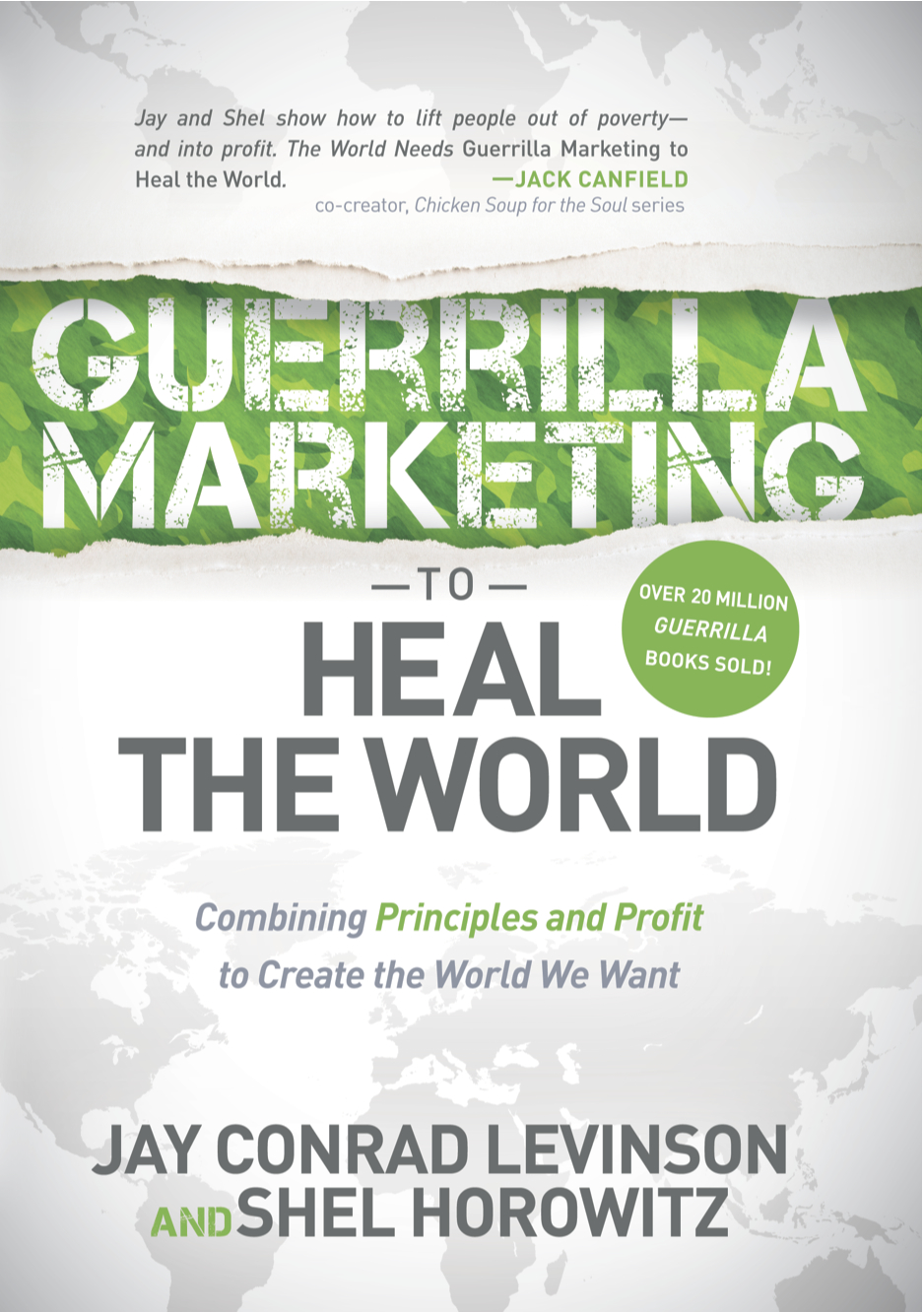
Order your copy of Shel’s newest book, Guerrilla Marketing to Heal the World
Learn how the business world can profit while solving hunger, poverty, war, and catastrophic climate change (hint: they’re all based in resource conflicts). Endorsed by Chicken Soup’s Jack Canfield, business blogger and bestselling author Seth Godin, and many others. Find out more and order from several major booksellers (or get autographed and inscribed copies directly from me). https://goingbeyondsustainability.com/guerrilla-marketing-to-heal-the-world/
Download a free sampler with several excerpts, the complete Table of Contents and Index, and all the endorsements.

Is Anyone REALLY Reading Your Sustainability or CSR Report?

Repurpose that expensive content, without using any staff time. I will extract the key items and turn them into marketing points that you can use immediately: https://goingbeyondsustainability.com/turn-that-nobody-reads-it-csr-report-into-a-marketing-win/

Another Recommended Book: Millionaire Success Habits
Like Twitter Pinterest GooglePlus LinkedIn Forward

Millionaire Success Habits: The Gateway to Wealth & Prosperity by Dean Graziosi
My goals have always included making the world better and having a rewarding life. Although acquiring big buckets of capital has never been a particular goal of mine, I have striven for financial comfort, freedom to travel and enjoy pleasures such as live performances and great restaurants. And because I enjoy learning from smart people and I find many of the self-made wealthy are very smart, I’ve read several books on the subject.

Dean Graziosi is one of those very smart people. Overcoming a childhood as a classroom underachiever with learning disabilities and poor social skills, Graziosi has succeeded in multiple industries, and has many great lessons to impart. His accessible, down-to-earth style, willingness to admit and learn from his mistakes, and especially his amazingly positive attitude make this worth a read.

I don’t often find a book about getting wealthy that not only discusses such concepts as attracting what you desire (a/k/a Law of Attraction) but also include a little mini-Marketing 101 course. This one does, and that makes a lot of sense to me, since 1) many entrepreneurs are motivated by the possibility of wealth, and 2) entrepreneurship is often a much better route to that wealth. Some of his marketing tips:

  • Transparency and trust, going in both directions, are essential to successful marketing—something I’ve been talking about since at least 2002, and built a movement around starting with my 2003 book Principled Profit, by the way (pp. 151-152).
  • People buy not when they understand, but when they feel understood (p. 145)—and when you sell them what they want, and not what you think they need (pp. 155-157).
  • Great marketing is often built around storytelling, as we’ve discussed here many times (pp. 157-162).
  • When you’ve closed the sale, stop talking—or you might talk yourself right out of the sale (p. 162).
  • Throw in unexpected bonuses (what New Orleaneans call “Lagniappe”) (p. 169).

Some of my many takeaways (or, in many cases, reminders), outside the marketing advice:

  • Keep asking why until you get to the real issue (pp. 34-41). Graziosi follows one of his mentors and goes seven levels. In my own life, I find it can be more or less than that.
  • Notice and list what you’ll no longer accept –and what you now demand (p. 67).
  • You have the power to largely disarm the negative impact of other people’s words (p. 72)—I’m in only partial agreement with this one; yes, when it’s a comment made to you. But how do you undo the negative impact of comments behind your back, that you’re not even aware of?
  • Frame things as positively as possible. For instance, transform overwhelm into “blessed with opportunity” (pp. 74-75). Look for ways to transform negative self-stories vby focusing on the good that came of those experiences. Graziosi found benefits in his dyslexia (p. 94); I have seen some positive outcomes in a bunch of difficult times from surviving childhood sexual assault to my parents’ divorce.
  • Think of the difficult times in your past as “research and development” necessary to create your amazing future (p. 95).
  • When something bad happens, find the best outcome; don’t seek revenge (pp. 197-108).
  • Come up with a series of motivational mantras or aphorisms to get you over the rough spots. One of his is “if I can get through this, I can get through anything”—but he has several that he uses for different situations (p. 121-122).
  • Having a “don’t-do list” may actually be more valuable than your to-do list (p. 128). Hire others to do the things on your don’t-do list that need to get done, but not by you, and save your own resources for the things you’re good at or the things it doesn’t make sense to delegate (p. 137).
  • Abundance mindsets open us up to solving problems that seem insurmountable when we view the world as scarce (pp. 154-155).
  • Happiness leads to success, not the other way around (p. 184).
  • Live life and run your business with passion (p. 163), but don’t be rigid about outcomes; be willing, even, to embrace failure (pp. 195-197).

And some places where I disagree. He sees wealth as a primary goal. I see wealth as one among many paths to abundance. I see money as only being useful for what it can buy; the stack of greenbacks in your drawer and the series of ones and zeros in your bank’s computer file aren’t useful by themselves. It’s only because we’ve agreed that you can trade them for services, possessions, and good works. But there are plenty of other ways to acquire goods and services or do good works.

I also disagree with the decision not to have an index. When will authors realize that their books become 10 times as valuable with an index that lets readers re-find key concepts and names in seconds?

The best part of the book is chapters 9, 10, and 11, leading off with 10 success habits, moving on to 17 “success hacks,” and concluding with a road map for getting started in the next iteration of your life. These 48 pages starting on page 184 are gold. If there were nothing else of value in the book (and as you can see, there’s quite a bit), it would still be worth reading just for these three chapters.

Accurate Writing & More
14 Barstow Lane
Hadley, MA 01035 USA
https://goingbeyondsustainability.com/contact/
Connect with Shel


Find on Facebook


About Shel & This Newsletter
As a green and social change business profitability/marketing consultant and copywriter…award-winning author of ten books…international speaker and trainer, blogger, syndicated columnist – Shel Horowitz shows how green, ethical, and socially conscious businesses can actually be *more* profitable than your less-green, less-socially-aware competitors. His award-winning 8th book Guerrilla Marketing Goes Green: Winning Strategies to Improve Your Profits and Your Planet was a category bestseller for at least 34 months (and is now available exclusively through Shel), his newest book, Guerrilla Marketing to Heal the World, has already won two awards and is endorsed by Jack Canfield and Seth Godin. Shel also helps authors/ publishers, small businesses, and organizations to market effectively, and turns unpublished writers into well-published authors.

Shel Horowitz’s consulting firm, Going Beyond Sustainability, is the first business ever to earn Green America’s rigorous Gold Certification as a leading green company. He’s an International Platform Association Certified Speaker and was inducted into the National Environmental Hall of Fame in 2011.
He began publishing his monthly newsletter all the way back in 1997, making it one of the oldest marketing e-zines (it’s changed names a few times along the way).

“As always, some of the links in this newsletter earn commissions—because I believe in the products and services enough to promote them (I get asked to endorse lots of other programs I don’t share with you, because I don’t find them worthy).”
Privacy Policy: We Respect Your Privacy

We collect your information solely to let our mailing service send you the information you request. We do not share it with any outside party not involved in mailing our information to you. Of course, you may unsubscribe at any time—but we hope you’ll stick around to keep up with cool developments at the intersections of sustainability, social transformation, and keeping the planet in balance. Each issue of Shel Horowitz’s Clean and Green Newsletter has a how-to or thought-leadership article and a review of a recommended book. We’ve been doing an e-newsletter all the way back to 1997, and some of our readers have been with us the whole time.

The Clean and Green Club, June 2018

Having trouble reading this as e-mail? Please visit www.thecleanandgreenclub.com to read it comfortably online.
Like Twitter Pinterest GooglePlus LinkedIn Forward
Shel Horowitz’s Clean and Green Marketing Tip, June 2018
Like Twitter Pinterest GooglePlus LinkedIn Forward

No-Cost Resources from Ryan Eliason’s Visionary Business School

It’s been at least 10 years since I first encountered Ryan Eliason. He has perhaps been the most successful person at combining entrepreneurial profitability with social change. He’s “walking the talk” that I’ve been advocating for years. It’s been a while, but I’ve mentioned him to you several times.

Ryan ALWAYS puts out a lot of value. Starting today and for the next couple of weeks, he is releasing a whole series of training pieces to make you a more skilled and successful social entrepreneur. Each piece is time-limited, so if you want the full collection of goodies starting with the manifesto and opening video, do yourself a favor and do it right away.

I know you’re an intelligent person who doesn’t need to be beaten over the head with offers of new content every day or two. Because this is only a monthly newsletter, I’m relying on YOU to take initiative and get the gifts. I will send one more note near the end of the cycle but not a constant stream. I benefit by knowing that YOU will benefit from the high-quality information and refreshing perspective he always provides. (And yes, if you sign up for the paid program, I earn a commission.) You will find him inspiring, I’m sure. I certainly do!

DOWNLOAD: The Revolutionary Entrepreneur Manifesto

You’ll learn a far more satisfying (even revolutionary) approach to business including:

  • The 4 essential foundations of all highly successful revolutionary entrepreneurs.
  • The unexpectedly simple way to build a lucrative career rooted in profound service.
  • Why you must avoid the deathtrap of isolated techniques!
  • The system used by over 6,200 of Ryan’s clients to collectively generate tens of millions of dollars while contributing to the greater good of the world.

Ryan spent the last 25 years coaching and training thousands of socially conscious entrepreneurs from 85 countries.

So if anyone’s qualified to teach you about this, it’s Ryan.

Go get a copy here to see for yourself 🙂

If you want to revolutionize your life, you definitely want give this a read today.

Enjoy!
Shel

P.S. When you download the manifesto you’ll also get instant access to Ryan’s video training on Revolutionary Success — How To Make A Lucrative Career Out of Profound Service. Be sure to check out minutes 5:18 to 19:02. Ryan’s personal story is captivating.

This Month’s Tip: Grow Your Business with the RIGHT Public Speaking
I was 12 or 13 when I gave my first speeches to 3 consecutive assemblies of several hundred junior high school students each (I ran for school office), and I’ve been speaking ever since. While most people have been programmed to be scared of addressing an audience, I really enjoy it. I love delivering an important message in an accessible format, even to people who might not read my books. And I love being able to grow my business just by opening my mouth.

  1. Practice to the point where you’d still be comfortable if you lost your slides (which happens sometimes—I’ve seen power failures bring down PowerPoint at least twice, including one of my own presentations).
  2. Keep text on slides pretty minimal, and NEVER stand there like an idiot reading them verbatim to the audience.
  3. At least some of your practice should be with a live audience, even if it’s five friends gathered over pizza. You need to know how people react to your material, and more importantly, how you react when people are in the room. Tweak what isn’t working and keep doing what is.
  4. Get to the room early, scope it out logistically, and MEET some of the early arrivals. Chat with them a bit, and if you’re feeling brave, feed off what they tell you: “Mary told me earlier that she struggles with ________ because __________. She’s not alone in that…”
  5. Control the introduction. Give the emcee something you’ve scripted out. Make the print really big, like 32 points. Keep it brief (1 to 2 minutes, maximum) but salient.
  6. If there’s a podium and the tech people allow it, stand to the side of it and not behind it. You can see your notes/computer screen but you don’t build a wall between yourself and the audience.
  7. Consider having your question period BEFORE your finale, so you don’t have the wind knocked out of your big finish and you leave them with the strongest reinforcement of your message.
  8. Unless there are legal compliance issues, don’t script out every word. Know the points you want to cover but use the natural language of the moment to cover them. But don’t ramble. I find PowerPoint helps me stay on track; I use it as my outline in the presentations where I use it (some of my talks, particularly on book marketing, don’t even use PowerPoint; I give the audience choices about what to cover, and I cover what they want to hear).
  9. Be your authentic self. Use approachable language. Smile. Make eye contact. Act like someone who not only has great information, but would be fun to go out to coffee with.
  10. Enjoy the perks but keep your ego in check. As a speaker, you can start a conversation with anyone in the room, so network away. You’re in demand as a meal partner, you get to go to the VIP events, you’re seen as important and having a message to share. As long as you are authentic and not arrogant, and not a prima donna, you have far more opportunities than most attenders to meet the key people (including other speakers), expand your network, offer informal advice, and build your client roster. You get more of these opportunities if you participate actively in the whole or most of the event. Fly-in/fly-out “helicopter” speakers get a lot less benefit.
  11. Remember that they are in the room because they want to hear what you have to say—and they want you to succeed. Be relaxed and have fun.

I won’t go into detail here about how to get speaking gigs, but I will give you two tips.

1) More than anything else, you need a “sizzle reel”: a quick video showing highlights of your talks. This is something that will evolve over time as you speak more often. My current (third) version is at https://www.youtube.com/watch?v=tooSVbHQ5Ik&feature=youtu.be (and presented in context on my speaking page, https://goingbeyondsustainability.com/social-change-business-profitability-speaking-and-presentation/ ) The decision to stay authentic and somewhat homespun, rather than glitzy was deliberate. Authenticity is a key component of my brand, as is the message that ordinary people can change the world.

2) I also pay commissions to people who bring me paid speaking gigs. It helps to have other people bragging about how great you are.

New on the Blog
Hear & Meet Shel

 
Carole Murphy of Heart Stock Radio interviews me live June 15, 6 p.m. ET/3 p.m. PT (the previous interview didn’t record due to technical failure). Carole has a very interesting green business of her own, making purses of wild-collected Indonesian rattan, which grows among the rainforest trees and makes them too valuable to log. KBMF 102.5 FM, Butte, Montana, on Facebook, iTunes, and elsewhere.
I’ve been taping several other podcasts lately, and will post the links in future newsletters as I get them.
Friends Who Want to Help

Looking for a Job? Visit Our Job-Finding Widget
If you’re looking for a job in marketing, visit the home page of https://frugalmarketing.com. If you’re looking for a job in some other field, try the widget on the home page of https://accuratewriting.com

Order your copy of Shel’s newest book, Guerrilla Marketing to Heal the World

Learn how the business world can profit while solving hunger, poverty, war, and catastrophic climate change (hint: they’re all based in resource conflicts). Endorsed by Chicken Soup’s Jack Canfield, business blogger and bestselling author Seth Godin, and many others. Find out more and order from several major booksellers (or get autographed and inscribed copies directly from me). https://goingbeyondsustainability.com/guerrilla-marketing-to-heal-the-world/
Download a free sampler with several excerpts, the complete Table of Contents and Index, and all the endorsements.

Is Anyone REALLY Reading Your Sustainability or CSR Report?

Repurpose that expensive content, without using any staff time. I will extract the key items and turn them into marketing points that you can use immediately: https://goingbeyondsustainability.com/turn-that-nobody-reads-it-csr-report-into-a-marketing-win/

Another Recommended Book: Purpose
Like Twitter Pinterest GooglePlus LinkedIn Forward

Purpose: The Starting Point of Great Companies by Nikos Mourkogiannis

This book surprised me. I’m a big believer in purpose as a tool of business success, but Mourkogiannis defines purpose rather more broadly than I do. He identifies four distinct categories of business purpose, based loosely on the work of four major schools of philosophy:
  • Choice (Existentialist: including themes such as choice, innovation, freedom, authenticity, and commitment)
  • Virtue (Aristotelian: including themes like excellence, quality, courage, and character)
  • Compassion (Humean, as in David Hume: focused on themes of compassion, altruism, well-being and happiness of others, and promoting the general good)
  • Power (Nietzschian: devoted to the individual’s triumph over others and not typically concerned about the impact on those less fortunate—think Ayn Rand, and descriptors like heroism, self-mastery, strength)

In his framework, I’m clearly a Humean first (with elements of the others, especially choice and virtue). When I think of business purpose, I think about how business can profitably identify, create, and market profitable offerings that turn hunger and poverty into abundance, war into peace, and catastrophic climate change into planetary balance. I don’t put Nietzschian values like maximizing personal wealth in the category of business purpose. If that were someone’s only business purpose, they might as well just learn how to be a successful casino gambler.

Of course, I understand that business has to make a profit. I teach that it is possible, and in some ways easier, to profit by running a socially and environmentally conscious business that is actively working for a better world. But I see purpose-driven businesses as looking well beyond their income statements—looking first and foremost at their impact. And thus I found some of his key examples puzzling because he seems to be conflating purpose with an industry-agnostic, impact-agnostic desire for excellence. Thus, he sees banker Siegmund Warburg as having a purpose, but the purpose he describes is simply to be the best at banking. Writing, most likely, in 2004 or 2005 for his 2006 copyright, he sees Warren Buffet’s purpose simply as to be the best investor—note that this was before Buffett pledged almost his entire fortune to the Gates Foundation, in the summer of 2006.
Despite my disagreement with his model, I found much wisdom and took four pages of notes. To name a few:
  • I like the construct of building purpose around one or more of his four bases: New, Excellent, Helpful, and/or Effective—and the six traits of purpose that immediately follow that idea (p. 16).
  • I love the idea of putting executives, including CEOs, in the front-line trenches of a business (p. 84), so they can gain both direct feedback and deep intuitive understanding about what motivates—or fails to motivate—employees, customers, and other stakeholders.
  • I think the idea of communities of expertise that integrate business folks and academics is terrific (pp. 144-145).
  • I totally agree that it’s cheaper (and more profitable) to create a genuine purpose than to try to fake one (p. 148).
  • I’m fascinated by the concept that a purpose can only continue to motivate if it is not achieved, and thus a true purpose is never fully achieved (p. 172).
  • And I’m thrilled to see acknowledgment that quarterly profits are often the wrong metric; that we need a much longer-term focus, which purpose can steer us toward (p. 189).

And those are just a few of my takeaways.

One gripe I do have is the way Mourkogiannis ignores historically marginalized constituencies. This was a book published only 12 years ago, but reading with a gender or race lens, you’d think it was from the 1950s. All five of his key exemplars are white males, and only Buffett is still alive. I don’t remember the words “she” or “her” appearing in the book. The vast majority of the extensive list of sources are written by people with male names. I do remember a passing reference to Katherine Graham of the Washington Post but don’t recall any other women even being mentioned, at least not by the time I started consciously looking for them, struck by their absence. It is unconscionable to do a book on corporate leadership that not only can’t find other examples but still pretends anyone worth even a mention is white and male.
Recent Interviews & Guest Articles: 

Shel’s done more than 30 podcasts recently, ranging from 5 minutes to a full hour. Click here to see descriptions and replay links.
Accurate Writing & More
14 Barstow Lane
Hadley, MA 01035 USA
https://goingbeyondsustainability.com/contact/
Connect with Shel


Find on Facebook


About Shel & This Newsletter

As a green and social change business profitability/marketing consultant and copywriter…award-winning author of ten books…international speaker and trainer, blogger, syndicated columnist – Shel Horowitz shows how green, ethical, and socially conscious businesses can actually be *more* profitable than your less-green, less-socially-aware competitors. His award-winning 8th book Guerrilla Marketing Goes Green: Winning Strategies to Improve Your Profits and Your Planet was a category bestseller for at least 34 months (and is now available exclusively through Shel), his newest book, Guerrilla Marketing to Heal the World, has already won two awards and is endorsed by Jack Canfield and Seth Godin. Shel also helps authors/ publishers, small businesses, and organizations to market effectively, and turns unpublished writers into well-published authors.

Shel Horowitz’s consulting firm, Going Beyond Sustainability, is the first business ever to earn Green America’s rigorous Gold Certification as a leading green company. He’s an International Platform Association Certified Speaker and was inducted into the National Environmental Hall of Fame in 2011.

He began publishing his monthly newsletter all the way back in 1997, making it one of the oldest marketing e-zines (it’s changed names a few times along the way).

“As always, some of the links in this newsletter earn commissions—because I believe in the products and services enough to promote them (I get asked to endorse lots of other programs I don’t share with you, because I don’t find them worthy).”
Privacy Policy: We Respect Your Privacy

We collect your information solely to let our mailing service send you the information you request. We do not share it with any outside party not involved in mailing our information to you. Of course, you may unsubscribe at any time—but we hope you’ll stick around to keep up with cool developments at the intersections of sustainability, social transformation, and keeping the planet in balance. Each issue of Shel Horowitz’s Clean and Green Newsletter has a how-to or thought-leadership article and a review of a recommended book. We’ve been doing an e-newsletter all the way back to 1997, and some of our readers have been with us the whole time.

The Clean and Green Club, May 2018


Having trouble reading this as e-mail? Please visit www.thecleanandgreenclub.com to read it comfortably online.
Like Twitter Pinterest GooglePlus LinkedIn Forward
Shel Horowitz’s Clean and Green Marketing Tip, May 2018
Like Twitter Pinterest GooglePlus LinkedIn Forward
This Month’s Tip: Practical Visionaries, Part 3: Why You Should Think of Mother Nature as Your Chief Engineer (an excerpt from my 10th book, Guerrilla Marketing to Heal the World)

I want to share with you some of the amazing people—I call them “practical visionaries—profiled in my award-winning 10th book, Guerrilla Marketing to Heal the World. These folks are doing incredibly exciting work in bringing about a regenerative, thriving world. By the time this series is over, I can safely guarantee that you’ll be glad you’ve “met” a few of them. After each excerpt, you’ll find a brief comment from me, adding more context since you haven’t read the whole book yet.

Think about this: Whatever engineering challenge we face, nature has probably already solved it.

Imagine the fortunes awaiting companies that can roll out a construction material as strong and lightweight as spider silk…a desalination process as cheap and effective as the one that mangrove roots use…a water collection method as powerful as the one used by the Namib desert beetle. John Kremer talked about “biological marketing”—so why not biological engineering, also known as biomimicry? It’s just as miraculous—and just like biological marketing, the results can be outsized. Nature has figured out Zero Waste, and figured out how to do pretty much anything that humans feel a need to do: housing, transportation, flood resistance…

These technologies have been around for thousands, maybe millions, of years, and they outperform what we humans have come up with.

Meet Janine Benyus, TED speaker and author of several books on biomimicry. When she walks you through Lavasa, India, where native vegetation has not grown for 400 years, and tells you that the area gets 27 feet of rainfall during the three-month monsoon season and basically nothing the rest of the year, you know that maintaining a thriving city here will be challenging.

Yet, immediately abutting this city, she finds proof that nature knows quite well how to handle this environment: a hilly wilderness area that, despite the alternating torrents and droughts, experiences zero erosion. As she walks us through this wilderness, she shows us adaptations like an anthill built with curves and swales, so that it doesn’t get washed away in the flood. She walks us through a sacred grove there, cool and delightful even in the dry season, and lets us understand that our cities could be just as pleasurable to live in.

She shows us a 1500-year-old live oak tree in Louisiana that has designed itself to withstand hurricanes, and points out that only four of New Orleans’s hundreds of live oaks were killed in Hurricane Katrina.

And whether it’s in India, Louisiana, China, or New York City, she captures metrics like carbon sequestration, energy and water use from those neighboring wilderness areas—things no one has bothered to measure in the past—and then cheerfully announces, “Because this is happening in the wild land next door, no one can say it’s impossible. A city that does this, that’s generous in its ecosystem services, is going to be great to live in.” She describes ecosystems in terms like “generous” and “competent,” and reminds us that the human species, at 200,000 years old, is still a baby, and we can learn much from our “elders” in the plant, animal, insect, fungal, and bacterial realms.

Her approach combines human-built infrastructure and nature-built ecostructure together to provide “ecological services” that contribute to meeting per-acre and per-block metrics, carried in part by the buildings and in part by the landscapes.

Species adapt and evolve over time, growing more able to influence their environment while being influenced by it in turn—and most of these adaptations are positive both for the organism and the ecosystem. Maladaptations create room for better-adapted species to move in. Species that fail to provide these ecological services are maladapting, and will be replaced by those that do contribute, she says. She remains optimistic that humans will learn to positively adapt, and be welcomed by other species.

A lot of her work is based on the idea that because each place is unique, the technologies we use should be matched to each place, as they are in nature. In nature, organisms ensure the survival of the species by protecting the survival of their habitat; they can’t directly take care of offspring many generations in the future, but they can protect the place where those future generations will live.

How can biomimicry change our patterns of design and construction? Thousands of ways. Here are just a few projects Benyus and other biomimicry researchers are working on:

  • Concrete that sequesters CO2 rather than emits more of it (Bank of America did a building this way, and the exhaust air was three times as clean as the intake air)
  • Altered wind patterns through urban rooftops, modeled after the reverse-hydraulics of an Indian forest
  • Artificial leaves that—just as real leaves do—convert sunlight to energy far more efficiently, and using far less expensive inputs, than today’s solar panels
  • A robot hand with more agility and dexterity, because it was inspired by cockroaches’ spring-like feet
  • Desalination systems that not only create drinking water from the sea at a fraction of the energy requirement, but can green the desert at the same time.
  • GeckSkin, an ultra-powerful adhesive developed at the University of Massachusetts after studying the way gecko lizards climb walls
  • The Biomimetic Office Building, whose designers encourage starting not with reality, but with the ideal, and then seeing how close they can come to it. They “found inspiration from spookfish, stone plants and brittlestars for daylighting; bird skulls, cuttlebone, sea urchins and giant amazon water lilies for structure; termites, penguin feathers and polar bear fur for environmental control; and mimosa leaves, beetle wings and hornbeam leaves for solar shading.” [End of excerpt]
If you want to know more about this amazing work, the full citations for most of the examples are in Guerrilla Marketing to Heal the World. Put into practice on a wide scale, biomimicry could revolutionize not just the business world, but the way we build structures, grow food, collect energy, move from place to place, and more. Imagine a world in harmony with itself!
New on the Blog
Hear & Meet Shel

Last fall, I recorded a brand new keynote, “Terrific Trends for Enlightened Capitalists,” for the Enlightened Capitalist Virtual Summit, and it came out great. The online event was rescheduled to May 16-18–yep, that means it starts TOMORROW. Sorry, I didn’t have the dates yet as of last month. Listen to all 20 sessions; they promise to be excellent. I’m especially looking forward to hearing Jeff Golfman, Donna Lendzyk, and Ravinol. I’m one of just two of those speakers giving a keynote; my session kicks off the final day. This is one series you’re really going to want to dip into: https://shelhorowitz.com/go/EnlightenedCapitalist/
 
Carole Murphy of Heart Stock Radio interviews me live June 15, 6 p.m. ET/3 p.m. PT (the previous interview didn’t record due to technical failure). Carole has a very interesting green business of her own, making purses of wild-collected Indonesian rattan, which grows among the rainforest trees and makes them too valuable to log. KBMF 102.5 FM, Butte, Montana, on Facebook, iTunes, and elsewhere.
I’ve been taping several other podcasts lately, and will post the links in future newsletters as I get them.
Friends Who Want to Help

Looking for a Job? Visit Our Job-Finding Widget
If you’re looking for a job in marketing, visit the home page of https://frugalmarketing.com. If you’re looking for a job in some other field, try the widget on the home page of https://accuratewriting.com

Is Anyone REALLY Reading Your Sustainability or CSR Report?

Repurpose that expensive content, without using any staff time. I will extract the key items and turn them into marketing points that you can use immediately: https://goingbeyondsustainability.com/turn-that-nobody-reads-it-csr-report-into-a-marketing-win/

Order your copy of Shel’s newest book, Guerrilla Marketing to Heal the World

Learn how the business world can profit while solving hunger, poverty, war, and catastrophic climate change (hint: they’re all based in resource conflicts). Endorsed by Chicken Soup’s Jack Canfield, business blogger and bestselling author Seth Godin, and many others. Find out more and order from several major booksellers (or get autographed and inscribed copies directly from me). https://goingbeyondsustainability.com/guerrilla-marketing-to-heal-the-world/
 
Download a free sampler with several excerpts, the complete Table of Contents and Index, and all the endorsements.
Another Recommended Book: Love Let Go
Like Twitter Pinterest GooglePlus LinkedIn Forward

Love Let Go: Radical Generosity for the Real World by Laura Sumner Truax and Amalya Campbell (Eerdmans, 2017)
You might remember that although I did recommend it, I was quite annoyed by my review choice last month, Doing Good Better (DGB).

DGB took a very clinical, engineer-like approach to deciding which charities to support and what activities to do—even what career to choose—for maximum impact but neglected many of the human factors. While I was still reading it, I went to an author talk by Amalya (“Ami”) Campbell and I thought her book Love Let Go would be the perfect antidote to my frustration.

Love Let Go, unlike DGB, is a very free-spirited approach to giving (DGB’s author would think it’s too free-spirited). It chronicles a church that had invested just USD $1000 into a mixed-income community affordable housing project in its Chicago neighborhood, back in the 1970s. All of a sudden, when that housing project was sold off, the church found itself with a $1.6 million windfall.

After long deliberation, the church leaders decided to tithe. They’d give 10 percent to their congregants, with only five words of direction: “Do good in the world.” This is introduced on page 8. Most of the rest of the book follows one of three strands:

  • What the parishioners did with their individual checks (with a side story of how the media treated this story and what happened as a result)
  • How the church—which had been struggling to get enough money for its own infrastructure— wrestled with what they’d do with the remaining $1.4 million (revealed, after teasing us all the way through, on pp. 183-184)
  • Sharing the research and various philosophies on generosity that they sifted through during their long and very deliberative process

The impact from this one church and its congregants was quite impressive, but it’s only the beginning. Enabling a generosity mindset could be huge; in his Foreword, Richard Stearns of World Vision says that if every Christian gave an extra 60 cents per day (which works out to $219 per year), we could eliminate poverty in a single generation (p. xi). And yes, this is an overtly Christian book, probably the first I’ve ever reviewed. I don’t happen to be Christian, but I see no reason why this process couldn’t be replicated in non-Christian houses of worship and in non-religious organizations.

Generosity, say the authors, is our neglected superpower (pp. 3-4); using it involves the simple five-step process outlined on page 4. And we help ourselves when we get generous, opening ourselves up to all sorts of little miracles—and generosity begets more generosity (p. 95). People who give are as happy as those who double their income (p. 7). Even the bottom-income congregants, people whom no one would have criticized for using the $500 for themselves (including homeless Stephen Martin, pp. 106-107 and debt-ridden Kristen Metz, pp. 108-110, among others), found deep meaning in their giving. Of course, even a homeless man in the US is far wealthier than many people around the world; in 2015, a net worth of just $3210 was enough to put someone in the top 50 percent worldwide (p. 188).

All of this is based in something I’ve been teaching for years: an attitude of abundance. When you know the world will provide, it gives you the freedom to experiment. And while not every congregant’s $500 experiment was successful, most of them were—and several inspired even larger acts of generosity. The ones that failed were sometimes recast, for instance bringing in an established social service agency better suited to the mission (pp. 150-152). Another failure (according to the way most of us measure things) involved donating to the medical expenses of someone in need, who died nonetheless—but even this experience, which removed the money from circulation, offered many blessings.

Generosity has a twin, according to the authors: gratitude (pp. 153-166). Like generosity, gratitude improves with practice. When theologian Mary Daly says “you learn courage by couraging,” this church creates a corollary: we learn thankfulness by thanking (p. 161). And sometimes the most charitable thing you can do is to receive charity with grace, creating the freedom for others to feel the abundance of giving (p. 105, for instance). For the authors, this abundance mentality is embodied in the opening chapters of Genesis (pp. 43-44) and in the story of Jesus feeding the multitude with five loaves and two fish (pp. 143-144), as long as we don’t let fear get in the way—something even the usually abundant-thinking Abraham was not immune from (pp. 51-52).

And here, abundance is coupled with awe (pp. 132-134). That’s something most of us rarely experience, but the process of giving away money to individuals who in turn gave it to others, as well as the much longer process of deliberating over the remaining money, created numerous moments of awe.

The book ends with a chapter-by-chapter reading guide that opens discussion of larger issues and how this kind of giving program can make a difference. The very last page (p. 195) notes that individuals, not foundations or corporations, make an astounding 81 percent of charitable contributions. Then it asks three questions, and I particularly love this one: “What causes you to be optimistic about the ability of one individual to make a difference in the world? How can you increase your exposure to these sources of optimism?

Recent Interviews & Guest Articles: 

Shel’s done more than 30 podcasts recently, ranging from 5 minutes to a full hour. Click here to see descriptions and replay links.
Accurate Writing & More
14 Barstow Lane
Hadley, MA 01035 USA
https://goingbeyondsustainability.com/contact/
Connect with Shel


Find on Facebook


Choose image
 

About Shel & This Newsletter

As a green and social change business profitability/marketing consultant and copywriter…award-winning author of ten books…international speaker and trainer, blogger, syndicated columnist – Shel Horowitz shows how green, ethical, and socially conscious businesses can actually be *more* profitable than your less-green, less-socially-aware competitors. His award-winning 8th book Guerrilla Marketing Goes Green: Winning Strategies to Improve Your Profits and Your Planet was a category bestseller for at least 34 months (and is now available exclusively through Shel), his newest book, Guerrilla Marketing to Heal the World, has already won two awards and is endorsed by Jack Canfield and Seth Godin. Shel also helps authors/ publishers, small businesses, and organizations to market effectively, and turns unpublished writers into well-published authors.

Shel Horowitz’s consulting firm, Going Beyond Sustainability, is the first business ever to earn Green America’s rigorous Gold Certification as a leading green company. He’s an International Platform Association Certified Speaker and was inducted into the National Environmental Hall of Fame in 2011.
He began publishing his monthly newsletter all the way back in 1997, making it one of the oldest marketing e-zines (it’s changed names a few times along the way).
“As always, some of the links in this newsletter earn commissions—because I believe in the products and services enough to promote them (I get asked to endorse lots of other programs I don’t share with you, because I don’t find them worthy).”
Privacy Policy: We Respect Your Privacy

We collect your information solely to let our mailing service send you the information you request. We do not share it with any outside party not involved in mailing our information to you. Of course, you may unsubscribe at any time—but we hope you’ll stick around to keep up with cool developments at the intersections of sustainability, social transformation, and keeping the planet in balance. Each issue of Shel Horowitz’s Clean and Green Newsletter has a how-to or thought-leadership article and a review of a recommended book. We’ve been doing an e-newsletter all the way back to 1997, and some of our readers have been with us the whole time.

The Clean and Green Club, January 2018


Having trouble reading this as e-mail? Please visit www.thecleanandgreenclub.com to read it comfortably online.
Like Twitter Pinterest GooglePlus LinkedIn Forward
Shel Horowitz’s Clean and Green Marketing Tip, January 2018
A very happy 2018 to you! In honor of the New Year, this month’s column looks at the kinds of personal goals that often find their way into New Year’s resolutions. Next month will look at an organizational strategy—another thing often evaluated at this time of year. And this month’s review is a movie, not a book—one that will help you start the year on a really positive note. And with that, “on with the show, good health to you”—and a copy of my Painless Green ebook to the first person who identifies the 1960s band and the song that quote is from (please keep the default subject line so I can sort the responses easily).
Like Twitter Pinterest GooglePlus LinkedIn Forward
This Month’s Tip: Bad Case of “Rusty Object Syndrome”?

In the worlds of marketing and entrepreneurship, we often hear the phrase, “Shiny Object Syndrome”: the temptation to get distracted by the next shiny new marketing technique.

I’ve just invented a term for its “evil twin”: “Rusty Object Syndrome”: getting distracted by all the little tweaks you can do to clean up the work you’ve already done, instead of doing the new work that should be higher priority.

I’m as guilty as anyone else. One day recently I had work orders from both a first-time and a long-time client, and an inquiry from a likely prospect. As I was about to send my standard response to the prospect, I noticed that one of the landing pages had an obsolete bio and the letter itself had a link to a shopping cart I no longer use. It took only five minutes to fix the cart link in my template immediately, but then I had to tell myself, STOP. Fixing the bio can wait. Getting started on the two actual bird-in-hand client projects should come first. I jotted a few notes on what I needed to fix on which pages, and turned toward something more productive, knowing that when I did turn to the bio, it would likely lead to a cascade of other things that needed tweaking or updating.

But sometimes I get sucked into that trap. Hours go by, and I’ve fixed 10 things that were in need of repair on my websites and email templates, but didn’t get any of my real work done.

Sure, those things are important. Accurate, up-to-date, easy-to-use websites are part of the clean and efficient image we want to present to the world. But that sort of thing can wait a few hours, because it doesn’t require enormous brain power. In the morning, when my brain is fresh, I should be doing the creative profitability and marketing work that my clients happily pay for.

How does this play out in your life and your business?

New on the Blog
Hear & Meet Shel

Another great interview! The Spotlight with Tony DUrso

  • Two key events at ages 3 and 12 that spurred me to a life of activism—and how activism turned me into a lifelong marketer and writer at age 15
  • Learning to build a platform to reach people who don’t agree with you—as a teenager
  • How I approached Guerrilla Marketing founder Jay Levinson to do our first book together—showing him the win-win possibilities—how I landed the contract with Wiley to publish it, and the easy things I did to get on Jay’s good side for the rest of his life
Visit this link to read the full description.

Is Anyone REALLY Reading Your Sustainability or CSR Report?

Repurpose that expensive content, without using any staff time. I will extract the key items and turn them into marketing points that you can use immediately: https://goingbeyondsustainability.com/turn-that-nobody-reads-it-csr-report-into-a-marketing-win/

Friends Who Want to Help

A note from my business coach, who has helped me enormously as I’ve shifted the direction of my own business: You can begin the New Year with new ideas, clear goals and a plan. Offering a Complimentary Holiday Coaching Session to assist you to begin the New Year in a way which helps you achieve your goals successfully. Call Oshana Himot, MBA, at 602-463-6797 or email oshanaben@yahoo.com.
 
Getting your book into the hands of those who love it forever can be daunting.
Authors: Consider adding this to your New Year’s Resolutions. See what my longtime friend and colleague, Paulette Ensign, created. She simplifies the process, based on her successful approach of less bringing more of what we want.

You’ll want to take action now

 
Looking for a Job? Visit Our Job-Finding Widget
If you’re looking for a job in marketing, visit the home page of https://frugalmarketing.com. If you’re looking for a job in some other field, try the widget on the home page of https://accuratewriting.com

Order your copy of Shel’s newest book, Guerrilla Marketing to Heal the World

Learn how the business world can profit while solving hunger, poverty, war, and catastrophic climate change (hint: they’re all based in resource conflicts). Endorsed by Chicken Soup’s Jack Canfield, business blogger and bestselling author Seth Godin, and many others. Find out more and order from several major booksellers (or get autographed and inscribed copies directly from me). https://goingbeyondsustainability.com/guerrilla-marketing-to-heal-the-world/
 
Download a free sampler with several excerpts, the complete Table of Contents and Index, and all the endorsements.
A Recommended FilmProsperity
Like Twitter Pinterest GooglePlus LinkedIn Forward

“Prosperity” by Dr. Pedram Shojai

Instead of a book this month, a brand new movie.

From the title, you might expect this would be a film about the “Prosperity Consciousness” trend embodied most famously in the movie, “The Secret” and Napoleon Hill’s book, Think and Grow Rich. You would be wrong.

And to me, that’s a good thing; bear with me while I rant for one paragraph. Even if their teachers have a broader perspective (and many do, including people I consider colleagues, like Jack Canfield and Marilyn Jenett)—far too many people see the Prosperity Consciousness world in a shallow, one-dimensional way—all about personal wealth and with only the lightest lip service paid to being of service, to improving the world. Also, too many people measure prosperity only by their bank account. For more than 20 years, I’ve been talking about other, nonmonetary, ways to create abundance. My ebook, The Penny-Pinching Hedonist: How to Live Like Royalty with a Peasant’s Pocketbook, came out all the way back in 1995.

This movie is about real prosperity: the kind where businesses and communities come together to enlist conscious capitalism to solve the world’s problems in ways that generate profit. It’s a visual representation of the principles I discuss in my 10th book, Guerrilla Marketing to Heal the World.

The founder of Well.org and author of The Urban Monk: Eastern Wisdom and Modern Hacks to Stop Time and Find Success, Happiness, and Peace (which has been on my read-it-one-day list for a while now) spent months talking to experts in conscious capitalism, from Whole Foods founder and Conscious Capitalism co-author John Mackey and Seventh Generation founding CEO and author of The Responsibility Revolution (which I reviewed several years ago) to Naomi Whittel of Reserveage™, a fair-trade entrepreneur and reforester who sells high-quality Panamanian organic cacao and coconut into the nutritionals and beauty markets, and Tom Szaky, founder of TerraCycle, the company long known for finding creative ways to recycle all kinds of trash (even cigarette butts).

Many of the people the interviews and stories he tells are familiar to me, but on screen, they come alive in a way you just can’t do in print. And for those who are new to this work, it’s a fabulous introduction.

The film makes a strong case for conscious capitalism: using business as a tool to both heal the world and make a very nice financial return. It takes us behind the scenes into the offices, the manufacturing plants, and the source communities in the developing world, where these businesses have direct impact on the local populace.

But this is no mere documentary. To me, by far the most exciting part was near the end, when Shojai, Whittel, Szaky, and the Guna elders in an island community in Panama join together with Procter & Gamble to harvest the solid waste washing up on the beautiful beaches in Guna territory—to sell them to P&G as raw material for shampoo bottles. This social entrepreneurship project, benefitting the locals, the environment, and the North American investors, was hatched directly out of the making of this movie. In other words, the film doesn’t merely document the emerging new business reality; it directly helps to bring it about.

Even though I was trained as a traditional journalist who takes the facts and writes them up. I’ve been a longtime fan of the power of advocacy journalism—of using the power of story to shed light on those who make the world better and offer alternatives to doing business with those who make it worse—and of participatory journalism—documenting an event where you are there as a participant. My very first published articles, as a 15-year-old high school student covering peace demonstrations in 1972, were participatory. This film is a fine example of going beyond even participatory journalism to what we might call activist journalism—not just participating, but organizing something new, and documenting it. Because the recycling/resale project actually arose from the filmmaking, this opens up an entirely new way of thinking about the intersection of journalism and social change. Let’s model it!

The film is available here. As of this writing, you’ll find a player right at the top of the page, but that looks like it might be temporary. If it’s no longer at the top, just scroll down to “Our Movies.”

Recent Interviews & Guest Articles: 

Shel’s done 29 podcasts recently, ranging from 5 minutes to a full hour. Click here to see descriptions and replay links.
Accurate Writing & More
14 Barstow Lane
Hadley, MA 01035 USA
https://goingbeyondsustainability.com/contact/
Connect with Shel


Find on Facebook


About Shel & This Newsletter

As a green and social change business profitability/marketing consultant and copywriter…award-winning author of ten books…international speaker and trainer, blogger, syndicated columnist – Shel Horowitz shows how green, ethical, and socially conscious businesses can actually be *more* profitable than your less-green, less-socially-aware competitors. His award-winning 8th book Guerrilla Marketing Goes Green: Winning Strategies to Improve Your Profits and Your Planet was a category bestseller for at least 34 months (and is now available exclusively through Shel), his newest book, Guerrilla Marketing to Heal the World, has already won two awards and is endorsed by Jack Canfield and Seth Godin. Shel also helps authors/ publishers, small businesses, and organizations to market effectively, and turns unpublished writers into well-published authors.

Shel Horowitz’s consulting firm, Going Beyond Sustainability, is the first business ever to earn Green America’s rigorous Gold Certification as a leading green company. He’s an International Platform Association Certified Speaker and was inducted into the National Environmental Hall of Fame in 2011.
He began publishing his monthly newsletter all the way back in 1997, making it one of the oldest marketing e-zines (it’s changed names a few times along the way).
“As always, some of the links in this newsletter earn commissions—because I believe in the products and services enough to promote them (I get asked to endorse lots of other programs I don’t share with you, because I don’t find them worthy).”
Privacy Policy: We Respect Your Privacy

We collect your information solely to let our mailing service send you the information you request. We do not share it with any outside party not involved in mailing our information to you. Of course, you may unsubscribe at any time—but we hope you’ll stick around to keep up with cool developments at the intersections of sustainability, social transformation, and keeping the planet in balance. Each issue of Shel Horowitz’s Clean and Green Newsletter has a how-to or thought-leadership article and a review of a recommended book. We’ve been doing an e-newsletter all the way back to 1997, and some of our readers have been with us the whole time.

The Clean and Green Club, November 2017

Having trouble reading this as e-mail? Please visit www.thecleanandgreenclub.com to read it comfortably online.
Like Twitter Pinterest GooglePlus LinkedIn Forward
Shel Horowitz’s Clean and Green Marketing Tip, November 2017
Bruce Springsteen, Lady Gaga, Willie Nelson, Rage Against the Machine, and You

Last month, I attended a concert by The Nields, who always put on a great show (they are local to me and I’ve heard them many times). Near the end of the show, they sang “Tyrants Always Fall,” a song that so blew me away that I went up to Nerissa Nields (the song’s author) after the show and told her it needed to get in front of someone who could bring it to audiences numbering into the seven or eight digits. Someone like the people I named in the headline. She answered that finding such a person “is your job.”

I take that seriously. So…if you know anyone with that kind of star power—or if you know someone who does—can you help me by getting the song in front of him or her? Listen to it at https://www.youtube.com/watch?v=ubWQHdHTLRI (and #westernma folks, you’ll recognize downtown Northampton).

Like Twitter Pinterest GooglePlus LinkedIn Forward
Is Anyone REALLY Reading Your Sustainability or CSR Report?
Repurpose that expensive content, without using any staff time. I will extract the key items and turn them into marketing points that you can use immediately: https://goingbeyondsustainability.com/turn-that-nobody-reads-it-csr-report-into-a-marketing-win/

Shel Horowitz is inducted into the National Environmental Hall of Fame by Judith Eiseman near his home on Barstow’s Longview Farm in Hadley, MA, December 2013

This Month’s Tip: How to Get the Most Marketing Oomph out of Receiving an Award
Last month, I told you how to select the right awards to enter—the ones where your chances are higher than average.

Let’s say you were successful, and you got that certificate or trophy. This is major “social proof” for you—third-party validation. Milk it for everything you can:
  • Send a press release announcing the award—but don’t just say you won an award. Use this as a chance to get your core message in front of the media. (See the example just below this article that I wote for a client) 
  • Put it prominently on your website
  • Add it to your email signature
  • Mention it several times on social media—not too often, and using an excited/humble rather than entitled tone, e.g., a Tweet like “Deeply thrilled to be named “Most Environmental Business in Pisqua. Thank you so much, @PisquaChamber” [this is a fake Twitter address] (I’d say no more than once every 20 posts or every three days, whichever is less)
  • Display conspicuously in retail locations and tradeshow displays
  • Mention it in radio, TV, and podcast interviews
  • Blog about it, including some of the backstory—make it interesting
  • Use that blog article again in your internal and external newsletters, reports to stakeholders (stockholders, employees, investors, vendors, government officials, etc.)
  • Feature the award in an e-blast
  • If the award is relevant, put it in your CSR or Sustainability Report, as well as in your public Annual Report
  • List it on business cards, brochures, sell sheets, and other printed materials
  • If your company has a Wikipedia page, make sure it’s included
  • Work the award into any review sites that cover you, such as Yelp, Trip Advisor, Amazon, etc.
  • To quote the king of Siam, “Etcetera, etcetera, etcetera”
For Release: On Receipt
Contact: Sheila Ruth: [phone number], info at imaginatorpress.com 
 
Why Does This Unknown Author Keep Winning All These Awards?
BALTIMORE, MD: Coming out of nowhere last year as a debut author with an unknown press, Nick Ruth has now won an astounding eight honors for his first two books in the Remin Chronicles series, The Dark Dreamweaver and The Breezes of Inspire
 
The latest honor: both titles have just won the Parent to Parent Adding Wisdom Award. In the fiercely competitive world of children’s products, Ruth, a government employee and homeschooling dad, is particularly proud that three different parenting organizations have recognized the books’ quality and appeal. 
 
The Dark Dreamweaver
  • One of only two chapter books to win the coveted Mom’s Choice Award in fall 2005
  • Chosen by iParenting Media as one of the “Greatest Products of 2005”
  • A Finalist for the prestigious Benjamin Franklin Award.
  •  Named an American Booksellers Association Book Sense Children’s Pick
  • Parent to Parent Adding Wisdom Award
The Breezes of Inspire
  • Named an American Booksellers Association Book Sense Children’s Pick
  • Parent to Parent Adding Wisdom Award
  • ForeWord Magazine Book of the Year Finalist (winner to be announced in May)
The Remin Chronicles is a fantasy-adventure series in the tradition of the Wizard of Oz and The Chronicles of Narnia. The books are imaginative stories of magic, friendship, and adventure—with a bit of environmental science blended in. In The Dark Dreamweaver, ISBN 0974560316, David, a boy from our own world, visits Remin, the world of dreams…does battle with the evil sorcerer Thane…and is aided by an imprisoned wizard battling the dream thief and living repeatedly through the lifecycle of a monarch butterfly. David and several cousins return to Remin in The Breezes of Inspire, ISBN 0974560332, but quickly get transported to the equally threatened world of Inspire. Both were published in hardback by Imaginator Press and are available at or through Greenleaf Book Group, Ingram, and Baker & Taylor. 
 
Journalists: Ruth and his illustrator Sue Concannon are available for interviews and the books are available for review. 
New on the Blog
Hear & Meet Shel

I recorded a brand new keynote, “Terrific Trends for Enlightened Capitalists,” for the Enlightened Capitalist Virtual Summit November 28-30, and it came out great. I’ll be on the line for live Q&A following the broadcast on November 30. Listen to all the sessions; they promise to be excellent. I’m especially looking forward to hearing Jeff Golfman, Donna Lendzyk, and Ravinol Chambers. https://shelhorowitz.com/go/EnlightenedCapitalist/
Friends Who Want to Help

Want to build a successful content brand? My friend Marc Guberti released his latest book Content Marketing Secrets which is available at a steep discount for a limited time. The book will teach you how to create, promote, and optimize your content for growth and revenue.
 
Looking for a Job? I’ve Just Added a Job-Finding Widget
If you’re looking for a job in marketing, visit the home page of https://frugalmarketing.com. If you’re looking for a job in some other field, try the widget on the home page of https://accuratewriting.com

Order your copy of Shel’s newest book, Guerrilla Marketing to Heal the World

Learn how the business world can profit while solving hunger, poverty, war, and catastrophic climate change (hint: they’re all based in resource conflicts). Endorsed by Chicken Soup’s Jack Canfield, business blogger and bestselling author Seth Godin, and many others. Find out more and order from several major booksellers (or get autographed and inscribed copies directly from me). https://goingbeyondsustainability.com/guerrilla-marketing-to-heal-the-world/
 
Download a free sampler with several excerpts, the complete Table of Contents and Index, and all the endorsements.
Another Recommended BookWe Rise
Like Twitter Pinterest GooglePlus LinkedIn Forward

We Rise: The Earth Guardians’ Guide to Building a Movement that Restores the Planet by Xiuhtezcatl Martinez

Martinez has been an activist for 11 years—and he’s not even old enough to vote. Only 17, he became aware of the earth’s current distress at age six and has been organizing ever since. Not just organizing. Performing original rap music and traditional dance, speaking at major conferences and even becoming only the second non-diplomat, non-politician to address the UN General Assembly, being featured in a film on youth activism, receiving an award from President Obama, standing up as one of 21 youth activists who are suing the US government to enforce climate change, and now, releasing his first book (with a major publisher, too—health and organic gardening leader Rodale). He was at the 20th Anniversary Rio Conference, organized a youth presence at COP21 (where the Paris Climate Accord was hammered out), and performed for the Water Protectors at Standing Rock.

I was a child activist too, starting—not counting an action against smoking I took in my own home at age 3—at age 12 when I went to my first demonstration, opposing the Vietnam war. And I, too, have been an activist ever since. Now, as I turn 61 next month, I’m seen as an elder—but I’ve got a few decades before I catch up with some of my activist friends in their 90s and 100s, such as Arky Markham.

But I was 16 before I turned vegetarian, 17 when I started speaking on the issues of our time, 20 before I participated in an action that definitely made a difference in the world (the Seabrook occupation of 1977), and 23 when my first book (on why nuclear power is a terrible idea) was published. So I’m in awe of this kid. We can think of him as a Malala Yousafzai for the United States. By the time he’s my age, he could have credits like toppling the whole fossil-fuel power structure or maybe managing a successful campaign to create a world unity government. I don’t know the specifics, but I do know he’s destined for greatness.

Martinez comes naturally to a holistic, intersectional approach that sees the relationships among multiple issues. Whether it’s getting big money out of politics, raising climate awareness among youth, or supporting the intersectionality of opposing different “isms,” he’s on the job. Raised in Boulder, Colorado by indigenous activists (his parents founded Earth Guardians, where he works as Youth Director), Martinez is strongly rooted in his own Mexica/Aztec tradition and very knowledgeable about the traditions of many other indigenous cultures, around North America and the rest of the world. This culture, where every living thing is sacred, informs his activism and his lifelong vegetarianism. It also provides a solid frame of earth guardianship and water protection from which he reaches out on a host of other issues.

That ability to see others’ oppression no matter what shape it has taken leads to deep wisdom: “Rather than pointing fingers, let’s work with people to help make better food choices” like eating less meat rather than instantly going cold turkey to vegetarianism (p. 135, pun intentional). That philosophy extends beyond food, to other areas where we can build connection, change our habits, and come together stronger.

And shifting our internal compasses to accept victory is part of that. He quotes activist Mika Maiava of Samoa: “You need to win from within, so that even if people look at you like you’re losing, you’re not losing because you’ve already won in your heart.” (p. 71)

At the same time, in a world where 200 species go extinct every day (p. 85), he demands immediate progress on climate change. And he’s doing what he can to create an empowered intergenerational movement to get us off fossil fuels into renewables, to create a humane and nutritious and just food system, and to secure the rights of every ethnic and cultural group on the planet. He’s doing his part to build a coherent, focused movement that can actually generate this needed shift, using every nonviolent tactic from lobbying through nonviolent direct action. Direct activism, he reminds us, “doesn’t wait for permission from leaders to act.” (p. 102)

He’s also very media-savvy. He understands the power of Standing Rock pipeline opponents self-identifying not as protestors but as water protectors—“defined by what we love and seek to defend” (p. 180). And writing in the earliest days of the Trump administration, he recognizes how the 2016 US election changed things for climate activists.

The book is well-researched, with plenty of facts and figures to back up his assertions. Even I didn’t know that not only does the fossil fuel industry receive $548 billion a year in direct subsidies, but also leaves us holding the bag for $5.3 trillion in externalized costs, for example (p. 144). On the positive side, he cites a study of college and university campuses investing in “green revolving funds” to finance the campuses’ own energy improvements; they show an astonishing 32 percent return (p. 219). The advance copy I have was in need of another round of proofreading, but hopefully that was fixed in the final printing.

Martinez is also using the book to spread messages from many leaders in the fight for global and local climate justice; the book includes his interviews with such luminaries as India’s environmental economist Vandana Shiva, Paul Watson of the environmentalist direct action group Sea Shepherds, climate activism pioneer Bill McKibben (founder of 350.org), actor/activist Mark Ruffalo, Bernie Sanders’ campaign liaison to Millennials, Moumita Ahmed, and several others including his own grandfather.

It gives me lots of hope to find a book this comprehensive and also (in places) really fun to read, written by a teenager. People like Martinez are our future, our bright hope. His book is well worth your time.

Recent Interviews & Guest Articles: 

Shel’s done 25 podcasts recently, ranging from 5 minutes to a full hour. Click here to see descriptions and replay links.
Accurate Writing & More
14 Barstow Lane
Hadley, MA 01035 USA
https://goingbeyondsustainability.com/contact/
Connect with Shel


Find on Facebook


About Shel & This Newsletter

As a green and social change business profitability/marketing consultant and copywriter…award-winning author of ten books…international speaker and trainer, blogger, syndicated columnist – Shel Horowitz shows how green, ethical, and socially conscious businesses can actually be *more* profitable than your less-green, less-socially-aware competitors. His award-winning 8th book Guerrilla Marketing Goes Green: Winning Strategies to Improve Your Profits and Your Planet was a category bestseller for at least 34 months (and is now available exclusively through Shel), his newest book, Guerrilla Marketing to Heal the World, has already won two awards and is endorsed by Jack Canfield and Seth Godin. Shel also helps authors/ publishers, small businesses, and organizations to market effectively, and turns unpublished writers into well-published authors.

Shel Horowitz’s consulting firm, Going Beyond Sustainability, is the first business ever to earn Green America’s rigorous Gold Certification as a leading green company. He’s an International Platform Association Certified Speaker and was inducted into the National Environmental Hall of Fame in 2011.He began publishing his monthly newsletter all the way back in 1997, making it one of the oldest marketing e-zines (it’s changed names a few times along the way).
“As always, some of the links in this newsletter earn commissions—because I believe in the products and services enough to promote them (I get asked to endorse lots of other programs I don’t share with you, because I don’t find them worthy).”
Privacy Policy: We Respect Your Privacy

We collect your information solely to let our mailing service send you the information you request. We do not share it with any outside party not involved in mailing our information to you. Of course, you may unsubscribe at any time—but we hope you’ll stick around to keep up with cool developments at the intersections of sustainability, social transformation, and keeping the planet in balance. Each issue of Shel Horowitz’s Clean and Green Newsletter has a how-to or thought-leadership article and a review of a recommended book. We’ve been doing an e-newsletter all the way back to 1997, and some of our readers have been with us the whole time.

The Clean and Green Club, October 2017

Having trouble reading this as e-mail? Please visit www.thecleanandgreenclub.com to read it comfortably online.
Like Twitter Pinterest GooglePlus LinkedIn Forward
Shel Horowitz’s Clean and Green Marketing Tip, October 2017
Like Twitter Pinterest GooglePlus LinkedIn Forward
Is Anyone REALLY Reading Your Sustainability or CSR Report?
Repurpose that expensive content, without using any staff time. I will extract the key items and turn them into marketing points that you can use immediately: https://goingbeyondsustainability.com/turn-that-nobody-reads-it-csr-report-into-a-marketing-win/
This Month’s Tip: How I Started Winning Awards—And How You Might, Too

Seven of my ten books, including two of my five self-published titles, have won at least one award and/or been translated and republished in foreign markets. My second award-winner was the self-published Principled Profit: Marketing that Puts People First, which I brought out back in 2003; it won the Apex Award for best book in the PR industry. Since so many of my readers are not part of large organizations, and since awards provide lots of credibility to independents who win them, it might be helpful to go over some tips on how to win awards. Next month, we’ll look at how to make the most of your award victories.

I am a big believer in third-party credibility. Awards are part of that package along with endorsements (Principled Profit was endorsed by Jack Canfield and more than 80 others), foreign rights sales (India and Mexico for this title, Italy and Turkey for the subsequent Wiley revision/expansion), press coverage (in addition to a Publishers Weekly review, this book was mentioned in dozens of articles), special sales (1000 copies sold to Southwest Airlines, making the book profitable the day it printed), etc. It shows that other people think you do a good job. In the ever-more-crowded publishing universe where there might be thousands of titles in your niche, this is critical.

Sales of this title were not stellar. But I think the overall package of credibility was a key factor in selling the rights to Wiley—which published an expanded and updated edition in 2010 as Guerrilla Marketing Goes Green—and again a few years later to Morgan James (Guerrilla Marketing to Heal the World, 2016). Because of these rights sales, I had to take the original self-published edition out of print, but that was fine.

Determining which awards to enter involves several factors: Whether it’s a fit, how many other entrants will be competing, overall quality of the product, the cost of entry… I don’t think it’s a coincidence that my first award-winner, published by Chelsea Green, had a very elegant design. That inspired me to hire a design team for Principled Profit after doing my own interiors on two previous self-published books. And that, I believe, is part of why my books started winning awards. I’ve always done very well-written, useful books, but my first two self-published books had poor design standards with covers done by people with no book experience and interiors I designed myself.

Does it matter that most people haven’t heard of the awards I’ve won? I don’t think so. There is a huge difference in top-tier vs. second-tier awards, e.g., Newberry, Caldicott, National Book Award, Booker Prize that absolutely everyone has heard of vs. Ben Franklin, Foreword BOTY (Book Of The Year), or Ippy, which are extremely respected in the indie publishing word but not beyond it. In terms of market effect, I don’t see much difference between the second tier and the third tier, where they are not widely known even in the industry. A skilled marketer can take good advantage of all of them. My Apex was a third-tier award, and I have fourth-tier awards on at least three other titles. Even those are just as good in getting prospective buyers to take another look, and that’s really why I do them.

My advice to you: Enter awards where your chances of winning are higher. If you’re producing a quality product, there may be opportunities in the industry vertical as well as the horizontal category (books in my case, perhaps green manufacturing or music or customer service or tasty food in yours). Apex Awards are given in many categories within the PR industry. I suspect that very few books were entered in the Best PR Book category that I won, so my chances were much better. If I found a book award in the green or social entrepreneurship space (as opposed to a green or social entrepreneurship category in a book contest), I’d enter my current Guerrilla Marketing to Heal the World in a heartbeat.

New on the Blog
Friends Who Want to Help

No cost to listen to this year’s Global Oneness Day, October 24. The awesome speaker lineup includes Marianne Williamson, Jean Houston, Michael Lerner, Panache Desai, Matthew Fox, Barbara Marx Hubbard, Bruce Lipton, Michael Beckwith, Marci Shimoff, and many others. Another superb event from Humanity’s Team.
 
Green and Profitable and Humanity’s Team invites to join evolutionary storyteller and visionary Barbara Marx Hubbard as she shares a compelling new video series: “What’s New in You?” Barbara will give voice to our collective and unprecedented “crisis of birth” into a new humanity.
 
Barbara will help you to understand why the crisis we are facing today is part of the birthing pains of Homo Universalis the opportunity and ability we have to transform as a species! https://vgi65.isrefer.com/go/bmhvs/shorowitz/
 
Looking for a Job? I’ve Just Added a Job-Finding Widget
If you’re looking for a job in marketing, visit the home page of https://frugalmarketing.com. If you’re looking for a job in some other field, try the widget on the home page of https://accuratewriting.com

Order your copy of Shel’s newest book, Guerrilla Marketing to Heal the World

Learn how the business world can profit while solving hunger, poverty, war, and catastrophic climate change (hint: they’re all based in resource conflicts). Endorsed by Chicken Soup’s Jack Canfield, business blogger and bestselling author Seth Godin, and many others. Find out more and order from several major booksellers (or get autographed and inscribed copies directly from me). https://goingbeyondsustainability.com/guerrilla-marketing-to-heal-the-world/
 
Download a free sampler with several excerpts, the complete Table of Contents and Index, and all the endorsements.
Another Recommended BookOur Earth, Our Species, Our Selves
Like Twitter Pinterest GooglePlus LinkedIn Forward

Our Earth, Our Species, Our Selves: How to Thrive While Creating a Sustainable World by Ellen Moyer

Rarely have I come across a book that so closely mirrors my own thinking. But our lenses are different. In my latest book, Guerrilla Marketing to Heal the World—and in three earlier related books—I look at the power of business to heal the world. Moyer looks at how consumer-citizens can do the same thing.

Also, I made a deliberate choice not to dwell on the gruesomeness of our situation and the urgency to change; I figure that information is widely available. Moyer spends several chapters on what’s wrong before moving to how we fix things.

If you’re in business, I recommend that you read both. They complement each other nicely.

On to the specifics: Before delving into the problems, she gives us a vaccine of optimism in the introduction—starting right on page 1 with a magnificent, empowering quote from Buckminster Fuller: “The best way to predict the future is to design it” and pointing out, correctly, that “changing course is not only doable but it is not so difficult as we may think—and it can be fulfilling.” (p. 3)

Fuller is only one of dozens of my favorite luminaries she quotes or cites. Her list includes environmentalists like Wangari Maathai, Wendell Berry, and Jane Goodall…human potential geniuses including Barbara Marx Hubbard, Deepak Chopra, and Jean Houston…activists from Gandhi and Martin Luther King to Mandela and Robert Reich…prosperity folks such as Marci Shimoff, Jack Canfield, and Napoleon Hill…deep thinkers like Einstein, Pope Francis, and Bruce Lipton—to name a few.

This list shows the breadth of her holistic approach. It’s not either/or but all, and. Instead of focusing on one necessary evolution at the expense of all the others, simultaneously pursuing world change and a healthy environment, exploring the 90 percent of our brains most of us don’t use, achieving financial comfort, expanding our compassion, and all the rest of it. Yes, we can have all this and more, and it’s actually easier to get there holistically.

Refreshingly, she doesn’t see a grumpy, hoarding billionaire as financially healthy (p. 105). Having money without happiness does not make you a success in her eyes (or mine).

That insight is part of a nice section on happiness. Quoting Gandhi: happiness is when our thoughts, speech, and actions align (p.99). Fun is transient; happiness is ongoing; both are important (p. 106). Quoting Shimoff: happiness is more likely to bring success than financial success is to bring happiness (p. 109).

She makes some connections that I didn’t know. I had no idea that we squander half our water to cool electric power plants (p. 30)—we wouldn’t need to do that if we’d switched to renewable energy—or the horrifying statistic that 1.8 million children per year die a thoroughly avoidable death from lack of water or lack of unpolluted water (p. 31). We waste water in many other ways, too, including far too great a share of irrigation water (p. 73). I’ve been saying for years that there’s no shortage of water or energy—but we deploy them poorly. So poorly that she sees climate change as a massive civil rights violation against the poor (p. 118).

I also didn’t know that the $5.3 trillion in global fossil fuel subsidies accounts for a full 6.5 percent of global GDP—more than we spend on health care! Eliminating those subsidies would reduce CO2 by 17 percent and eliminate 50 percent of pollution deaths—while hastening the transition to clean, renewable energy, which is already cost-competitive if you take away the fossil and nuclear subsidies.

And she points out that the lone wolf doesn’t usually create the sweeping change we need. Cooperation with each other and with other species, not ruthless social Darwinism, makes us fittest (pp. 43-46).

Speaking of wolves: I love her description of the many positive ripples resulting from wolves’ reintroduction into Yellowstone (pp. 62-63). So in pursuing any big goal, we need to factor in all the costs and all the benefits.

That means rethinking absolutely everything—and setting big goals that let us get out of either-or thinking and into all-and. We can switch to fully organic and leverage that to eliminate food scarcity; the UN says this would double our produce supply (p. 150). We can fund the space program and fund human and environmental needs, but not if we box ourselves in with small thinking and limiting stories (p. 141).

Combining “high-tech and high nature” (p. 148), Here’s her four-part formula for creating this kind of systemic change:

  1. Exercise the Precautionary Principle to avoid unintended consequences
  2. Work upstream to eliminate problems in the first place
  3. Change from centralized to distributed systems (solar is a great example)
  4. Use a holistic approach

A lot of this is about mindset. One great example: shift our thinking from “environmental protection” to “rights of ecosystems” (p. 177). But even as we build a new castle in our corner of the sandbox, we can’t ignore the soldiers at the moat. Reich notes that if we give up on politics because it’s too corrupt, we collapse the buffers protecting the planet and most of its people from corporate and government rapists who would plunder without limit (p. 185). But citizens, leading through creative nonviolence, can create leadership where governments eventually have to follow—and according to Paul Hawken, the environmental movement is the largest people’s movement in history (p. 191). When just 15 percent of us (p. 199) combine our vision of possibility (pp. 195-196) and our outrage at the status quo, (p. 198), change happens.

And then maybe the whole world will start to look like the remarkable success story of Bhutan (pp. 200-201). Years ago, Bhutan looked beyond Gross National Product to Gross National Happiness—and manifested massive improvements in sectors including democracy, health, environment, carbon, and energy.

This is only a tiny taste of the wisdom in Moyer’s book. Read it, buy it for friends, apply it to the business world by also reading Guerrilla Marketing to Heal the World, and put the lessons of both books into action.

Recent Interviews & Guest Articles: 

Shel’s done 24 podcasts recently, ranging from 5 minutes to a full hour. Click here to see descriptions and replay links.
Accurate Writing & More
14 Barstow Lane
Hadley, MA 01035 USA
https://goingbeyondsustainability.com/contact/
Connect with Shel

Follow on Twitter

Find on Facebook

Connect on LinkedIn

Join Shel’s Circle on Google+


About Shel & This Newsletter

As a green and social change business profitability/marketing consultant and copywriter…award-winning author of ten books…international speaker and trainer, blogger, syndicated columnist – Shel Horowitz shows how green, ethical, and socially conscious businesses can actually be *more* profitable than your less-green, less-socially-aware competitors. His award-winning 8th book Guerrilla Marketing Goes Green: Winning Strategies to Improve Your Profits and Your Planet was a category bestseller for at least 34 months (and is now available exclusively through Shel), his newest book, Guerrilla Marketing to Heal the World, has already won two awards and is endorsed by Jack Canfield and Seth Godin. Shel also helps authors/ publishers, small businesses, and organizations to market effectively, and turns unpublished writers into well-published authors.

Shel Horowitz’s consulting firm, Going Beyond Sustainability, is the first business ever to earn Green America’s rigorous Gold Certification as a leading green company. He’s an International Platform Association Certified Speaker and was inducted into the National Environmental Hall of Fame in 2011.
He began publishing his monthly newsletter all the way back in 1997, making it one of the oldest marketing e-zines (it’s changed names a few times along the way).
“As always, some of the links in this newsletter earn commissions—because I believe in the products and services enough to promote them (I get asked to endorse lots of other programs I don’t share with you, because I don’t find them worthy).”
Privacy Policy: We Respect Your Privacy

We collect your information solely to let our mailing service send you the information you request. We do not share it with any outside party not involved in mailing our information to you. Of course, you may unsubscribe at any time—but we hope you’ll stick around to keep up with cool developments at the intersections of sustainability, social transformation, and keeping the planet in balance. Each issue of Shel Horowitz’s Clean and Green Newsletter has a how-to or thought-leadership article and a review of a recommended book. We’ve been doing an e-newsletter all the way back to 1997, and some of our readers have been with us the whole time.

The Clean and Green Club, September 2017

Having trouble reading this as e-mail? Please visit www.thecleanandgreenclub.com to read it comfortably online.
Like Twitter Pinterest GooglePlus LinkedIn Forward
Shel Horowitz’s Clean and Green Marketing Tip, September 2017
Like Twitter Pinterest GooglePlus LinkedIn Forward
Before We Get to This Month’s Tip: A Few Quick Things

Did Your Organization Spend a Bunch of Time and Money Creating a Sustainability or CSR Report to Let it Gather Dust on a Shelf?
Here’s an easy, quick, and affordable way to repurpose that content and get more mileage out of the resources you put into preparing that expensive report, without any staff time on your end. I will extract the key items and turn them into marketing points that you can use right away: https://goingbeyondsustainability.com/turn-that-nobody-reads-it-csr-report-into-a-marketing-win/  
Looking for a Job? I’ve Just Added a Job-Finding Widget
If you’re looking for a job in marketing, visit the home page of https://frugalmarketing.com. If you’re looking for a job in some other field, try the widget on the home page of https://accuratewriting.comJust Because it Would Be Cool
I need 101 more followers on Twitter to reach 10,000. Will you be one of them? Once you’ve done so, Tweet “Subscriber” to @shelhorowitz and I will follow you back.

Hear and Meet Shel
I’ll be attending Linda Hollander’s Sponsor Secrets seminar October 3-5 in Los Angeles. I did a course with Linda and she definitely knows her stuff. If you’d like to learn all about how to get companies to give you money for their own promotional purposes, visit https://www.1shoppingcart.com/app/?Clk=5591242

 
Want to learn how to accomplish all of your goals and become a high achiever? My friend Marc Guberti is hosting the Productivity Virtual Summit from September 18th to the 25th. I am one of over 50 speakers at the upcoming summit and would love for you to join us. 
Hurricanes, Flooding, and Climate Change, Oh My


My heart goes out to all those impacted by Hurricanes Harvey and Irma, the flooding in Bangladesh and other parts of Asia (not much in the US news but also very severe), or the out-of-control fires in the American West (a friend in Oregon told me, “the whole state is on fire. I can’t go out of my house because of the smoke.”

Every bit of research (read more)

This Month’s Tip: 4 Questions to Create Eco-Friendly Transformation, Part 3
And now, the final two questions:

3. How can I maximize impact and minimize waste?

You may have heard the term, “circular economy.” Or you might remember it from my reviews of books like Cradle To Cradle. It’s the idea that you find a use for the things you used to consider waste. So each former waste stream becomes an ingredient in another process, making something else. This could be very simple (like food waste becoming garden compost), or it could be quite complex.My favorite example is one of the complex ones: The Intervale, in the Burlington, Vermont, area of the Northeastern United States. The site includes a brewery, whose spent grain is used to grow mushrooms. The mushrooms in turn donate material to raise tilapia for restaurants. And the fish waste provides nutrients for a crop of hydroponic greens, which in turn feed the grains and hops the brewery uses to make its beer.This kind of thinking can go far beyond minimizing waste, though. We can take it a few steps further and design to make a difference in the biggest problems we face as a society. Imagine creating profitable products and services that actually turn hunger and poverty into sufficiency, war into peace, and catastrophic climate change into planetary balance.Want an example? At least three companies have developed solar-powered LED lanterns that typically replace flammable, toxic, carbon-hostile kerosene. The LED lamps provide a better light that needs no fuel, does not produce toxic fumes, has no risk of setting the house on fire, reduces pollution, and leaves considerably more money in the hands of the family using the lantern—addressing health, safety, carbon footprint, and poverty all at once.

4. Am I counting all the costs?

When a new technology is introduced, people often object because they see increased costs. But a closer look often reveals that they’re comparing apples and eggplants.

An example would be the nuclear power industry. Nuclear is hailed by people who don’t know better as a miracle technology that doesn’t have a significant carbon footprint and is so economical. But they’re wildly wrong. Actually, nuclear is a multiheaded hydra of a disaster.

As it happens, my first book was on why nuclear is not a viable technology, and I updated that book following the 2011 accident at Fukushima. So this is something I know quite a bit about.

Both the economics and the supposed carbon benefits of nuclear are very dubious. Because its apologists only count the costs of actually operating the nuclear power plant, the numbers appear on first glance to work. But to be fair, we have to add in all the other parts of the fuel cycle: mining the uranium, milling it, processing it into fissionable form, encasing the fuel mixture into metal-clad fuel rods, transporting it hither and yon for each of these steps, encasing those fuel rods in a massive, carbon-hostile structure of concrete and steel, storing and/or reprocessing the spent fuel rods, keeping them isolated from the environment and secure from terrorists for an unfathomable 220,000 years, friction losses in power transmission, etc. Once we do that, the economics, the carbon costs, and a bunch of other factors are a lot shakier.

Then add in the costs of a catastrophic failure every ten years or so—a very conservative estimate considering that we have experienced over 100 potentially devastating nuclear accidents in the seventy-odd years of this experiment, including two (Chernobyl and Fukushima) that made wide swaths of land unlivable for decades. More than 30 years after Chernobyl, the 1000-square-mile (2600-square-km) dead zone is still not even open to the public.

Of course, renewable energy has hidden costs too, and we need to look at those as well. Once we do, we may find that centralized wind or solar farms don’t make as much sense as distributing small solar and wind (and other renewable energy), constructing them at or near the point of use and moving away from the central power grid model.

Let’s look at counting all the costs in a different context: industrial pollution. Through the first couple of centuries of the Industrial Revolution, companies poisoned tens of thousands of toxic sites by using public air, land, or water as their private dumping ground, externalizing all those costs to the taxpayers and abutters—or so they thought. However, it’s become common practice to hold companies financially responsible for decades-old toxic dumping, even if that dumping had been legal at the time. And the cost is far higher now than it would have been to just clean it up properly in the first place.

Your business can avoid this huge and expensive headache by doing it right the first time. And as we see in question 3 above, the best way is to find a use for the stuff being dumped. Reuse or resell it instead of throwing it away-but-not-really-away.

New on the Blog
Friends Who Want to Help

No cost to listen to this year’s Global Oneness Day, October 24. The awesome speaker lineup includes Marianne Williamson, Jean Houston, Michael Lerner, Panache Desai, Matthew Fox, Barbara Marx Hubbard, Bruce Lipton, Michael Beckwith, Marci Shimoff, and many others. Another superb event from Humanity’s Team.

Order your copy of Shel’s newest book, Guerrilla Marketing to Heal the World

Learn how the business world can profit while solving hunger, poverty, war, and catastrophic climate change (hint: they’re all based in resource conflicts). Endorsed by Chicken Soup’s Jack Canfield, business blogger and bestselling author Seth Godin, and many others. Find out more and order from several major booksellers (or get autographed and inscribed copies directly from me). https://goingbeyondsustainability.com/guerrilla-marketing-to-heal-the-world/
 
Download a free sampler with several excerpts, the complete Table of Contents and Index, and all the endorsements.
Another Recommended BookThe Code of the Extraordinary Mind
Like Twitter Pinterest GooglePlus LinkedIn Forward

The Code of the Extraordinary Mind: 10 Unconventional Laws to Redefine Your Life & Succeed On Your Own Terms by Vishen Lakhiani (Rodale, 2016)

Brules. Godicle. Blissipline. These are just three of the words you’ll add to your vocabulary reading this powerful book—because Vishen Lakhiani, founder of the wildly successful personal growth site Mindvalley.com, loves to make up new words to describe his concepts.

Although I read several self-help books a year, I rarely review them here. And not since The Success Principles by Jack Canfield and Janet Switzer, which I reviewed some time around 2006, have I been so enthusiastic about one. But Code, true to its promise, is an extraordinary book.

Starting with his note in the introduction that he’s a sponge for and codifier of learning (p. xvi), I knew I would like this book, and probably would like Lakhiani if we ever get to meet in person. I’m wired that way too; I often say I became a writer because I’m interested in almost everything.

In encouraging all his readers to become extraordinary, Lakhiani starts from the premise that all of us can make that journey. The “code of the human world…is just as hackable” as a computer program.

This is directly in line with what I teach: that the world is changed by ordinary people stepping into greatness when the door swings open. Rosa Parks was a seamstress; Lech Walesa was an electrician in a shipyard.

Lakhiani is a proponent of changing yourself first, and from there, changing the world. But I think sometimes those growths can be in parallel. For me, I found the purpose of changing the world long before I gained the life skills to make it happen—but making the commitment to the world gradually helped me find the road toward my own highest self (and I’m still on the path to get there—I see much more potential in my future and—at age 60—I’m far from done).

Lakhiani offers ten new laws to improve our physical and mental health, our relationships, financial security, and our ability to impact the world. Each law gets a chapter. He also includes many nuggets of wisdom from some of the most successful people in our time, from Richard Branson and Elon Musk to the Dalai Lama and meditation teacher Emily Fletcher.

Perhaps more importantly, starting in Chapter 1, “Change the Culturescape,” he gives you reasons to question and discard the old rules, imposed by others who don’t understand your loves or your purpose—even if these rules have been handed down through your culture for centuries What other people think you should do for a living, who they think you should marry, what they think you should eat is not your concern—all of those are matters for you to decide. You’ll need strength if the whole culture lines up against you, but you can still be true to your inner self.

But the power to choose what to believe or not to believe is a powerful gift to yourself (p. 88). And that’s one tool in understanding that your “software,” your “systems for living.” They are not static. Just like a computer, they can be upgraded. Lakhiani says he tries to upgrade at least one of his systems for living every week (p. 95). Just as we’ve learned to clean out our bodies, we can also consciously deactivate our anxieties, stress, fear, and other negative emotions that hold us back (p. 106), and emerge into disciplined bliss: “Blissipline.”

By Chapter 3, he’s talking about our ability to engineer our own consciousness, finishing the chapter on pages 63-64 with a checklist of 12 areas of life you can self-rate.

This just one of many self-help exercises scattered throughout the book. Others I particularly like are the question from parenting expert Shelly Lefkoe, “What beliefs is my child going to take away from this encounter?” (p. 77) and the “I love you” mirror exercise (pp. 181-182).

But all this is prologue. It’s necessary to go through it, so you’re ready for the really life-changing parts of the book. Parts Three and Four (chapters 6-10) need all the pre-work of the first five chapters, just as most of us first learn to crawl, then walk, before we try to do a four-minute mile.

By this time, you’re ready to really learn the tools to create the reality you want in your own life, and in the world. You’ll become an extraordinary person when you see happiness less as a goal than as an empowerment tool (p. 124); you begin to think in the future, and not in a past that holds you back, and when you stop overestimating your short-term possibilities while underestimating the long-term ones (p. 125).

To realize those possibilities, say goodbye to traditional “goal-setting.” Instead, learn to sift END goals—which you’ll actively pursue—from MEANS goals—which would lock you in to the existing limited reality (pp. 151-157).

And we haven’t even touched on some of the really life-changing pieces near the end, like the concept of “beautiful destruction (p. 192) and the Godicle Theory (pp. 196-198).

Read this book. Set some time aside to do the exercises and to drink in some of the many extra resources for readers online. And then go out there and do the amazing thing you are here to do.

Recent Interviews & Guest Articles: 

Shel’s done 24 podcasts recently, ranging from 5 minutes to a full hour. Click here to see descriptions and replay links.
Accurate Writing & More
14 Barstow Lane
Hadley, MA 01035 USA
https://goingbeyondsustainability.com/contact/
Connect with Shel

 Follow on Twitter

Find on Facebook

Connect on LinkedIn

Join Shel’s Circle on Google+


About Shel & This Newsletter

As a green and social change business profitability/marketing consultant and copywriter…award-winning author of ten books…international speaker and trainer, blogger, syndicated columnist – Shel Horowitz shows how green, ethical, and socially conscious businesses can actually be *more* profitable than your less-green, less-socially-aware competitors. His award-winning 8th book Guerrilla Marketing Goes Green: Winning Strategies to Improve Your Profits and Your Planet was a category bestseller for at least 34 months (and is now available exclusively through Shel), his newest book, Guerrilla Marketing to Heal the World, has already won two awards and is endorsed by Jack Canfield and Seth Godin. Shel also helps authors/ publishers, small businesses, and organizations to market effectively, and turns unpublished writers into well-published authors.

Shel Horowitz’s consulting firm, Going Beyond Sustainability, is the first business ever to earn Green America’s rigorous Gold Certification as a leading green company. He’s an International Platform Association Certified Speaker and was inducted into the National Environmental Hall of Fame in 2011.
He began publishing his monthly newsletter all the way back in 1997, making it one of the oldest marketing e-zines (it’s changed names a few times along the way).
“As always, some of the links in this newsletter earn commissions—because I believe in the products and services enough to promote them (I get asked to endorse lots of other programs I don’t share with you, because I don’t find them worthy).”
Privacy Policy: We Respect Your Privacy

We collect your information solely to let our mailing service send you the information you request. We do not share it with any outside party not involved in mailing our information to you. Of course, you may unsubscribe at any time—but we hope you’ll stick around to keep up with cool developments at the intersections of sustainability, social transformation, and keeping the planet in balance. Each issue of Shel Horowitz’s Clean and Green Newsletter has a how-to or thought-leadership article and a review of a recommended book. We’ve been doing an e-newsletter all the way back to 1997, and some of our readers have been with us the whole time.

The Clean and Green Club, February 2017

Having trouble reading this as e-mail? Please visit www.thecleanandgreenclub.com to read it comfortably online.
Like Twitter Pinterest GooglePlus LinkedIn Forward
Shel Horowitz’s Clean and Green Marketing Tip, February 2017
Like Twitter Pinterest GooglePlus LinkedIn Forward
This Month’s Tip: Cautions in Setting Up a Social Entrepreneurship Venture

An entrepreneur asked on a discussion list for “best ideas to apply entrepreneurial skills to social enterprise” for a social entrepreneurship bootcamp in Taiwan. Since I’ve spent the last two months showing you how to move forward with social entrepreneurship, I thought you’d benefit to see some of the caution flags, too. Here’s the relevant part of my response:

The earlier a company can build in holistic thinking, the better. I see way too many would-be social entrepreneurs go off half-baked on a poorly conceived project that can actually make the situation worse on the ground. For example, many people jump into the famous Buy One Give One model without thinking through the effect on the pre-existing local economy in the target developing area. It has to be done in ways that don’t undermine the struggling local entrepreneurs. Others create something very dependent on continued input from the developed-nation partner but don’t create the structures to make sure that input IS in fact continued.

I see it as a strength that you want to include marketing, and that your vision of marketing includes storytelling. Social entrepreneurship companies are uniquely positioned to benefit by telling the right story to the right people. I do think some of the pieces you’ve identified may want to wait until the organizations are more established, and that the format should be interactive and not pure lecture.

You may find it helpful to view the ways I bring this material to an audience, by viewing my TEDx talk, https://www.ted.com/tedx/events/11809 (click “event videos”) or my 4-minute demo reel, which is footage from this year and somewhat more evolved: https://www.youtube.com/watch?v=tooSVbHQ5Ik You would definitely benefit from my 10th book, Guerrilla Marketing to Heal the World—and you can download a sampler at no cost at https://goingbeyondsustainability.com/guerrilla-marketing-to-heal-the-world

If your situation is similar to this entrepreneur’s, here are some other cautions to consider:

  • Will it be economically viable? Without profit or a funding source, all the good in the world will be undercut by the need to close before completion, leaving people frustrated and enraged as the progress they’d made disappeared.
  • Can your project be developed without enormous expenditures of resources, time, and money?
  • Do you have buy-in from locals on the ground that will partner with you?
  • Will the project sustain itself using local managers once you’ve moved on?

There are many more questions you should ask yourself. This list will get you started, and then keep asking questions like “and then what happens?” or even the marketer’s question, “so what?”

Again, I’m happy to help you think this through. It’s one of the things I do as a consultant to social change and environmental businesses.

New on the Blog
Just because I haven’t shared with you some of my recent blog posts in months doesn’t mean I’m not blogging regularly. I’ve put up 23 new posts since October 1, or about six new ones per month as of early February. Several I’m particularly proud of (not in chronological order)—note that one post is in more than one category:

Changing the World through Business
The Most Important Question to Create Eco-Friendly Technological Leaps

New Uses for CO2? Elkington’s Latest Out-Front Thinking

$10 Million to Charity—Another Cheer for Patagonia!

When Does Social Change Work Become a “Calling”?

Marketing/Customer Service
Will Budweiser’s Gamble Pay Off? (analysis of the company’s immigration-themed Superbowl ad)

Why I’ve Boycotted My Neighborhood Theater Since 1969

A committed author is always looking for book promotion opportunities

And THIS is Why Trump Won!

The Election and its Aftermath
George Lakey: DT’s Repression is a Huge Opportunity for the Movement (if you pick just one article on the blog, make it this one)

I DID Give Him a Chance…And That’s Why I March

And THIS is Why Trump Won!

10 Reasons to Resist Nonviolently, Chanukah, And Barbara Kingsolver’s Message

Friends Who Want to Help
JV Crum III, who has twice featured me on his Conscious Millionaire Podcast, turned a recent diagnosis of diabetes into a way to help others. Not only has he cut his blood sugar in half in just two weeks (and without insulin treatments), but he’s changed the focus of his series to “From Diabetes to Healthy and Thriving Entrepreneur.

If you’ve been around the independent publishing community for any length of time, you probably know the name Deltina Hay. Here’s her latest project: Elearning Delta is a full-service elearning solutions company, specializing in innovative course development and custom learning management systems. The Elearning Delta team can produce your elearning project from the ground up, providing full production services all the way through your ecommerce solution. (https://elearningdelta.com)

Hear and Meet Shel
I’ll be one of the featured experts on the Monetise Your Passion Summit with Rita Joyan, February 13-March 5. That’s not a typo; she’s Australian. In fact, she was named Canberra’s Young Business Woman of The Year for 2015. Canberra, you might know, is Australia’s capital. And I’m especially excited because the other experts are not the same old same old. I’ll be learning for the first time from people like:
  • Stephanie Leigh Mulac – how to build 6-7 figure businesses
  • David Essel –  known as The new leader of the positive thinking movement.
  • Jesse Brisendine – founder of the 1 year 1000  challenge
  • Ally Laporte – radio personality and parenting expert  – her radio program has 6 million listeners.

I have several other interviews scheduled but don’t yet have their air dates:

  • With Internet marketer Willie Crawford
  • On the Positive Phil podcast “interviewing entrepreneurs and positive people” (I’m both)
  • With Kymm Nelsen on the Conscious Business Weekly podcast
  • With Alyssa Wright on the Leading Change podcast
  • Business Code Podcast with Karina Crooks
  • Game Changers with Lisa Faulkner

And shortlisted/in negotiation with meeting planners at several other events, but none are definite yet. Possibilities include Chicago and Rapid City, South Dakota, among others.

I’ll be moderating two panels at Ethical Corporation’s 5th Responsible Business Summit NY taking place on March 27-28 2017 at the Brooklyn Marriott Hotel.

The Summit offers three focused tracks all shaped to uncover the REAL potential for CSR to drive profit, accelerate growth and change culture. Over 200 major-corporation delegates will attend to hear 45+ senior level speakers. And I’ve arranged to save you $200 on the conference fee. Just use the code, MP200, when you register at https://events.ethicalcorp.com/rbs-usa/register.php

How Social Entrepreneurs Can Thrive in the New Political Climate: webinar put on by Green America (my fourth for them), Thursday, April 29, 1 pm ET/10 am PT.

I missed Book Expo America last year after attending every one since 1997. But it’s back in NYC and my daughter is NOT getting married the following week (as she did in 2016), so I expect to be attending (May 30-June 2). If there’s interest, perhaps we can organize a gathering.

Order your copy of Shel’s newest book, Guerrilla Marketing to Heal the World

Learn how the business world can profit while solving hunger, poverty, war, and catastrophic climate change (hint: they’re all based in resource conflicts). Endorsed by Chicken Soup’s Jack Canfield, business blogger and bestselling author Seth Godin, and many others. Find out more and order from several major booksellers (or get autographed and inscribed copies directly from me). https://goingbeyondsustainability.com/guerrilla-marketing-to-heal-the-world/
 
Download a free sampler with several excerpts, the complete Table of Contents and Index, and all the endorsements.
Another Recommended BookPeople Shock
Like Twitter Pinterest GooglePlus LinkedIn Forward

People Shock: The Path to Profits When Customers Rule by Tema Frank

It’s been a really long time since I’ve reviewed a customer service book in this space. While I love writing about deep sustainability, occasionally I will revisit the basics and review a book on customer service, marketing, or general leadership. As a marketer, I see customer service and leadership as part of marketing. Get customer service wrong, and it doesn’t matter how brilliant your ads and messaging on, how clever your company colors—you’re toast.

This is a nicely written book by someone who was a corporate insider and moved into independent consulting for companies in desperate need of better customer service. And as we all know, a whole lot of companies could benefit from some coaching and consulting on that end.

Frank builds her book around a simple formula:

Promise + People + Process = Profit

She breaks this down, with at least one chapter on each of the 3 Ps on the left side of the equals sign.The promise is what the brand is really about: what your company stands for, its higher purpose.

People, of course, refers to the human factor: treat your workers well, make them feel like valued players, give them enough responsibility to take initiative and make customers happy. And in turn, they will be loyal, productive, and creative, willing to help you achieve greatness by making your customers feel great.

But even the best team will not be able to help you if you fail on process. Staff can be super-friendly and helpful, but if the system just doesn’t work, you’ll still take a hit on the bottom line.

Meanwhile, the companies that do customer service well, like Nordstrom and (in her view) Amazon, are raising the bar. At the same time, and social media provides a forum to massively amplify consumer complaints; she cites the infamous “United Breaks Guitars” video (which I also cite in my own latest book, Guerrilla Marketing to Heal the World)—and points out that United failed to learn from that debacle.

Some of her other many good points:

  • Customer-focused companies outperformed the S&P 500 by 5 times (p. 29)
  • Examine your “defector pipeline” to find ways to stop the loss (p. 62)
  • Only break your brand promise if you’re willing to break your brand (p. 67)
  • A bad apology can make things worse; a good, sincere apology—backed up with proper action—can turn a disgruntled customer into a fan (pp. 67-72); base apologies in “humility, transparency, and a desire to learn” (pp. 285-286)
  • Act on employee ideas immediately when feasible (p. 119)
  • Remember your existing customers, who are too-often neglected even though they’re more profitable than new business (I’ve written about this as well)(p. 148)
  • Make sure your frontline staff can access ALL the information about problems and solutions (p. 159)—and welcome their input on better ways to address various issues; even think about honoring your employees in “mistake of the week” meetings (p. 204)
  • Understand that fans of yours who recommend you are likely to also recommend your competitors—giving you the opportunity to earn even more referrals as you discover why they recommend others and can earn their trust in those areas (p. 274)

She also has great examples of companies that reinvented one or more of these Ps, with particularly wonderful examples around management. I especially loved learning about Ricardo Semler, head of the Brazilian company Semco, which eliminated practically every aspect of traditional hierarchical management and has grown 40 percent per year.

There’s lots more. If you have a customer service staff, you’ll pick up some great tips from this book.

Recent Interviews & Guest Articles: 

Shel’s done 16 podcasts recently, ranging from 5 minutes to a full hour. Click here to see descriptions and replay links.
Connect with Shel


Find on Facebook


About Shel & This Newsletter

As a green and social change business profitability/marketing consultant and copywriter…award-winning author of ten books…international speaker and trainer, blogger, syndicated columnist – Shel Horowitz shows how green, ethical, and socially conscious businesses can actually be *more* profitable than your less-green, less-socially-aware competitors. His award-winning 8th book Guerrilla Marketing Goes Green: Winning Strategies to Improve Your Profits and Your Planet was a category bestseller for at least 34 months (and is now available exclusively through Shel), his newest book, Guerrilla Marketing to Heal the World, has already won two awards and is endorsed by Jack Canfield and Seth Godin. Shel also helps authors/ publishers, small businesses, and organizations to market effectively, and turns unpublished writers into well-published authors.

Shel Horowitz’s consulting firm, Going Beyond Sustainability, is the first business ever to earn Green America’s rigorous Gold Certification as a leading green company. He’s an International Platform Association Certified Speaker and was inducted into the National Environmental Hall of Fame in 2011.
He began publishing his monthly newsletter all the way back in 1997, making it one of the oldest marketing e-zines (it’s changed names a few times along the way).
“As always, some of the links in this newsletter earn commissions—because I believe in the products and services enough to promote them (I get asked to endorse lots of other programs I don’t share with you, because I don’t find them worthy).”
Privacy Policy: We Respect Your Privacy

We collect your information solely to let our mailing service send you the information you request. We do not share it with any outside party not involved in mailing our information to you. Of course, you may unsubscribe at any time—but we hope you’ll stick around to keep up with cool developments at the intersections of sustainability, social transformation, and keeping the planet in balance. Each issue of Shel Horowitz’s Clean and Green Newsletter has a how-to or thought-leadership article and a review of a recommended book. We’ve been doing an e-newsletter all the way back to 1997, and some of our readers have been with us the whole time.

The Clean and Green Club, January 2017

Like Twitter Pinterest GooglePlus LinkedIn Forward
Shel Horowitz’s Clean and Green Marketing Tip, January 2017
Like Twitter Pinterest GooglePlus LinkedIn Forward

Happy 2017. May we all come together for a better world. I worry greatly about the future of my country: the US. I recognize that this newsletter goes to people who may have very different politics than mine. I offer these first five paragraphs in a spirit of dialog. Even if you don’t agree with me, as a businessperson who cares enough about social responsibility to be on my list, you need to have a sense of what’s going on in your logical market. But if you really don’t want to know this, skip down to this month’s tip.

But I take hope in knowing that the power of social movements is stronger than the power of governments. We will continue to work for the environment, for social justice, for better conditions for all, and for a climate where bullying, misogyny, and racism are no longer acceptable—and I hope you join me.

Thus, my wife and I will be marching in the streets of Washington, DC on January 21, holding the new president’s feet to the metaphorical fire on Inauguration Weekend.

Similar rallies are being held in several major US cities. The Facebook page is https://www.facebook.com/events/2169332969958991/ and you can find one near you at https://www.womensmarch.com/sisters . Although they’re calling it a women’s march, they’ve made it very clear that men are welcome.

One easy specific action you can do if you agree is to Like the Facebook page 3NoTrump. Each week, my wife, daughter, and son-in-law provide three easy but meaningful actions you can do to not stand idly by: phone calls to make with the phone number and a sample script, copy-and-paste emails, that sort of thing. Already, we’ve been able to celebrate victory on a couple of the projects they’ve posted.

This Month’s Tip: How to Choose the Right Social Responsibility Path for Your Particular Business
The best types of CSR (Corporate Social Responsibility) activities do all this:

  1. Dovetail closely with your company’s skills, capabilities, interests, and goals
  2. Make a measurable difference in global problems, e.g., turn hunger and poverty into sufficiency, war into peace, and/or catastrophic climate change into planetary balance—ideally, look for strategies that create multiple wins and address multiple goals
  3. Launch profitable products and services
  4. Open possibilities for new marketing initiatives

Helping companies figure this out is part of what I do. If you visit https://goingbeyondsustainability.com/d-i-y-do-it-yourself-resources/ , the first two links are self-assessments—one for social responsibility and one for green practices. Filling either or both out entitles you to 15 minutes of my time, via Skype or similar.

And here’s a real-world example, an excerpt from one of many case studies in my latest book, Guerrilla Marketing to Heal the World. To me, this is a “perfect storm of positivity” with wins all around: for the company, the purchaser, the dealer, the community, the environment, and the economy. The references to Polak, Warwick, and Prahalad are all explained earlier in that section.

Let There Be Light

d.light—one of the companies Polak and Warwick mention—simultaneously addresses poverty, education, air pollution/toxic fumes/health risks, energy savings, carbon footprint, and more—and makes a huge difference in lives of those at the bottom of the economic pyramid. All with a simple three-item product line.

Headquartered in San Francisco with additional offices in China, India, and Kenya, d.light sells inexpensive freestanding bright-light LED lanterns with lifetime batteries powered by dual solar/plug-in electric chargers. The company’s mission statement: “to create new freedoms for customers without access to reliable power so they can enjoy a brighter future.”

And to accomplish this mission, the company employs a deeply holistic analysis of the problems faced by people at the bottom of the heap, and how a reliable and renewable source of good light can help solve them.

The lights go into two types of environments: places where light has been supplied by kerosene (or, conceivably, open fires)—and those with no pre-existing night-time light source.

If the lantern replaces an existing kerosene model, it accomplishes many desirable goals: It provides a better quality of light that needs no fuel, does not produce toxic fumes, has no risk of setting the house on fire, reduces pollution, and leaves considerably more money in the hands of the family using the lantern—because the savings over purchasing kerosene typically pay for the lantern in about two months.

Where the lantern provides light in a previously unlit area, the benefits are different, but just as significant: four more hours per day of productive time. Children can advance much further with their studies; cottage industries, farms, and microbusinesses can produce and sell more. In short, the lamp becomes a ladder out of poverty.

Using classic Prahalad-inspired design principles, the units are cheap, extremely durable, and designed for multiple environments. A company video shows the lamps dropped from a high balcony and run over by a car, and still working afterward. At least one of the three models can be mounted on a wall or ceiling. The top-line model can also charge mobile phones. In developing countries, payment plans can be arranged for less than the previous monthly cost of kerosene; in developed countries, 10 percent of the proceeds funds lamps for children who could not buy them. Worldwide, they’re sold with a two-year free-replacement warranty.

Operating 6000 retail outlets in 40 countries, d.light is very successful, both financially and in the social and environmental good it has created. As of February 28, 2013, the company claims:

  • 13,638,438 “lives empowered”
  • 3,409,610 school-aged children reached with solar lighting
  • $275,817,462 saved in energy-related expenses
  • 3,589,490,280 productive hours created for working and studying
  • 656,952 tons of CO2 offset
  • 10,115,224 kWh generated from renewable energy

Build This Kind of Success Into Your Own Business

So how can you build this kind of profitable social change focus into your own business? Start by filling out one or both of those assessments at https://goingbeyondsustainability.com/d-i-y-do-it-yourself-resources/ , and get on the phone with me for 15 minutes at no charge. Wouldn’t you just love to start 2017 with a new focus on profitable social entrepreneurship?

Friends Who Want to Help
Over the past three years, I’ve worked closely with a remarkable business coach who has helped me wrap myself around the idea of thinking so big as to turn hunger and poverty into sufficiency, war into peace, and catastrophic climate change into planetary balance.

As I do once in a while, I’m sharing a note from her. Just because working with her has been transformational for me and might be for you. I am not compensated for any referrals to her. Doing this just to help her—and you.

“I work as a business and life coach and a Certified Hypnotherapist. Working on your goals and letting go of the thoughts and feelings no longer helpful to you assists you to move forward in your life and work and create wellbeing for yourself and for others. You can do these separately or combine them together. To see how they can assist you to go forward, call Oshana Himot, MBA, CHT, at 602-463-6797 or email oshanaben at yahoo.com ”

Hear and Meet Shel
I’ll be one of the featured experts on the Monetise Your Passion Summit with Rita Joyan, February 13-March 5. That’s not a typo; she’s Australian. In fact, she was named Canberra’s Young Business Woman of The Year for 2015. Canberra, you might know, is Australia’s capital. And I’m especially excited because the other experts are not the same old same old. I’ll be learning for the first time from people like:
  • Stephanie Leigh Mulac – how to build 6-7 figure businesses
  • David Essel –  known as The new leader of the positive thinking movement.
  • Jesse Brisendine – founder of the 1 year 1000 challenge
  • Ally Laporte – radio personality and parenting expert  – her radio program has 6 million listeners.

Look for a solo mailing about this with the full details around February 5, once I have them to share with you.

Also look for these upcoming podcasts (details when I have them):

  • With Internet marketer Willie Crawford
  • On the Positive Phil podcast “interviewing entrepreneurs and positive people” (I’m both)
  • With Kymm Nelsen on the Conscious Business Weekly podcast
  • With Alyssa Wright on the Leading Change podcast

I also expect to be moderating at least one panel at Ethical Corporation’s Responsible Business Summit in New York, March 27-28: https://events.ethicalcorp.com/rbs-usa/conference-agenda.php

And shortlisted/in negotiation with meeting planners at several other events, but none are definite yet. Possibilities include Chicago and Rapid City, South Dakota, among others.

I missed Book Expo America last year after attending every one since 1997. But it’s back in NYC and my daughter is NOT getting married the following week (as she did in 2016), so I expect to be attending (May 30-June 2). If there’s interest, perhaps we can organize a gathering.

Order your copy of Shel’s newest book, Guerrilla Marketing to Heal the World

Learn how the business world can profit while solving hunger, poverty, war, and catastrophic climate change (hint: they’re all based in resource conflicts). Endorsed by Chicken Soup’s Jack Canfield, business blogger and bestselling author Seth Godin, and many others. Find out more and order from several major booksellers (or get autographed and inscribed copies directly from me). https://goingbeyondsustainability.com/guerrilla-marketing-to-heal-the-world/
 
Download a free sampler with several excerpts, the complete Table of Contents and Index, and all the endorsements.
Another Recommended BookBorn on Third Base

Born on Third Base by Chuck Collins (Chelsea Green, 2016)

One-percenter Chuck Collins, an heir to the Oscar Meyer fortune who went to prep school with Mitt Romney, has written a dramatic and well-penned book on why wealthy people will benefit from getting out of their isolation bubble and getting down and dirty in social change organizing. It’s a great read, and a very provocative one—and it includes reader-friendly features including a resources list, detailed notes, and a thorough index (yay!). His primary audience is the wealthy themselves, with a secondary audience among organizers who would like to enlist one-percenters to work in and/or fund their efforts.

And he walks his talk. He gave away his own fortune, and he’s been community organizing on class and climate issues for more than 30 years.

Collins says many of the one percent are actually disadvantaged by their wealth. It binds them to a set of conventions and isolates them from meaningful community in the wider world. When he had a fire, the neighbors from the trailer park he’d organized came over with casseroles and offers of help. When he needs access to a tool, he can often borrow it. He notes that this kind of gift economy is additive, not zero-sum. Generosity creates more generosity; there are no losers if it’s done with balance and good intention.

But the wealthy, isolated in mansions within “gated communities and gated hearts,” don’t often experience those resilient and vibrant relationships. When they can buy whatever they want, they don’t bother to tap into those community resources. When the civic infrastructure fails them, they have the luxury to opt out and take advantage of for-profit private-sector alternatives—while the poor have to either suffer or agitate for change. Collins suggests instead that the wealthy stay and fight, “be the squeaky wheel,” and get results for the entire community. As an example, he organized to improve conditions at the local municipal swimming pool, rather than fleeing with his family to a private country club. He suggests forming “resilience circles” that build deep community while addressing neighborhood (and global) issues—and urges wealthy allies to tell their stories.

Wealthy people also have the resources to address systemic change through the economic system. As his late colleague Felice Yeskel said, they can work at “the intersection of personal change and system rewiring.” Collins is heavily involved in the climate movement, and he quotes a study showing that superior attention to climate risk correlates well with superior financial metrics. Thus, wealthy investors can choose to invest in conscious businesses. And the socially responsible investment sector is growing exponentially.

The one percent, he notes, is not a monolith. He divides the sector into five “neighborhoods”: substrata of class, ranging from “Affluentville,” with incomes in the $680,000 to $3 million range, on up to “Billionaireville,” a rarified enclave of just 540 households at the very top.

Many of those in the lower strata of the upper class are reachable, he says. Once they see the disconnect between their lives and the lives of others, once they understand the benefits that accrue by replacing purchasing power with real community, once they realize that when others climb out of poverty, it is not an attack on them—they will join and stay involved as long as they’re treated as human beings with something valuable to offer, and not just as either a human ATM machine or a target for class anger. He quotes social change theorist Gar Alperovitz: “You learn by engagement, not by hanging back.

And it’s in those risk-taking leaps that we find the excitement, the meaning of life.”

After more than 40 years of organizing and marketing for social and environmental change, a lot of his points were familiar to me. But one that wasn’t was his shocking chapter on charitable giving. Apparently, many family foundations are basically a way to scam out of paying taxes and do very little genuine charitable work. And this is part of how 22 percent of wealth now devolves to the one percent (most of it to the top 1/10 of 1 percent), more than doubling the 9 percent figure of 1978.

Collins is not anti-capitalist. But he distinguishes generative (healthy) capitalism from degenerative (unhealthy) manifestations. He shows numerous examples of how the wealth can make a difference day to day, and how wealthy people can grapple with their own issues around wealth. The book ends very powerfully, with his story of going back to his childhood community of Bloomfield Hills, Michigan, and discovering that he still had friends there whom he could turn into allies—he didn’t have to be alienated from others in the one percent just because he was working full-tine on social change and had given away his fortune.

And on the very last page, he shares an amazing metaphor: “Our job is to serve as hospice workers for the old world, the old story…and midwives to the new world, the new story.”

Disclosure: Chuck Collins and I lived in the same social change community in 1980-81. I didn’t know him well, but we traveled in the same circles.

Like Twitter Pinterest GooglePlus LinkedIn Forward
Recent Interviews & Guest Articles: 

Shel’s done 16 podcasts recently, ranging from 5 minutes to a full hour. Click here to see descriptions and replay links.
Connect with Shel


Find on Facebook


About Shel & This Newsletter

As a green and social change business profitability/marketing consultant and copywriter…award-winning author of ten books…international speaker and trainer, blogger, syndicated columnist – Shel Horowitz shows how green, ethical, and socially conscious businesses can actually be *more* profitable than your less-green, less-socially-aware competitors. His award-winning 8th book Guerrilla Marketing Goes Green: Winning Strategies to Improve Your Profits and Your Planet was a category bestseller for at least 34 months (and is now available exclusively through Shel). Shel also helps authors/ publishers, small businesses, and organizations to market effectively, and turns unpublished writers into well-published authors.

Shel Horowitz’s consulting firm, Green And Profitable, is the first business ever to earn Green America’s rigorous Gold Certification as a leading green company. He was inducted into the National Environmental Hall of Fame in 2011.
He began publishing his monthly newsletter all the way back in 1997, making it one of the oldest marketing e-zines (it’s changed names a few times along the way).
“As always, some of the links in this newsletter earn commissions—because I believe in the products and services enough to promote them (I get asked to endorse lots of other programs I don’t share with you, because I don’t find them worthy).”
Privacy Policy: We Respect Your Privacy

We collect your information solely to let our mailing service send you the information you request. We do not share it with any outside party not involved in mailing our information to you. Of course, you may unsubscribe at any time—but we hope you’ll stick around to keep up with cool developments at the intersections of sustainability, social transformation, and keeping the planet in balance. Each issue of Shel Horowitz’s Clean and Green Newsletter has a how-to or thought-leadership article and a review of a recommended book. We’ve been doing an e-newsletter all the way back to 1997, and some of our readers have been with us the whole time.

The Clean and Green Club, May 2016

Having trouble reading this as e-mail? Please visit www.thecleanandgreenclub.com to read it comfortably online.
Shel Horowitz’s Clean and Green Marketing Tip, May 2016
Like Twitter Pinterest GooglePlus LinkedIn Forward
This Month’s Tip: Words I Don’t Use
Like Twitter Pinterest GooglePlus LinkedIn Forward

Vocabulary is an important thing; it’s part of framing. I do believe that the words we use influence the outcomes we get. I want to share with you a few choice words and phrases that I either avoid altogether or use only to make a point—and yes, I recognize the irony that I’m dedicating my entire feature article to them—but only as a teaching exercise.

Sustainable/Sustainability: These words are everywhere in the green business world. But they talk about staying where we are. My vision takes us well beyond the status quo to a world that’s actively healing itself—reversing catastrophic climate change, turning hunger and poverty into sufficiency, war into peace.

Global Warming: Oh, it sounds so warm and comfortable and fuzzy and tender! While I don’t spend a lot of time jumping up and down about the need to change human patterns that influence climate—preferring to use the power of enlightened self interest to effect change, rather than guilt and shame—when I do, I refer to “catastrophic climate change.”

Killing It/Crushing It: I’m not interested in killing or crushing things, people, or organizations. I don’t see my success as require anyone else’s failure. I can thrive without hurting others, and you can too.

Niggardly: While I’ve looked at the origins of both words and they actually have nothing in common linguistically, I will never use that term other than to say why I don’t use it—because it sounds far too close to a nasty word to describe black people, and I don’t want to put out any kind of racist vibe.

Sucks (as a negative descriptor): This one came into use decades ago as an anti-gay-male slur, derived from a longer word that begins with “c.” ‘Nuff said.

Gendered pronouns to represent all people: I work toward gender-neutral language. Sometimes, because it’s easier than saying “he or she” or “his or her,” I’ll alternate. The first paragraph might use she and her, while the next switches to he, his, and him. Or I’ll write a paragraph in the plural, using words like “people,” “they,” and “their”—but grammatically, this requires that everything else is plural too. It’s not a construction I use often.

That’s Impossible: This is a special case, because actually I use this one in my speeches, writing, and media interviews—but I use it to prove its opposite. I talk about “impossible” as “the red flag in front of the bull,” defying me to prove it wrong. My most popular (and I think best) presentation is called “Impossible is a Dare” and it builds from this magnificent quote by Muhammad Ali:

“Impossible is just a big word thrown around by small men who find it easier to live in the world they’ve been given than to explore the power they have to change it. Impossible is not a fact. It’s an opinion. Impossible is not a declaration. It’s a dare. Impossible is potential. Impossible is temporary. Impossible is nothing.”

I use that same quote as a chapter title in my 10th book, Guerrilla Marketing to Heal the World, and as the theme for my most popular talk. I feel similarly about Can’t.

What are your banished words and phrases?

(With thanks to Marilyn Jenett and George Lakoff)

Order your copy of Shel’s newest book, Guerrilla Marketing to Heal the World

Learn how the business world can profit while solving hunger, poverty, war, and catastrophic climate change (hint: they’re all based in resource conflicts). Endorsed by Chicken Soup’s Jack Canfield, business blogger and bestselling author Seth Godin, and many others. Find out more and order from several major booksellers (or get autographed and inscribed copies directly from me). https://goingbeyondsustainability.com/guerrilla-marketing-to-heal-the-world/
Shel Interviews Thought Leaders
Michael Shuman, author of The Local Economy Solution, is the first person I’ve interviewed for a new series with thought leaders in enviro-friendly and/or transformational business. Michael talks about why most conventional economic development makes no sense and what to do instead. https://transformpreneur.com/2016/04/08/michael-schuman-why-most-economic-development-programs-are-a-disaster/
Hear and Meet Shel
GUEST ON THE ENRICHMENT HOUR WITH MIKE SCHWAGER, Thursday, May 19, 7 p.m. ET/4 p.m. PT https://wsradio.com/category/lifestyles/the-enrichment-hour-with-mike-schwager/ (and archived on that link afterward)

INTERVIEW WITH DR. WAYNE DORBAND OF ECOLONOMICS.COM via blab.im, Friday, May 20, 8:30 a.m. ET/5:30 a.m. PT (log on to blab and search for one of our names)

WEBINAR FOR INDEPENDENT PUBLISHERS OF NEW ENGLAND, “Green Audiences, Green Titles, Green Printing” Thursday, May 26, 6 p.m. ET/3 p.m. PT https://attendee.gotowebinar.com/register/7842561726385736194
Connect with Shel


Find on Facebook


About Shel & This Newsletter

As a green and social change business profitability/marketing consultant and copywriter…award-winning author of ten books…international speaker and trainer, blogger, syndicated columnist – Shel Horowitz shows how green, ethical, and socially conscious businesses can actually be *more* profitable than your less-green, less-socially-aware competitors. His award-winning 8th book Guerrilla Marketing Goes Green: Winning Strategies to Improve Your Profits and Your Planet was a category bestseller for at least 34 months (and is now available exclusively through Shel). Shel also helps authors/ publishers, small businesses, and organizations to market effectively, and turns unpublished writers into well-published authors.

Shel Horowitz’s consulting firm, Green And Profitable, is the first business ever to earn Green America’s rigorous Gold Certification as a leading green company. He was inducted into the National Environmental Hall of Fame in 2011.

He began publishing his monthly newsletter all the way back in 1997, making it one of the oldest marketing e-zines (it’s changed names a few times along the way).

“As always, some of the links in this newsletter earn commissions—because I believe in the products and services enough to promote them (I get asked to endorse lots of other programs I don’t share with you, because I don’t find them worthy).”
Privacy Policy: We Respect Your Privacy

We collect your information solely to let our mailing service send you the information you request. We do not share it with any outside party not involved in mailing our information to you. Of course, you may unsubscribe at any time—but we hope you’ll stick around to keep up with cool developments at the intersections of sustainability, social transformation, and keeping the planet in balance. Each issue of Shel Horowitz’s Clean and Green Newsletter has a how-to or thought-leadership article and a review of a recommended book. We’ve been doing an e-newsletter all the way back to 1997, and some of our readers have been with us the whole time.

Recent Interviews & Guest Articles:
Western Massachusetts Business Show with Ira Bryck, https://whmp.com/podcasts/western-mass-business-show-4-9-16/ Profiles of several companies that were founded to good in the world. Green companies as price leaders. How to get a copy of my $9.95 ebook, Painless Green: 111 Tips to Help the Environment, Lower Your Carbon Footprint, Cut Your Budget, and Improve Your Quality of Life—With No Negative Impact on Your Lifestyle at no cost.
 
Bill Newman: https://whmp.com/podcasts/the-101-best-dingers-in-baseball/ (segment starts at 28:28): A quick, intense 11-minute trip through the highlights of my work

Ask those Branding Guys: https://santafe.com/thevoice/podcasts/guerrilla-marketing-to-heal-the-world (segment starts at 9:23)
 
 
Todd Schinck, Intrepid Now, with a nice emphasis on the power of ordinary people to change the world: https://intrepidnow.com/authors/shel-horowitz-combining-principles-profits-grow-business-heal-world/ (segment starts at 2:28)

JV Crum, Conscious Millionaire, second interview: We cover my first activist moment at age 3, how I helped save a mountain, the next big environmental issue, and how a simple vow in my 20s changed my life https://consciousmillionaire.com/shelhorowitz2/ (segment starts at 3:25)

Jill Buck, Go Green Radio: https://www.voiceamerica.com/episode/92012/guerrilla-marketing-to-heal-the-world (segment starts at 0:52). The difference between socially responsible and socially transformative businesses, impact of a social agenda on employees, urban farming, new energy technologies…and a cool case study of how a dog groomer could green up.

Kristie Notto, Be Legendary: The perfect example of a business that addresses social issues, the hidden revenue model I showed a social entrepreneur, how a famous gourmet food company went head-to-head with a much larger competitor, what we can learn about engineering from nature, and why wars are solvable https://traffic.libsyn.com/belegendarypodcast/Be_Legendary_Podcast_-_Shel_Horowitz_for_itunes.mp3 

Guest on Leon Jay, Socialpreneurtv https://socialpreneur.tv/building-better-products/guerilla-marketing-to-heal-the-world (you’ll get to see what I look like when I’m overdue for a haircut/beard trim—a rare glimpse at Shaggy Shel)
 
Two-part interview on Steve Sapowksy’s excellent EcoWarrior Radio podcast: https://itunes.apple.com/us/podcast/pt.-1-guerrilla-marketing/id1080237490?i=363550688&mt=2/ (Listen to Part 1 before Part 2, of course)

The first of two excellent shows on Conscious Millionaire https://consciousmillionaire.com/shelhorowitz/
Another Recommended Book: The Responsible Company
Like Twitter Pinterest GooglePlus LinkedIn Forward

The Responsible Company: What We’ve Learned From Patagonia’s first 40 Years, by Yvon Chouinard and Vincent Stanley (Patagonia Books, 2012)

This thin book—the main text is only 92 pages—is not only crammed with a ton of great information (I took four dense pages of notes—more than I often do on books of 300 pages), but it’s also a joy to read. The book is extremely reader-friendly, with such touches as a warm and personal writing style, endnotes that reference the context so you don’t have to keep flipping back and forth, a list of further reading, and a super-comprehensive 12-page index.

Chouinard (Patagonia’s founder) and Stanley (its long-time marketing chief) start by pointing out the places where industrial society falls short:

  • Europe uses three times its share of the world’s resources, while the US consumes seven times its share (p. 19)
  • Rivers have been so dammed and polluted that many enter the seas through dead zones (pp. 19-20)
  • Every time we manufacture “crap,” we consume irreplaceable resources: human intelligence and natural capital (p. 27).

Reacting to humans’ negative impact on nature, Chouinard first manufactured high-quality mountaineering equipment. He started Patagonia as an alternative to sweating over hot metal forges for hours at a time; they saw clothing as both personally and environmentally more benign—until they started looking at the horrible environmental and social costs of chemiculture cotton. This started a journey to make Patagonia the greenest and most socially responsible company it could be, including

  • Switching all cotton to organic way back in 1996
  • Pioneering such employee perks as on-site daycare
  • Starting its famous take-back program for end-of-life products
  • Making sure that any job at the company was meaningful (defined as combining doing what we love and giving back to the world, p. 40)

And they extend this beyond the employee mix to all stakeholders—including the natural world (pp. 29, 32-34). Priding itself in its collaborative relationships with competitors, Patagonia has been instrumental in creating environmental standards for outdoor companies. It participates actively in two major industry trade associations: the Outdoor Industry Association and the Sustainable Apparel Coalition (p. 86). It also sees its customers as partners—and suggests that companies can accomplish a great deal when they romance their customers rather than B.S. them (p. 77).

One of the things I like best about this remarkable book is its overall attitude that doing the right thing not only promotes excellence, but expands our horizons. Without being preachy, the authors scatter aphorisms like

  • “To make a bad product is to do a bad business” (p. 35)
  • “Every time people in the company do something new that was formerly thought impossible, they contribute…to the sense that much will be possible in the future” (p. 40)
  • “The strongest thing your company can do is something no one else will do, or do well” (p. 78)
  • Collaborating industry-wide presents “a confluence of virtue and perceived opportunity” (p. 86).

There’s so much wisdom in this book! I expect to read it every few years. I recommend it heartily.