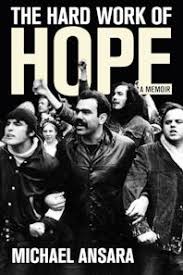
The Hard Work of HopeBy: Michael Ansara (ILR Press, imprint of Cornell University Press, 2025)
A fascinating memoir of Ansara’s organizing days in the 1960s-70s—beginning in the civil rights movement, progressing to leadership roles in Students for a Democratic Society (SDS), and later as the Executive Director of Massachusetts Fair Share, an early attempt at a multi-issue, multiclass community coalition working both in neighborhoods and throughout the state for economic justice issues like utility rate reform, affordable housing, services for veterans, and more.
Although I’m a decade younger, it’s full of stories I can relate to: movements building and crashing, coalitions forming, working for unity against factionalist pressure, continually shifting definitions of the movement, issue and demographic intersectionality, right-wing pushback, our impatience when we’re young and our resistance to change as we age, the consequences of bad or absent strategy, the occasional miracles of luck plus hard work creating success, the need to celebrate even limited victories—I’ve lived all of that, though not as intensely as he did. For instance, I’ve never been attacked by cops; he was beaten many times and had guns put to his head by some of them.
It’s also a who’s who of the movement, full of people whose names I recognize, though I only knew one (Dave Dellinger) personally.
And it’s wonderfully full of chutzpah in the service of others: the willingness to break convention and do outrageous things that people don’t expect in order to achieve results that people think you can’t get.
Some of the tactics:
- An impromptu one-to-one debate with then-Secretary of Defense Robert McNamara, both of them standing on top of a car in the midst of a big crowd of peace demonstrators (and some pro-war demonstrators), relaying audience questions to McNamara over a bullhorn (pp. 64-66)
- Exposing a CIA money laundering campaign that funded right-wing front groups by closely examining tax returns—including parts he wasn’t supposed to be shown (p. 70)
- Organizing a huge demonstration that physically blocked a recruiter from Dow Chemical (makers of Napalm) at Harvard from meeting with students—and collecting student IDs from so many participants AND nonparticipants to turn over to the administration that the school could not enforce it disciplinary code against those who put their bodies on the line (pp. 90-91)
- Going to his military induction physical with a big pile of antiwar leaflets and distributing them to other potential draftees waiting for their physicals—and quoting the Constitution and the history of colonialization in Vietnam to the sergeant and then the colonel who tried to interfere (p. 142-143)
- Getting inside information from a mobster who incriminated a vicious and corrupt judge (pp. 186-187); that judge was eventually disbarred and forced off the bench
- Obtaining 300 shares of Boston Edison stock from a sympathetic wealthy person, distributing them to organizers and supporters, and essentially taking over a stockholders meeting —resulting in a freeze on electric rate increases (pp. 222-223)
- Organizing a “one-peanut-per-plate” public protest outside a major fundraising dinner, pointing out that ordinary people couldn’t afford the price of admission to gain the access that lobbyists had (p. 229)
- Learning, over time and across many campaigns, how to deeply listen even to those you disagree with, how to uncover common ground, how to create enough pressure that governments and institutions are willing to address your goals
- As Executive Director for several years of the broad-based community organization Massachusetts Fair Share, building coalitions that included both Black inner-city activists and the white suburban women who had opposed school busing (a super-divisive issue in 1970s Boston that made national news for months), both veterans and peace activists, and several other pairings of opposites
Yes, I’m aware that the current administration loves to break rules. But they do it for personal gain of wealth and power. Ansara and his cohort did it to create a better world.
Ansara is more than willing to criticize his cohort’s actions and strategies. He takes responsibility again and again for things he would do differently now—from not alienating veterans by marching with National Liberation Front (Vietnam communist) flags to offering an alternative organizing model to the 1968 Democratic Convention protests that turned so ugly: pressuring the Democratic candidate, Hubert Humphrey, to come out against the war and then organizing enough support to defeat Nixon. Had that happened, he believes, we might have avoided not just Nixon but the worse administrations of Reagan and Trump (I would add George W. Bush).