|
|
Shel Horowitz’s Clean and Green Marketing Tip: December 2025
|
|
|
|
|
Great news! All of my eBooks with a publication date through 2023 are now free to subscribers to The Clean and Green Club (the monthly newsletter I’ve been publishing in some form all the way back to 1997).
|
|
|
|
|
Volunteer for Fishbowls
|
|
|
|
Image: Andrea Piacquadio via Pexels
I regularly attend several networking meetings over Zoom. At the UK-based Networking for Good one recent Monday, the first great thing that happened was a first-time attender, a video expert, giving us all permission not to obsess over ums and uhs when we speak or make a video. I’ve never liked the Toastmasters focus on that, and it’s one reason why I never joined. It’s a sign that we’re human, and even super-experienced professional speakers have them slip in.
Even better, they asked for a volunteer to have people ask anything they wanted about the volunteer’s business, and I eagerly waved my hand. And I’d urge you to wave your hand wildly when you’re offered a chance to be in a fishbowl, because there are so many benefits.
Yes, I recognize that many people are uncomfortable bringing attention to themselves or speaking to a group. While public speaking or going on TV is not scary for me (anymore), I frequently do things that are out of my comfort zone. It’s one of the ways I continue to grow and learn. Two days before that meeting, I asked the protester standing next to me who was wearing a slogan that disturbed me deeply if he was open to discussing it. That was definitely out of my comfort zone, but we had a five-minute conversation where we disagreed but were both respectful and each brought some facts. So put your hand up anyway.
It won’t be as scary as that ?
To name a few, it’s:
- An opportunity to get consulting at no charge, as people brainstorm together to help you solve a problem
- A chance to see how others think, and figure out who in the group you might hire to go deeper on solving that problem (I’ve gotten many clients because people saw the value of advice I was giving without even charging)
- A fabulous way to let people know more about what you do without getting accused of being too salesy
- A chance to show off your problem-solving abilities to others, as I did here
- A market research bonanza, because you have no idea of what questions you’ll br asked—and those questions provide deep insight into the minds of your prospects
- And, of course, the challenge of spontaneously answering keeps your mind sharp and builds skills useful when you’re pitching clients, being interviewed in the media, or even being grilled by a government body with authority to grant or decline your permit. Plus, it’s fun.
I also think the session is worth sharing with you, because it shows a lot about how I see the world, and how I find possibilities to put it together differently—and also how I seized the opportunity to clear up misunderstandings (such as the ideas people had that my strategies were specific to my own country or were only relevant to large corporations. Actually, large corporations usually have in-house experts, and my client load is almost entirely micro-sized businesses and community groups.) You’ll also see my techniques for replying under pressure—such as when I began my answer with “Mm-hmm. Great question” or related my reaction when I was asked about what to do for a pizza shop. Those little fillers bought me the 5 or 10 seconds I needed to decide which case studies I would talk about or what solution I would offer that pizza shop.
Yeah, and I took that guy’s advice about leaving in most of the ums and uhs, which I do think adds a layer of authenticity ;-). Here’s the transcript, edited to remove names, clean up punctuation, etc.:
Q: How applicable are your methods beyond the lower 48?
A: Oh, totally. I’ve gotten clients in Australia, all across Asia and Europe, um, occasionally in Latin America. Basically, certain things don’t work, like if I’m talking about whatever government subsidies might be available, that’s not going to be relevant, but I almost never talk about that. It’s not my expertise, and I’m much more interested in the fundamental concepts. That, for example, when you build environmental and social good into your business, you are then able to project yourself as something different and better than your competitors. My favorite example is ice cream: Haagen-Dazs and Ben & Jerry’s are both worldwide companies. One is cold and corporate, I call it the Exxon of ice cream. And the other is warm and fuzzy, uh, with old bearded people on the labels, like me. And it has big commitments to social justice, to employing the so-called unemployable, to green energy. Which one are you going to take your $6 or your £4, um, and buy at the supermarket? It’s a very easy choice. The ice cream isn’t that different. So, you get more customers, you get less resistance from those customers, you might be able to charge a little more, will probably have better relationships with your neighbors, your competitors even, and yes, your government regulators who are in charge of you. So, my question is, why wouldn’t any company want to build this in?
Q: Oh, I was going to say, ask Shel what he wants, because I know he’s bringing a book out. So, this time next year, where do you want to be?
A: I want to have written the book, um, which means that I will have found a charity partner, and then found a publisher. The book is about being an activist when you’re old. And, so I—it takes me usually about 6 months to a year to write a book, so I hope to have it done and be into the marketing phase as the publisher is readying it for publication, which is also something that can take a year. I’m not self-publishing, and therefore I’m on somebody else’s timetable when I do it. But, uh, because it’s a relevant book right now in this country, I suspect they may put it on fast track. And my grandson will be 4 instead of 3, and I expect that he will still be delightful. That’s kind of what I want to be. And oh, yeah, I also want to be living in a democracy again by then, which involves not just me, but millions of other people to make that happen.
FOLLOW-UP Q: Well, by this time next year?
A: Yeah, why not? Just because his term won’t be over doesn’t mean that he has to have the power that we’ve given him. What has been given can be taken back. So he might still be president, but he might be unable to pass anything through Congress, for example, because all he needs is about 5 of his Republican buddies to jump ship, and he doesn’t have anybody to vote him anything anymore. It’s a very, very tight Senate and House.
Q: Shel, how does it apply to small… Um, interpret what they’re about. Like, small practice like mine?
A: Well, I’m a small practice like yours. I am a one-person business. I’ve never had an employee in 45 years in business, I have freelancers, and um, partners for various things, but I am as small as it’s possible to get. I don’t even have a separate office. I work out of my home. And these principles were adopted from my own career, so they are all extremely applicable. So, as, uh, going way, way back, about differentiation, when I started really focusing on resumes, which was 1984 or 85. I put a little ad in the Yellow Pages, a half-inch ad, that said, Affordable Professional Resumes While You Wait. Nobody else had a slogan like that. I started getting lots of clients. Just that simple a thing. It was, I don’t know, $50 a month or something like that to have that in. And back in those days, before everybody had their resumes written by an AI bot, it was very effective. And when I moved into business-to-business services, I was able to connect on various online communities that gave me as much reach within those communities as any big corporation would have. So, and then as I began to differentiate as the green and social conscious marketer, the people who were attracted to that would find me.
Q: And what’s your recommendation for the most effective marketing tool currently that you’ve…?
A: Well, it’s bespoke, so it’s going to depend on who you are and what you do, and what your interests are. Like, for example, I’ve got a client now whose socially conscious book should be coming out next year, finally. And, um, she is not a good candidate for radio and TV, because she’s a double-stroke survivor, she speaks slowly, and she thinks slowly. So normally that’s a great medium for somebody with a book like hers. It’s not going to work for her, I’m not going to suggest it. Uh, for her, we’re going to be courting print interviews. And her goal is not to sell a huge number of copies, and there’s also going to be some word of mouth in the communities where they believe in what she’s writing about. And it’s going to be very targeted and very cheap, actually, and paid advertising will not be a part of it. It almost never is for my clients. It’s the last thing I suggest in very few situations.
Q: So, Shel, what are some tangible impacts your business have done, maybe through your clients? Because I’m interested… because you have this, uh, amazing message to make, like, the world a better place. Um, are there any specific, kind of, examples of how you’ve made an impact?
A: Mm-hmm. Great question. So, I’ll just talk about some of the clients I’ve worked with. I had a guy who came to me with, uh, he owns a conference center, and it happens that 2 or 3 owners ago, that property was the birthplace of the safe energy movement in the United States. So I wrote him a marketing plan about attracting the kinds of events for whom the organizers would find themselves walking on sacred ground coming there. Like, you can be where in… not in the room where it’s happening, but in the room where it happened, 50 years ago, these were where these meetings were held. This is the commune where so many of the experts in the safe energy movement happened to be living at that time. And, um, I don’t think he would have ever thought of doing that on his own.
I had another client who has a cell phone sized solar lamp. And with her, I brainstormed a huge list of applications for it, ranging from disaster relief to night lights for kids. And, um, so I think I expanded her horizons about what’s possible.
And my favorite example is actually not a real client, but a radio interviewer once asked me, “well, this is all well and good for big corporations. What would you do for a pizza shop owner?” So, I said, hmm, nobody’s ever asked me that before, and on the spot, I came up with this idea that the pizza shop owner could go into a local inner-city low-income high school, recruit a few kids, teach them how to grow tomatoes and garlic and oregano, teach them how to make a pizza, and then teach them how to go into their schools on a Friday and say, okay, we’re taking orders for Monday delivery. Monday, in the U.S., is a dead day in the restaurant industry. Nobody goes out to eat, most restaurants are closed. So, this pizza shop owner is going to open on Mondays, make the exact number of pizzas that’s already ordered and prepaid. The kids are going to deliver them to their classmates and collect a little bit of the money. And basically, there are no losers in this except the school cafeteria…Yeah, and that was just on the fly that I came up with that.
Q: What are you the best at?
A: I think I’m really good at seeing the way things fit together in ways that other people don’t fit together, and how you can form partnerships, and how you can really just shift your thinking, like that pizza shop example. Um, that’s—I could immediately see the connection between making pizzas and helping low-income kids, uh, both with entrepreneurial skills and also with getting better food into their bellies. I think I’m really good at that, and I’m also a pretty darn good writer and communicator. I invented what I call the story behind the story press release, which is not the Who, What, Where, When, Why press release that we’re all taught to write. Uh, so instead of “electronic privacy expert releases new book,” when I had a client with a book on electronic privacy, my headline was, “It’s 10 o’clock. Do you know where your credit history is?” Yeah, so just reframing the whole thing, I’m very good at that. Where I’m lousy at is managing all the little details of a big project.
|
|
|
|
|
|
|
|
|
|
|
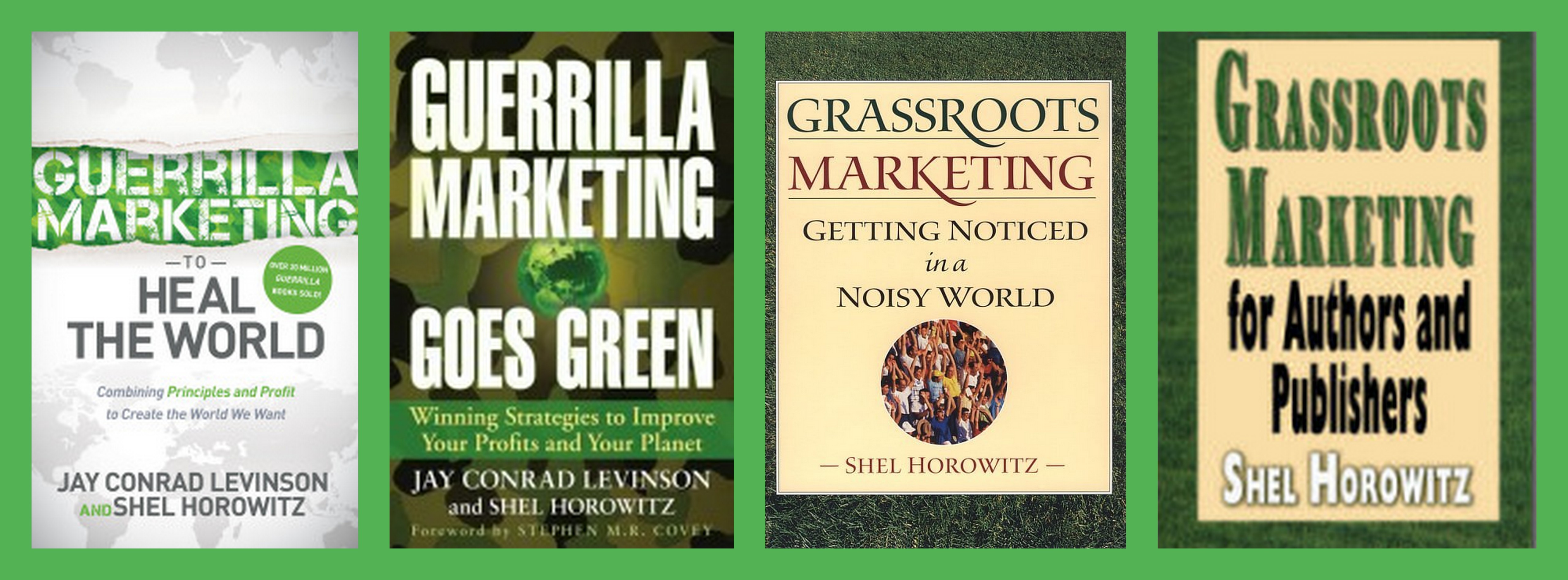
Discover why Chicken Soup’s Jack Canfield, futurist Seth Godin, and many others recommend Shel’s 10th book, Guerrilla Marketing to Heal the World (and download a free sampler). Autographed and inscribed copies available. |
|
|
|
Marketer of the Day Interview
Robert Plank just released the interview he did with me for his Marketer of the Day podcast. We covered a lot of ground in just 30 minutes. A few of the highlights (you can read more in the extended summary on my interviews page):
- One simple action any consumer of chocolate can do to better the world
- How a very NON-tree-hugger company (you know their name) doubled the market for organic foods and personal care products by going way beyond the Whole Foods customer profile
- The kind of lateral thinking I bring to my clients that creates value and opportunity by seeing possibilities that aren’t obvious but make perfect sense
- Why I love engineers, with three examples of how they change the world
- How to harness the savings from “low-hanging fruit” changes to create capital and momentum to take the next steps
- Community-focused and eco-centric alternatives to Amazon and Google
https://www.robertplank.com/1476-guerrilla-marketing-heal-world-shel-horowitz/
Movie Reviews and More Podcast
- How activism in my teens turned me into a marketer (1:13)
- How, in my 40s, starting the campaign that saved a mountain (1:30) led me back to the business world, with a new focus on profiting through environmental and social good (2:24)—and why, now, I’m swinging back to writing a how-to book for badass older activists (3:59)
- How sometimes you find out what impact you had—but even when you don’t, you still have impact (6:10)
- The lessons in humility I learned from Pete Seeger (8:34)
- Who will inherit the Earth if we humans don’t get our act together (10:02)
- Lessons I learned from my mom about confronting injustice even in your own family, and finding non-obvious ways to make a difference (10:12)—and from my dad about living your truth even when the world tells you differently (11:01)
- How Trumpism may create opportunities for true progressive alternatives well beyond the centrism of mainstream Democrats—and how few people it can take to set deep change in motion (12:42)
- How ordinary people have made big societal changes, over and over again—and why, more than ever before, we need to mobilize in opposition NOW (16:21)
- The little thing I’ve done on Facebook for more than 2800 days in a row that empowers others and strengthens community (19:32)
https://www.youtube.com/watch?v=0BAJUcr-1cw
East Trade Winds Networking Group
I’ll be giving a short 15-minute presentation in environmental and social good as a profit strategy for the East Trade Winds networking group on Tuesday, February 10, some time between 8-9 a.m. Eastern (5-6 a.m. PT). It’s free to register for the weekly calls; here’s the link.
View highlights from (and listen to) more than 30 podcasts ranging from 5 minutes to a full hour. Click here to see descriptions and replay links.
|
|
|
|
|
From Ellen Finkelstein:
A couple of friends have been frustrated by not seeing progressive politicians or well-known thought leaders offer positive ideas for improving life in the United States. So we decided to create a place for anyone to post ideas on a variety of topics, such as gun violence, healthcare, homelessness, poverty, immigration, and more. And we hope people who can implement them will notice. It’s a simple site but it works.
Please post your ideas here and then share the site! https://www.project2029.community
|
|
|
|
Revenge of the Tipping Point
|
|
|