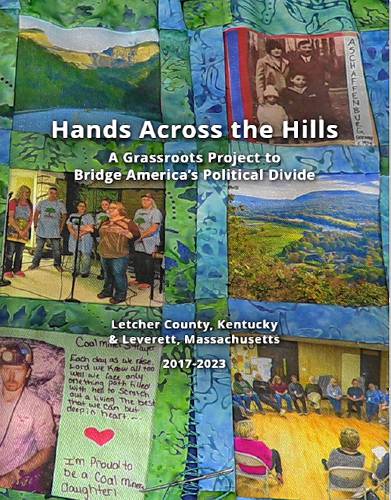
Hands Across the Hills: A Grassroots Project to Bridge America’s Political Divide, Letcher County, Kentucky & Leverett, Massachusetts 2017-2023
This remarkable book came out of an even more remarkable four-year dialogue project between residents of a county that voted overwhelmingly for Trump and a small town that voted overwhelmingly for Clinton in 2017. Unfortunately, they only printed enough copies to fill the advance orders—but fortunately, it’s available as a no-charge e-book.
Talking to the other side has never been easy, and it’s even less so in the highly polarized climate driven by social media and conventional media that value clicks and sensationalism more than they value truth, communication, or working together to 1) find common ground, then 2) organize toward common goals. Yet if we only talk within our own bubbles, all we do is reinforce othering and dehumanize the other side. Real peace is always through dialogue and often through some sort of reconciliation process. That’s how it happened in Ireland/Northern Ireland, South Africa, Sierra Leone, many countries in Latin America…and if there’s any hope for Middle East peace, they will have to talk and listen to each other a whole lot.
Hands Across the Hills (HATH) was an organization that attempted to humanize opponents and replace othering with understanding. HATH (the book) is about that common ground. Working not only across political differences but from very different cultures, education levels and economic classes (and with vastlty different generational traumas), these folks built trust in a multi-year process that involved alternating delegations. Kentuckians came to Leverett. Then Leverett residents visited Kentucky. And then the Kentucky folks made a return trip. COVID forced cancellation of a planned second visit to Kentucky, but the groups stayed in touch over Zoom. A business in Letcher County took its name from a café in Amherst, the bigger college town that borders Leverett. Leverett people were crucial in pitching in when their Kentucky comrades were hit with epic flooding.
A lot of attention went into designing and facilitating the encounters. Leverett resident Paula Green, who had done peace building and de-escalation in war zones from Bosnia to Rwanda, and Ben Fink, director of a network of community institutions in Letcher County, took primary responsibility to make sure the gatherings were safe, nonjudgmental, able to discuss hard issues—not to convince anyone but to understand the other perspectives—and included a wide range of fellowship enhancers from homestays to shared community meals to sightseeing, above and beyond the fellowship that was already building from the formal sharing circles and discussions.
Beginning with how the organization and the program were conceived and some of the early successes, the book also faces the hard truths that some things could have been better. While each group had read materials and watched videos to get a sense of the other culture—and to inoculate against the fear of being seen as hostile outsiders—there was too little preparation for the differences between working-class coal-mining families living in very basic housing and the largely upper-middle-class academic families of prosperous Leverett (pp. 8, 120-122). Both communities took some heat for failing to reach out to those who think differently in their own community (pp. 125-128). The Leverett group had tried earlier to set up dialogue with local Trumpers but were repeatedly rebuffed.
The Letcher County delegation skewed heavily toward Appalachians of Scottish-Irish ancestry, many generations removed from the immigrant experience. Though both communities were almost entirely White, Leverett’s group was more multicultural, and included several Jews who had family that either fled or were caught in the Holocaust. For some in the Kentucky group, these were the first Jews and the first children of immigrants they’d met. Many of the Leverett people were back-to-the-landers from more urban backgrounds, while the Kentuckians had been on their land for generations.
And yet they were able to discover many commonalities. Both lived in mountainous rural areas, both valued the land and their community intensely, both had similar forms of traditional music and dance. New Englanders’ beloved contra dances include many of the same moves as Appalachians’ equally beloved square dances, just done in two lines rather than squares. From either culture, those dances are likely to be powered by a live band with fiddle, banjo, mandolin, and other acoustic instruments.
And both groups ultimately wanted the same things: strong families, decent work, being valued for who each person is. The differences surfaced in the paths to implement those values. For instance, the Kentucky folks felt universal gun ownership was a way to keep safe, which appalled the Massachusetts group (p. 89). But then they dug a bit deeper to find out why. In Leverett, if someone calls the police, an officer will show up right away. In Letcher County, it could take 30 to 60 minutes to navigate the rough roads across sparsely populated areas. So even “sweet little old ladies” (p. 90), have to take primary responsibility for their own protection (p. 91).
HATH gained both local and national media attention and was successful enough so that organizers in both communities began to train other people to facilitate these types of dialogue groups and story circles, create these kinds of theater experiences, and create strong community networks within and across geography. And one of the most interesting and powerful sections of the book is a 30-page section of Appendix I that contains a thorough organizing manual (pp. 169-198), with major sections on fostering dialogue, cultural organizing, and communication. This would be useful to organizers in many issue-focused campaigns as well.