Category Archive for Clean & Green Club

The Clean & Green Club, July 2012

The Clean & Green Club      July 2012
 
CONTENTS
Brilliant Library Marketing
Hear & Meet Shel
JV Teleseminar
Friends Who Help
Book Review
 
Connect with Shel on Social Media: 

twitter birdFollow on Twitter
 

FBFacebook Profile
 

linkedinLinkedIn
 

greenprofitableBlog

fbGreen & Ethical Marketing Facebook

googleGoogle+


About Shel & This Newsletter
As a marketing consultant and copywriter… award-winning author of eight books… international speaker, blogger, syndicated columnist — Shel Horowitz shows how green and ethical businesses can actually be *more* profitable than your less-green competitors.

His most recent book is category bestseller Guerrilla Marketing Goes Green: Winning Strategies to Improve Your Profits and Your Planet.

Shel also helps authors/publishers, small businesses, and organizations to market effectively, and turns unpublished writers into well-published authors.

He was inducted into the National Environmental Hall of Fame in 2011.

Shel Horowitz’s consulting firm, Green And Profitable, is the first business ever to earn Green America’s rigorous Gold Certification as a leading green company

He began publishing his monthly newsletter all the way back in 1997, making it one of the oldest marketing e-zines (it‘s changed names a few times along the way).


“As always, some of the links in this newsletter earn commissions—because I believe in the products and services enough to promote them (I get asked to endorse lots of other programs I don’t share with you, because I don’t find them worthy).”

         
  Since When Are Libraries Known for Brilliant Marketing?  
This month’s marketing lesson comes from one of the best examples of marketing ju-jitsu I’ve ever seen.

In ju-jitsu (a/k/a jiu-jitsu), like many martial arts, you use the strength of your opponent, rather than your own strength, and deflect it back on him or her. You get to still be nonviolent and righteous, while your opponent is lying in a heap on the floor.

Similarly, in marketing ju-jitsu (a term that may have been coined by Max Lenderman in 2001), you can overcome an opponent with far greater resources who can afford to hire wildly talent advertising agencies and saturate the airwaves with the result.

In the business world, the classic examples are car rental giant Avis’s “we’re only #2 so we try harder” campaign, Volkswagen’s Small Wonder ads from the 1960s, and of course, the legendary Smash Big Brother ad that debuted the Apple Macintosh in 1984.

In the anti-business world, the day in 1967 Abbie Hoffman and the Yippies threw dollar bills on the floor of the New York Stock Exchange comes to mind, as do many of the Adbusters campaigns, such as Buy Nothing Day.

LibrarySo what does this kind of guerrilla marketing have to do with libraries? Librarians are thought of as a quiet bunch who rarely make any kind of public stink (though this is actually not true—just ask progressive author and filmmaker Michael Moore, whose book Stupid White Men was saved by a national campaign by librarians).

Well, here’s a video (less than three minutes long) outlining a particularly intense use of marketing ju-jitsu: threatened by a Tea Party campaign to defund the library, supporters created a fake campaign in favor of book burning, even saying the event would include live music and refreshments generating massive backlash.

They then revealed their true agenda: to raise consciousness that “closing a library is like burning books.” This in turn resulted in a massive outpouring of library supporters on Election Day that easily defeated the defunding initiative. And both the book burning announcement and the later clarification got lots of social media buzz and the attention of the press nationally.

Go watch it now. I’ll wait.
Back? Good.

I’d love you to share the takeaways you got in the comments. Here are some of mine:

  • Memes have a lot of power. Revulsion against book burning is a deep-seated response to centuries of oppression. Whether in 15th-century Spain, 18th-century America, Nazi-era Germany, or the late Ray Bradbury’s fictional dystopia Fahrenheit 451, book burning is seen as an attempt to suppress and control thought.
  • Reductio ad absurdum arguments—taking a line of thinking past its logical conclusion into the realm of the ridiculous—still work.
  • Even without funding, an organized populace can defeat injustice, especially when we make it a mom-and-apple-pie issue. (This was the approach we used when we saved our local mountain.)
  • Please share yours in the comments.
       
  Hear & Meet Shel                       

Monday, August 6, 11:30 a.m. ET/8:30 a.m. PT and indefinite replay, Marsha Dean Walker interviews me on Minding Your Own Business radio https://www.blogtalkradio.com/lwl-radio.

Thursday, September 6, 1 pm ET/10 a.m. PT, Barbara Saunders interviews me on Solo Pro Radio https://www.iasecp.com/solo-pro-radio

October 24-27, Association for Business Communication 77th Annual International Convention, Honolulu, Hawaii. I’m deeply honored to share the opening plenary panel with Jonas Haertle, head of the United Nations PRME initiative, widely published CSR author Nick Tolhurst, and a sustainability official from the Hawaiian government official. My wife, Dina Friedman, and I will be attending the entire conference. To register online: https://abchawaii2012.wordpress.com/registrationto-register-online-to-register-by-mail-or-scan-form-to-send-as-email-attachment-2012-annual-convention-registration-form-word-2012-annual-convention-registration-form-pdf/

Earn a Commission: Get Me a Speech in Hawaii in October

Hawaii

If your lead gets me a speech at my standard $5000 rate, you’d earn $1250 in commission. Drop me a note: shel ATprincipledprofit.com, subject line Hawaii Speech Possibility. NOTE: You can also earn commissions for getting me speaking other times and places–but for Hawaii, you can offer a big savings in airfare, since I’ll already be there. Email me at the same address, subject line Have Shel Speak. If your subject line is something like “Hi,” I’ll probably dump it unopened because I will think it’s spam. Processing hundreds of emails per day, I have to be kind of ruthless.

Planning Waaay Ahead

4th annual Amherst Sustainability Festival will be held on Saturday, April 27, 2013.

Book Expo America, June 4-6, 2013, NYC.

         
  DATE CHANGE: JV Teleseminar with Robert Smith    

Thursday, August 2, 7 p.m. ET/4 p.m. PT

Click for details on call-in information 

Reminder: if you registered before July 15 (for the original June date), the computers ate it. Please take a moment to register again.

I had a good chat with Robert over the phone, and I think this no-charge call will be well-worth your while.

I’m a long-time fan of joint ventures (JVs), because they let you dollar signgo to new markets and audiences on the arm of someone they already know and trust I used JVs to reach 5 million people for the launch of my most recent book Guerrilla Marketing Goes Green-versus the roughly 25,000 I can reach on my own.

Robert, a JV expert, approached me recently about doing a program for you. I listened to one of his earlier programs and thought you would benefit by having me bring him in. You’ll learn:

• How to set up Joint Ventures to make fast revenue-sometimes in just a few hours using your phone book 

• Secret method for mailing 10,000 sales letters per month…at no cost…not even postage 

• An amazing strategy for telling 200 million people about your business for FREE 

• How to dominate your local market as a JV Dealmaker 

• How to use publicity to get potential joint venture partners to call you 

• Sneaky way to get $5000 a month in free radio promotions 

• From zero to $1.5 MM using joint venture strategies

Robert Smith is president of Champion Media Worldwide, a public relations and marketing firm in Loves Park, IL. He has mastered the art of joint venture deals and teaches others how to spot hidden opportunities to help their businesses.

         
  Friends/Colleagues Who Want to Help  

Up close and personal with my celebrated co-author, Jay Conrad Levinson, Father of Guerrilla Marketing

Jay is offering his famous intimate 21-hour intensives at his lovely Florida home, July 23rd-25th and again August 20-23rd.. Only 10 people will be allowed in. https://3bl.me/ysqdva . Jay describes it as “a three-day face-to-face training personally conducted by me in our home here on a lake just northeast of Orlando, Florida. It’s intense because it’s from noon till 7 pm three days in a row – 21 hours with lots of hands-on, devoted to making you a true guerrilla marketer.”

       
  Another Recommended Book: Marketing Without Advertising  
Marketing without AdvertisingMarketing Without Advertising: Eight Ways to Build a Business Your Customers Will Love & Recommend, by Michael Phillips and Salli Raspberry (Nolo Press, 2008)

This book offers some very good out-of-the-box thinking related to two central concepts:

1. Every aspect of the way you operate your business is part of your marketing. I’ve been saying for years that your brand has a lot more to do with customers’ and prospects’ perceptions of dealing with your company than with your slogan, logo, colors, etc., and this book is very much rooted in that idea.

2. If you take steps to grow your business, first make sure you can handle the growth. If your sales outpace your ability to provide service, your growth plan will backfire badly, and your business will be deeply hurt—maybe even fatally wounded.

But before I go farther, I have to point out two deep and disturbing flaws.

First, the title is misleading, and I have a big problem with that. Really, the book should be titled “Marketing Without Intrusive Advertising.” The big difference is that the authors have irrationally chosen to exclude all listings from their definition. Thus, they don’t consider such purchases as Yellow Pages ads, paid directory listings, or Internet search engine keywords as advertising.

Sorry, but by my definition and in the eyes of most people, if you’re paying to be included in a book or website, you’re advertising. You’ve chosen a “pull” medium, where people who are actively looking for you discover and contact you, rather than the more common (and less effectual) “push” style, where you jam your message in front of people and hope they are annoyed enough to notice you and buy, but not so annoyed that they refuse to do business with you. I agree with the authors that push advertising is usually a poor strategy, but I emphatically disagree with the idea that paid pull listings are not advertising.

The promise in the title is that you will be able to bring in customers without buying ads. And while many of the recommended marketing approaches do meet that standard, plenty do not. The book breaks its own brand promise, in other words. In a book that’s all about building a consistently high-quality customer experience, and which uses words like “honesty” and “integrity” dozens of times, this is unforgivable.

And second, despite its 2008 copyright (still the most recent version on Amazon), the book really seems stuck around 1998. I don’t know what kind of update they did for this 6th edition, but they missed an awful lot. Whether telling people a fax machine is essential…feeling a need to define and explain what a website is…ignoring the potential to connect with known resources on LinkedIn and similar sites…or listing website creation tools such as Microsoft Expression and Adobe Contribute, but not WordPress (except as a blogging vehicle), Joomla, or Drupal, the information frequently feels old and stale.

Yet there’s much of value here, if you can get past those two inexcusables. And therefore, I do recommend this book. Here’s why:

It starts with great examples of major companies that have succeeded without traditional advertising, noting, for instance, that Costco (a company I’ve respected for many years) outperformed Walmart (a company with which I have many issues) even though it spends nothing on advertising while Walmart advertises hugely, and that the well-respected Anchor brewery (one of the first to return to the idea of craft beer) does quite well without advertising.

Later in the book, you’ll find numerous creative examples of ways to get in front of prospects and make a positive impression, as well as ways to increase customer/prospect awareness and desire both within your own business and through complementary firms—like the department store where purchases result in a same-day 20% off coupon good at a specified different department, or the Japanese restaurant that gives out cards with 5-yen coins redeemable for free saki on a future visit. Since it’s always far cheaper to bring back an existing customer than to recruit a new one from scratch, these types of marketing can be quite effective.

To get those new customers—recognize that people come to you not only from different fields, but at different levels of expertise; websites are great tools to steer people to the content they need at their own level, and this can be automated easily—and the same triage that annoys the heck out of people in a voicemail tree actually creates a positive user experience on the web.

On the web, you’re competing in a global marketplace, and your points of differentiation (Unique Selling Propositions) must be clear enough to establish your value compared to an underpriced competitor on the other side of the world.

And another important piece is ensuring customer happiness, including follow-up even when it’s not expected. Chapter after chapter reinforces the idea that every point of interaction is a potential windfall or nightmare of publicity, depending on how the customer feels about it. Whether it’s store/shop appearance, quality of service, ease of interaction (especially when there’s a complaint), or a hundred other factors, these are all areas that a business owner can strongly influence. You may not be able to control the interaction entirely, but you can assure, for instance, that:

• If customers come to your location, every employee can give directions over the phone
• People feel they get more value in their purchase than they paid for
• Your interactions focus on creating educated consumers who understand why doing business with you serves their needs (which may lead to such marketing activities as teaching continuing education classes)
• You are right there after the purchase, making sure everything is OK, and earning the chance to fix anything that isn’t (this turns disgruntled customers into loyal evangelists for you)

 
GetResponse.com
https://www.GetResponse.com


The Clean & Green Club, June 2012

The Clean & Green Club      June 2012
 
CONTENTS
Sustainable Ireland
Powerful No-Cost JV Seminar
Hear & Meet Shel
Book Review
 
Connect with Shel on Social Media: 

twitter birdFollow on Twitter
 

FBFacebook Profile
 

linkedinLinkedIn
 

greenprofitableBlog

fbGreen & Ethical Marketing Facebook

googleGoogle+


About Shel & This Newsletter
As a marketing consultant and copywriter… award-winning author of eight books… international speaker, blogger, syndicated columnist — Shel Horowitz shows how green and ethical businesses can actually be *more* profitable than your less-green competitors.

His most recent book is category bestseller Guerrilla Marketing Goes Green: Winning Strategies to Improve Your Profits and Your Planet.

Shel also helps authors/publishers, small businesses, and organizations to market effectively, and turns unpublished writers into well-published authors.

He was inducted into the National Environmental Hall of Fame in 2011.

Shel Horowitz’s consulting firm, Green And Profitable, is the first business ever to earn Green America’s rigorous Gold Certification as a leading green company

He began publishing his monthly newsletter all the way back in 1997, making it one of the oldest marketing e-zines (it‘s changed names a few times along the way).


“As always, some of the links in this newsletter earn commissions—because I believe in the products and services enough to promote them (I get asked to endorse lots of other programs I don’t share with you, because I don’t find them worthy).”

         
  How Ireland Is Moving Toward Sustainability  
Irish crafter at workIrish crafter at work

During my trip last month to Ireland and Northern Ireland, I was pleasantly shocked to see evidence that this was a culture that cared about working conditions for both humans and animals.

Yes, of course, I could find fairly traded products in the health food stores and even in supermarkets. But it was astounding to me that every roadside convenience store had them as well. Little places in the middle of nowhere, just bathroom stops on the motorways, uniformly offered a pretty good selection of fair-trade chocolate and coffee, among other products. Such items are much harder to find in those types of stores in the United States, where I live.

Furthermore, the Insomnia coffee chain, which seems to be Ireland’s largest, has also gone fair-trade over there. When I encountered that brand in Canada about seven months ago, I saw no fair-trade markings.

Supermarket shopping was actually fun. I got a fantastic house-brand fair-trade chocolate bar at Sainsbury’s, which is comparable to Giant Food or A&P. If I remember right, the cocoa content was around 82 percent, and the quality was terrific. I also noticed that Hellman’s mayonnaise is made with free-range eggs over there; if that’s true in the US, it hasn’t said so on the label, last time I checked.

As a percentage, the number of “conscious” products in these stores is still quite small. But if roadside convenience stores are carrying fair-trade products, that means enough people who shop in those stores have requested those products that the store chains have decided to carry them. And I find that remarkable, especially considering that as a culture (and particularly outside of Cork, Galway, and Dublin, which all seem to have higher food awareness), Ireland is not particularly focused on eating well. It’s very meat-centric, vegetables are routinely overcooked, and the food generally is bland and heavy. Dairy is very good, however.

Those three cities seem to have a well-established local/organic culture. We found vegetarian restaurants in Dublin and Cork, a terrific Saturday farmers market including not only organic produce but also artisan foods and crafts in Galway, just outside an amazing artisan cheese shop. A health food store in Dublin offered an amazing selection of raw chocolates, and one raw chocolatier had a booth at the Galway market.

Asian noodle bar, DroghedaAsian noodle bar, Drogheda

One other trend that surprised me: the infiltration of ethnic restaurants (particularly South Asian and Far Asian) into just about every corner of the island. So if you’d rather not have beef and cabbage stew with potatoes, you’ll find options like Afghani kebab shops, Chinese or Korean restaurants, or Pakistani takeaways in even relatively small towns.

This is a slice of globalization that actually leads toward greater sustainability—not only because it’s easier to find healthy food choices, but also because I believe monocultures are not sustainable, whether you’re talking about growing a single crop or a single human culture. Cultural diversity allows for cross-pollinating the best practices that other societies have come up with, recognizing that some may not be appropriate for a different climate. Here are a few other random observations from my trip:

  • Wind power plays a significant role. It’s common to see large wind turbines (as in much of the rest of Europe), though for the most part in small clusters of one to five, rather than in the vast wind farms of say, Spain—and also to see older, smaller  private installations on individual farms, of the sort that were common on US farms in the late 1970s.
  • Solar’s role is minimal. I have seen only a handful of rooftop solar hot water installations, and most of the  photovoltaic have been on self-powered electronic highway signs. Of course, it’s not the sunniest place in the world; an Italian immigrant told us, “in Ireland, they call this a beautiful day. In Italy, we would call it a disaster.”  But there must be more than is obvious, because we passed quite a number of solar businesses, even in some pretty rural areas.
  • Big cities have some limited public recycling in the major commercial and tourist areas. I imagine there are recycling programs for households, too.
  • On the campus of the technical college we visited, environmental awareness was quite high. This school is also about to launch a degree program in sustainability and one in agriculture, yet they haven’t explored the obvious linkages between those two program offerings—in part because they’re slotted for different campus, 50 miles apart.

Since it’s part of Europe, I wasn’t surprised that attention to conservation is more prevalent. Toilets with low/high settings, tiny cars, and composting projects all seem fairly common. Yet, to my shock, the small conference center we stayed at in rural Donegal was still using energy-hogging incandescent light bulbs.

         
  DATE CHANGE: JV Teleseminar with Robert Smith    

Thursday, August 2, 7 p.m. ET/4 p.m. PT

Click for details on call-in information 

We had a glitch in our registration form, which means if you signed up for this call, we never received your registration. The form should be working now, with a confirmation sent to your inbox. If you did register already, please take 30 seconds and do it again. I apologize for that.

I had a good chat with Robert over the phone, and I think this no-charge call will be well-worth your while.

I’m a long-time fan of joint ventures (JVs), because they let you go to new markets and audiences on the arm of someone they already know and trust I used JVs to reach 5 million people for the launch of my most recent book Guerrilla Marketing Goes Green-versus the roughly 25,000 I can reach on my own.

Robert, a JV expert, approached me recently about doing a program for you. I listened to one of his earlier programs and thought you would benefit by having me bring him in. You’ll learn:

• How to set up Joint Ventures to make fast revenue-sometimes in just a few hours using your phone book 

• Secret method for mailing 10,000 sales letters per month…at no cost…not even postage 

• An amazing strategy for telling 200 million people about your business for FREE 

• How to dominate your local market as a JV Dealmaker 

• How to use publicity to get potential joint venture partners to call you 

• Sneaky way to get $5000 a month in free radio promotions 

• From zero to $1.5 MM using joint venture strategies

Robert Smith is president of Champion Media Worldwide, a public relations and marketing firm in Loves Park, IL. He has mastered the art of joint venture deals and teaches others how to spot hidden opportunities to help their businesses.

       
  Hear & Meet Shel                       

Thursday, July 12, 10:30 a.m. ET/7:30 a.m. PT and indefinite replay, Michelle Vandepas interviews me on Talking Purpose radio

https://www.blogtalkradio.com/talkingpurpose/2012/07/12/shel-horowitz-interview–ethics-green-and-frugal-business.

Monday, August 6, 11:30 a.m. ET/8:30 a.m. PT and indefinite replay, Marsha Dean Walker interviews me on Minding Your Own Business radio https://www.blogtalkradio.com/lwl-radio.

Thursday, September 6, 1 pm ET/10 a.m. PT, Barbara Saunders interviews me on Solo Pro Radio https://www.iasecp.com/solo-pro-radio

HawaiiOctober 24-27, Association for Business Communication 77th Annual International Convention, Honolulu, Hawaii. I’m deeply honored to share the opening plenary panel with Jonas Haertle, head of the United Nations PRME initiative, widely published CSR author Nick Tolhurst, and a sustainability official from the Hawaiian government official. My wife, Dina Friedman, and I will be attending the entire conference. https://abchawaii2012.wordpress.com/

Earn a Commission: Get Me a Speech in Hawaii in October

If your lead gets me a speech at my standard $5000 rate, you’d earn $1250 in commission. Drop me a note: shel ATprincipledprofit.com, subject line Hawaii Speech Possibility. NOTE: You can also earn commissions for getting me speaking other times and places–but for Hawaii, you can offer a big savings in airfare, since I’ll already be there. Email me at the same address, subject line Have Shel Speak. If your subject line is something like “Hi,” I’ll probably dump it unopened because I will think it’s spam. Processing hundreds of emails per day, I have to be kind of ruthless.

Planning Waaay Ahead

4th annual Amherst Sustainability Festival will be held on Saturday, April 27, 2013.

Book Expo America, June 4-6, 2013, NYC.

       
  Another Recommended Book: The Underdog Edge  
The Under DogThe Underdog Edge: How Ordinary People Change the Minds of the Powerful…and Live to Tell About It, by Amy Showalter


A Theory of Social Change to Make Sense of this Book

One of my long-held theories of social change is that it’s easier to influence the power structure, and accomplish change within it, if you’re seen as the rational and reasonable negotiating partner. And in order to be perceived as a good negotiating partner, there has to be someone more extreme, who can be dismissed as the lunatic fringe, but who actually makes space for your demands to seem like a compromise.

Examples:

  • Martin Luther King, Jr. and the civil rights movement were able to make more progress because Malcolm X and the Black Panthers existed (very publicly).
  • George W. Bush was forced to endorse same-sex civil unions even though the idea was anathema to his Fundamentalist “base”—because the alternative was same-sex marriage (this example also shows how society can evolve very quickly sometimes—we’ve moved way past civil unions now).
  • Franklin Roosevelt’s New Deal, a radical restructuring of capitalism, was more palatable to the business/financial world because massive unrest made Communism (the destruction of capitalism) somewhat likely.
  • My own outsider candidacy for my local City Council, many years ago, gave space for a more moderate progressive to win in a four-way race, and then go on to serve four terms as Mayor.

A Book for More Moderate Activists
Through this lens, I view Amy Showalter’s book, The Underdog Edge: How Ordinary People Change the Minds of the Powerful…and Live to Tell About It. Showalter targets those who want to be seen as the reasonable and rational alternative. Those who want to meet with powerful politicians and heads of corporations, and get them to change their actions.

And thus, her message about dialing down the passion makes sense. Big dogs try not to negotiate with (or concede points to) those they find threatening. But I believe that seeing the threat out there in the distance makes them more willing to come to the table with those who are more persistent than passionate, those who’ve done their homework, and those who can articulate a change program that leaves the top dog feeling he or she did the right thing.

Without that lens, the book would leave me confused, because I can point to hundreds of examples throughout history where loud, passionate, angry people made big, sweeping changes. But in many of those cases, it was a symbiosis between the loud and angry in public view and the quiet, warm and friendly, but very persistent negotiators in the background; each needed the other to succeed.

However, reasonable doesn’t mean passive. The more vivid you make your case, the more likely you are to succeed, Showalter says. And this is true whether your cause is liberal, conservative, or nonideological.

While charisma makes the struggle easier, Showalter says a much more essential quality is grit: determination, doggedness—not going away. Proximity, which she sees as the key element of vividness, is a big part of winning, because you’re much harder to ignore if you’re right there.

From “Underdog” to “Sled Dog”
But it’s not enough if you’re so ego-involved that you make it all about you. Showalter has examples that take the “dog” metaphor from underdog to sled dog. Success, she says, depends on the pack leader being collaborative and encouraging of the entire group.

Not surprisingly, those underdogs who succeed in persuading their big dogs have often built relationships with them years before they ever tried to sway them or gain a favor. Not that it’s impossible to do it cold, but it’s much, much easier if you have an existing relationship based in mutual respect.

And it is helped, as she points out, if you can win over sincere and influential converts who can be seen by your opponents as one of their own, and pave the way for a change of heart by documenting their own impetus to change.

Social change theory also says that if you start to experience heavy repression, it means the power structure is scared of you and thinks you need to be crushed. If you can hang on through the crackdown, you succeed…eventually. As Gandhi said, “First they ignore you, then they ridicule you, then they fight you, then you win.”

Can Social Media Spark Social Change
Gandhi, like most successful revolutionaries throughout history, did not have access to Twitter and Facebook. Showalter is highly skeptical of the role of social media in fostering change, pointing out that even Egypt’s much-celebrated revolution was primarily offline—in the streets. She notes that only a quarter of Egypt’s population even has Internet access.

I believe social media—like TV during the civil rights and Vietnam struggles, and like printed publications of an earlier era—is crucial for bringing awareness of the struggle into the public eye.

The election protests in Iran are an obvious case, even though they failed to bring about regime change. Revolution is not always quick; Gandhi’s revolution in India took decades, Ireland’s, centuries.

However, as she points out, that awareness must be accompanied by action—and action is a lot more than signing a petition or posting a status update.

And where am I on the continuum? I’ve been all over it. I’ve risked arrest several times for what I believe in, and was actually arrested once. I’ve been the militant marcher shaking my fist into the TV camera—but I’ve also negotiated privately with a developer to create a compromise that allowed him to build after failing to gain a yes vote three times, once he agreed to protect a bunch of farmland and granted other concessions to the activist community. Both approaches are effective, in their time.

 
GetResponse.com
https://www.GetResponse.com


Shel Horowitz’s Clean and Green Newsletter, October 2011

News Flash: I Was Inducted Into the National Environmental Hall of Fame

Read all about it and see a picture at https://greenandprofitable.com/i-was-inducted-into-the-national-environmental-hall-of-fame-today/ I hope to post a video next week, if the videographer sends me something I can use. Several dignitaries in attendance, too.

Contents of This Issue:

A Marketing Ploy that Cut Through the Clutter

UPS dropped off a surprise package from Random House recently; it looked like a box that would be used to ship a case of books.

When I opened the box, I saw a smaller, unmarked, white box, shrinkwrapped and floating on a cushion of air-filled plastic bags. I cut the shrinkwrap, opened the box, and took out a black slipcase, unadorned except for a line of headline type saying “GUESS THE YOUNGEST AGE EVER TARGETED BY A MARKETER.” Just below and to the right, these words in a starburst: “Be the first to know with this fascinating sneak-peek.”

The press kit inside the slipcase inside the box on top of the outer boxFinally, inside the slipcase, another, very deluxe box.  The front cover answered the question on the slipcase. When I opened it, the inside cover had four panels of marketing copy, contact information, *and* a video player containing three video trailers and a screen about the size of an iPhone’s. Needless to say, the graphics on the whole thing were extremely professional. The main part of the box contained two cutouts: one held an advance review copy of a new book, Brandwashed, by Martin Lindstrom, and the other held a small red plastic infant bottle whose label, extremely reminiscent of the famous Heinz catsup bottle, declared,

“WHINES EST’D 2011 BRAND WASHING YOU’RE NEVER TOO YOUNG”

The two enclosures were topped with a custom plastic tray that had a cut out for the bottle and fit snugly but comfortably into the box.
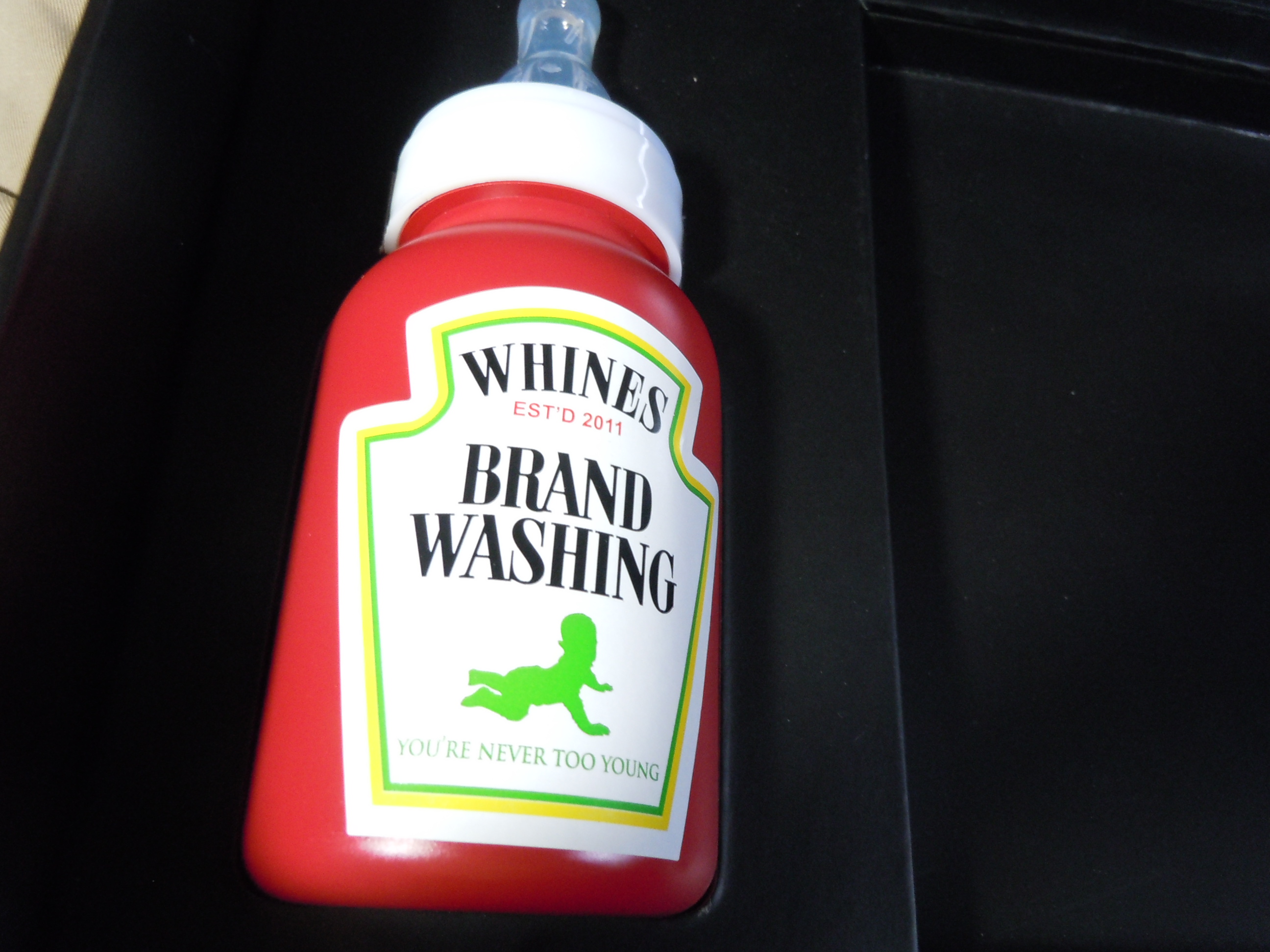
I remembered that Lindstrom had personally e-mailed me two weeks earlier, asking if I’d be interested in reviewing his forthcoming book. He’d written,

Like you, I have long been a proponent of environmental responsibility and have sought ways to encourage others to take a more active role in making and keeping our communities more “green”. That is why I think you should take a careful look at the multi-million dollar world-of-mouth marketing experiment that I had funded and chronicled in Brandwashed. I wanted to study just how persuasive word-of-mouth marketing could be as pertaining to household decisions, and in the latter stages focused specifically on environmentally conscious products and services. The results were shocking!

I’d been impressed at the time that he not only sought me out but that he spoke directly to my key interest area: the intersection of marketing with the environment.

As book reviewers go, I’m pretty low on the food chain. Typically, I do one review a month, in this newsletter (whose circulation figures don’t exactly set the world on fire)—and then the reviews get posted on Amazon about a month later. To receive such an intricate package despite my low status in the book review world was a recognition that somebody, in this case a best-selling author and top consultant in my field, values my opinion enough to be sure he gets noticed—and that’s flattering.

I had a number of reactions to receiving this package, and as a marketer/environmentalist who educates other marketers and environmentalists, I’d like to share some of them with you. The insights you might gain from a look into my psyche may help you as you design your next campaign.

  1. Undeniably, it was effective. As it happened, I hadn’t yet picked out a book to review this month, and with half the month gone, I needed to start. Martin’s book didn’t even stop at the top of the pile; it went directly to my exercise bike, where I read while working out, and I started reading it that very night (see my review elsewhere in this issue).
  2. To make that impression cost quite a bit of money. I’m guessing the package cost at least $50 per copy to design, prepare, and send. Am I enough of an influencer to be worth that investment? It would be nice to think so, but I don’t know.
  3. Obviously, the campaign is reaching people who do have a great deal of influence. On October 6, less than 10 days after publication, the book not only has 41 reviews on Amazon, but the #1 and #2 slots on three subcategories for marketing books and an enviable overall rank of 283. His earlier book, Buyology, is also doing quite well at the moment, probably with a little help from Amazon’s “people who bought also bought” trick.
  4. While the marketer in me is quite impressed, the environmentalist part of my brain is appalled. This was a very resource-intensive effort involving unrecyclable mixed materials and weighing seven pounds. In tiny print on the back of the player box, it notes that you’re not supposed to throw this out in the trash and should return the box to the video player company for processing. Not a lot of reviewers will even see that note, and fewer still will go through the trouble to find a suitable box, address a label, and pay for the postage to return it. Reviewers get dozens of packages per day, and many cases, get them pre-opened by a mailroom employee. The slipcase and the two outer boxes can be recycled with my other cardboard, but the rest of it is problematic. This is especially ironic, given Lindstrom’s personal message to me.
  5. After experiencing this elaborate and expensive press kit, I am surprised by the book cover, which in my opinion is both unattractive and unimaginative. If a client came to me with this cover, I’d have advised a different concept.
  6. Targeting is key. This book was well-targeted to me, and Lindstrom’s personal message was even more targeted. Had I received a similar press kit for, let’s say, a book about Britney Spears’ hairstyle shenaningans, I would have been annoyed instead of intrigued, and the whole thing would have gone into the recycle bin without a second look.

How would you react if you received a package like this? Click on this link to tell me, or to make any other comments. Please tell me if I have permission to publish your comment publicly. I’m thinking of gathering the responses into a blog post (which is also an easy way for you to get a link from my site—just include your URL in the e-mail).


Friends Who Want to Help

The Best-Conceived JV I’ve Seen

Do you do Joint Ventures? As I hinted last month, I’m helping to orchestrate a particularly exciting one, involving celebrities, politicians, environmental education, kids, quilts and all sorts of other cool stuff that appeals to the media and will get you coverage and contacts. We’re planning ahead on this–want to get commitments this year for ramping up early next year and a launch that ties in with Earth Day next spring–but don’t wait to get involved. If you’d like to receive an invitation as soon as we’re ready, please use this link to tell me (and let me know if you think of yourself as more of a marketer, or more of an environmentalist).

Unfamiliar with Joint Ventures? Basically, we partner with you, you tell your own contacts (like the readers of your e-zine or blog), and if people make purchases from your link, you earn a commission.

30-minute No-Cost Consultation with Scott Cooney from Green Business Owner, and a Cool-Looking Sustainability Game, Too

Scott gave me one of these consultations, and I very much appreciated his fresh perspective. He’s also just developed a very spiffy-looking game on sustainability themes, set in Hawaiii. To get your consult, visit GreenBusinessOwner.com, and then click on the Consulting link on the top menu. For the game, go directly to this link.

Two Book-Publishing Conferences:

D’vorah Lansky’s Online Book Marketing Conference

Check out the amazing speaker line-up for the 3rd Annual Book Marketing Conference Online–I now almost all of them and can vouch for their good work. And this one has a series of free preview calls, too.

* Kathleen Gage: “Become an Online Bestselling Author in Today’s Crowded Author’s Market”
* Carolyn Howard-Johnson: “Your Awards: How to win them and then use them to set your book apart”
* Brian Jud: “Selling More Books, More Profitably to Non-Bookstore Buyers”
* Lynne Klippel: “Going Beyond the Book: Fast, Easy Product Creation for Authors”
* Jill Lublin: “Be the News”
* Connie Ragen Green: “How to Repurpose Your Existing Content to Become a Bestselling Author”
* Marnie Pehrson: “Using Social Media to Create a Buzz About Your Book”
* Penny Sansevieri: “Maximize and Monetize Social Media -3rd Annual Book Marketing Conference”
* Felicia J. Slattery: “How Authors Can Create a Signature Speech to Build Platform and Sell More Books”
* Dana Lynn Smith: “The Secrets to Planning a Profitable Virtual Book Tour”
* Steven E. Schmitt: “How I made millions by listening to my intuitive voice”
* Noah St. John: “Attract More Money Blueprint: Your Hidden Power for More Wealth and Happiness”
* Denise Wakeman: “The Secret to Author Blog Success: How to Dominate Your Niche with a Book Blog”

Get the details at: https://www.bookmarketingmadeeasy.com/center/idevaffiliate.php?id=139

Publishing Conference in Nevada Next Month

This is taken directly from a press release I received: PubWest, the leading trade association for small- and medium-sized book publishers, is pleased to announce the full agenda for the PubWest Conference 2011 in November. The programming includes notable keynotes by Len Riggio, Chairman of Barnes & Noble; Tyson Cornell of Rare Bird Lit; and Kevin Smokler, author of the forthcoming essay collection Practical Classics. Sessions include intensives on Digital Publishing and Creating EPUBS with Adobe InDesign CS5.5, Exploration and Discussion of the Chicago Manual of Style’s New 16th Edition with Alice Levine, Evaluating the Effectiveness of Social Marketing, Optimizing Digital Production Workflows, Improving Your Publishing Company’s Profitability, Product Line Branding and Permissions, “Green” Publishing, Faceoff between Traditional and New Social Media, Enhanced E-Books, Metadata and Discoverability, plus lively and interactive roundtables held by professionals in the industry.

Registration: www.pubwest.org/conference. More info: kent@pubwest.org

The Living Organization

Tough times call for better ideas – Packed with powerful insights, tools, and practices, this book is a potent resource for aspiring, emerging, and seasoned business leaders alike. Norman Wolfe reframes and broadens our understanding of how organizations can create better results. Every leader, every CEO, board member and senior executive will benefit from the practical guidance this book provides. The Living Organization – check it out: https://bit.ly/puW6nt

Hear & Meet Shel

October

  • Speaking at Bioneers-By-The-Bay, wonderful conference October 21-23 in New Bedford, MA, https://www.marioninstitute.org/connecting-for-change My talk is Sunday October 23: signing books at 12:30-1 p.m. at Bakers Books tables inside the Butterfly Exhibition Tent, then presenting Getting Buy-In: Building Stakeholder Consensus for Sustainability, at Bristol Community College, 800 Purchase St., Conference Room. Note: this is the very first time I’m giving this talk, aimed at activists, government leaders, and green business owners. Lots of good nitty-gritty stuff about how to analyze and reach your market.
  • October 28 and beyond, my interview on Good And Green Radio will be available at https://wgrnradio.com/archive-good-and-green-radio-with-susan-davis/
November
  • I’ll be walking the floor in the afternoon at the Green Expo Opportunity Fair in Springfield, MA, at the MassMutual Center. Let me know ahead if you’d like to meet there.
  • November 15, 8:00 pm ET/5 pm PT, January Jones interviews me: 818-431-8506
  • November 16, 7 pm ET/4 pm PT: Interviewed on Your15Minutes Radio’s “Brand This” with Shaun Walker and Reid Stone, www.your15minutesradio.com
  • November 17, 11 a.m. ET/8 am PT: Interviewed by Susan Rich on “Get Noticed Now.”
January
Remember-if you set me up an engagement, you could earn a generous commission.

Another Recommended Book: Brandwashed

Brandwashed: Tricks Companies Use to Manipulate Our Minds and Persuade Us to Buy, by Martin Lindstrom (Crown, division of Random House, 2011)

Both as a marketer and as a consumer, you want to understand the psychology of modern-day marketing (and especially the particular marketing subset called advertising). Without a clear picture of just how deeply manipulated we are, at a level not even dreamed of when Vance Packard wrote The Hidden Persuaders back in the 1950s, you will be defenseless against the continual assault on your wallet.

Martin Lindstrom, an industry insider who has helped big brands go deep into their consumers’ minds and come out the other end with fistfuls of money, turns his attention to explaining how these companies get inside your brains, and what they do once they get there.

While he certainly pays attention to the traditional buy triggers, like fear, sex, celebrity, spirituality, fear, and nostalgia—each of which gets its own chapter—the real news in this book is the evolution of companies’ knowledge about us, and how they manipulate every aspect of your “buyer experience,” through a huge range of tools, to create the desired effect: a ravenous, insatiable hunger for the company’s brand.

This well-written and well-researched book should give anyone pause. But perhaps the scariest part is how early it starts. Marketers have known for many years that buying habits and brand loyalties acquired in childhood can shape lifelong preferences. That’s why, for instance, computer companies value the elementary education market so highly.

But it starts much earlier than that. Literally, the music you hear, the smells you experience in the womb can influence your choices all through life. And peer pressure has been documented at 14 months old.

The positive side of this is that these sensual memories can help with things like stroke recovery. But the Big Brotherish part of it is disturbing. Add in such factors as the deliberate manipulation of fear to literally make us stupid and not only do you have a commercial marketer’s paradise, but also (here I’m extrapolating from Lindstrom) the easy ability to whip up patriotic fervor to justify evil actions by governments (think about the manufacture of anti-Jewish sentiment during the Holocaust, or anti-Muslim sentiment in the US following 9/11, with the media cheering on the crackdown in both cases).

Another key insight: when we encounter arousing images, we perceive ourselves as sexier. (This is what psychologists call “transference.”) No wonder so much of advertising features sultry women and hunky men. And according to his research, straight men are a major, if hidden, market that responds to those pictures of hunky men. Also, the male who is conscious of his own beauty and spends lavishly on personal care products/services is a hot new trend.

Celebrity marketing is related to this; we perceive ourselves as increasing our status and power when we read and watch those with high status and power—they are our idealized future selves. Celebs (including various royal families) feed into this and deliberately manage their personal brands very carefully.

Concerned about privacy? Basically, it no longer exists. Data mining is far more sophisticated now, and companies can create incredibly detailed profiles not just segment-by-segment, but person-by-person. They know who you are, what you wear, what you eat, where you work, where you are (if you use a cell phone), and how long you’ve spent on which web pages. Not only do we voluntarily reveal enormous amounts of information about ourselves to companies like Facebook and Google (and some companies have learned how to subvert the privacy safeguards and harvest this), but there’s plenty of data collection going on without our consent, too. And data mining companies sometimes require their customers to provide more data if they want the service.

But wait! There’s more!

  • Some products, notably in the cosmetics industry, do the opposite of what they promise, thus feeding more purchases because the wearer thinks, “I must not have put enough on.”
  • 60 percent of teens think they can buy their way to happiness with the right brands (and many of them will outright reject unbranded items)
  • While brands are seen as a path to self-esteem, knowingly buying a counterfeit lowers self-esteem
  • Nostalgia marketing has hooks back to our earliest childhood; we long for simpler times before we had grown up worries, and will welcome even products we ignored at the time
  • GPS-like devices on shopping carts allow stores to track individual movement patterns in the store—while digital price signage allows companies to actually change prices to reflect trends at different times of day
  • Receiving advice that seems to be expert shuts down our critical thinking, even if the expertise is weak or is really celebrity in disguise)—and word-of-mouth from a trusted friend or colleague *definitely* counts heavily

Lindstrom ends the book with a complex experiment he set up, giving a real family a mission to influence the buying habits of their friends.  The results are shocking; go read the book to learn what happened, and to learn many more startling tidbits than I had room to describe. (See, now I just implanted a suggestion to you. I’m not being paid in any way to recommend this book and am not using my Amazon affiliate code. But I’d love to see whether my self-perception as a trusted expert translates into sales that bear out Lindstrom’s hypothesis, despite my transparency about it —so if you buy the book on my say-so, please drop me a note: mailto:shel@frugalfun.com?subject=IBoughtBrandwashed .) Please tell me if I have permission to publish your comment publicly. I’m thinking of gathering the responses into a blog post (which is also an easy way for you to get a link from my site—just include your URL in the e-mail).

February 2011: Lessons from the Ritz-Carlton, San Francisco

Shel Horowitz’s Clean and Green Newsletter, February 2011

In This Issue…
  • Marketing Tip: Lessons from the Ritz-Carlton, San Francisco
  • Clean & Green Spotlight: Pepsi: $20 MM to Community, Instead of Super Bowl Ad
  • Another Recommended Book: Bye-Bye Boring Bio
  • Hear & Meet
  • Friends Who Want to Help

A full issue this time, with a tip, a spotlight on a company doing the right thing (a company I don’t often praise, I might add), AND a book review. Enjoy!

PS–Remember that I pay commissions if you find me new corporate/organizational (non-media) markets for my columns, a full-price speaking gig, or a marketing or publishing consulting client. Write for details: mailto:shel@principledprofit.com?subject=NewClientReferralForYou

Lessons from the Ritz-Carlton, San Francisco

Ritz-Carlton has a reputation for blow-your-socks-off customer service, including the widely reported mantra that any employee is empowered to do anything to make a customer happy, as long as implementation will cost less than $200. I’ve even heard a story about a Ritz restaurant employee overhearing a mother telling her non-dairy-eating daughter that there was no soy ice cream on the menu—and going to a nearby store to purchase some.

This was the first time I got to check it out first-hand.

The gleaming white Ritz-Carlton San Francisco sits on a hilltop overlooking the confluence of Chinatown, Nob Hill, and the financial district. Looking like a 1930s-era Washington DC government administrative edifice, with its pillared entrance and huge windows in massive wooden frames, the building exterior is nicely decorated with green bas-relief. It was originally built in 1909 for the Metropolitan Life Insurance Company and was later Cogswell College (this information conveniently printed on the room key packet). Because of the hill, the lobby entrance is actually on the fourth floor, which is confusing if you don’t realize it. Bellmen in top hats handle the pull-through driveway, but I arrived on foot.

Staff was universally courteous and informative, yet not obsequious—and totally willing to engage as one human being to another. Maybe because this was relaxed and mellow San Francisco; I found them a lot less reserved than many other corporate hotel employees of my experience—more like what you’d expect to find at a single-location boutique hotel or bed-and-breakfast. (I was told by another guest that the staff here is in fact a lot friendlier than staff she’s experienced at other Ritz locations.)

The lobby is pleasant but not enchanting, with rather fewer plush chairs than many upscale hotels, and those mostly scattered around the periphery. The front desk was surprisingly small. I think every time I passed by, there were only one (usually) or two clerks on duty, but I never saw a line build up. The interior public spaces are well-decorated: curio cabinets at the ends of hallways featuring tasteful Asian pottery and the like, and the halls lined with paintings and photographs of San Francisco street scenes and landmarks.

My room was refreshingly uncorporate. The furnishings are simple but not sparse; my guess is that they’re relatively new but designed to look old and comfortable. (I did see a reference to a recent $12 million renovation.) The décor is anchored by round mirrors with sun’s-rays frames above each bed (too high to be usable as a mirror, but quite effective in anchoring the eye and setting the tone). The feeling, once again, was not of a corporate chain but a small and homey hotel. And since I personally relate much better to cozy than to cold or edgy, I was pleased. A classical radio station was playing softly as a walked in—nice touch.

In fact, “nice touch” was something I found myself thinking a lot. When I opened my room key packet, I didn’t notice it at first, but there was a business card saying

The Ritz-Carlton

Shel Horowitz

In Residence

with the hotel’s full contact information. Very classy, and something I don’t think I’ve ever experienced at any other hotel. I actually brought it back with me at the end of my trip.

At home, I answer my work phone line (if I don’t recognize the caller ID info) “How may I make your day special?” That business card made me feel special.

Another nice touch was the choice of both dark and milk chocolates on the room tray.

The next morning, my conference started, and here was the nicest touch of all: two concierges assigned to the conference, available for any type of assistance. Roy and Lauren were extremely facilitative. Unasked, Lauren brought my box of books to the exhibit table, and at the end of the conference, Roy took it away to reseal and ship back to me—so their suits got sweaty instead of mine. They rang the chimes at the end of every break to signal time to regather, and were there to handle any logistics issues not just for the organizers but also for all of us attenders. Their presence (for the most part, one of them at a time, but sometimes both were on duty) was beyond the expected staff who brought and removed food and beverages, etc., and made it easy to establish a personal connection between the conference and the hotel. Roy, in particular, also seemed quite interested in the subject of the conference (sustainable foods).

That evening, I called the front desk with a question about the iron, which used icons instead of labels for the controls. I’m a word guy, and I found the interface unintuitive. Rather than trying to explain over the phone, the desk clerk said he’d send someone up from housekeeping to show me—very cool. However, after 20 or 30 minutes when the staffer hadn’t arrived, and as I was fading out for the night, I figured it out on my own and canceled the staffer.

Housekeeping redeemed itself on my final morning, I reported a problem with the toilet and a staffer was at my door in less than three minutes. That’s even better than my experience at a Disney hotel a few years back.

Catering was quite good, with a lot of locally grown fresh vegetables and well-prepared desserts. Another nice touch was having the staff bring the dessert carts from our lunch spot in the courtyard tent (nice and sunny after a morning in the basement conference room) down to the exhibit area so we could continue to feast as the sessions restarted.

One thing that does need to be modernized, however, is the electricity. In this era of multiple devices each with its own charger, there was only one open outlet in my room, and it was nowhere near the desk. In order to type this on my laptop while plugged in, I’m sitting in an armchair and balancing the laptop on a tiny nightstand.

Outlets were also in short supply in our conference room, although there were a decent number along the back wall of the exhibit and food area just outside. Inside, there were none along the side walls, a few (in high demand) at the back and front.

And the elevators had minds of their own. Whether they chose to bring you to your floor without first going in the opposite direction and either opening and closing the doors or just hanging on the wrong floor for a moment with the doors closed seemed quite arbitrary.  At least twice a day, I was taken up when I wanted down, or vice versa, without anyone waiting to board at the opposite location.

And another thing that would be easy to rectify is the signage. One elevator bank doesn’t go to the rooms, but to a large and unnavigable staff work area. It took me fifteen minutes to undo the confusion and get back to my room. It would have been easy to put up a small sign saying, “If you wish to go to the guest rooms, please use the elevators on the opposite side of the building.”

These, however, are minor quibbles. In all, I found my first experience of a Ritz-Carlton quite charming, and am better prepared to believe the legends. It certainly rates as my most positive experience in a large corporate hotel chain.

So…what lessons can marketers and customer service people take away from this experience?

Lessons From Things the Ritz Did Right:

  • Exceed your customer’s expectations for the experience
  • Provide ongoing and consistent human points of contact (Roy and Lauren) who are not only very helpful but also genuinely interested in the customer and the agenda
  • Make customers feel special with several “nice touch” flourishes
  • Create a superbly pleasant ambience, including high quality fresh, interesting, and well-prepared food along with excellent service

Lessons From Things the Ritz Could Have Done Better

  • Never promise more than you deliver; after thrilling me by promising to send someone up to demonstrate the iron, the no-show from housekeeping (with no call explaining the delay) was a definite downer
  • Make sure the basics work. Infrastructure issues like bad signage, elevators overriding human instruction, and inadequate electrical outlets need to be addressed, because they can form the core of a customer’s experience, and undermine a lot of the good stuff if the customer chooses to focuses on them (I didn’t—but I certainly noticed).

Shel Horowitz’s latest book is Guerrilla Marketing Goes Green. He also writes the monthly columns, Green And Profitable and Green And Practical.

Pepsi: $20 MM to Community, Instead of Super Bowl Ad

It’s pretty rare that I shine the Clean and Green Spotlight on a huge corporation that’s a household name around the world. It’s a nervous-making proposition, especially since the only time I had to rescind the honor was a company in that category (BP).

However…I have learned that if I bestow the honor for a particular achievement or stance, I’m less likely to smear egg all over my face. And I like to “catch companies doing something right” and highlight them. After all, even Walmart  (a company I don’t do business with) was named, because of its amazing reaction to the Katrina flooding of 2005, and may get named again down the road because of its powerful sustainability initiatives at every level and every stakeholder interaction. Yes, I could criticize Walmart for many things—but the company earns my respect in those two areas.

This month, it’s another corporate giant: Pepsi. I am not endorsing Pepsi’s products, many of which are nutritionally dubious or worse. But I do wholeheartedly endorse the company’s decision to stay out of Super Bowl advertising this year, and instead donate the $20 million  it would have spent—an obscene amount to spend on an ad—on community fundraisng projects.

Here are a few lines from the New York Times story about the campaign:

More than $20 million in grants, ranging from $5,000 to $250,000, has been distributed to about 400 winners so far, including $25,000 for new uniforms for the Cedar Park High School band in Cedar Park, Tex., which took its campaign to win votes to Friday night football games. In Las Vegas, a new playground opened last week with a $25,000 grant won in September.

The idea is nicely interactive, involving a lot of voting mechanisms, including heavy use of social media—and spreading the wealth around many projects that could benefit from mid-range grants. It’s a cool bit of community building that also does an excellent job of brand building. And I love win-wins like that.

(My thanks to Chris MacDonald, @ethicsblogger on Twitter, for steering me to this story.)

Another Recommended Book: Bye-Bye Boring Bio by Nancy Juetten

What’s the kiss of death at a party? It’s answering the “what do you do” question the wrong way–some deadly response like “I sell life insurance.” While people will be stampeding away for anyone who answers like that, they’ll flock to someone who does the same thing, but knows how to express it creatively. To keep the same example, wouldn’t you be willing to spend a few minutes finding out about the person who responds, “I help your hard-earned money pass to your children without stopping to drop half of it at the tax offices.”

Many websites and marketing materials make the same kind of mistake. You’ve seen “about us” pages that just blah blah blah about the boring facts, or drown their unique focus in “corporatese.”

If your marketing materials suffer for that disease, Nancy Juetten has the cure. I’ve been an admirer of hers for quite some time, and have incorporated some of her thinking into the work I do with my own marketing clients.

Nancy’s the author of a wonderful book, Bye-Bye Boring Bio, that shows you how to turn on the excitement in everything from Twitter profiles to books, and then convert that excitement into monetization. Highly recommended for speakers, authors, entrepreneurs, and nonprofits–anyone, in short, who wants to convince anyone else that their product, service, or idea is exactly what the prospect needs. Your choice of e-book or spiral-bound.

https://www.byebyeboringbio.com

Hear & Meet Shel

February
  • I’ve really enjoyed Ryan Eliason’s Social Entrepreneurship teleseminar series. In fact, I’ve really made a point of listening to the replays on the calls I couldn’t attend live, and have listened to far more than I do of most series.  Speakers include tree activist Julia Butterfly Hill, former Obama green jobs czar Van Jones, brain researcher/philosopher Dr. Bruce Lipton, the writer Marianne Williamson, Green America head Alisa Gravitz, Bioneers co-founder Nina Simons, and my eco-biz friends George Kao and Tad Hargrave. My session with Ryan airs tomorrow, February 16, 2011, 1 pm ET/10 am PST.
    –>If you want to gain access to the replays, visit https://shelhorowitz.com/go/RyanEliason to register for the no-cost live calls. Once you’ve signed up, you’ll get the information about how to buy the entire set of this excellent series.
  • Yes, it’s short notice. I did mention it last month, though–I’ll be a panelist (not the same thing as a speaker, in this case) at Ken McArthur’s next JV Alert, Orlando, February 18-20. I’ve heard amazing things about these conferences, including some legendary and very profitable deals and partnerships. I’m eager to experience it.  If you’d like to go too, click here for the very impressive speaker lineup and registration link https://shelhorowitz.com/go/JVAlert
March
  • Social Media for Terrified Authors: How to Turn Scary Into Success: Wednesday, March 30, 2 pm ET/11 a.m. PT, with Shel Horowitz and book coach/social media maven Judy Cullins.
    * Have an impact on the three major social media networks in just minutes a day: control social media and keep it from controlling you
    * Understand how to spread your content around the Internet with just a couple of clicks: more ROI for less work
    * Turn social media connections into website traffic, book sales, and client gigs without spending any money to do it.
    *Increase your credibility as a savvy expert.
    *Define and find your book’s target audience on the big 3 social media marketing sites–and market directly to the exact people who can benefit from your book.
    * Get your website or blog pages highly ranked on Google and other search engines.
    Just $19.95, and includes several valuable bonuses. Click https://www.bookcoaching.com/shel-judy-teleseminar.php to get all the details (this is not an affiliate link, but I do benefit financially from your registration).
April
  • April 8-10 I plan to attend the National Conference on Media Reform, in Boston. I’ve attended two previous conferences and am always blown away. If you’re interested in the impact of corporate media on our culture, progressive politics, or exploring the diversified world of D-I-Y (do-it-yourself) independent media—everything from setting up a blog to running your own TV station), this is a must. And if you happen to be in the Amherst/Northampton, MA area, let’s talk about carpooling. I’m thrilled to attend one that won’t require getting on a plane!
  • Saturday, April 23rd, 2011 10 AM-4 PM, my wife D. Dina Friedman and I will exhibit again at Amherst Sustainability Festival in downtown Amherst, MA
  • Thursday, April 28, 1 pm ET/10 a.m. PT: Becky Cortino interviews me on Green Marketing for Biz Buzz: https://www.blogtalkradio.com/bizbuzz Becky is a master networker who has reached out consistently over time, and I’ll bet she does a terrific interview.
May
  • Once again, I’ll be attending Book Expo America, May 24-26 in New York City, and probably IBPA University May 22- 23

Friends Who Want to Help

  • Next to marriage, a business partnership is the most intense and collaborative-dependent and interdependent relationship you can have.  And like marriage over 50% of them fail. That’s a staggering statistic by any measurement.  Finding the Fork in the Road is all about business partnerships.  To buy the book, to see all the people Linda is partnering with to give you *more than 80 goodies* goodies during the launch, or to learn more, go to:  https://www.findingtheforkintheroad.com/book (scroll down to see the gifts).
  • Dr. Mani presents ‘A DAY FOR HEARTS: CHD Awareness Day’ on February 14th – a re-launch of his ebook, “47 Hearts” at https://EzineMarketingCenter.com/47hearts You can read the book in Kindle or PDF format for just $2.99, but he’s hoping you then choose to buy a few copies as a donation to his beloved children’s heart surgery program in India. I bet he’ll still let you in the door even though it was yesterday.

Does Visibility Marketing Ever Serve a Purpose? Part 2: Frugal/Green Marketing Tip, July 2010

Last month, we looked at the incredible effectiveness of visibility marketing in advancing social causes. Can it also advance a for-profit business, and do so without buying enormous amounts of expensive advertising? Can small businesses take advantage of this kind of messaging?

I’d give the answer a qualified yes. Branding/visibility campaigns can work for small businesses, especially those with a social and/or environmental message. And now that a branding campaign can drive traffic to a website that reveals the whole story, it’s easier to pull one off than it would have been 20 years ago.

A large-scale but very counterculture example is Read the rest of this entry »

Does Visibility Marketing Ever Serve a Purpose? Part 1: Frugal/Green Marketing Tip, June 2010

I used to be really scornful of “visibility advertising”: campaigns that had only a branding purpose, didn’t try to sell anything and in many cases didn’t even try to pass on a message. For most of my career, I thought this kind of marketing was only the province of corporate giants with unlimited budgets: companies like Coke, Nike, and McDonalds.

But ten years ago, I had an experience that caused me to change my mind. We were in the middle of a deep, multichannel campaign to block a particularly nasty housing development going all the way to the ridgeline of our local mountain (right next to a state park on the next mountain over, whose gorgeous view would be ruined). In addition to the press releases, the media campaign, the lobbying, the massive turnout at public hearings, and all the other tactics we were using, we did lawn signs and bumper stickers.They just said “Save the Mountain” (the name of our group) and gave our website. Of course, this was not only branding the organization, but also the idea that the mountain could actually be saved; our action mission was right there in the organization’s name.

One day, some of our canvassers were working a local farmers market when who should stroll by but the developer and his wife. And she turned to our people and said, Read the rest of this entry »

Jeff Brown, RideBuzz.org: Expert Audio Interview, June 2010

Jeff Brown, founder of RideBuzz.org: a web-based organization to promote and facilitate ridesharing/carpooling, thus reducing carbon footprint and use of fossil fuels, easing traffic congestion, and saving its users money. Jeff talks about how and why he started this organization in the Pioneer Valley of Massachusetts, how it’s benefiting its users, and how others might replicate this idea elsewhere. Read the rest of this entry »

Clean & Green Spotlight: PrintResponsibly.com

When I spoke at the Go Green Expo in New York City a couple of months back, one of the companies exhibiting there was a wind-powered printing company from New Haven, offering attractive pricing, eco-oriented design templates, and of course, FSC-certified and/or recycled paper. I have actually seen their wind turbine when I take the bus from New York back home to Massachusetts; it’s visible along the coast, just as my bus turns up I-91.
Read the rest of this entry »

Recommended Book, 5/10: Free: The Future of a Radical Price

Free: The Future of a Radical Price, by Chris Anderson (Hyperion, 2009)
Reviewed by Shel Horowitz

The influential author of The Long Tail has once again broken new ground. He argues persuasively that the price of anything that can be digitized, and the price of even many things that are based in physical space inexorably gravitates toward zero–and then, even though it might be counterintuitive, demonstrates a seemingly infinite number of ways to monetize your free offerings.
Read the rest of this entry »

Clean & Green Spotlight, April 2010: Mr. Ellie Pooh

I love it when a single offering addresses multiple social and environmental issues, providing benefits on several levels. And increasingly, I’m finding quite a number of them. One that has intrigued me since I first learned of it about a year ago is Mr. Ellie Pooh.

How’s this for capturing a whole bunch of birds with one photograph (my nonviolent spin on the old “killing two birds” proverb 🙂 ):

  • Reduce deforestation Read the rest of this entry »