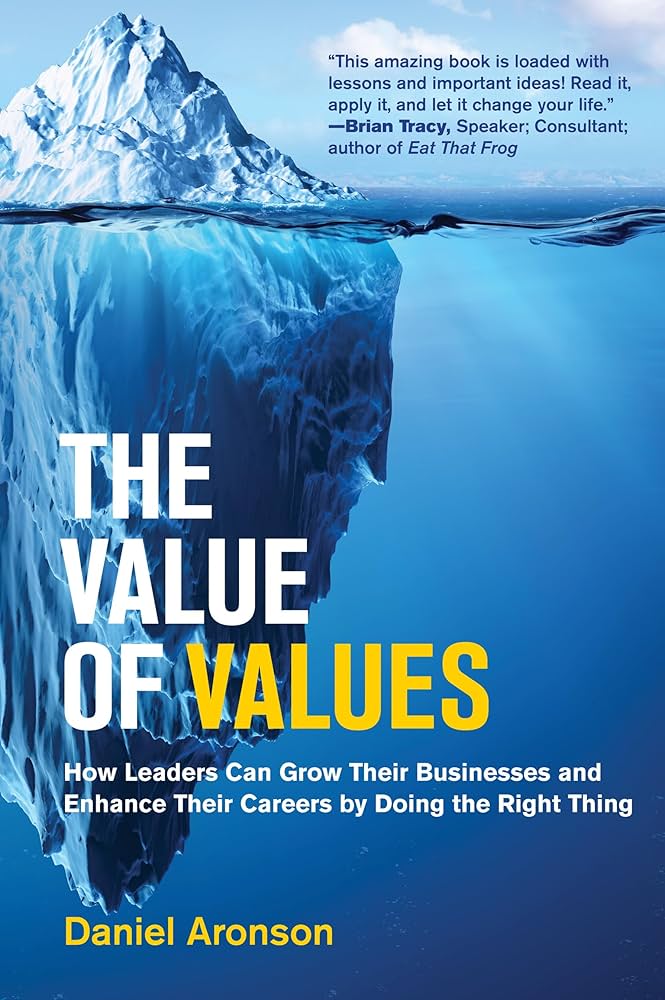
The Value of Values: How Leaders Can Grow Their Businesses and Enhance Their Careers by Doing the Right Thing
By Daniel Aronson (MIT Press, 2024)
Of the many books on the business case for ethics, social justice, and green principles I’ve read and reviewed over the years, this is the first to reflect massive global changes over the past five years: COVID, the Black Lives Matter movement that gained prominence after the murder of George Floyd, accelerated climate change (p. 155) and—though the book predates the 2024 election—the growing authoritarian backlash. These system-wide seismic shifts interact with each other and can threaten the stability of companies that have not prepared (p. 175).
Aronson and his consulting firm, Valutus, have done massive work with major clients, and massive research on other success stories. In this rapidly changing world, he proves doing the right thing not only remains a business success strategy, it becomes crucial.
My most recent book, Guerrilla Marketing to Heal the World, is my fourth on that topic. It’s also well-researched (with over 400 reference citations), though I lacked the consulting base to fill the book with stories from my practice. But it was published in 2016. I’ve known it needed updating but haven’t been motivated to do the work (I’m working on a different book). So I’m delighted that Aronson validates the core principles of those four books:
- Done right, initiatives that improve ecosystems, increase social justice, and decrease or mitigate destructive influences like hunger, poverty, war, racism/othering—and, of course, catastrophic climate change—can be highly profitable. They enable massive cost reductions and major revenue improvement. Lowering costs while boosting revenues = more profit.
- Beyond the obvious dollars-and-cents direct impact, many other benefits ensue. To name three: more loyal and productive employees who stay longer and do more; happier clients/customers becoming unpaid ambassadors; easier interactions with regulators. While I discuss these in my book, Aronson has found ways to quantify them—and the positive financial impact can be enormous. Example: 3M’s Pollution Prevention Pays program not only blocked 3bn pounds of pollution but saved $2bn (p. 71).
- Factors in the previous bullet generate a positive reputation that compounds those benefits; ignoring them causes “severe reputational risk” (p. 206).
Aside from the final ten pages, Aronson doesn’t talk much about positive publicity and marketing, which I cover in detail in GMHW. Publicity amplifies all those reputational benefits.
I took more than ten pages of notes. A few of the highlights:
- Competitors pay (in lost business diverted to you) for your values-based improvements (p. 10)—and thus, if you DON’T build in values—or don’t work to maintain your values leadership as others start emulating and exceeding—it will cost you business (pp. 45-49, 122).
- Waste reduction yields five additional benefits that multiply the savings in ways we usually don’t even think about—such the fuel saved in not heating and cooling a warehouse you no longer need (p. 14) or using water that’s already the right temperature instead of heating some water while cooling other water—which helped save IBM $3.6mm per year, returning $4 for each dollar saved on its water bill (pp. 73-74).
- 82 percent of consumers have taken active steps to support a values-aligned company; 76 percent will tell others—and an astonishing 73 percent will take the risk to defend that company against negative accusations (p. 36).
- Diverse workplaces (by culture, economic class, race/ethnicity, sexual orientation, age, gender, etc.) dramatically cut costs in several ways, from direct cost reduction to easier recruitment and retention to better price-earnings ratios to vastly higher productivity (pp. 75-77, 83-87, 179-208).
- By constraining choices, values encourage innovation (p. 79).
- Language influences outcomes: inclusive, team-building language like “we support” outperforms excluding language like “we oppose” (p. 119).
- While it may seem unintuitive, values-centered companies did well during the pandemic because…
1) more people considered values in their purchasing decisions—and this shift is likely to last (pp. 124-125), in part due to climate awareness (pp. 132-133);
2) purpose-driven companies listen for early warnings of environmental and social crises, so they have more time to plan healthy responses (p. 138).
- Rather than simply add new, values-based products, replace the anti-values products to keep your expenses consistent [and, I would add, strengthen your values proposition and your credibility with consumers and other stakeholders who demand consistency] (p. 151).
- Long-term customer retention is easier for committed companies—and if customers see themselves as long-term, they’ll put in the time and resources to use your products more effectively, becoming happier and more likely to recommend you (p. 198).
- Stick to your principles. Sincerity matters. You can gain support from people who disagree with you and respect your stand, as Tim Kaine did in his successful race for Virginia Governor (pp. 224-225). But if you talk the talk but don’t walk the walk, you’ll face greenwashing/purposewashing accusations and won’t reap the benefits (pp. 208-230).
- Finally, tell others what you’re doing and why (pp. 230-239).
|
|
|