The Clean and Green Club, February 2026

<!doctype html>


Having trouble reading this as an email? Please visit thecleanandgreenclub.com to read it comfortably online.

Shel Horowitz’s Clean and Green Marketing Tip: February 2026

Great news! All of my eBooks with a publication date through 2023 are now free to subscribers to The Clean and Green Club (the monthly newsletter I’ve been publishing in some form all the way back to 1997). https://shelhorowitz.com/shels-green-products-and-services/
It’s a “Both, And”
People making protest posters
Image: Photo by Alena Darmel via Pexels

“Don’t find customers for your products, find products for your customers.”

—Seth Godin, “Building Blocks of Marketing”

I usually agree with Seth Godin, who I read daily. But this time, I see it as not “either/or”

but “both, and.” Absolutely, find products for your customers. Ask yourself some
important questions, like:

  • Why did they buy what they bought from me?
  • What other products or services would add value to that previous purchase?
  • What other products or services would address other needs that someone who bought for that reason might have?
  • What would be the next product they would want after success with the first one, and why?
  • How will I create and distribute marketing messages specifically designed to attract existing customers’/clients’ attention to the new offer?

But also ask another set of questions, like:

  • Who outside of my existing market would have a need or desire for this product or service—and why?
  • How could it be repurposed for new markets with no changes? For example, a creative new tool that helps carpenters might also be useful to plumbers, roofers, masons, etc.
  • How could it be repurposed for new markets with smallish changes? A book or online course on the business end of chiropractic could easily be repurposed for other medical specialties with 10-20% new content, because the business side is going to be pretty similar: you will still address the challenges of bringing in patients, working with staff, dealing with government regulation, etc.
  • How will I create and distribute marketing messages specifically designed to attract and resonate with this new market? If you’ve been reading this newsletter for a few years, you might remember that I’ve talked about different marketing messages when you’re marketing the same green product to Deep Greens, Lazy Greens, Non-Greens, and Anti-Greens.
  • And, very importantly, can I provide adequate support for the people within that market—how much and what sort of new expertise and infrastructure will I have to acquire or bring on board? If the answer is no, don’t expand into it until you can answer with a yes.

I ask questions like these (and many others) in my consulting practice, to uncover new
possibilities and also to make sure the realities are clear. If that would be useful to you,
please get in touch. I offer first-timers a 15-minute freebie consult:
https://calendly.com/meet-shel/15min

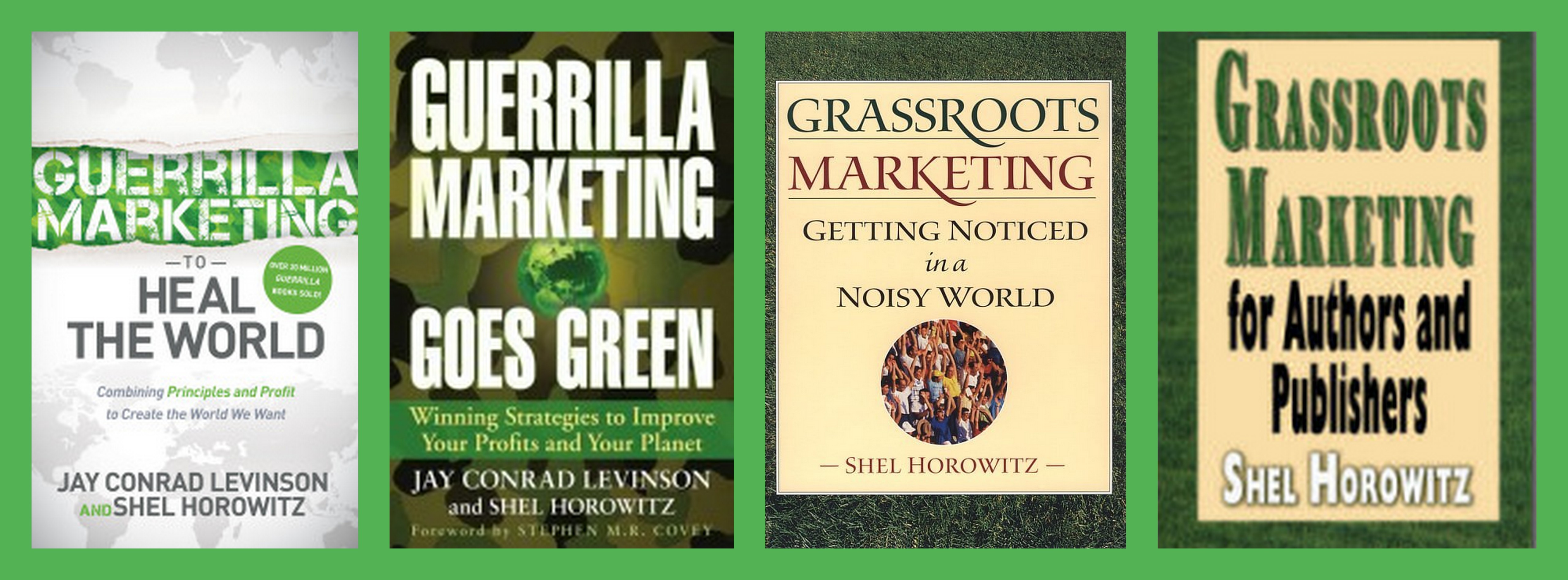
Discover why Chicken Soup’s Jack Canfield, futurist Seth Godin, and many others recommend Shel’s 10th book, Guerrilla Marketing to Heal the World (and download a free sampler). Autographed and inscribed copies available.
Janette Anderson interviewed me for a wonderful episode on how to be an activist at any age. This was the first time I devoted an entire interview or talk to this topic, which I hope to turn into my 11th book.

You can watch at
https://www.youtube.com/watch?v=-kzxdZ37HT8&t=2s You can also visit my interviews page to read 22 highlights from that interview.


View highlights from (and listen to) more than 30 podcasts ranging from 5 minutes to a full hour. Click here to see descriptions and replay links.

From Ellen Finkelstein:

A couple of friends have been frustrated by not seeing progressive politicians or well-known thought leaders offer positive ideas for improving life in the United States. So we decided to create a place for anyone to post ideas on a variety of topics, such as gun violence, healthcare, homelessness, poverty, immigration, and more. And we hope people who can implement them will notice. It’s a simple site but it works.

Please post your ideas here and then share the site! https://www.project2029.community

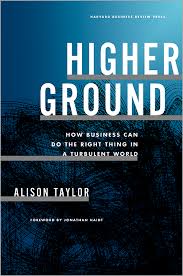
Higher Ground: How Business Can Do the Right Thing in a Turbulent World

Higher Ground: How Business Can Do the Right Thing in a Turbulent World

By: Alison Taylor (Harvard Business Review Press, 2025)


Back in 2003, I published the first of four books on why building environmental, social, and ethical good directly into products, services, processes, and even mindsets is a profit strategy. In all four books, I focus on how business bottom lines can benefit when the company does the right thing. 


So I understand where the author is coming from in a book that could have been subtitled “How to Avoid Getting Your Company Targeted by Activists.” Self-defense and self-interest reflect the cynicism we find in much of the business culture. They may not reflect our true internal attitudes, but are a way to open those cynical executives to new mindsets. While I chose to look at encouraging aspirational goals by looking through the lens of self-interest, she focuses more on risk avoidance.

I was a quarter of the way through before I had that epiphany, and then I could start enjoying the book and not just being irked by it. She goes deeper and with more intensity into that mindset than I ever did. She also has decades of in-the-trenches project work for major corporations, and that’s completely outside my practice that focuses mostly on solopreneurs, microbusinesses, and community organizations. My knowledge of the world of multinational corporations is mostly research-based; hers is hands-on. So she chooses to target scared, worried executives at mid- to large-sized companies.


The book is based not only on her own experience but on numerous interviews and familiarity with many other books. And there’s a lot here: I took 11 pages of notes, versus 3-6 in most of the books I review.


Her superpower seems to be juggling conflicting needs in a world where being silent can get you in at least as much trouble as making a policy stand (p. 129)—and she’s not afraid to be contrarian. As one prominent example, in the worlds of solopreneurs and microbusinesses, activists, and community organizations where I do most of my work, transparency is almost always seen as a virtue. But Taylor makes a compelling case that opaqueness, in some situations, is a better option, because people will take the time to huddle and work out differences—while in a fully transparent model, they might just shout at each other from metaphorical opposite streetcorners, open up unsolvable cans of worms, reduce trust, and get buried in criticism because they haven’t done enough (pp. 141-149).


She also criticizes the all-too-common box-checking approach to ESG (Environmental, Social, Governance: a common framework for looking at social progress), noting that diagnostic instruments applied company-wide create resentment from people whose duties aren’t even relevant to what’s being measured, yet have to take time away from productive work for the assessment (p. 199). She also perceives that far too many compliance officers think all they have to do is track down and fire the “bad apples”—but without addressing the systemic flaws that allowed those bad apples to go bad, new ones will reappear. As she puts it, that “conveniently absolves leaders of personal responsibility for wrongdoing on their watch (pp. 161-162). And she shocked me by citing research showing that narcissistic CEOs tend to score surprisingly well on ESG (p. 178).


She wants to get the discussion unsiloed, so that, for instance, sustainability people are actively problem solving alongside risk management and compliance people. And that might help when over-eager managers change things around without first interviewing those who will be directly affected. She recommends going beyond that and creating a culture where employees feel confident speaking up and don’t fear reprisals (p. 213)—as well as ensuring that your own house is in order before you tackle the world’s big problems (p. 220).


Taylor plants her flag on strategy (pp. 83-85)—and grounds that strategy in centering human rights 106-118) rather than changeable political issues.

Ultimately, as I did a decade earlier, she validates the idea of building companies on the basis of their values and purpose, both of which are addressed all the way through.

There’s a lot more. This well-written, well-indexed, and thoroughly footnoted book may shift your perspective. It’s a good complement to my own 10th
th book, Guerrilla Marketing to Heal the World, which is now available as a freebie in PDF format (reply to this newsletter with the subject, “GMHW PDF, please”).

Connect with Shel

Turn Your Sustainability/CSR Report Into Powerful Marketing!  http://goingbeyondsustainability.com/turn-that-nobody-reads-it-csr-report-into-a-marketing-win/

About Shel

Speaker, author, and consultant Shel Horowitz of GoingBeyondSustainabiity.com helps businesses find the sweet spot at the intersections of profitability with environmental and social good — creating and marketing profitable products and services that make a direct difference on problems like hunger, poverty, war, and catastrophic climate change. His 10th book is Guerrilla Marketing to Heal the World.

If you’re not already a subscriber, please visit http://goingbeyondsustainability.com and scroll to the very bottom left corner. You’ll find lots of interesting information on your way to the subscription form, too.

————–

Links in this newsletter may earn commissions. Please click here for our privacy and endorsement policy.


Powered by:

GetResponse

Leave a Comment

Name: (Required)

E-mail: (Required)

Website:

Comment: