Category Archive for Hear and Meet Shel

The Clean and Green Club, July 2023

<!doctype html>


Having trouble reading this as an email? Please visit thecleanandgreenclub.com to read it comfortably online.

Shel Horowitz’s Clean and Green Marketing Tip: July 2023

What Got Left Off His List?

In a recent newsletter, Ian Brodie discusses having a signature style for your public-facing writing: the stuff that you write to draw an audience specifically to YOU (or, fellow writers-for-hire, for your client). You might have to subscribe to see it; I had to subscribe (again) to get into the archives so I could share the direct link. He describes several possibilities in some detail:

  1. Cause-motivated maverick
  2. Serious expert
  3. Charming and funny
  4. Angry ranter
  5. Experienced friend

Brodie recognizes that his list is not complete. And here’s one I’d add: Passionate purveyor (PP).

I think a lot of you are probably PPs: you run some kind of artisan business where quality and craftsmanship matter far more than volume. Maybe you make the product, maybe you sell or service it. Maybe you run a retail store that showcases your curation of those kinds of products, and you don’t just put stuff on the shelves but work with your customers to understand their needs and help them sort through the offerings to find the perfect one for them at that exact moment.


Two days before writing this, my wife and I spent $2000 on a bed set from someone who did just that. Yes, we probably could have saved a few hundred dollars elsewhere—but even as frugal as I am, I wanted the guidance. (And I bought the floor model, which knocked the $3800 price down by $1800). We went to three bed and mattress stores that day, starting with the one that got the sale. The other two convinced us that we had made a good choice not just in what we bought, but in whom we bought it from.


You want to be the best so your customers and clients will fall in love with what you do (and, perhaps subconsciously, by extension you want them to fall in love with you—nothing wrong with that!). You might do this through your sales floor personnel (as the bed store did), but also with personal touches in your signage: the way you describe a certain cheese, or an incisive book, or the comfort and quality of the all-natural fabrics you use—in short, telling the product’s story in a compelling way.


My first understanding of the power of the PP approach harnessed to story-based copywriting was through
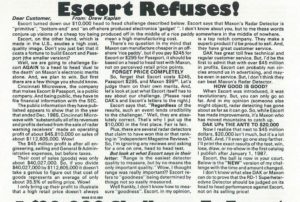
Drew Kaplan’s DAK catalog in the 1980s. I think he could probably have fascinated me into wanting to buy a cardboard box. While I would only buy a few items a year from him, I would eagerly devour the catalogs, reading about products that didn’t interest me at all just to catch his enthusiasm—his passion. The link above takes you to an archive that allows you to download any of the catalogs just by clicking on the cover, no charge.


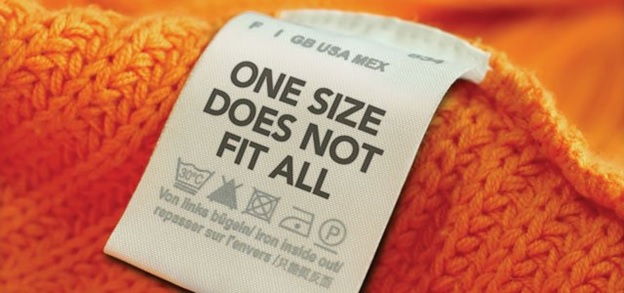
If this is what you do, make it very clear in your marketing. People will pay more to do business with experts who understand how to find the best match for each and every buyer—who understand that one size never fits all, who can make them feel special and send them home with exactly the right thing.

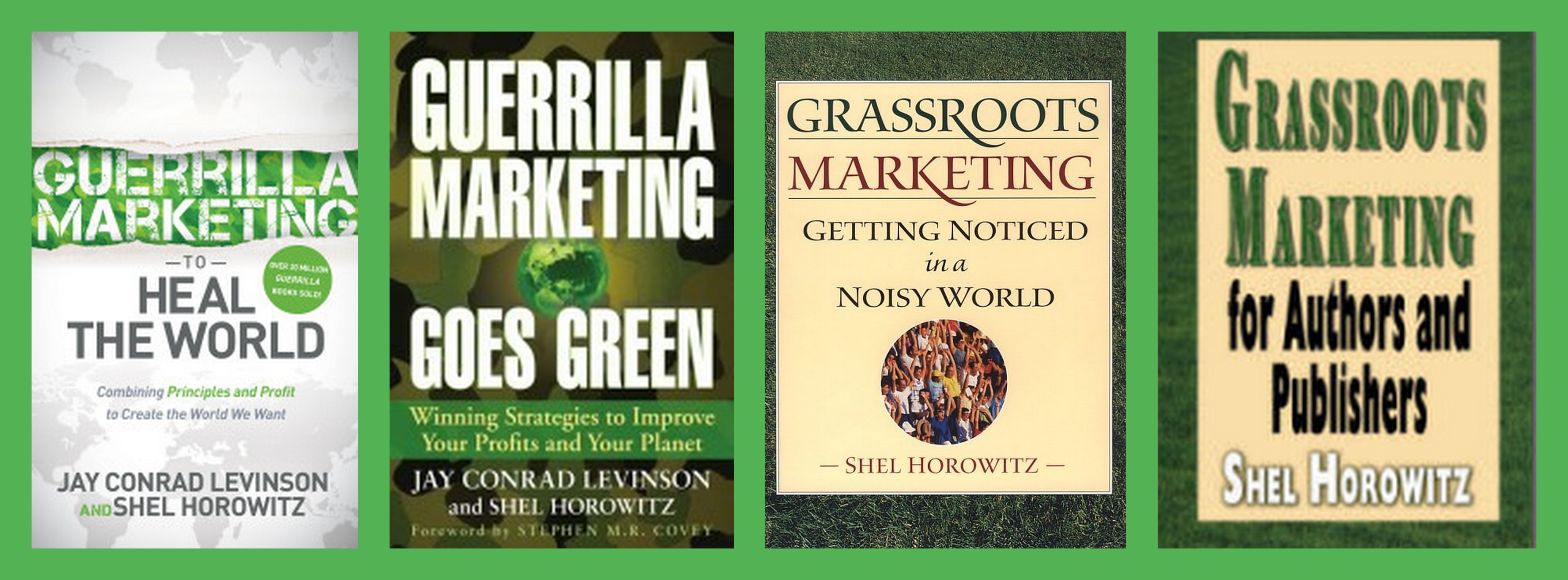
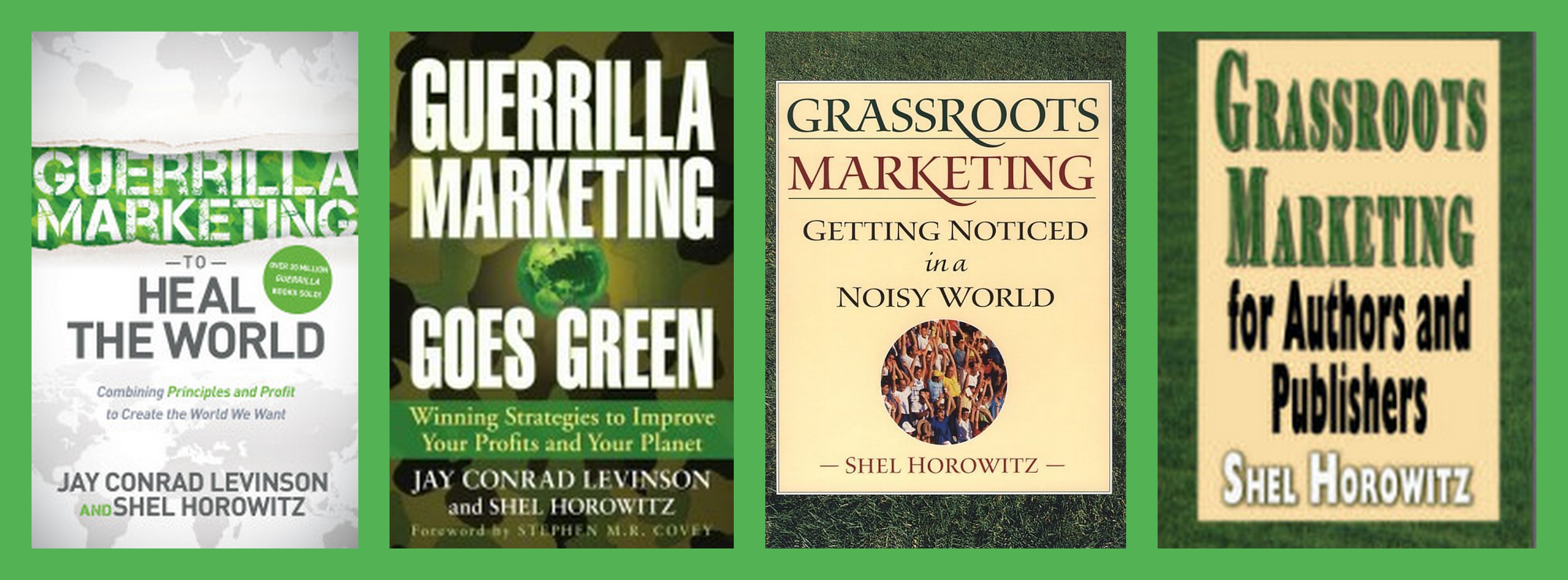
Discover why Chicken Soup’s Jack Canfield, futurist Seth Godin, and many others recommend Shel’s 10th book, Guerrilla Marketing to Heal the World (and download a free sampler). Autographed and inscribed copies available.
I consider this one of my best interviews ever, and we covered a lot of ground I don’t normally get to in interviews. Aveline Clarke of the 6 Star Business Podcast (all the way in Australia) is a terrific interviewer! You can read details in a much more thorough summary on my recent interviews page.

Audio only with transcript:
https://podcast.6star.business/1743080/13106695-profitable-sustainability-balancing-business-success-and-positive-impact-with-shell-horowitz/

Or video without transcript:
https://www.youtube.com/watch?v=mibStVs0MiY

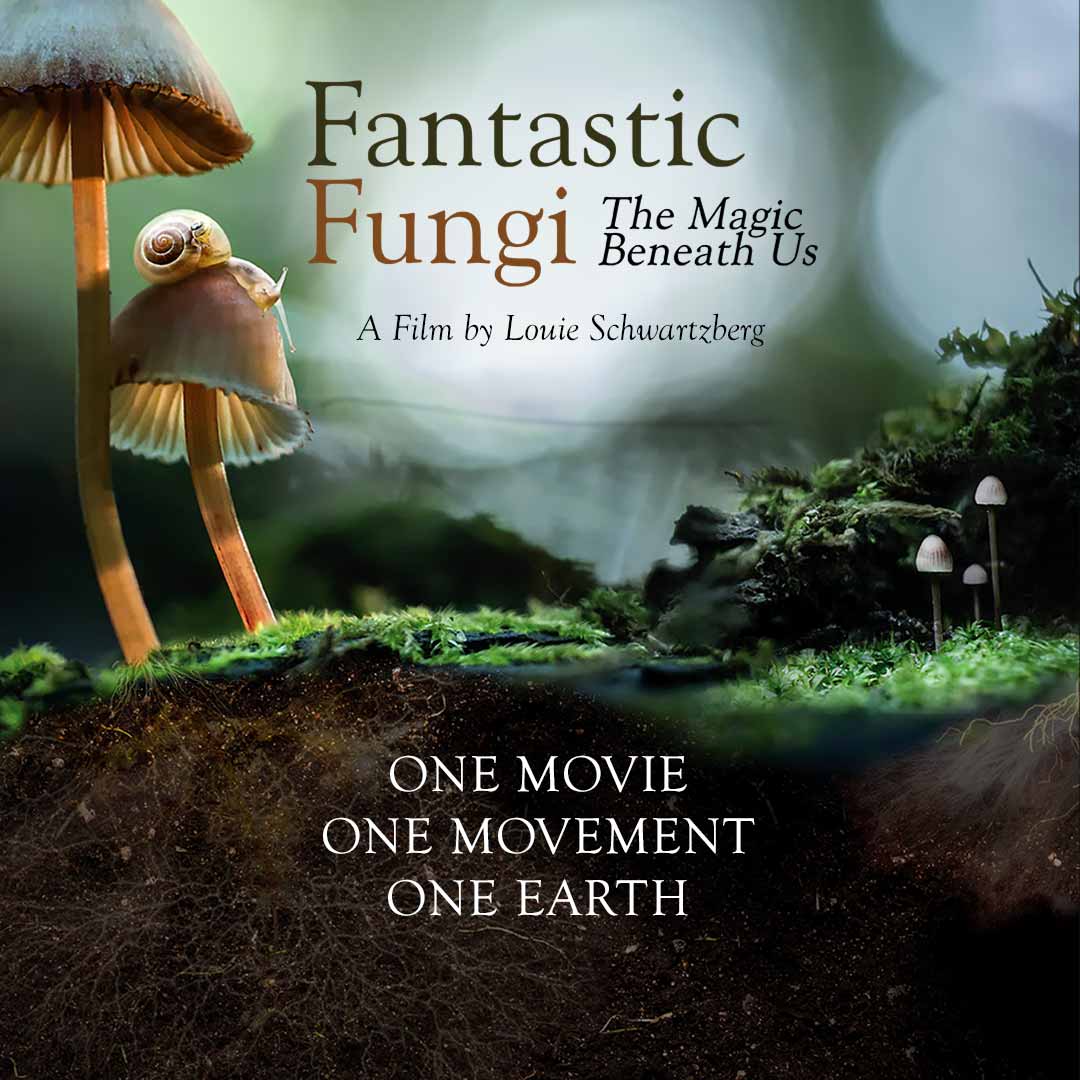
Fantastic Fungi (Movie)

 Fantastic Fungi
 Directed by Louie Schwartzberg

I’ve been fascinated by the intricacy of nature for decades and began to pay attention to non-animal natural systems around 1971, when I took high school electives in ecology and field biology. I remember discovering the book The Secret Life of Plants a few years later—and listening to Stevie Wonder’s album with the same title when HE discovered the book. At the Bioneers-by-the-Bay conference in 2005, I heard the late Dr. Lynn Margulis give a
fascinating slide talk on the secret life of bacteria (the link will take you to her section of my report; only rough notes on the beginnings of her talk, as I couldn’t take notes in the dark when she ran the slide show). I’ve known for several years that trees not only communicate with each other but act in ways that benefit the forest even if that collaborative action puts the individual at risk—just as people sometimes do. And for at least a few years I’ve known that the primary inter-tree communication system is the underground mycelial network: in other words, fungi.


Neither plant nor animal, fungi are the most diverse kingdom in nature, with something like a million species. About 20,000 of those species produce mushrooms as their reproductive organs. And this movie tells some of their astonishing story—including (and this I’d never heard before) that the evolutionary tree of mammals branched off from mycelium. If it was
controversial even as recently as 98 years ago to claim that humans are descended from other primates such as apes, imagine the backlash when people start hearing that we’re descended from mushroom networks!


“Fantastic Fungi” would be worth watching for the cinematography alone. Time-lapse movies allow us to see the opening and blossoming of dozens of mushrooms, often in clusters and sometimes accompanied by plants opening right next door. The natural landscapes run the gamut from dense forests to arid canyons. It’s as visually stunning as a Jacques Cousteau film.


But there’s so much more in this roughly hour-long movie (the YouTube version I saw was an hour and twelve minutes and included material before and after the actual film). The filmmakers interview a number of leading-edge scientists across several disciplines such as ethnopharmacology, as well as food writer/chef Eugenia Bone and natural wellness celebrity Dr. Andrew Weil. They also interview two cancer patients who were part of a clinical trial involving psylocibin, both of whom described the experience in deeply spiritual terms.


Are you wondering, why is Shel reviewing this movie—what does it have to with environmentally- and social-equity-friendly business or how social change happens? I would make the case that it’s directly relevant. Understanding the natural world, the complexities of interdependent species across different kingdoms and the threat to civilization if these networks are destroyed is crucial to preserving them, and thus preserving humans on Earth. And it happens that the day I watched the movie and wrote this review, I also became aware of an attempt to pass a law in Brazil that would trash the Amazon basin and evict indigenous people so the whole thing could be industrialized—cutting off the regenerative system that is probably keeping our planet alive. Understanding the fungal world seems like an important first step in protecting that natural heritage, in the Amazon and elsewhere.

Connect with Shel

Turn Your Sustainability/CSR Report Into Powerful Marketing!  http://goingbeyondsustainability.com/turn-that-nobody-reads-it-csr-report-into-a-marketing-win/

About Shel

Speaker, author, and consultant Shel Horowitz of GoingBeyondSustainabiity.com helps businesses find the sweet spot at the intersections of profitability with environmental and social good — creating and marketing profitable products and services that make a direct difference on problems like hunger, poverty, war, and catastrophic climate change. His 10th book is Guerrilla Marketing to Heal the World.

If you’re not already a subscriber, please visit http://goingbeyondsustainability.com and scroll to the very bottom left corner. You’ll find lots of interesting information on your way to the subscription form, too.

————–

Links in this newsletter may earn commissions. Please click here for our privacy and endorsement policy.


Powered by:

GetResponse

The Clean and Green Club, March 2023

<!doctype html>


Having trouble reading this as an email? Please visit thecleanandgreenclub.com to read it comfortably online.

Shel Horowitz’s Clean and Green Marketing Tip: March 2023

 Where Left and Right Meet—and Where They Don’t

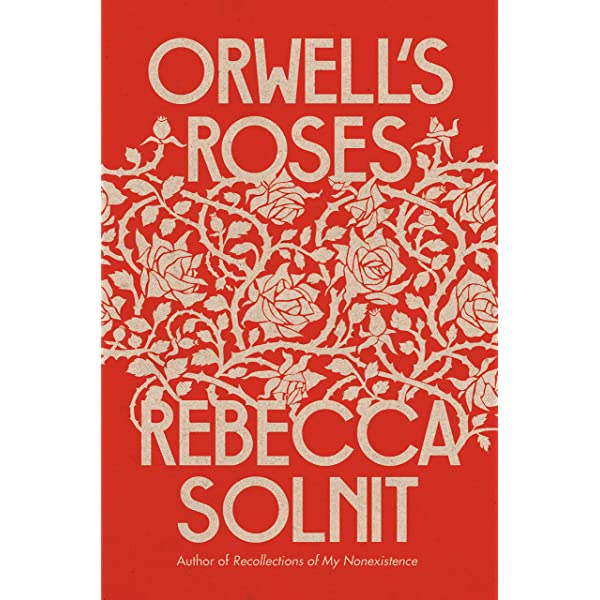
In her book, Orwell’s Roses (see book review, below), essayist Rebecca Solnit writes,

Past and present support for authoritarians and denial of their crimes among those who are supposed to be the left has long made me wonder what, if anything, the term left means, since at other times it means those who support the human rights, freedoms, and egalitarianism that are antithetical to this

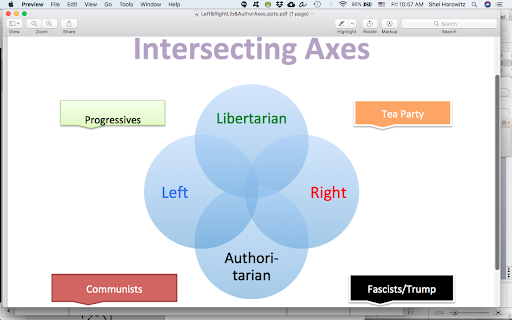
Perhaps I have an answer for her: Left and right, libertarian and authoritarian are often thought of as linear: as a journey of static points along a continuum. Some people even see this “linear” journey as age-related: that most people grow more conservative and more comfortable with repression as they get older.

Maverick that I am, I see the world differently. My theory is much more circular. Think of two circles, intersecting at two 90-degree angles at opposite ends of each circle (180 degrees apart)—kind of like this drawing of a hydrogen atom, but with only two circles. One circle embodies points on the left-right spectrum, the other marks degrees of loving freedom or loving repression.

What are those points of intersection? Left and right come together at both libertarian and totalitarian ends. Similarly, along the freedom arc, they meet at both left and right. I see very little difference between Fascist thugs of the Right and Stalinist thugs of the Left; they are both into suppressing dissent and inflicting an all-powerful state. And this, I believe, is how the socialist George Orwell—who fought in the militia against the Franco version of Fascism in the Spanish Civil War until he realized that totalitarians of the Left were equally dangerous—came to write two of the most powerful anti-Communist books ever written.


Finding and Harnessing That Common Ground

On the freedom side of the spectrum, it’s no coincidence that Right- and Left-libertarians have both used the “Don’t Tread On Me” flag from the revolution that created the United States of America. Both value personal freedom enormously, but not necessarily the same aspects of freedom. For someone on the progressive side, it might be the freedom to wear clothing more typical of a different gender, while a conservative might be more interested in reducing regulation of small business. And people on both sides might advocate for various positions on issues ranging from homeschooling to firearms to organic foods to unrestricted speech.

Still, Tea-Party libertarians (the real ones, who actually believe in individual freedom even for those who don’t look like them or share their backgrounds) and civil liberties progressives have more in common with each other than either do with the Fascists and Stalinists.
What this means is that politics can indeed create strange bedfellows. You may find opportunities to coalition with people whom you disagree with on many fundamental issues—but where you agree, you can work together, powerfully and effectively.

Want real-life examples? How about these two:
  1. In 1999, I founded a movement called Save the Mountain, to stop a proposed luxury home development that would have ruined the four-state view at the top of the much-loved state park immediately abutting the site. In the press release announcing the group’s formation, I wrote (as close as I can remember it), “Mr. ___________ [developer’s name] has vastly underestimated the love that people of Hampshire County have for this mountain.”

    And it was true! By using messaging that crossed all demographic and psychographic divisions, attracting not just environmental activists but farmers, store owners, academics, local politicians, and more, we created a near-consensus movement that could routinely bring 400 people out to public hearings in a town of 5000—and we achieved near-total victory in just over a year. Even though I expected to win all along, even I’d thought it would take us five years.
  2. Since 1994, environmentalists and Tea Partiers in the Green Scissors movement have worked in coalition to expose and oppose wasteful government spending on things that aren’t good for the environment. They recognize they’re stronger together than separately.


Aging Doesn’t Mean Ossifying

As for people getting more conservative with age, I disagree with that too. From my initial flowering into activism at age 12, I was constantly influenced by my elders—sometimes people who were 60 or more years older than me. I’ve been to two birthday parties four years apart for women who were still passionate activists on their 100th birthdays (the link goes to my blog entry for the earlier one, in 2015). I remember after my arrest during the Seabrook Occupation of 1977 that the largest and most vocal faction inside our armory was the “gray hair caucus,” numbering at least 100 out of the 700 or so gathered inside.

And at 66, I’m still an activist, working on progressive causes such as immigration justice and protection of diversity—but also on showing the business world that addressing the environment and our toughest social issues can be profitable. There have been victories and defeats along the way—but if I make it to 100 like my two friends, I expect I’ll still be doing my part to improve the world.

Discover why Chicken Soup’s Jack Canfield, futurist Seth Godin, and many others recommend Shel’s 10th book, Guerrilla Marketing to Heal the World (and download a free sampler). Autographed and inscribed copies available.
View highlights from (and listen to) more than 30 podcasts ranging from 5 minutes to a full hour. Click here to see descriptions and replay links.

Orwell’s Roses

Solnit, a well-known voice in progressive politics, shows us a very different side of Eric Blair, the complex bundle of contradictions better known as George Orwell. The world knows him as a dystopian author of Animal Farm and 1984: two scathing novels attacking Stalinist Totalitarian Communism. Academics also know his work chronicling the lives of coal miners in his native UK, the impact of imperialism in Burma (where, as a young man, he was a police officer), and fighters in the Spanish Civil War (where he was a soldier fighting against Franco’s fascists). Solnit knows him as an avid gardener with a special passion for roses—who sought refuge from polluted London first in the small cottage where he gardened in 1936, and near the end of his life on a farm on a remote Scottish island where the last eight miles of the journey could only be done on foot; a fighter for the principle of clear language and opponent of government or corporate euphemisms; and above all, an optimist who maintained hope all the way through his life.

Why am I reviewing this book HERE, in my newsletter? What relevance does this fascinating portrait of a many-faceted man have for my audience of business leaders involved in social and environmental good, with an interest in marketing?

First, because Orwell was incredibly aware of the interplay of humans with the natural world. Second, because he was involved in social causes throughout his adulthood, even putting his own life at risk several times. Third, because he himself was a solopreneur, running a little shop in the cottage with his wife. Fourth, because Orwell, himself an outcast as a working-class student at elite Eton and then as an Eton-educated person seen as trying to be better than his peers (p. 22), understood that history is shaped by people on the margins. Fifth and perhaps most germane, because this book has a lot of relevance in its discussions of messaging, building positive AND negative movements, and influencing culture.

Solnit starts (p. 8) by noting that planting can be a semi-permanent legacy; trees we plant might outlive us by generations, sometimes centuries. A tree in my front yard was planted in 1916, when my oldest grandparent was 11; I’ve eaten carob from the 2000+-year-old tree that sustained Shimon Bar-Yochai when he hid from the Romans in a cave in northern Israel for thirteen years when people who had known Christ were still alive. Orwell suggested planting an acorn for “every time you commit an antisocial act (p. 10).”

Solnit has a gift for lyrical writing. She refers to the Carboniferous Era as “a sixty-million-year inhale by plants, sucking carbon dioxide from the sky, and the last two hundred years as a monstrous human-engineered exhale, undoing what the plants did so long ago” (p. 60). Here’s another of many beautiful passages:

Much of the beauty that moves us in the natural world is not the static visual splendor that can be captured in a picture, but time itself as patterns, recurrences, the rhythmic passages of days and seasons and years, the lunar cycle and the tides, birth and death. As harmony, organization, coherence, pattern itself is a kind of beauty, and some of the psychic distress of climate change and environmental disruption is in the shattering of this rhythm… (p. 189).

Solnit celebrates Orwell’s joy in the natural beauty and simple pleasures around him, decrying the puritan, humorless aspects of the Left (e.g., pp. 91-92). Having been criticized for making space for pleasure travel, daily time in nature, and eating delicious food instead of being an activist every waking minute, I appreciate this celebration, and the third-party validation she offers through people like Emma Goldman. In my 20s, I proudly wore a t-shirt with a picture of Emma and a distilled version of her response to an activist who criticized her for dancing, “If I can’t dance, I don’t want to be a part of your revolution.” I still agree, even though the shirt wore out long ago. Solnit gives the complete and accurate quote, in context (p. 114).

So much more to say, but this is already long. Quick highlights:

  • Class perspectives on how we experience nature (p. 163) and beauty—and their interaction with justice/injustice, including visiting a sweatshop “rose factory” in Colombia (pp. 189-219)
  • How authoritarians exploit lies and gaslighting (pp. 222-224)—and the dangers of letting them create and control history (pp. 222-228 and in numerous references to 1984 protagonist Winston Smith’s career expunging inconvenient history from the written record)
  • Orwell’s surprising critique of Gandhi as dogmatic and questioning his tactics (pp. 263-264)
  • Right at the end, a key insight: Orwell wasn’t a prophet of doom but a merchant of hope (pp. 259-264). Orwell issued warnings, not prophecies. Warnings give people the option to change, and avoid calamity. In his own words, “I do not believe that the kind of society I describe [in 1984] necessarily will arrive, but…something resembling it could arrive” (p. 262), “The essence of being human is that one does not seek perfection” (p. 263), and “Our job is to make life worth living on this earth, which is the only earth we have” (p. 264).

Connect with Shel

Turn Your Sustainability/CSR Report Into Powerful Marketing!  http://goingbeyondsustainability.com/turn-that-nobody-reads-it-csr-report-into-a-marketing-win/

About Shel

Speaker, author, and consultant Shel Horowitz of GoingBeyondSustainabiity.com helps businesses find the sweet spot at the intersections of profitability with environmental and social good — creating and marketing profitable products and services that make a direct difference on problems like hunger, poverty, war, and catastrophic climate change. His 10th book is Guerrilla Marketing to Heal the World.

If you’re not already a subscriber, please visit http://goingbeyondsustainability.com and scroll to the very bottom left corner. You’ll find lots of interesting information on your way to the subscription form, too.

————–

Links in this newsletter may earn commissions. Please click here for our privacy and endorsement policy.


Powered by:

GetResponse


The Clean and Green Club, January 2023

<!doctype html>


Having trouble reading this as an email? Please visit thecleanandgreenclub.com to read it comfortably online.

Shel Horowitz’s Clean and Green Marketing Tip: January 2023

 Sporks vs. 3-in-1 Printers
Photo Credit: Lenore Edman
A spork seems like a great invention—until you actually try to eat soup or spear a vegetable. Then, you discover it’s a compromise. It can do some of what a spoon does, and some of what a fork does, but for the most part, does neither very well.

The early 3-in-1 printers were like that, too. Dot-matrix (low-quality) printing, horrendous fax and scanning software, and expensive general awkwardness. They didn’t catch on until they got a lot better. Now, with high-resolution laser printing and quality scanning, good reliability, intuitive software, and smaller footprints both in price and square footage than having three separate devices (well, okay, two—I don’t know a lot of people who still use fax), they make a heck of a lot of sense. My first one, a gift from the manufacturer, retailed for $1200. It had a good laser printer but the scanning software was so awkward I had to relearn it each time I used it. My current one was only about $150, does two-sided printing, and takes up much less space. Once I figured out how to batch scans, my only complaint is the lack of autofeed for scanning. Fortunately, I don’t scan very much.

At this point, even if you only needed scanning or fax capabilities once in a while, why wouldn’t you buy a 3-in-1?

So—What’s the Lesson Here?

This: Usability, quality, and simplicity are as important as convenience. Convenience is only appreciated if you’re not compromising usability, quality, and simplicity. My current printer passes the test—not with flying colors, but adequately for my purposes. The spork, despite its brilliant simplicity, fails—and so did the $1200 printer I no longer have. So, if you’re designing a convenient solution, make sure you don’t leave essential performance tools on the cutting room floor.
In the green world, that might mean making appliances or even floor tiles modular and easy to disassemble, so if one part fails it can be replaced easily and inexpensively. It’s why single-stream recycling (sorted later, not by the user) is so popular. It means that if you offer compostable coffee cups, you should make sure the tops are compostable as well—AND you should have a collection point for used ones at your retail location and other convenient spots.

PS: Even sporks have their uses. I discovered recently that the spork is awesome for scraping out a can of wet cat food. But I don’t think I’d buy one just for that purpose.

Discover why Chicken Soup’s Jack Canfield, futurist Seth Godin, and many others recommend Shel’s 10th book, Guerrilla Marketing to Heal the World (and download a free sampler). Autographed and inscribed copies available.
View highlights from (and listen to) more than 30 podcasts ranging from 5 minutes to a full hour. Click here to see descriptions and replay links.

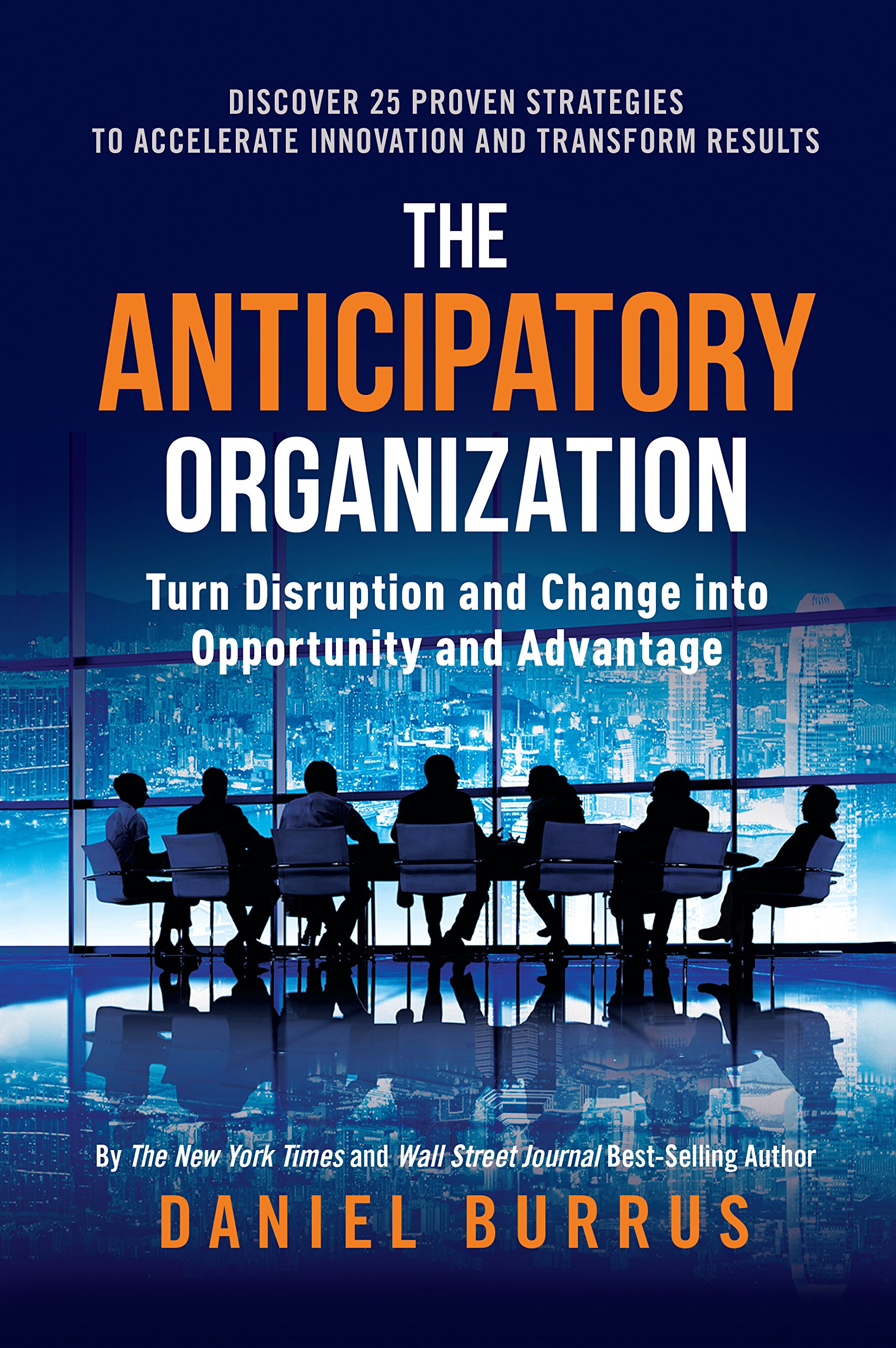
The Anticipatory Organization

The Anticipatory Organization: Turn Disruption and Change into Opportunity and Advantage by Daniel Burrus (Greenleaf Book Group Press, 2017)

A few years ago, I reviewed Burrus’s earlier book, Flash Foresight. This book revisits that territory and expands from it. While aimed at large corporations, much of his advice holds for small businesses, including solopreneurs like me—even if we don’t have the kinds of financial and logistical resources big companies can throw at a problem. Note: I am using his preferred capitalization.

His main theses?

  1. If we divide our forecasting into inevitable Hard Trends (e.g., Baby Boomers are aging out of the workforce and into eldercare services) and malleable Soft Trends (Boomers take their hard-won knowledge with them as they exit), we will know how to both anticipate and be ready for the inevitable changes and consider whether we want to impact the soft ones—such as creating a way to capture that soon-to-be-lost experience-based knowledge through the exit process.
  2. Checking whether we are using Hard (data-based) or Soft (gut-based) Assumptions can help avoid disaster. Trends based on Hard Assumptions are much more likely to come true.
  3. Many of the disruptions are caused by three technology trends: faster processing speed, higher bandwidth, and better/more storage. Others are caused by the changing relationships these tech trends enable.
  4. Even though phones, tablets, and personal computers might face hardware limitations, these three trends allow us to push more tasks out to the cloud—which has, for practical purposes, no such limitations.
  5. Disruptive approaches can be created and harnessed by “Opportunity Managers” who can spot the possibilities and ride the exponential curves. And if you don’t disrupt, someone else will (p.129).
  6. Be a contrarian. Innovate instead of competing. Choose to be extraordinary every day and ask the questions an extraordinary person would ask (p. 157). Skip the obvious problems and anticipate/plan for the deeper ones so you can turn them into opportunities—especially when you see the low-hanging fruit others aren’t noticing. Zag when others zig.

I would add one more to his three megatrends: exponentially better ease of use. That, in turn, democratizes the technology. Ease of use takes something out of the realm of engineers in lab coats and puts it into the pockets of ordinary people, even kids. Compare a DOS interface from the 1990s (or worse, a punch card-driven mainframe of the 1970s) with the few simple, well-labeled icons on a smart phone—WOW! My first experience going online was CompuServe, in 1987. Not only did we have to use command-line prompts, we had to deal with 10-digit all-numeral user names—so we never knew who was writing to us. And my creakingly slow 300-bps modem connection was very balky, so I was constantly getting thrown off. After a couple of months, I gave up. Now, nine-year-olds and ninety-nine-year-olds can get online with a few clicks.

And this means that any of us—a preschooler, a solopreneur, someone just learning a written language—can become a disrupter and harness the early-mover advantage. Even as a home-office solopreneur, I disrupted the local portion of an industry all by myself, back in 1984, after buying my first computer (an original 128K Mac). At that time, my business focused on typing term papers with some resume writing—using an involved process of interviewing the client, writing and editing a draft, having the client approve the wording, and then typing a final, formatted copy. Suddenly, I could do the whole thing in one shift. I put a little half-inch in-column ad in the Yellow Pages reading “Affordable Professional Resumes While You Wait.” Clients loved the speed, quality, and low price. Within about a year, it was the biggest part of my business—for a decade. And after that success, each time I switched my focus again, I looked for an approach that was at least a bit disruptive and different from what everyone else was doing: from popularizing “story-behind-the-story” press releases in the 1990s to staking my position around the idea that business can profit from building deep environmental and social responsibility into core products and services, which has been my core mission for almost a decade now.

Be sure to read Appendix A, a list of 25 principles in the book, and Appendix B, an expanded glossary that serves like an alphabetically organized Cliff Notes; they come after the acknowledgements and author bio, but before the thorough index. These two together will deeply reinforce the learning. Appendix C is about his video program.

Connect with Shel

Turn Your Sustainability/CSR Report Into Powerful Marketing!  http://goingbeyondsustainability.com/turn-that-nobody-reads-it-csr-report-into-a-marketing-win/

About Shel

Speaker, author, and consultant Shel Horowitz of GoingBeyondSustainabiity.com helps businesses find the sweet spot at the intersections of profitability with environmental and social good — creating and marketing profitable products and services that make a direct difference on problems like hunger, poverty, war, and catastrophic climate change. His 10th book is Guerrilla Marketing to Heal the World.

If you’re not already a subscriber, please visit http://goingbeyondsustainability.com and scroll to the very bottom left corner. You’ll find lots of interesting information on your way to the subscription form, too.

————–

Links in this newsletter may earn commissions. Please click here for our privacy and endorsement policy.


Powered by:

GetResponse


The Clean and Green Club, December 2022

<!doctype html>


Having trouble reading this as an email? Please visit thecleanandgreenclub.com to read it comfortably online.

Shel Horowitz’s Clean and Green Marketing Tip: December 2022

Be sure to read the blog post, This Could Change Everything–it’s crucial to understanding a big shift that’s upon us. The link is below the main article and seasonal message.

Marketing Lessons from a Fruit Tree and a Spider Web? Yup.

Last month, we talked about operational reasons why one size DOESN’T fit all. This month, we continue that conversation, but look directly at why it doesn’t work in marketing either—looking to nature for examples.

I’ve been really interested in biomimicry for many years, and have written and spoken about how it can improve our engineering and design. My latest book, Guerrilla Marketing to Heal the World, even has sections about biomimicry visionaries like Janine Benyus, Amory Lovins, and John Todd. It also has a section on John Kremer’s concept of biological marketing, where he talks about a single ear of corn generating thousands of ears.

But it was only just last month, on a beautiful day where I spent half an hour telling a prospect why I was uniquely qualified to write him a marketing plan for a venture that actually is unique (synthesizing ideas from at least three different industries) and then another hour planting garlic, that I really GOT how biomimicry applies to marketing.

Let’s ask some questions of our friends in nature.

Reporter: “Fruit tree, what’s your marketing plan?”

Fruit tree: “You’re going to think this is really funny, because it’s not a human thing—my marketing plan is to be eaten.”

Reporter: “Wow, that sounds crazy. How does that even work?”

Fruit tree: “Birds and animals nibble my fruit, then they move someplace else, poop out my powerful seeds—and my little babies, little clones of me, grow in all sorts of places I can’t reach (in case you haven’t noticed, I’m rooted deep into the ground. Not only is this how I reproduce, it’s the only way I can travel—and I love to travel).”

Reporter: “How about you, Spider—what’s your marketing plan?”

Spider: “Remember that famous book, The Lazy Man’s Way to Riches by Joe Karbo? He was so lazy he took his idea from me. I’ve been doing lazy spider marketing for 250 million years [see https://en.wikipedia.org/wiki/Evolution_of_spiders], and Joe-com-lately didn’t show up until 40 years ago. All that talk about passive income, that’s my jam since before there were any humans. OK, I do work hard spinning a fancy web—but hey, the artistry feeds my soul and the craftsmanship feeds my body. Because once it’s done and my web looks gorgeous, all I have to do is lay back, quiet down, and wait for some company to drop by—and get stuck until I can have a nice snack. It’s eco-friendly, too, by the way. Zero carbon footprint—and without me and my sisters and daughters, this world would be overrun with pesky bugs.”

So what are the lessons here? I’ll offer two of them. If you come up with others, I just might mention you and your idea.

1. Just as the fruit tree’s marketing plan wouldn’t work for the spider and vice versa, a marketing plan for a B2B (business-to-business) green engineering firm would be useless to a B2C (business-to-consumer) weatherization company, even though are both are sub-slices of the green building scene. Your marketing plan has to make sense for your products and services, your market niches and their demographics/psychographics, and yes, your mission, values, and impact on the wider world.

2. Both the tree and the spider offered benefits. The tree’s ultimate client is its own progeny, but to achieve that ultimate goal, it offers food to hungry animals in search of sweetness—just as so many industries (social media networks, Internet search tools, and traditional media, to name three) entice users with services—but their real clients are buying eyeballs, or data. And the spider, perhaps aware of her own arrogant reply, points out the bug protection benefit to us, which helps to neutralize a predator (humans kill a lot of spiders).

If you need help thinking through the best ways to apply this in your particular organization, I’ll happily give you a 15-minute phone or Zoom consultation. Request a time at https://calendly.com/meet-shel/15min (Note: Calendly sometimes offers times it shouldn’t, and I sometimes miss the notifications—so after you get instantly “confirmed” from the Calendly robot, you’ll also get a manual confirmation or request to shift from me.)

Blessings of the Season
If you celebrate a special holiday at this season, such as Christmas, Chanukah (I do that one), Kwanzaa, or Solstice, may you enjoy many blessings and joys in your celebration. If you celebrate a holiday at a different time, such as Ramadan or Diwali, may the blessings I’m sending now ripen and blossom at the time they apply. Here in the U.S., we also celebrate the beginning of a new calendar year; many parts of Asia mark that time a month or two later. Jewish culture celebrates several New Years, the earliest of which is Tu B’Shvat, the New Year for the Trees (this year, it’s the evening of February 5th and all day February 6th. And the one you’ve probably heard of, Rosh HaShanah, is always in the fall, usually in September.

Discover why Chicken Soup’s Jack Canfield, futurist Seth Godin, and many others recommend Shel’s 10th book, Guerrilla Marketing to Heal the World (and download a free sampler). Autographed and inscribed copies available.

View highlights from (and listen to) more than 30 podcasts ranging from 5 minutes to a full hour. Click here to see descriptions and replay links.

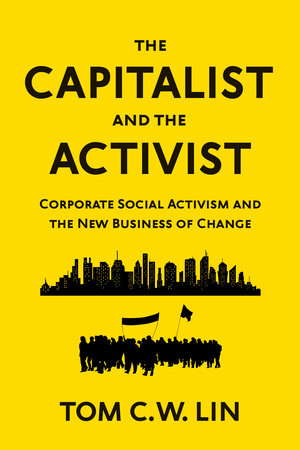
The Capitalist and the Activist

The Capitalist and the Activist: Corporate Social Activism and the New Business of Change by Tom C.W. Lin (Berrett-Koehler, 2022).

Lin urges coalitions between activists and capitalists. Since I’ve written four books on activist business success (most recently, Guerrilla Marketing to Heal the World), I’m very familiar (and agree) with that case.

Lin covers some ground that I don’t. I appreciate his analysis of both sides’ strengths. He cites corporate skills in communications, operations, and accountability (p. 104)—and I’d elaborate to specify analytical/data capture/measurement skills (accountability), exponentially larger resources (operations), and global presence. But I see activists as the better communicators; their passion, tenacity, and creative tactics capture public attention, at no cost, that corporations often have to purchase.

And I appreciate his call for both groups to enlist governments—with far larger resources than activists and corporations combined—as partners (pp. 151-152), and how much power those combinations can bring to bear. He starts off with the four—four!—teenage Parkland shooting survivors who not only organized a massive Washington million-person demonstration (plus satellite demonstrations around the world) in just six weeks but also actually got gun safety legislation passed into law in notoriously gun-friendly Florida (pp. 1-4). Later (pp. 109-113), he discusses JP Morgan Chase’s $200 million economic and skills investment—in close collaboration with local government, business, and activist organizations—to rebuild Detroit’s shattered economy. Chase CEO Jamie Dimon freely acknowledges its self-interest. This effort turned it into “the home bank,” with 65 percent market share (p. 112). The company plans to replicate the effort elsewhere.

He documents many other corporations benefitting through social and environmental advocacy and argues that companies should choose their activism targets according to their strengths: logistics for a delivery service like UPS, housing for AirBNB, financial activism for banks… (p. 153). And he notes that social and environmental action can attract more impact investors and more capital (p. 115).

Also, recency creates relevancy. Lin documents many events and trends that hadn’t happened yet when I wrote my books. He covers the revulsion of CEOs like Apple’s Tim Cook and Facebook’s Mark Zuckerberg against the previous administration’s policies of deliberate cruelty, open racism, othering of numerous groups from Muslims (pp. 72-74) to women to people with disabilities to protestors exercising their rights to dissent to immigrants—even to the point of caging children (pp. 76-79). He also chronicles business response to the nationwide elevation of the Black Lives Matter movement following the murder of George Floyd in Minneapolis (pp. 86-89), the gender gap and #MeToo movement (pp. 92-96), and the attack on democracy itself that culminated in the violent riot of January 6, 2021 (pp. 79-81).

Refreshingly, he warns against over-reliance on corporate saviors (pp. 117-131). Corporate elites (especially those not yet changed by diversity efforts) may slant their causes toward the most mediagenic or the ones with the largest financial stake (p. 127) rather than the most important, may attempt to deflect attention from bad actions in other areas, may water down legislation, etc. And causes without profit potential still need attention—thus, he sees a major role for government.

He encourages companies to see their purpose-driven mission not as PR but as a key element in the company’s core identity (something I’ve advocated for years). And he applauds the many ways activist corporate execs are making changes from the inside.

But he lacks deeper analysis of business’s ability to benefit by addressing really big problems in a systemic way. Guerrilla Marketing to Heal the World has a lot more depth there. In short, the books complement each other, and you’ll benefit by reading both.

Connect with Shel

Turn Your Sustainability/CSR Report Into Powerful Marketing!  http://goingbeyondsustainability.com/turn-that-nobody-reads-it-csr-report-into-a-marketing-win/

About Shel

Speaker, author, and consultant Shel Horowitz of GoingBeyondSustainabiity.com helps businesses find the sweet spot at the intersections of profitability with environmental and social good — creating and marketing profitable products and services that make a direct difference on problems like hunger, poverty, war, and catastrophic climate change. His 10th book is Guerrilla Marketing to Heal the World.

If you’re not already a subscriber, please visit http://goingbeyondsustainability.com and scroll to the very bottom left corner. You’ll find lots of interesting information on your way to the subscription form, too.

————–

Links in this newsletter may earn commissions. Please click here for our privacy and endorsement policy.


Powered by:

GetResponse


The Clean and Green Club, November 2022

<!doctype html>


Having trouble reading this as an email? Please visit thecleanandgreenclub.com to read it comfortably online.

Shel Horowitz’s Clean and Green Marketing Tip: November 2022

If You Appreciate this Newsletter and its Mission, Maybe You’ll Be the One I Hire to Keep it Going
My long-time assistant is moving on to other ventures. I’m looking for someone to take over two tasks from her: 1) Formatting the email (using Get Response) and web (using WordPress) versions of the newsletter each month, and 2) Sending a pre-written birthday message to Facebook friends as their birthdays come up (typically somewhere between 5-15 per day). Interested? Please write to me (shel AT greenandprofitable dot com) with the subject line “Newsletter Formatter” with a bit about your background.
DUMP this Useless Business “Truism” Already—Because It Isn’t True

One-size-fits-all is a myth! Want proof?

  1. A colleague in New York City is trying to drum up support for a citywide education campaign to encourage recycling in New York’s thousands of large apartment buildings. I read her material and thought it’s going to take more than education—because multifamily apartment buildings present challenges that just aren’t relevant in a single-family house, or even a triple-decker with a yard or a driveway. Example: many inner-city apartments (not just in NYC but around the world) are really, really tiny. I’ve seen some that only had one sink in the kitchen and none in the bathroom. Other bathrooms have a triangle-shaped mini-sink that fits into a corner, allowing the bathroom itself to be only a couple of feet wide. I had a friend who used a Murphy bed that folded up vertically into the wall of her one-room apartment, so she could have living space during the day. When space is so scarce, who’s going to devote a big percentage to separate bins for recycling glass, metal, plastic, and paper, plus compost and trash? The suburban solution assumes a garage or at least a large closet and just won’t work in a studio or efficiency apartment with living space of only 200 to 500 feet. Even if you have a bigger place, the average apartment size in NYC is only 702 square feet—with an average monthly rent of (are you sitting down) $4265. If you’ve ever wondered why the tables are so close together in NYC restaurants, that’s why. Every square inch has to count.
  2. Selling to a poverty market. Even the very poor in the US, Europe, or the big economies in Asia would be considered extremely wealthy in much of the developing world. In four countries in Africa, the average gross income is under $1000 US. Since the wealthy are always a little sliver of the population, most residents are surviving on far less than that. So if you’re selling into that kind of economy, you need to re-engineer everything. You’ll be asking how to produce products for 1/10 the cost you’d face in the developed world, how to deal with poor or nonexistent transportation, storage, and dealership network, how to handle government corruption and high security threats, how to get people to pay such a big chunk of their income for your stuff (Among many possible models: no-interest time payments; money recouped from savings; rent-to-own; advertiser or grant support), and how to best support your people on the ground—all without compromising the product or service’s key functionality.

Yes, it can be done—but not with the same models as you’d use in a country where people are far more economically secure. I’ve written a few times about one company that has risen to the challenge: d.light sells solar LED lamps to replace toxic, flammable, and expensive kerosene or go into situations that hadn’t had any artificial light before. That first link has a quick summary of six benefits this product offers to its customers (and some other examples of solving multiple problems with one initiative). The other link is the excerpt from my 10th book, Guerrilla Marketing to Heal the World that describes d.light’s business model and accomplishments in more detail.

If this area interests you, I’d also strongly recommend not only my own book, but two other brilliant books: The Business Solution to Poverty: Designing Products and Services for Three Billion New Customers by Paul Polak and Mal Warwick, and The Fortune at the Bottom of the Pyramid: Eradicating Poverty Through Profits, Enabling Dignity and Choice Through Markets by C.K. Prahalad (both links go to my review of the book). The two links about d.light and the Polak review go to full newsletter issues; you’ll need to scroll down. The Prahalad review is its own page.

Next month, we’ll continue looking at one-size-fits-all is nonsense—but from a marketing lens.

Test Drive This Powerful Green Business Certification—No Cost

I’ve been telling you about the Green Business Bureau and the many benefits they offer, including the GBB EcoAssessment™, a very spiffy self-guided software-driven certification process that is very easy to use and much more friendly to small businesses than other certifications I’ve looked at.

A GBB staffer will be happy to demo the assessment tool for you. You don’t have to be a member to see how it works. All you have to do is fill out this 1-minute form with your name, company or organization, email and phone. Your request will be forwarded to a member of the Green Business Bureau staff.

You do have to be a member to actually go through the assessment and obtain certification. Membership is quite affordable, starting at just $212.50 (10 employees or less) once you factor in the 15 percent off I’ve arranged for you no matter how big your business is. To claim the lower price, just visit https://greenbusinessbureau.com/membership-purchase-options/ , choose the number of employees that describes your business, and enter the code Shel15 (no space between the lower-case L and the number 1).

Yes, I will get a commission if you join—and YOU get 15 percent off.

Discover why Chicken Soup’s Jack Canfield, futurist Seth Godin, and many others recommend Shel’s 10th book, Guerrilla Marketing to Heal the World (and download a free sampler). Autographed and inscribed copies available.

View highlights from (and listen to) more than 30 podcasts ranging from 5 minutes to a full hour. Click here to see descriptions and replay links.

The Answers Are There

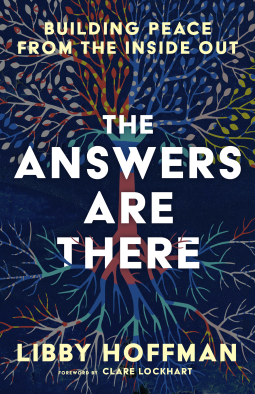
The Answers Are There: Building Peace from the Inside Out by Libby HoffmanThis is a remarkable, super-optimistic book that I wouldn’t even have looked it based on the title, but a colleague I have great respect for not only recommended it but sent me a pre-release copy (publishing date was October 25). It’s all about forming real community in strife-torn lands, in ways that respect and honor and take direction from the indigenous perspective while helping establish resilience in very different ways than the typical First World development agencies try to work. It’s a deeply personal account that’s also elegantly written and remarkable easy to read. I often found myself gliding through 20 or 30 pages at a sitting—not typical of the books I review—even while pausing to take lots of notes.

Hoffman has been working with local peace leaders in Sierra Leone, and especially John Caulker, founder of an organization called Fambul Tok (Family Talk) that has done amazing work in helping that country move through the deep bitterness and resentment following a civil war with tens of thousands of atrocities. Starting in a single village, Hoffman, Caulker, and their colleagues have spiraled out to develop a framework that was eventually accepted by the national government—one resilient enough to help turn the country around during the Ebola epidemic, which hit Sierra Leone particularly hard.

Unlike typical western aid projects, Fambul Tok was at least as much about the process as the result—and because of that, the results have been spectacular.

Some of the key principles and insights:

  • Peace must be in a local context, based holistically in local ecosystems and traditions: not just physical ecosystems, but cultural and spiritual ones
  • No matter how barbarous a crime or series of crimes, reconciliation can happen if space is made for sincere repentance and apology and rebuilding, for listening to the perpetrators AND the survivors, and communally figuring out how to move forward—and sometimes, the most brutal actors can be among the strongest supporters, taking leadership to undo the damage they caused
  • Successful aid/development is not a one-way street from funders and programs to passive recipients; every person has things to contribute, things to learn—and perhaps more importantly, things to unlearn
  • The typical current pattern of development agencies is broken, because it doesn’t recognize that truth, attempting instead to impose a project from the outside, plan out all the details, pilot it and rapidly scale it up, rather than let one emerge organically from the needs—and strengths and capabilities—of the local community, and according to that community’s traditions and initiatives, on a timeframe that makes sense in the local culture
  • Proactively building locally-rooted resilience is immediately empowering to indigenous people who have long felt unheard, unseen, and uncared about—and that resilience is a powerful way to get beyond the next crisis; rebuilding Sierra Leone after the civil war meant it was much more ready to face Ebola
  • Unheard voices may belong to women or others who have not been welcomed into the circles of power—and their leadership can bring deeper changes than anyone would have anticipated before those conversations started
  • Even the most dedicated leaders need to recharge and be nourished, and amazing learning and growth can come out of the spaces and rituals that enable those recharging moments

Hoffman uses a lot of powerful metaphors. Example: As early as page 10, she introduces the concept of repairing the cup (the community) before pouring water (aid) into it, and by page 218, that morphs into a series of nested bowls, spiraling up and out from the local villages through chiefdoms, districts, nations, the world, and whatever might be beyond—which she calls “the idea of wholeness.”

I could easily write another couple of thousand words, pulling out specific quotes and wisdom. But I want to honor the organic nature of Hoffman and Caulker’s work, and not to be just like those western planning and development agencies that impose their own structure on a recalcitrant village instead of coming in expecting to learn as much as they teach—and I don’t want to subject their message and methods to that subtle violence. So I will end simply by saying that anyone who really cares about peace and about ending poverty will find this book well worth the time you put into it.


Connect with Shel

Turn Your Sustainability/CSR Report Into Powerful Marketing!  http://goingbeyondsustainability.com/turn-that-nobody-reads-it-csr-report-into-a-marketing-win/

About Shel

Speaker, author, and consultant Shel Horowitz of GoingBeyondSustainabiity.com helps businesses find the sweet spot at the intersections of profitability with environmental and social good — creating and marketing profitable products and services that make a direct difference on problems like hunger, poverty, war, and catastrophic climate change. His 10th book is Guerrilla Marketing to Heal the World.

If you’re not already a subscriber, please visit http://goingbeyondsustainability.com and scroll to the very bottom left corner. You’ll find lots of interesting information on your way to the subscription for, too.

————–

Links in this newsletter may earn commissions. Please click here for our privacy and endorsement policy.


Powered by:

GetResponse


The Clean and Green Club, September 2022

<!doctype html>


Having trouble reading this as an email? Please visit thecleanandgreenclub.com to read it comfortably online.

Shel Horowitz’s Clean and Green Marketing Tip: September 2022

Effective Persuasion Demonstrated in a Four-Minute Video; Failed Persuasion in Two Sentences

As marketers, we have to be persuaders. Here’s a four-minute lesson in the art of persuasion: Notice how he builds an effective rational argument, point-by-point, and backing it up with documentation (the text of the Constitution, his background, and a government training document) to activate the rational left-side-of-the-brain—then moving stealthily into emotion-based arguments that hook the right-brain side.

He’s a candidate for public office, but he’s on the other side of the country and this is not an endorsement of his campaign. He offers his credentials in the video and on his campaign’s About page (which reinforces both the left- and right-brain approaches here). This video takes a position on a super-controversial issue: How to interpret the language of the Second Amendment to the US Constitution (the gun clause).

This month’s tip is all about modeling persuasion—something we as marketers have to do every day. Too many marketers go on and on about how great they and their company are. They forget that what’s relevant to their prospects is how you can help them, and they fail to use both emotional and logical hooks.

Here’s a real-life example of the ego-centric approach (copied from an actual website):

We engage mission groups, NGOs, private sector organizations, and governments to fund and implement sustainable projects and developments in developing communities.

Find out more about our vision, approach, and projects.

Words like “we” or “our” can be an inclusive or exclusionary term—it can mean “you and I, together on this journey” OR “my colleagues and me, an exclusionary tribe.” The two sentences I typed in from that website are an exclusionary example—while the first and third paragraphs of this tipsheet article are inclusionary: “we” work together as marketers. How would you do that web copy differently?

<this space is to give you time to think about that question>

If the site owner had hired me to rewrite this web page, it might read:

Are your project dollars effectively supporting the right sustainable projects and developments in developing communities? NGOs, private sector organizations, and governments should get their money’s worth.

Find out more about how you can fund and create projects that align with your vision and mission.

See the you-focus in both paragraphs? The emotional triggers around not wasting precious resources and aligning with vision? The same identification of target markets in the original? Copy this inclusive takes some work. The first draft of this tip included four instances of “I” in the first three paragraphs—but they and some later ones were edited out in the revision.

Oh, and if you want some help with your own copy, please visit https://goingbeyondsustainability.com/marketing-consulting-copywriting/ —where you might notice 108 instances of the words “you” (including contraction forms) or “your” but only one “I” and one “I’m,” excluding those in client testimonials—and two very powerfully inclusive “we” sentences.

Test Drive This Powerful Green Business Certification—No Cost

I’ve been telling you about the Green Business Bureau and the many benefits they offer, including the GBB EcoAssessment™, a very spiffy self-guided software-driven certification process that is very easy to use and much more friendly to small businesses than other certifications I’ve looked at.

A GBB staffer will be happy to demo the assessment tool for you. You don’t have to be a member to see how it works. All you have to do is fill out this 1-minute form with your name, company or organization, email and phone. Your request will be forwarded to a member of the Green Business Bureau staff.

You do have to be a member to actually go through the assessment and obtain certification. Membership is quite affordable, starting at just $212.50 (10 employees or less) once you factor in the 15 percent off I’ve arranged for you no matter how big your business is. To claim the lower price, just visit https://greenbusinessbureau.com/membership-purchase-options/ , choose the number of employees that describes your business, and enter the code Shel15 (no space between the lower-case L and the number 1).

Yes, I will get a commission if you join—and YOU get 15 percent off.

Discover why Chicken Soup’s Jack Canfield, futurist Seth Godin, and many others recommend Shel’s 10th book, Guerrilla Marketing to Heal the World (and download a free sampler). Autographed and inscribed copies available.

View highlights from (and listen to) more than 30 podcasts ranging from 5 minutes to a full hour. Click here to see descriptions and replay links.

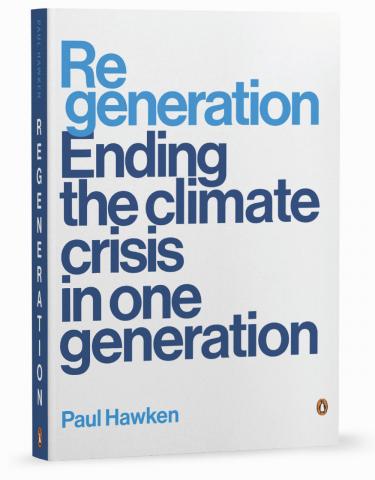
Regeneration: Ending the Climate Crisis in One Generation

Regeneration: Ending the Climate Crisis in One Generation by Paul Hawken (Penguin, 2021)

This book came out last year, while The Carbon Almanac, which I reviewed in June, was only published in July 2020. There are a lot of similarities. Both are large-format paperbacks divided into many short articles, both were assembled by a team, both feature color photographs throughout and many additional resources—including all the numerous reference citations—online.

Most importantly, both spend a lot of time outlining the problems with the way we humans have chosen to live on the earth these last several millennia—but instead of getting mired in despair, both show that we have already developed the solutions we need, and give some advice on how we can undo the damage humans have wreaked on the earth. I recommend reading both, taking good notes on each, and perhaps having a month or two off between readings. They reinforce each other, but they also complement each other, with each including some pieces the other leaves out or glosses over.

Regeneration is more holistic than the Almanac, and somewhat more focused on actions we can take to restore the planet, its ecosystems, its peoples, and the other living creatures we share it with. It encourages action both by individuals and through sweeping changes in policy, legislation, and culture. And it hammers at the hypocrisy of corporate and government approaches that—as one among many examples—allow companies to take carbon credits for planting monoculture forests of non-native species that will take 20 years to offset the carbon, will displace indigenous cultures, and will be destroyed for lumber within a generation or so of planting (p. 245, with a related article on pp. 44-45).

These companies talk the talk, these days, but they aren’t walking the walk; CO2 emissions in 2019 were a third more than in 2000 (p. 246); more than half the total virgin-materials plastic produced since its invention in 1907 has been in the past 15 years, and 60 percent of that ends up as waste (p. 237). The Paris Climate Accord is not resulting in the huge progress we need. Morocco and Gambia are the only two countries on track to limit temperature rise to 1.5 degrees Celsius.

Hawken, who has been a major figure in the responsible business movement for decades, is also much more willing to face the big, scary social issues like poverty, prisons, and racism, as well as under-the-radar but high-negative-impact industries such as fast fashion, big pharma, and big ag—and to look both at their climate impact and their human impact. To look at the reality that much of the world lives in megacities and is distanced from the land (see especially p. 149). And to look at the unintended consequences of human efforts to improve things by reducing biodiversity (addressed throughout the book, with the especially relevant story about how humans disrupted a balanced system in Yellowstone, pp. 64-67).

Hawken and his team are surprisingly optimistic. They cite research to bolster their conclusion that once climate is under control, which can be done in a single generation, the earth will stabilize rapidly (p. 9)—although the work of making sure will continue for a century (p. 12), still a nanosecond in our history as a species.

This review barely scratches the surface of this remarkable book. Go get a copy. Read an article or two every day, and take good notes. Then think about how you can turn these insights into action, starting with the action section at the end, pp. 248-255. I’m including the last page, 255, a brief essay on how to develop and share the hopeful yet realistic stories we need to get un-sunk and move forward: as individuals, communities, nations, and species.

Connect with Shel

Turn Your Sustainability/CSR Report Into Powerful Marketing!  http://goingbeyondsustainability.com/turn-that-nobody-reads-it-csr-report-into-a-marketing-win/

About Shel

Speaker, author, and consultant Shel Horowitz of GoingBeyondSustainabiity.com helps businesses find the sweet spot at the intersections of profitability with environmental and social good — creating and marketing profitable products and services that make a direct difference on problems like hunger, poverty, war, and catastrophic climate change. His 10th book is Guerrilla Marketing to Heal the World.

If you’re not already a subscriber, please visit http://goingbeyondsustainability.com and scroll to the very bottom left corner. You’ll find lots of interesting information on your way to the subscription for, too.

————–

Links in this newsletter may earn commissions. Please click here for our privacy and endorsement policy.


Powered by:

GetResponse

The Clean and Green Club, August 2022

<!doctype html>


Having trouble reading this as an email? Please visit thecleanandgreenclub.com to read it comfortably online.

Shel Horowitz’s Clean and Green Marketing Tip: August 2022

Don’t Send Out Turnoffs!

Latest in the “Archives of Ridiculously Bad Marketing”: I received this email with a From name that matched the name at the bottom of the letter, but the address looked spammy and from a different person–and the subject line was someone else’s name. Oh, and there was no signature or even URL—just the person’s probably-fictitious name. Here’s the content, exactly as I received it. I found at least 8 grammar and usage errors in the four-line first paragraph. How many did you spot?

This Morning I was on your website and I can see a few issues affecting your website Ranking I would like to send you a no-cost proposal on your website that will give some vital insight as to why you aren’t on page 1 yet and to show you some bigger issues. This is totally no-cost you’ll not be charged for any of this
Does this sound good?
Regards,
[Name]

Normally, I wouldn’t even respond—but somehow, I felt that maybe this person was teachable. And I know how hard it can be when it feels like your communications fall into the abyss. So I wrote back:

If I could give you some unasked-for advice: sending an ungrammatical mess with three different identities isn’t a really effective marketing strategy.

Why am I sharing this? Because I see a lot of people making mistakes like this—and I believe one of the best ways to do better is to dissect the failures.

It’s not just the bad grammar, punctuation, and capitalization. What other problems do you see in this 70-word message?

Here are a few that I notice:

  1. The writer failed to be specific. The letter is generic and could be applied to any business owner in any industry.

  2. There’s no attempt to engage with me as an individual business owner, e.g., “I love your focus on business succeeding by solving the world’s biggest problems”—or even “On your About page, I noticed that your use of the phrase, ‘extravagant cookie monsters’ could be costing you search engine rankings because [insert brief explanation].” If I had seen some indication that my correspondent had actually gone to my web page and spotted a problem, I would have been willing to gamble the time to read the report. (And just in case you go looking, that was a made-up example. I’m pretty sure that the archive of this newsletter will be the first time “extravagant cookie monsters” has appeared on any of my sites 😉 .)

  3. While it has a call to action, it has no third-party validation (like testimonials or reviews). It has no URL for me to check it out on my own (and a generic Gmail address that doesn’t give me the website). And it has no credibility.

  4. There’s also no differentiation. What makes this service different than the dozen other SEO services that pitched me this month? The only differentiation is the sense that this is a low-skill individual that I cannot trust to do a good job.

So there’s a quick four-point list of how to turn a pathetic email into a useful one. Go out there and make it happen! And if you want expert help with your copy, visit my contact form (on my main site, Going Beyond Sustainability), and let’s talk.

———————————————————————————————————————————-

Test Drive This Powerful Green Business Certification—No Cost

I’ve been telling you about the Green Business Bureau and the many benefits they offer, including the GBB EcoAssessment™, a very spiffy self-guided software-driven certification process that is very easy to use and much more friendly to small businesses than other certifications I’ve looked at.

A GBB staffer will be happy to demo the assessment tool for you. You don’t have to be a member to see how it works. All you have to do is fill out this 1-minute form with your name, company or organization, email and phone. Your request will be forwarded to a member of the Green Business Bureau staff.

You do have to be a member to actually go through the assessment and obtain certification. Membership is quite affordable, starting at just $212.50 (10 employees or less) once you factor in the 15 percent off I’ve arranged for you no matter how big your business is. To claim the lower price, just visit https://greenbusinessbureau.com/membership-purchase-options/ , choose the number of employees that describes your business, and enter the code Shel15 (no space between the lower-case L and the number 1).
Yes, I will get a commission if you join—and YOU get 15 percent off.


Discover why Chicken Soup’s Jack Canfield, futurist Seth Godin, and many others recommend Shel’s 10th book, Guerrilla Marketing to Heal the World (and download a free sampler). Autographed and inscribed copies available.

View highlights from (and listen to) more than 30 podcasts ranging from 5 minutes to a full hour. Click here to see descriptions and replay links.

Business and Corporate Social Responsibility Presentation

Business and Corporate Social Responsibility Presentation by @Tutor2U, 2015

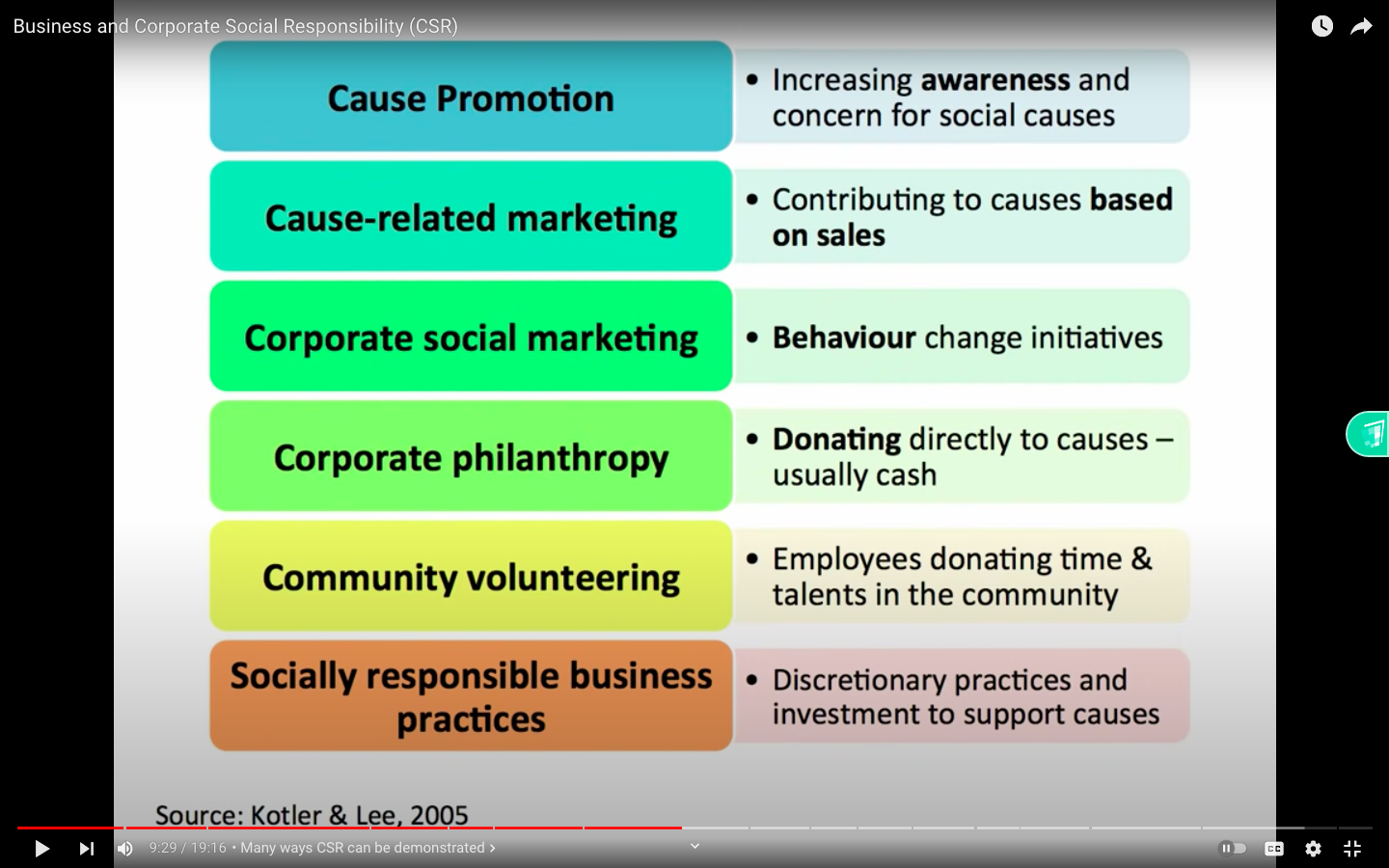
If you find yourself bollixed up when someone asks why social responsibility is important in your business, share this 20-minute slide presentation. The UK-native speaker has a charming accent and his slides are clear and easy to understand. He covers the basics (including the Milton Friedman-inspired arguments against it, which he knocks down reasonably well though not in great detail) and at least mentions the idea that CSR can be a profit strategy, citing experts like then-Unilever CEO Paul Polman and the very positive experience of major UK retailer Marks & Spencer.

For a much deeper exploration of CSR generally and its potential role as a bottom-line success driver, I recommend my own 10th book, Guerrilla Marketing to Heal the World. You can sample some really nice excerpts at no cost at https://goingbeyondsustainability.com/freebies/

Connect with Shel

Turn Your Sustainability/CSR Report Into Powerful Marketing!  http://goingbeyondsustainability.com/turn-that-nobody-reads-it-csr-report-into-a-marketing-win/

About Shel

Speaker, author, and consultant Shel Horowitz of GoingBeyondSustainabiity.com helps businesses find the sweet spot at the intersections of profitability with environmental and social good — creating and marketing profitable products and services that make a direct difference on problems like hunger, poverty, war, and catastrophic climate change. His 10th book is Guerrilla Marketing to Heal the World.

If you’re not already a subscriber, please visit http://goingbeyondsustainability.com and scroll to the very bottom left corner. You’ll find lots of interesting information on your way to the subscription for, too.

————–

Links in this newsletter may earn commissions. Please click here for our privacy and endorsement policy.


Powered by:

GetResponse


The Clean and Green Club, July 2022

<!doctype html>


Having trouble reading this as an email? Please visit thecleanandgreenclub.com to read it comfortably online.

Shel Horowitz’s Clean and Green Marketing Tip: July 2022

Test Drive This Powerful Green Business Certification—No Cost

I’ve been telling you about the Green Business Bureau and the many benefits they offer, including the GBB EcoAssessment™, a very spiffy self-guided software-driven certification process that is very easy to use and much more friendly to small businesses than other certifications I’ve looked at.

A GBB staffer will be happy to demo the assessment tool for you. You don’t have to be a member to see how it works. All you have to do is fill out this 1-minute form with your name, company or organization, email and phone. Your request will be forwarded to a member of the Green Business Bureau staff.

You do have to be a member to actually go through the assessment and obtain certification. Membership is quite affordable, starting at just $212.50 (10 employees or less) once you factor in the 15 percent off I’ve arranged for you no matter how big your business is. To claim the lower price, just visit https://greenbusinessbureau.com/membership-purchase-options/ , choose the number of employees that describes your business, and enter the code Shel15 (no space between the lower-case L and the number 1).

Yes, I will get a commission if you join—and YOU get 15 percent off.

A Peace Prize for Pill Pockets? A Lesson in Ultimate Benefits

If you have a cat or dog, you may have experienced medicating your companion with the help of a nifty thing called a Pill Pocket. It’s a little animal treat shaped kind of like a Hershey’s Kiss. The canine model is about the same size, while the feline version is much smaller. You press the pill into the pocket in the middle and then wrap the corners around it so the medicine is completely enveloped in the treat. And the animal is usually happy to gobble it down.

If you’ve ever tried to medicate some dogs or (especially) cats the old-fashioned way, you know it can be an act of war. I speak from experience that holding a cat’s mouth open and then jamming it closed before the pill can be spat out, while massaging the throat to force a swallow and trying not to get ripped to pieces by the furious cat is not fun for you or the cat.

Pill Pockets uses the slogan, “turn pill time into treat time.” It’s a good statement, focusing on shifting an unpleasant experience into a more enjoyable one for all concerned. But what would happen if their marketing went deeper? What would happen if the explored the ultimate benefits?

I learned the concept of ultimate benefits (and many other basic marketing strategies that I’ve used ever since) reading the books of Jeffrey Lant and interviewing him for one of my own early marketing books. I have my issues with Jeffrey (particularly in his approach to marketing online, which I totally disagree with), but I learned more from reading Cash Copy than any other marketing book. The idea is you keep drilling down until you find the reason for the reason. So if you go to the hardware store to purchase a hammer, your ultimate goal wouldn’t be to own a hammer or even to put nails into the wall—because the goal of hammering the nail would be to put up shelves or hang pictures or build something, and the goal of hanging pictures is to live surrounded by beauty—and the goal of living surrounded by beauty might be to have a more serene and creative life, and the goal of that might be to invent something world-changing that in turn would have a purpose like enabling people to climb out of poverty. You just keep drilling down to the core benefits (yes, I know, hammers aren’t good at drilling ?).

So—the obvious benefit of a Pill Pocket is to get your animal properly medicated. But going deeper, we find much more “ultimate” benefits:

  • Your pet gets the proper dose of medication without hiding or spitting out big pieces of it
  • YOU don’t get clawed or bitten, leading to both a better mood and more productive time afterward
  • Your PET avoids a traumatic incident—or, more likely, a series of traumatic incidents until the medicine is used up or no longer needed—and thus is able to trust you more and be more loving with you
  • If you have kids or housemates, you get to model creativity and nonviolent solutions to problems—which could make a huge impact on an observer who goes on to devote their life to peace, clean energy, or other forms of betterment (in keeping with a core principle of mine that we don’t always know the full impact of our actions at the time)

Here’s the “ultimate” question: What ultimate benefits can you discover in your own products and services, and how can you leverage that to get into new markets?

Discover why Chicken Soup’s Jack Canfield, futurist Seth Godin, and many others recommend Shel’s 10th book, Guerrilla Marketing to Heal the World (and download a free sampler). Autographed and inscribed copies available.

Ian Peterman interviewed Shel on his Conscious Design podcast. Shel is not a designer, but had a lot to say on how design can be a tool of environmental and social justice.

View highlights from (and listen to) more than 30 podcasts ranging from 5 minutes to a full hour. Click here to see descriptions and replay links.

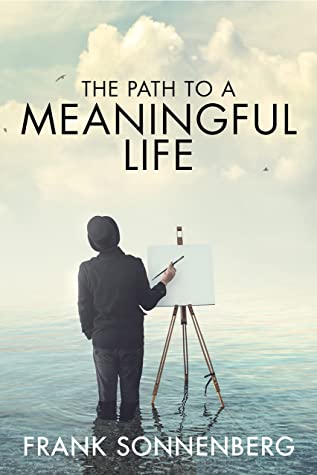
The Path to a Meaningful Life

The Path to a Meaningful Life by Frank Sonnenberg

If you want a book that builds character—and especially if there’s a person in your life who could use some firm guidance—Sonnenberg may offer just what you need. Directed both at business and personal life, his book probes to the heart of what it means to be a person with strong ethics and solid character: someone who others can count on, and who can look in the mirror and feel good. It’s full of lessons, many in easy-to-digest list format, such as:

  • 30 ways to live the Golden Rule (pp. 7-9)
  • 4 reasons why earning your accolades is better than receiving them without doing the work (p. 28)
  • 25 ways to demonstrate a strong work ethic (pp. 35-37)
  • 13 ways to turn mistakes into learning opportunities (pp. 60-61)
  • 9 reasons why selfish people are losers (pp. 87-88)
  • 15 positive business choices (pp. 116-117)
  • 15 negative choices that could ruin your business (pp. 119-121)
  • 10 times you want to walk away from a sale (pp. 123-125)
  • 11 ways to make yourself proud (pp. 154-155)
  • 13 workplace policies that work better than rigid rules (pp. 162-163)
  • 14 examples of leading by example (pp. 181-183)
  • 25 things not to stress about and 15 negative attitudes to dump (pp. 219-225)
  • 20 things to either fix now or regret not fixing them when it’s too late (237-239)
  • 16 ways to give more effectively (pp. 241-242)

As well as affirmations and principles within the text including:

  • “Self-discipline is not a punishment; it’s a gift.” (p. 21)
  • “Winning doesn’t have to be at someone’s expense…focus on how much you can accomplish together.” (p. 63)
  • “Someone’s good fortune is not your misfortune.” (p. 82)
  • “What’s the cost to your well-being of harboring anger and resentment?” (p. 92)
  • “If you think that doing the right thing most of the time makes you reliable, you’re kidding yourself.” (p. 109)
  • [On people who always need to be right] “You never know if your ideas are sound until they are challenged.” (p. 147)
  • “Watch your children grow, and they will teach you what you’ve taught them.” (p. 175)
  • [Quoting actor/author Sean Patrick Flanery] “Do something today that your future self will thank you for.” (p. 187)
  • “Doing your best isn’t an activity; it’s a mindset.” (p. 197)
  • “Impossible means that you just didn’t do it yet.” (p. 203)
  • “A wedding reveals promises made while a funeral recounts promises kept.” (p. 205, emphasis in original)
  • “Forget your to-do list and create a to-be list.” (p. 215)
  • “If work isn’t fun, you’re playing on the wrong team.” (p. 225)

The final list, on pages 245-247, is “30 questions only YOU can answer.” While he presents them as binary choices, I found many of them were really “both-and.” For example, #21, “Identify as a member of a group or view yourself as a unique individual?” I’d even say that my uniqueness could be the sum of my descriptors (writer, social justice/environmental activist, business owner, consultant, husband/father, visionary, music lover, voracious reader, photographer, vegetarian foodie, etc.), memberships (Jewish Activists for Immigration Justice, National Writers Union, a grassroots political action network in my town, several Internet forums, and dozens of groups I support financially), and various intangibles and personal experiences.

While I agree with about 95 percent of the content, there are places where Sonnenberg and I disagree. One is his oft-repeated urging to always finish what you start. I once wrote a piece called “Failure is ALWAYS an Option.” For me, knowing when to walk away is a key life skill. It should not be done casually and it should acknowledge the consequences. A lot of people would look at where I’ve put much of my energy for the past 20 years, see big change-the-world ambitions but less-than-stellar results, and tell me I’m a fool to keep going. But showing the business world that social change and planetary healing can be profitable is still the passion that gets me up in the morning, and I’ve had enough results that I see the worth of continuing. But when something just isn’t working—or simply no longer inspires me—I walk away, without guilt. To me, failure is an essential part of evolution—and my business, my life, and my thinking continue to evolve.

My other two quibbles:

  1. The blanket statement that breaking the law is always wrong (p. 159). I almost agree: breaking the law for personal financial gain or to do violence to others is always wrong. But as a nonviolent activist, I’m well aware of the 3000-year-old tradition of resisting unjust laws. The Bible is full of examples of courageous people who broke unjust laws; my favorite is of Shifra and Pu’ah, midwives to the Hebrews enslaved in Egypt. Ordered by Pharaoh to kill the newborn Hebrew males, they responded with the lame (but effective) excuse that the Hebrew women gave birth too fast. In our own recent past, we saw vast nonviolent resistance to unjust laws in such diverse situations as Nazi Germany and Nazi-occupied territories around Europe; the US Civil Rights, draft resistance, and peace movements; Tiananmen Square; South Africa’s rebellion against apartheid; Arab Spring, Greta Thunberg’s school strike (among thousands of examples)
  2. His long rant opposing affirmative action could have argued (but didn’t) that while you should hire someone who is qualified, if you have a choice to hire another person from the majority culture or someone from a historically disenfranchised and abused culture, this can be a chance to partially right a grievous wrong.

But these are minor points in a book filled with wisdom. So much so that if I had a time machine, I would bring a copy to the teenage version of a certain disgraced recent US president who was so out of alignment with the principles of this book that he was willing to subvert democracy rather than admit defeat.

Connect with Shel

Turn Your Sustainability/CSR Report Into Powerful Marketing!  http://goingbeyondsustainability.com/turn-that-nobody-reads-it-csr-report-into-a-marketing-win/

About Shel

Speaker, author, and consultant Shel Horowitz of GoingBeyondSustainabiity.com helps businesses find the sweet spot at the intersections of profitability with environmental and social good — creating and marketing profitable products and services that make a direct difference on problems like hunger, poverty, war, and catastrophic climate change. His 10th book is Guerrilla Marketing to Heal the World.

If you’re not already a subscriber, please visit http://goingbeyondsustainability.com and scroll to the very bottom left corner. You’ll find lots of interesting information on your way to the subscription for, too.

————–

Links in this newsletter may earn commissions. Please click here for our privacy and endorsement policy.


Powered by:

GetResponse


The Clean and Green Club, June 2022

<!doctype html>


Having trouble reading this as an email? Please visit thecleanandgreenclub.com to read it comfortably online.

Shel Horowitz’s Clean and Green Marketing Tip: June 2022

Test Drive This Powerful Green Business Certification—No Cost

I’ve been telling you about the Green Business Bureau and the many benefits they offer, including the GBB EcoAssessment™, a very spiffy self-guided software-driven certification process that is very easy to use and much more friendly to small businesses than other certifications I’ve looked at.

A GBB staffer will be happy to demo the assessment tool for you. You don’t have to be a member to see how it works. All you have to do is fill out this 1-minute form with your name, company or organization, email and phone. Your request will be forwarded to a member of the Green Business Bureau staff.

You do have to be a member to actually go through the assessment and obtain certification. Membership is quite affordable, starting at just $212.50 (10 employees or less) once you factor in the 15 percent off I’ve arranged for you no matter how big your business is. To claim the lower price, just visit https://greenbusinessbureau.com/membership-purchase-options/ , choose the number of employees that describes your business, and enter the code Shel15 (no space between the lower-case L and the number 1).

Yes, I will get a commission if you join—and YOU get 15 percent off.

50.17 Years in Marketing—and This Still Blew Me Away

Yes, that’s a clickbait headline—something I almost never do in this newsletter. I used it this time to very deliberately illustrate something. Can you guess what it is? Here’s another example—the actual reason I’m choosing this topic for this month’s newsletter: a presentation by direct-mail legend Denny Hatch called

A Whirlwind Tour of Direct Marketing Knowhow: From July 10, 1194 through the 21 st Century

That title got me to stop what I was doing, put aside my agenda for the day, go and watch Denny’s 41-minute talk, and then write this article—and that sequence doesn’t happen too often.

Why were these 15 brief words so persuasive to me? Can you guess?

Yes, it helped that I knew Denny Hatch’s reputation, and that it was sent in a newsletter from Brian Kurtz, for whom I have enormous respect. But the real motivator would have gotten me to click even if I knew nothing about the presenter. Have you figured it out yet? Here’s the secret:

This talk title used specificity to harness curiosity!

By putting in a specific date from more than 800 years ago, in an industry that most people assume is only about 250 years old, Denny didn’t just engage my curiosity, he grabbed it.

One-paragraph digression: And yes, he delivers on why that date is important in marketing—avoiding a mistake too many clickbait headline writers make (a mistake that I’m betting leaves the reader feeling cheated and less interested in the product). If you’ve clicked on any ads that use words like “tragedy” and then name a celebrity like Willie Nelson or Whoopi Goldberg and then discover an ad for a CBD company, you may have experienced that sort of disgust. End of digression.

The thing is, this talk title wouldn’t hook in everyone—but I happened to be the ideal audience for it. I wrote my first marketing copy around April 1972 (yep, that’s the 50.17 years in my own headline) and I’m fascinated by history. So when he offers something very specific and unknown to me about the long-ago history of marketing? Oh, yeah, baby, I am so hooked! For someone who’s more interested in football or the Kardashians, this headline weeds them out. Only the actual markets (marketers and lovers of history) will respond to that title and watch the presentation—but they won’t be able to stay away.

If you’re curious also, his presentation is at https://www.youtube.com/watch?v=8Ww8a-8hyio

Discover why Chicken Soup’s Jack Canfield, futurist Seth Godin, and many others recommend Shel’s 10th book, Guerrilla Marketing to Heal the World (and download a free sampler). Autographed and inscribed copies available.

View highlights from (and listen to) more than 30 podcasts ranging from 5 minutes to a full hour. Click here to see descriptions and replay links.

The Carbon Almanac: It’s Not Too Late

The Carbon Almanac: It’s Not Too Late by The Carbon Almanac Network, foreword by Seth Godin

Did you know…

Bad News

  • Climate change has secondary impacts in every aspect of our lives: flooded homes and roads, inflation, loss of precious beaches, diseases, famines… (pp. 28-29)
  • 634 million people (~2x US population) risk climate-related flooding (p. 34)
  • Flying adds 6x atmospheric carbon per person as the same trip done by train (p. 37)
  • Despite years of pretending they didn’t know, Exxon released a memo (excerpts reproduced on pages 46-47) on November 12, 1982 outlining the consequences of human-caused climate change and identifying fossil fuel industries as the major cause
  • Methane traps 80 times as much heat as CO2; nitrous oxides trap 270 times as much (p. 51)
  • We use 8x energy and produce 7x emissions to support 3x the population of 1950 (p. 72)
  • Plastic produces 6x its weight in CO2 over its lifetime (pp. 78, 79); plastics manufacturing also causes massive deforestation (preventing capture of 6.5 million metric tons per year of carbon) and emits gigatons of CO2. Only 9 percent of discarded plastic is recycled; 12 percent is incinerated, further worsening carbon impact (p. 34).

Good News

  • Only 8 percent of Norway’s 2021 new-vehicle sales were powered by fossil fuels (p. 101)
  • We improved air and water quality and slashed food waste during the pandemic (pp. 113-114)—so we can replicate that success through behavior changes
  • Switching from chemiculture to organic could cut crop losses by about half—as they were before most farmers switched to chemical pesticides (p. 120)
  • Trees, wetlands, and coral reefs embody biodiversity; a single tree can host 2.3 million organisms; coral reefs contain 25 percent of marine species; peat bogs (wetlands) capture twice the carbon of forests (pp. 136-140)
  • Tools such as “border carbon adjustments” (p. 163) and counting GNP to factor in environmental and social costs and benefits (Robert F. Kennedy quote, p. 117) could eliminate the competitive advantage of poor carbon habits and help businesses actively mitigating their environmental and carbon impact
  • Primitive solar continues to power the Vanguard I satellite, launched in 1960 (p. 178)
  • Humans first harnessed tidal power in 687 A.D.; it was widely used in 18th-century England (pp. 182-183)
  • 25 percent of all US fossil fuel hubs are ideally suited to green energy (which provided 90 percent of new capacity in 2020)—thus offering retraining opportunities for thousands of miners (p. 196)
  • We could probably eliminate world hunger by using the 1/3 of all food that’s thrown away uneaten (p. 201)
  • Drip irrigation cuts water 60 percent while increasing crop yield 90 percent over open-channel irrigation (p. 204)
  • Cross-laminated wood buildings have many superiorities over steel (p. 223)
  • Solarizing all US K-12 schools could replace 18 coal plants (p. 245)
  • Above all, humans have risen to overcome all sorts of “insurmountable” crises (p. 326); this book proves we have the know-how—let’s find the will to do it!

You’ll find or extrapolate hundreds more takeaways in The Carbon Almanac, spearheaded by Seth Godin and written by 300+ volunteers. Forthcoming in July from Penguin/Random House. It’s a readable and comprehensive single-volume guide to…

  1. Why atmospheric carbon must be addressed
  2. The many ingenious solutions—and a refreshing willingness to confront the new problems these solutions (from bioplastics to mass-scale solar) sometimes bring
  3. The impact of lifestyle choices, such as using an electric bicycle instead of a car for the short trips that represent more than half of our car travel (p. 166), changing our fashion habits (p. 162), planting trees (p. 155, in numerous suggestions to switch your primary search engine Ecosia, and in the collective’s pledge to replace 10x as many trees as are consumed to produce the book, p. 226), and eating less meat (pp. 76, 200, 203)—and the potential impacts of our activism (I love that the glossary, p. 312, defines “activist” as “You”—and the long list of activist organizations to get involved with).
  4. The way all these factors and many more intersect and interact, presenting a holistic analysis a bite at a time

Besides 40+ pages of information and action resources within the book, each article has an info/sources page on https://thecarbonalmanac.org —which keeps that single volume to a manageable size while encouraging interested readers to drill much deeper. That also allows the content to be updated easily: As a long-time opponent of nuclear power, I wrote to Godin challenging the nuclear fission article’s implication that there have been only three accidents, vs. the actual 100+. While it was too late to change the book text, he immediately posted a correction at the top of that web page, https://thecarbonalmanac.org/093

I’d scheduled my review expecting a mid-June release date. That’s been pushed back a month. I urge you to 1) preorder your copy from your favorite independent bookstore (a chance to make a lifestyle change and support your local economy), 2) get involved in the launch promotion: https://seths.blog/joining-the-almanac-launch-team/ , and 3) sign up for the Carbon Almanac Network’s Daily Difference newsletter (at the bottom of thecarbonalmanac.org home page).

Connect with Shel

Turn Your Sustainability/CSR Report Into Powerful Marketing!  http://goingbeyondsustainability.com/turn-that-nobody-reads-it-csr-report-into-a-marketing-win/

About Shel

Speaker, author, and consultant Shel Horowitz of GoingBeyondSustainabiity.com helps businesses find the sweet spot at the intersections of profitability with environmental and social good — creating and marketing profitable products and services that make a direct difference on problems like hunger, poverty, war, and catastrophic climate change. His 10th book is Guerrilla Marketing to Heal the World.

If you’re not already a subscriber, please visit http://goingbeyondsustainability.com and scroll to the very bottom left corner. You’ll find lots of interesting information on your way to the subscription for, too.

————–

Links in this newsletter may earn commissions. Please click here for our privacy and endorsement policy.


Powered by:

GetResponse


The Clean and Green Club, May 2022

<!doctype html>


Having trouble reading this as an email? Please visit thecleanandgreenclub.com to read it comfortably online.

Shel Horowitz’s Clean and Green Marketing Tip: May 2022

Test Drive This Powerful Green Business Certification—No Cost

I’ve been telling you about the Green Business Bureau and the many benefits they offer, including the GBB EcoAssessment™, a very spiffy self-guided software-driven certification process that is very easy to use and much more friendly to small businesses than other certifications I’ve looked at.

GBB will be happy to let you play with that assessment tool. You don’t have to be a member to see how it works. All you have to do is fill out this 1-minute form with your name, company or organization, email and phone. Your request will be forwarded to a member of the Green Business Bureau staff.

You do have to be a member to actually go through the assessment and obtain certification. Membership is quite affordable, starting at just $212.50 (10 employees or less) once you factor in the 15 percent off I’ve arranged for you no matter how big your business is. To claim the lower price, just visit https://greenbusinessbureau.com/membership-purchase-options/ , choose the number of employees that describes your business, and enter the code Shel15 (no space between the lower-case L and the number 1).

Yes, I will get a commission if you join—and YOU get 15 percent off.

If HE Can Make the Transition, Anyone Can!

Schematic of a Passive House. Licensed under Creative Commons

I had a half-hour phone call recently with a very interesting man, a former oil and nuclear control systems engineer who had gone green not only in his engineering work but in his personal life, even designing and helping to build his own Passive House on a challenging, steeply sloped parcel here in Massachusetts. Like all Passive House buildings, his home puts more electricity into the grid than it uses. And because much of the land is forested, it stores more carbon than his family releases in all their activities. He has a much lower carbon footprint than I do, and mine—heating our house and hot water with recaptured heat from a methane digester, lighting mostly with super-efficient LEDs and a few CFLs (no energy-hogging, carbon-emitting incandescents), returning nutrients to the soil with our organic garden, reusing, recycling or composting everything practical, etc.—is better than most.

Listening to him, I had an insight: I realized that many people see the use of fossil and nuclear as ends, rather than means. With that mindset, many people in the business world are asking “how do we possibly keep our high standard of living (and our profits) if we don’t burn fossil fuels or process uranium?” But when we recognize that those power sources are means to a larger end, those turn out to be the wrong questions.

I’ve talked for years about money not as an end in itself, but as a means to other ends: the things it can be traded for: goods, services, social impact, environmental mitigation…why not view our fuel sources through that lens?

In other words, let’s look at those polluting technologies as merely one route among many to powering our buildings, vehicles, and machines and building/maintaining our infrastructure projects. Once we do, we open ourselves up to a much better question: “What’s the best way to meet the power needs of our society, with both the most bang for the buck and the most positive impacts on job creation, poverty elimination, achievement of equity, and protecting the environment and our health?”

The strengths of coal, oil, and gas derive from energy density: these compact, energy-dense fuels are easy to store, transport, and use. And through a lens of short-term corporate profit, they have the added advantage of being consumable: people, companies, and organizations have to keep buying them over and over again—just as Gillette made its real profits not on the razors themselves, but on the disposable blades. But these come with enormous social and environmental cost, leading to pollution- and workplace-safety related health crises, growing economic disparity, and of course, global catastrophic climate change.

Nuclear does not share the fossil-fuel advantages of compactness and ease of deployment in small quantities; while atoms are tiny, the facilities needed to harness them are not. Its apparent main advantages are elimination of dependence on foreign petroleum reserves and ability to produce large quantities of stable electricity without adding to the carbon footprint—but these turn out to be chimeras when we look closely at the entire fuel cycle, with its eco-destructive mining, milling, refining, fuel rod assembly, and plant construction; its inability to safely store waste; thermal pollution and radioactive discharges from operating plants; and many other issues—including the all-to-real experience of more than 100 catastrophic (Chernobyl, Fukushima) and near-catastrophic (Three Mile Island, Enrico Fermi, Browns Ferry, at least one earlier Fukushima incident, and many more) accidents (Note that this article lists 99 through 2009—before the 2011 disasters in Japan).

By phrasing the question like that, we see clearly that fossil and nuclear are not good answers—but that there’s quite a bit of work to do before green energy technologies can address those needs of storage, transportation, and compact, energy-dense deployment.

But when we take this holistic deep-dive, we also discover the BEST thing we can do to address our dependence on fossil and nuclear: doing more with what we have! Efficiency and conservation, reimagined holistically, can probably save at least 60 and maybe 90 percent of our energy, just by wasting a whole lot less. As one example, consider the Deep Energy Retrofit that saved the Empire State Building $3.4 MM per year with a three-year payback–and that was when fossil energy prices were much lower. It’s probably at least $5 MM per year right now.

Side Note: He called me because I’d left a voicemail inquiring about his upcoming conference, where I thought I might be a fit as a speaker. That turns out not to be a fit, but we’re talking about at least doing a webinar, and possibly even collaborating on some new directions in consulting that could combine our skills. Which proves another of my truisms: new challenges and opportunities can arise from unexpected places.

Discover why Chicken Soup’s Jack Canfield, futurist Seth Godin, and many others recommend Shel’s 10th book, Guerrilla Marketing to Heal the World (and download a free sampler). Autographed and inscribed copies available.

View highlights from (and listen to) more than 30 podcasts ranging from 5 minutes to a full hour. Click here to see descriptions and replay links.

Paradise Lot

Paradise Lot: Two Plant Geeks, One-Tenth of an Acre and the Making of an Edible Garden Oasis in the City by Eric Toensmeier (with a few sections written by Jonathan Bates)

This month’s featured reading is not a business book, though it has a small amount of business content. It’s a back-to-the-land book that takes place on a lot most people would think is too small, in a densely populated and economically depressed area of Holyoke, Massachusetts that always reminds me of a smaller version of my native Bronx, NY.

I’m reviewing it here because you and I, as active or would-be green and socially conscious business leaders, have to spend some of our time on highlighting ways to develop and market attractive alternatives to the carbon-intensive, chemical-laden, soul-killing business and living practices that have become the norm. And leading by example, as Toensmeier has done, is a great way to present those alternatives.

In 2004, Toensmeier and his semi-co-author Bates bought a two-family house on a nearly lifeless 1/10-acre lot about a mile from the downtown of the first planned industrial city in the US (and two towns away from our house in a much more rural area), a city where poverty is rampant and the infrastructure has seen hard times. While most permaculture farms have considerably more space and many are located in more temperate areas, Toensmeier and Bates spent 18 years creating a mini-permaculture farm that could survive the harsh winters of the northeast, on a lot where every square inch had to count—starting with rebuilding the badly abused soil, moving on to annual vegetables, and then beginning to build long-term viability with perennials, including many kinds of berry bushes and fruit trees.

Because their goals were not only to achieve a measure of food self-sufficiency but also to create replicable models for small-scale urban permaculture projects in the US northeast (p. 203) and to eventually minimize the work of caring for it, they kept careful notes: what they planted, what they pulled out when they planted something different, how and when it bore, whether they liked eating it, which parts were edible, and more.

One aspect directly relevant to my own work is the way they paid attention to social justice and neighborliness—something that more people are talking about now than when they started, and something that’s particularly important for two white males from the suburbs moving into an urban community of color where many people are under economic stress. They found many ways to involve the community, and particularly the neighborhood children. For example, they would have kids over to talk about what they were doing and experience it hands-on, and gave out berry starters and other plants for their neighbors to have some fresh food of their own (p. 61). Eric eventually took a day job managing a local community farm where the predominantly Puerto Rican or Puerto Rican-heritage farmers in the area had a place to raise their crops.

They called the project (and the book) Paradise Lot. I first found out about it this past October 9 (which happens to be Dina’s and my official wedding anniversary), when we were invited to an event there. Eric gave us a tour that included lots of tastes. I was blown away. I took some pictures that day and posted them at https://www.facebook.com/shel.horowitz/posts/10159709970249919 . Then Dina gave me his book for Chanukah.

Eric is also the author or co-author of several other food self-sufficiency and permaculture books including Edible Forest Gardens, and is a scholar of permaculture’s history in the US and elsewhere. And he has come to respect the positive impact that well-thought-out human intervention can have on the landscape. He was awed to realize that the pre-Columbus Native civilizations in the Americas constituted “the largest example of permaculture the world has ever seen” (p.178). And bringing this movement back into the mainstream has major implications as a hedge against fossil-fuel price chaos (pp. 201-202).

The book is a decade old, and Eric has just purchased a much larger farm. I hope his little urban dreamstead continues to flourish, I’m sure that the new farm will once again be a meticulously documented laboratory of agronomic innovation, and I wish him and his wife Marikler much happiness.

Connect with Shel

Turn Your Sustainability/CSR Report Into Powerful Marketing!  http://goingbeyondsustainability.com/turn-that-nobody-reads-it-csr-report-into-a-marketing-win/

About Shel

Speaker, author, and consultant Shel Horowitz of GoingBeyondSustainabiity.com helps businesses find the sweet spot at the intersections of profitability with environmental and social good — creating and marketing profitable products and services that make a direct difference on problems like hunger, poverty, war, and catastrophic climate change. His 10th book is Guerrilla Marketing to Heal the World.

If you’re not already a subscriber, please visit http://goingbeyondsustainability.com and scroll to the very bottom left corner. You’ll find lots of interesting information on your way to the subscription for, too.

————–

Links in this newsletter may earn commissions. Please click here for our privacy and endorsement policy.


Powered by:

GetResponse