Category Archive for Hear and Meet Shel

The Clean and Green Club, June 2013

Having trouble reading this as e-mail? Please visit www.thecleanandgreenclub.com to read it comfortably online.
Shel Horowitz’s Clean and Green Marketing Tips, 

June 2013

Introducing “The Making Green Sexy Club”

“Shel Horowitz…is both an inspiring and an articulate spokesman on the topic of the environment…His passion and fire make me highly recommend him…He is blessed with that perfect combination of a sense of humor, an encompassing knowledge of his topic, and the courage to say what must be said.”
Jay Conrad Levinson, father of Guerrilla Marketing, and co-author with me of the award-winning and best-selling book, Guerrilla Marketing Goes Green


Jay, with more than 60 books to his credit, creator of the best-known marketing brand in history, chose to work with me because he recognized that I had the expertise he lacked in the green world, as well as a very solid knowledge of marketing.

I’ve written two books on green and ethical marketing, have been in both the green world and the marketing world for more than 40 years, have written a monthly column on green profitability since 2010, have done a monthly newsletter since 1997, and have covered green business issues in my blog since 2004. And as you know from reading the Hear and Meet column, I speak frequently on the topic, nationally and internationally.

Could you benefit from my in-depth knowledge about green business profitability and green marketing? Here’s your chance:

I’m launching a six-month mentorship program called “The Making Green Sexy Club.” It includes:

  • 30-minute private “kickstart” consultation, just for you, about your particular green business concerns
  • 1-hour group coaching call every month—bring your challenges
  • Private and group calls recorded for you
  • Monthly Green And Profitable column in your inbox (normally a paid subscription)
  • Ebook of column archives since 2010
  • Newsletter bonuses: 7 tips to Gain Marketing Traction; 7 weeks to Greener Business
  • Open access to newsletter archives since 1997

With a total value of $4199.95, this is going to roll out at $49.95 per month. But because you subscribe to my newsletter, and because you’ll be among the first to join, you get it for half price; your cost will only be $24.95 per month. In other words, the entire cost of your six-month membership will be just $149.70—and that’s less than you’d pay for a single hour of my consulting. Plus, as a charter member, you’ll have input into when the group calls take place.

The program will start once ten people have committed to it. That’s what I consider a “critical mass” to provide the “juice” that will provide excitement and synergy on the group calls. And I won’t accept your payment until the program launches.


Want to join (or simply to know more)? Send me an email at shel AT greenandprofitable.com (don’t forget to close up the spaces and change the word to the @ sign—I have to do it this way so the address doesn’t get spam-bombed), with the subject: Making Green S Club (in case the full four-letter S word with the x as third letter triggers spamfiltering).

This Month’s Tip

Business Cards, Part 3: Actual Examples
In this third and final column on business cards, you’ll get to see actual examples of cards I’ve used in my own business, and watch me analyze their different components and purposes. Be sure you have image display turned on, or visit the copy posted on the web to see the examples.

Here are four that I still give out—all of which happen to be template designs from web-based printing services, and all of which required tweaking of the field names so that I could emphasize the information *I* wanted to highlight, rather than my name or the company name:

In all four, the dominant line is not my name or company, but how the reader can benefit from working with my company (in fact, my company name—Accurate Writing & More—and postal address don’t even appear on any of these four cards):

Green + Ethics = Success
Be Green AND Profitable
Want Book Success?
SUCCEED Through Ethical/Green Business Principles

It is not a coincidence that all four mention success or profit.

Three of these are pretty similar regarding content and message, but quite different in their look and feel. Visually, my favorite is the blue one in the upper left, with the wind turbine motif. It’s bright, high-contrast, and uses bold black type that’s easy to see against the background. As I refined my messaging and gained more credentials in the green marketing world, though, I wanted to redo the card. When I shifted from the wind turbine card to the green earth image below it, I really wanted to emphasize the message that green is profitable, and the website, GreenAndProfitable.com. I also changed the body-copy tagline from “Better enviro-footprint, less cost, more profit” to the much simpler, though less specific, “Affordable, Effective Strategies”—in part, because I already cover profitability now in the headline. In retrospect, I’d look for something more specific again, but less clunky than what I had on the blue card.

I added the new credentials as a syndicated columnist and international speaker (when I did the wind turbine cards, I had only spoken in my own country). And instead of just saying “primary author, Guerrilla Marketing Goes Green,” I could now legitimately claim “Best-selling lead author, Guerrilla Marketing Goes Green”

I would have liked to use the wind turbine template again, with its attractive and eye-catching look, even though I’m more aware now of some of the major issues with industrial wind. However, the company I’d used to print those cards had gone out of business. I really loved the green-earth image for my message, even though I recognized that the card was lower contrast and harder to read. And at the time I did them, I hadn’t seen that design anywhere. Since then, though, I’ve found far too many people using the same template, so I won’t use it again

I still give the wind turbine card out occasionally to people who I think will respond better to a message with a strong ethical component. And I’ll sometimes use the spruce trees version if I think someone is interested in both the green marketing and the publishing consulting/book shepherding sides of my business—though actually, I’m much more likely to hand them one of the green-earth and one of the green stripe. I also use both the wind turbine and the spruce trees designs when entering drawings, because I think their brighter colors and bolder type make them more likely to be chosen in a jar full of cards, and I like to win stuff. Mostly, though, I use the green ones, especially since I’m nearly out of both the blue designs.

The white card with the green stripe is for a different audience: authors and publishers in need of marketing or publishing consulting. When I go to a book-industry event, I bring lots of these—but I find I meet a lot of authors and would-be authors, so I always have a few with me, even if I’m going to a green consumer event.

Note: I’m already thinking about my next business card design. I want it to be as bold as the windmills, as obviously eco-friendly as the green-earth card, and contain copy that positions me as a world thought leader in green marketing who does speaking, writing, and consulting. I’ll probably wait several months to do that card, because I’m still working out the product mix and websites to support them. And I’ll probably spring for a more eye-catching custom design that resonates with the messages of green profitability and making green sexy, not a packaged template.

This picture was my last “mini-brochure” business card, done up around 2000. I didn’t use a template; I designed it myself in a word processor, and it matched the look and feel of a 16-page brochure I was using at that time. As you can see, the folded, two-sided format gave me a LOT of room. I attempted a one-size-fits-all model that I could use for pretty much any purpose. The problem is, it comes across as jack-of-all-trades, master-of-none. There’s nothing for anyone to focus on.

It’s also the last card I ever did with a postal address, and the last that was aimed primarily at a local audience. (All of the contact info other than my phone number is obsolete on that card, though, so please don’t try to use that P.O. box, e-mail or fax number.) By the time I did my next batch of cards—and there were at least three designs in between the two-sided one and the four in the top photo—Internet access was universal enough that I felt I no longer needed a postal contact. If people want to mail me something, they can find my address on the Web, and I don’t need to waste precious space on the card. Obviously, for a walk-in business, the street address would be a high priority.

Things I did well on that card: the slogan, “Ideas into words…words onto paper,” which encapsulated most of what I did at that time…the mention of an award that means something in my local area…and the very quick summary of who we could help and how long we’d been doing it (both of them on the rear flap, shown upside down at the upper left).

I hope this three-part series will be very helpful when you do your next batch of business cards.


Connect with Shel on Social Media
Follow on Twitter

Facebook Profile

LinkedIn

Blog

Green & Ethical Marketing Facebook

Google+

About Shel & This Newsletter

As a marketing consultant and copywriter… award-winning author of eight books… international speaker, blogger, syndicated columnist — Shel Horowitz shows how green and ethical businesses can actually be *more* profitable than your less-green competitors. His most recent book is category bestseller Guerrilla Marketing Goes Green: Winning Strategies to Improve Your Profits and Your Planet. Shel also helps authors/ publishers, small businesses, and organizations to market effectively, and turns unpublished writers into well-published authors.

He was inducted into the National Environmental Hall of Fame in 2011.

Shel Horowitz’s consulting firm, Green And Profitable, is the first business ever to earn Green America’s rigorous Gold Certification as a leading green company

He began publishing his monthly newsletter all the way back in 1997, making it one of the oldest marketing e-zines (it’s changed names a few times along the way).

“As always, some of the links in this newsletter earn commissions—because I believe in the products and services enough to promote them (I get asked to endorse lots of other programs I don’t share with you, because I don’t find them worthy).”
Hear & Meet Shel

“Copywriting for the Green Marketplace.” Dalya Massachi, author of Writing to Make a Difference: 25 Powerful Techniques to Boost Your Community Impact, interviews me Wednesday, July 10, 3 p.m. ET/noon PT. 712-432-3900; Conference ID: 315434.


My July talk at SolarFest was cancelled. It’s still a great festival, if you’re near Vermont on July 13-14.

July 23, 2p.m. ET/11a.m. PT: Ruth Hegarty interviews me on green profitability strategies as part of her : https://theseercafe.com
“Incorporating Values in Copy: When, Why and What to Avoid,” Speaking at Marcia Yudkin’s No-Hype Copywriting Telesummit, Thursday, September 26, 4 p.m. ET/1 p.m. PT. She has a great lineup. No charge to attend the live calls, and a bonus session if you choose to purchase the recordings. https://shelhorowitz.com/go/NoHype/
Talk on “Do-It-Yourself Book Marketing,” Amherst Publishing Fair, Saturday, September 28, Masonic Hall, 99 Main Street, Amherst, MA: speaking at 10 a.m., and exhibiting until 2 p.m. $10.00 covers all workshops and the exhibit area.

Just booked my first talk for 2014: I think it’s my fourth time speaking at CAPA University in Hartford, CT, May 10, 2014. Usually I’ve done a talk on book marketing. This time, it’s on “Turning Your Self-Published Book Into Something a Mainstream Publisher Wants.”

—> Remember: You can get a very nice commission if you get me a paid speaking gig.

Letter to the Editor
I am glad to see another professional offering advice about the importance of business cards. I have been assisting firms for 24 years and still see, over and over, the same problems with this basic but key piece of information–our most important marketing and advertising tool.

I would add: make sure the paper and inks used are of good quality. Avoid those with a terrible smell of gasoline that seems like it will last 1000 years.

Adriana Michael – Founder and Editor in Chief
OrganicWellnessNews.com

Another Recommended Book: Working for Good

Working for Good, by Jeff Klein (Sounds True, 2009)

Not too many US business books are full of Buddhist parables, yogic breathing exercises, and quotes from the likes of Martin Luther King, Jr., Mother Teresa, and Albert Einstein. This one is—though it also quotes more typical business leaders, among them Whole Foods founder John Mackey and master copywriter Robert Collier.

As one of the formative figures in the Conscious Capitalism movement, Klein doesn’t say so explicitly, but his message is clear: to transform the corporate culture, we must transform ourselves.

Klein lists Howard Gardner’s nine different types of intelligences involving all the senses as he examines the concept of Working for Good: the idea—very familiar to you as a reader of my newsletter—that business can be a lever for doing good in the world. His goal is to help each reader find our “big why”: our purpose.

There’s a story told (not in Klein’s book) about Gandhi: a mom asked him to tell her son that eating sugar was a bad idea. He sent her away and told her to come back a month later. When she returned, he told the child to give up sugar. When the happy but perplexed mother asked why she had to return, he replied, “I had not yet given up eating sugar when you came the first time.” Like Gandhi, Klein declares that we must be in total integrity as human beings in order to make that warrior’s journey through the business world and create the impact we want to have on the big issues of our time. Many of the exercises and stories are aimed at helping his readers achieve that integrity.

And many are aimed at helping us see beyond our own worldview, to reach understanding of the Sartre/Buber Other. The potential for connection, Klein says exists in every interaction–especially the bumpy ones. One very helpful and easily implemented exercise he proposes is to hear the other person’s backstory, the context of every statement. This is a great way to defuse tension, listen deeply, and arrive at a resolution that addresses everyone’s needs. Not coincidentally, solutions arrived by this kind of group consensus tend to be smoothly implemented, more lasting, and ultimately transformative; they arise out of Robert Greenleaf’s concept of servant leadership rather than dictatorship.

Klein suggests four other key principles (I’m quoting them exactly):

  • Not compromising quality for cost
  • Not jeopardizing friendships through our business decisions
  • Resolving conflicts through open dialogue, facilitated if necessary
  • Making major business decisions with consideration for the implications for people, planet, and profit

To make the theories more concrete, Klein uses a series of avatars that show different personality traits, and follows one in particular as she plans and facilitates a series of very collaborative meetings, using various consciousness tools to arrive at a strong, consensus-driven outcome. While this makes a lot of sense in theory, as a veteran of many meetings that were facilitated with those kinds of tools, I’d suggest that his happy outcome is a bit too rose-colored. Even in the most conscious communities, run by the most skilled facilitators, meetings sometimes get ugly. However, it is certainly true that the chances of a truly successful collaboration are far greater using this model, and I’ve seen it work beautifully—even to the point of seeing consensus arise rapidly and repeatedly in a group of over 700 people who had been arrested together, in a meeting that used a hub-and-spoke communication model. This was a key to the success of citizen safe energy movements in the 1970s and the Occupy movement in our own time—and can easily be applied to business. And now, Klein points out, new collaboration tools can be converted out of new technology tools, even including Facebook.

For Klein, his key teachings are that our individual actions matter…that when we discover our purpose through greater practice of awareness, and can listen and act with authenticity, we can achieve Working for Good. For me, the most important lessons are in two ideas at the very end of the book:
We value what we count—so count what you value
Working for Good is not about being a martyr; it comes from a place of joy.

Like Twitter Forward

The Clean & Green Club, May 2013

Having trouble reading this as e-mail? Please visit www.thecleanandgreenclub.com to read it comfortably online.
Shel Horowitz’s Clean and Green Marketing Tips, 

May 2013
TIME-SENSITIVE: Did You Hear the Call with Media Trainer Jess Todtfeld? 


Listen to the replay at https://www.PRsecretWeapon.com/MediaAndPublicityAudio-mp3.mp3 . There is a bit of a background hiss (it gets better after a few seconds), but you’ll love the information. And pick up the slides at https://prsecretweapon.com/BonusWithExamples.pdf . No registration required. 

Jess is also making a special offer to my readers on his full-scale media placement training program full of great audios and videos–but only for the next 48 hours–which includes (a few among many): 
  • The 24 *most essential* elements of effective PR emails 
  • 12 crucial elements if you want your PR pitches to work 
  • Analysis of real-life pitches: what worked, what didn’t
    * How to turn interviews into sales 
  • AND Jess’s own Rolodex of 7000 media contacts, including senior producers (this alone would be quite a bargain comparing to buying your own media database without all the teaching) 
Pick yours up by Friday, May 17, 11:59 p.m. at Click this link to see the PR Secret Weapons Program 

If you include coupon code “SHEL” during the next 48 hours, you can get Jess’ program for 50% off the full price.

This Month’s Tip

Business Cards, Part 2: What Your Card Says About You

As promised last month: general observations about the role of business cards.

Before the 1980s, business cards pretty much all followed the same format: Your name, title, company, work address and phone, all done in a good-looking serif font, most of it in pretty small type, printed in black ink using raised-letter engraving in a run of 500 to several thousand. One business card looked like another, pretty much.

A few pioneers began to put a marketing message on their cards, rather than pure contact information.

Then came the desktop publishing revolution, which allowed short-run production. Not too far behind were innovations that allowed much greater use of color, creative fonts and design, graphic elements, and even photos—at less cost than the old plain black ones. And finally, colored stocks and standard design templates opened up a world of possibilities for marketing-oriented business cards.

So where does that leave you as you try to figure out what kinds of cards to do, among thousands of choices? Confused, in all likelihood.

Here’s my attempt to shine a flashlight (a nice, green, energy efficient LED flashlight—or torch, as the Brits call it) through the maze.

The first things to figure out are what kind of image you’re striving for, what message you want to be remembered for, and what action you’d like the recipient to take.

For example, if you’re a hard-sell kind of person, you might barely have any contact information, choosing instead to have screaming red and blue colors urging readers to visit your website to get your free consultation.

If you’re more aligned with a softer-sell, information-driven model, you could use quieter font and color choices to offer some kind of freebie report or white paper or comparison chart.

And if you run an activist group focused on passing a specific legislation, you may want to do up just enough cards for a very short-term action push, focused on swamping particular elected officials with mail about that exact issue.

Second, there are several format considerations. Will you print one side of the card, or both? Will you include a picture? If so, is it a head shot of you, an action shot of you, or a picture of your product or service being used? Will you do double-sized cards that fold in the middle? Are there advantages in your particular market to using nonstandard sizes or shapes that outweigh the added difficulty for your recipients in filing the card? Do you use a template or create a design from scratch? Do you need to have visual continuity for different employees’ cards from different departments or even different countries?

Each of these factors (as examples among many) applies differently *in different markets.* Your individual situation will help you determine the right choices.

Let’s look at some specific examples, starting with headshot photos.

When I see a business card with a headshot, I usually assume it belongs to either a real estate agent or a car salesperson. I have never felt the need to include a photo on any of the couple of dozen card designs I’ve used over the years—BUT I’ve heard from other people that they love getting cards with photos, because it helps them associate the card with the person, and with the event where they met. One person even commented that she scans photo business cards into a database, and if she’s looking through her contacts, the picture is a nice visual reminder.

Two-sided and double-size cards obviously give you a lot more room, and are well suited to people with a wide range of products or services. I used to use a lot of those types of cards. But about ten years ago, I shifted toward doing smaller, more tightly targeted cards. I decided, for instance, that the people who would be interested in my publishing consulting services—going on the journey from unpublished writer to well-published author—really didn’t want to read about marketing services for green businesses.

Remember, too, that you can use different cards for different audiences and purposes. Next month, I’ll share five cards I’ve used in my own business; four of them are cards I still give out, and one of them is a laundry-list card with a huge amount of information that I stopped using about ten years ago.


Friends who Want to Help

Connect with Shel on Social Media
Follow on Twitter

Facebook Profile

LinkedIn

Blog

Green & Ethical Marketing Facebook

Google+

About Shel & This Newsletter

As a marketing consultant and copywriter… award-winning author of eight books… international speaker, blogger, syndicated columnist — Shel Horowitz shows how green and ethical businesses can actually be *more* profitable than your less-green competitors. His most recent book is category bestseller Guerrilla Marketing Goes Green: Winning Strategies to Improve Your Profits and Your Planet. Shel also helps authors/ publishers, small businesses, and organizations to market effectively, and turns unpublished writers into well-published authors.

He was inducted into the National Environmental Hall of Fame in 2011.

Shel Horowitz’s consulting firm, Green And Profitable, is the first business ever to earn Green America’s rigorous Gold Certification as a leading green company

He began publishing his monthly newsletter all the way back in 1997, making it one of the oldest marketing e-zines (it’s changed names a few times along the way).

“As always, some of the links in this newsletter earn commissions—because I believe in the products and services enough to promote them (I get asked to endorse lots of other programs I don’t share with you, because I don’t find them worthy).”

Spring of Sustainability Returns—Through June 14:
Last year, I was privileged to speak at the Shift Network’s Spring of Sustainability teleseminar series–which I would rate the best such series I’ve ever listened to. In fact, I keep the replay window from last year up on my web browser, and I’m listening to one of those calls as I write this.

This year’s series includes Joanna Macy, Francis Moore Lappé (Diet for a Small Planet), Vicki Robin (Your Money or Your Life), John Trudell (who impressed me greatly when I head him speak more than 30 years ago), Bill McKibben (350.org), Randy Hayes (Rainforest Action), and many more. More than 30 leading sustainability pioneers will be presenting at this online series, and we’re proud to be co-sponsors of this world-changing event. You can listen at no charge to the live calls, and to the replays for about two days after each call. You can also get complete unlimited access to all the calls at a very reasonable cost, so that—as I’m doing today—you can still listen even a year later.

Get all the details and sign up at zero cost at https://shelhorowitz.com/go/SOS2013/

Take your Visionary Business to the Next Level with Ryan Eliason
Series of four no-cost webinars:

Webinar #1: Ten Vital Steps to Explode Your Positive Impact
How to make a great living by changing the world.

Webinar #2: The 11 Most Damaging Business and Marketing Myths
Avoid years of struggle, save 10-100K, and arrive at your ultimate destination 2-5 years ahead of schedule.

Webinar #3 – The Six Essential Pillars of Mastery
Learn to catalyze massive transformation through collaboration, communication, movement building, enrollment, and effective technology use.

Webinar #4 – Visionary Business Mastery
The proven 12-module system that leads to a “Black Belt” in visionary entrepreneurship.
https://shelhorowitz.com/go/Ryan/  

$747 in Bonuses with David Newman’s New Marketing Book
Every time I read an article by David Newman, I am amazed at how similarly we think about marketing. So I’m happy to tell you about his book, Do It! Marketing: 77 Instant Action Ideas to Boost Sales, Maximize Profits, and Crush Your Competition.

If you pre-order the book today, you will immediately get over $747 in business-building bonuses, including an e-copy of my own award-winning Principled Profit: Marketing That Puts People First. And you’ll be among the first to take delivery of the book the moment it is released—on or about June 5. He sent me a PDF and I found much wisdom.

To check out the pre-order bonuses you’ll get immediately when you buy today, visit:
https://doitmarketing.com/book-bonus

Hear & Meet Shel
I’ll be listening, learning and networking at CEOSpace in Nevada, May 21-26. And I also expect to be at Book Expo America, May 30-June 1, NYC (Note date change). I’ve gone every year since 1997. If you’re going to any of these events, contact me ahead of time and maybe we can meet.

I’m doing the Making Green Sexy talk again at SolarFest’s new Business2Business Day, Friday, July 12, Tinmouth, Vermont. This will be my third time speaking at this lovely (and completely solar powered) music and technology festival. Think of it as a much tinier, Vermont-scale version of South x Southwest. www.solarfest.org

Another Recommended Book 
Raising Eyebrows: A Failed Entrepreneur Finally Gets It Right

Raising Eyebrows: A Failed Entrepreneur Finally Gets it Right, by Dal LaMagna (Wiley, 2010)


After the dense academics of Thomas Friedman’s Hot, Flat, and Crowded, which I reviewed last month, this month’s pick is a lot lighter.

Dal LaMagna’s memoir recounts a long string of business failures before founding the very successful, socially conscious firm Tweezerman, starting by losing all the money he had borrowed on a bad stock tip, his first day as a Harvard Business School student and continuing through such ahead-of-his time ideas as a computer dating service using a school mainframe computer (well before the introduction of personal computers) and a drive-in-movie disco scheme that drowned in a summer of torrential rain.

It’s fun, entertaining, full of encounters with movers and shakers and even a too-strange-to-make-this-up car chase, and demonstrates that even a very screwed up entrepreneurship addict can eventually get it right, even if inspiration takes the form of getting stuck in the tush with a whole bunch of wood splinters while enjoying some non-g-rated “entertainment” on a worn-out wooden deck. And it has a lot to say about dealing with failure, dealing with success and growth, managing expectations, coping with rip-off artists, negotiating international businesses deals…all while staying honest and true to your values (yes, he told Harvard Business School that he’d gambled away his student loan). Plus some very good marketing advice from a master promoter.

There’s also the quixotic adventure of trying to change the world, running a close miss for a seat in Congress on the slogan, “LaMagna—rhymes with lasagna,” and then even campaigning for President of the United States on a stop-the-Iraq-war plank.

Like Twitter Forward

The Clean & Green Club, April 2013

Having trouble reading this as e-mail? Please visit www.thecleanandgreenclub.com to read it comfortably online.
Shel Horowitz’s Clean and Green Marketing Tip, 

April 2013

Business Cards, Part 1

About this Issue
You’ll want to pay close attention to the Friends who Want to Help section this month–some VERY special trainings there, exclusively for my community. And especially if you’re in Western Massachusetts, please see the first entry in the Hear and Meet Shel section.

I’m keeping the actual tip short, both because of all the announcements and offers, and also because I went pretty long on the book review. It’s a pretty amazing book; I could have said a lot more than I did about it, in fact.

This Month’s Tip


Business Cards, Part 1: Dos and Don’ts

Do:

  • Include at least a phone number, e-mail, website, and one way to connect on social media
  • If not obvious from the name of your company, say something about what you do: how you can help your prospects
  • Use big enough type that people over 40 can read it
  • Have different cards for different purposes, if you do more than one set of things

Don’t:

  • Laminate both sides or fill up every square millimeter—people need a place to take NOTES on your card
  • Thrust your card at people without a clear sense that they want it
  • Make your card difficult to read or computer-scan
  • Use an old-style format that makes it look like you haven’t updated anything about your business since 1954
  • Expect people to keep received cards in any reasonably retrievable system
  • Forget to include something to make you stand out
  • Use the same template pattern that you’ve seen on more than five other people’s cards
  • Order more than you can use in 6 to 12 months—this is a document that you may need to revise often!

The series will continue with some general observations about business cards, and conclude with a bunch of visual examples.


Friends who Want to Help

Wednesday, May 1, 8 pm ET/5 pm PT—new LIVE call with Marilyn Jenett: “The Universe is Your Marketing Department”


Connect with Shel on Social Media
Follow on Twitter

Facebook Profile

LinkedIn

Blog

Green & Ethical Marketing Facebook

Google+

About Shel & This Newsletter

As a marketing consultant and copywriter… award-winning author of eight books… international speaker, blogger, syndicated columnist — Shel Horowitz shows how green and ethical businesses can actually be *more* profitable than your less-green competitors. His most recent book is category bestseller Guerrilla Marketing Goes Green: Winning Strategies to Improve Your Profits and Your Planet. Shel also helps authors/ publishers, small businesses, and organizations to market effectively, and turns unpublished writers into well-published authors.

He was inducted into the National Environmental Hall of Fame in 2011.

Shel Horowitz’s consulting firm, Green And Profitable, is the first business ever to earn Green America’s rigorous Gold Certification as a leading green company

He began publishing his monthly newsletter all the way back in 1997, making it one of the oldest marketing e-zines (it’s changed names a few times along the way).

“As always, some of the links in this newsletter earn commissions—because I believe in the products and services enough to promote them (I get asked to endorse lots of other programs I don’t share with you, because I don’t find them worthy).”
I’m putting this first and not in chronological order because I really want you to receive the benefit of this teaching.

Last month, I had promised you an encore recording of one of prosperity teacher Marilyn Jenett’s most popular calls. But Marilyn made room in her busy schedule to do something even better for you and much more exciting for me.

She’s going to do a new LIVE teaching call for you, with much more of a business focus. I will be interviewing her about applying her unique prosperity principles in a business context, Wednesday, May 1, 8 pm Eastern/5 pm Pacific.

Using these prosperity laws, Marilyn overcame her own “lack” consciousness to build a successful business from nothing. Her tiny one-woman company attracted the world’s top corporations, including Campbell’s Soup and Michelin, among others. And she built it without spending a penny in advertising. Now she’ll teach you how to make “the Universe your marketing department.”

This call costs you nothing and could change your life.

I’ll also share many of the ways applying Marilyn’s lessons have changed mine, including one that allowed me to deposit a check for $221,000 just last week. Marilyn likes to call herself “the common person’s prosperity teacher.” But there’s certainly nothing common about the results her students get.

I’ll give you more details in a special mailing shortly before the call. But meanwhile, mark that date on your calendar, and register for the call.
Register at https://www.greenandprofitable.com/the-universe-on-speed-dial

This Thursday, April 18, 1 pm ET/10 am PT. I’ll be interviewing legendary media trainer, best-selling author, and former TV producer Jess Todtfeld—holder of the Guinness World Record for most interviews in 24 hours (112 of them). If you’d like to get on TV and radio more often, to perform better on microphone and camera, and to convert more viewers to buyers, be on this call.

During this no charge high octane call, you will learn exactly how to break through the noise and get noticed by the media, from crafting a pitch email to coming up with compelling story ideas, we’ll show you what the media wants and how you could provide it. We’ll also remove all fear of the unknown by giving you the media training techniques to look, sound, and feel like a media expert.

Also, note that this call is unscripted—just as many interviews you do will be unscripted. Jess will model how to answer questions you might not be expecting, to keep your cool under pressure. We’re going to have a dialogue as the moment moves me to ask questions, and paying attention to how Jess handles this will be invaluable for you.

Here’s some of what Jess will cover—be ready to take notes:
-What gets producers and reporters to open pitch emails
-How to look, sound, and feel media ready
-How to use sound bites in your pitches (and interviews)
-How to focus in your media messages
-How to convert interviews into web traffic (and sales.)

Register at https://prsecretweapon.com

As founder, President, and Lead Media Trainer for Success In Media, Inc., Jess helps CEOs, business executives, spokespeople, public relations reps, experts, and authors, to not just do a better job when working with the media … but to CONTROL THE MEDIA. On a daily basis, Jess helps people to propel their business forward by helping them to make the media work FOR them instead of against them.

Book People in/Near New England: A Conference for You
The 4th Annual Publishing Conference sponsored by Independent Publishers of New England (IPNE) will be held April 19-21, 2013 at Southbridge (MA) Conference Center. Sessions in niche-publishing, marketing, distribution, digital and print publishing and specially-targeted sessions for writer-publishers will be led by industry experts. Network with other professionals and exhibitors. More information at https://www.ipne.org.

Spring of Sustainability Returns—Through June 14:
Last year, I was privileged to speak at the Shift Network’s Spring of Sustainability teleseminar series—which I would rate the best such series I’ve ever listened to. In fact, I keep the replay window from last year up on my web browser, and I’m listing to one of those calls as I write this.

This year’s series includes Joanna Macy, Francis Moore Lappé (Diet for a Small Planet), Vicki Robin (Your Money or Your Life), John Trudell (who impressed me greatly when I head him speak more than 30 years ago), Bill McKibben (350.org), Randy Hayes (Rainforest Action), and many more. More than 30 leading sustainability pioneers will be presenting at this online series, and we’re proud to be co-sponsors of this world-changing event. You can listen at no charge to the live calls, and to the replays for about two days after each call. You can also get complete unlimited access to all the calls at a very reasonable cost, so that—as I’m doing today—you can still listen even a year later.

Get all the details and sign up at zero cost at https://shelhorowitz.com/go/SOS2013/

$747 in Bonuses with David Newman’s New Marketing Book
Every time I read an article by David Newman, I am amazed at how similiarly we think about marketing. So I’m happy to tell you about his book, Do It! Marketing: 77 Instant Action Ideas to Boost Sales, Maximize Profits, and Crush Your Competition.

If you pre-order the book today, you will immediately get over $747 in business-building bonuses, including an e-copy of my own award-winning Principled Profit: Marketing That Puts People First. And you’ll be among the first to take delivery of the book the moment it is released—on or about June 5. David promises “a terrific book jam-packed with savvy marketing, sales and business development strategies, tactics and tools.”

To check out the pre-order bonuses you’ll get immediately when you buy today, visit:
https://doitmarketing.com/book-bonus

Hear & Meet Shel

Want to see the WHOLE new Making Green Sexy Powerpoint presentation—at ZERO cost? You saw some slides from this last month. If you’re in Western Massachusetts, join me…

—> Tuesday, April 30, 12 noon through 1:30 p.m., Jones Library, Amherst, MA: presentation for the Amherst Area Chamber of Commerce (and be part of the taping for my new speaking video). To RSVP: info@amherstarea.com, 413-253-0700. Examples include toilet paper, ice cream, and even the Empire State Building. Learn how to market differently to deep green, light green (or “lazy green”) and, yes, nongreen audiences—plenty of time for questions in this one, too.

I’d really appreciate a good crowd for this. If you’re local, please bring a lunch and come on over.


Other events:

Monday, April 22, 9 a.m. ET/6 a.m. PT, I’ll be Bill Newman’s guest live in the studio on WHMP-AM, 1400, here in Western Massachusetts, some time between 9 and 10. Podcasts go up the same day at https://whmp.com/pages/8875192.php and stay live for a couple of weeks.

Monday, April 22, 8:30 p.m. ET/5:30 p.m. PT, I’ll be a guest on Patrick Walters’ Triangle Variety Radio show, https://www.blogtalkradio.com/trianglevariety . If you’d like to call in live, (949) 272-9578.

Weather permitting, I’m exhibiting at the 4th annual Amherst (MA) Sustainability Festival, Saturday, April 27, on the Amherst Common. Stop by and say howdy.

I’ll be walking the floor at Green America’s Green Festival in NYC, April 19-21. I’ll be listening, learning and networking at CEOSpace in Nevada, May 19-26. And I also expect to be at Book Expo America, May 30-June 1, NYC (Note date change). I’ve gone every year since 1997. If you’re going to any of these events, contact me ahead of time and maybe we can meet.

I’m doing the Making Green Sexy talk again at SolarFest’s new Business2Business Day, Friday, July 12, Tinmouth, Vermont. This will be my third time speaking at this lovely (and completely solar powered) music and technology festival. Think of it as a much tinier, Vermont-scale version of South x Southwest. www.solarfest.org

Another Recommended Book: 

Hot, Flat, and Crowded
by Thomas L. Friedman
Thomas Friedman is both the most optimistic and the most pessimistic futurist I’ve encountered in a long time. His upbeat side sees the enormous potential to solve the world’s problems through technological creativity, combined with people in government and industry who are visionary enough to create incentives for these solutions to get developed and start working. In Europe, especially, he finds much hope.

But he channels Cassandra, the prophet of doom, when he tries to imagine these solutions manifesting in the politically schizophrenic chaos of today’s (well, 2008’s) United States of America. And he’s not sure which way China will go, pulling the rest of the world willy-nilly over a cliff, or developing and marketing the green solutions the world needs (cleaning the US’s economic clock in the process). Many of his statistics are frankly bleak.

Friedman himself sums up this tension at the end of the book: “I would call myself a sober optimist…If you are not sober about the scale of the challenge, then you are not paying attention. But if you are not an optimist, you have no chance of generating the kind of mass movement needed to achieve the needed scale.”

He knows the solutions are out there, but in today’s political and business universe, he’s not sure how the planet will survive the “hot, flat, and crowded” perfect storm of his title: rising temperatures causing numerous natural and agricultural disasters, a voracious appetite for fuel to power US-style standards of living around the globe, a world population expected to more than triple from 2.68 billion in 1953 to 9.2 billion by 2050 (a mere 37 years in the future)—demanding ever-more resources from a finite and endangered planet. A world in which atmospheric carbon, which had been stable at about 280 parts per billion for 10,000 years, shut up 37 percent to 384 ppm by 2007, nearly all of the increase occurring in less than 40 years. London, around 1800, was the first city to exceed one million; now there are more than 300, including 26 super-megalopolises of 10 million or more. The people who will feel the strongest negative impact of these colliding trends will be those at the economic margins: the so-called bottom of the pyramid.

The threat to our environment is also a threat to our freedom, he says. There is a correlation between the rise of authoritarian “petrodictator” governments and the oil addiction in developed and developing countries that cements their power.

Though the book draws on research and his own experience around the world, he addresses his message to Americans: we have to get rid of ossified tax and subsidy structures that favor fossil fuels and disincent renewable energy. We have to go on an energy diet that might not bring us to the per-capita levels of China or India, which use 1/9 to 1/30 of what we do—but could certainly achieve the high standard of living with roughly half as much energy use per person that is common across Europe.

Without really using the word, he talks of the need for better framing. Seeing going green as a national security issue, for instance—and he has some very interesting examples from the military—is a powerful way to communicate with those for whom green is not yet religion. And so is his wonderful frame of “Code Green” as the most massive economic opportunity since at least the Industrial Revolution: rebuilding our entire society along sustainability lines. I’ve previously called for a Marshall Plan-style initiative, but this is framing it even bigger.

Here’s some particularly sweet framing: if the climate deniers turn out to be right, we get so many benefits like cleaner air and water, greater spending power, and jobs that can’t be easily offshored that we should do the massive “Code Green” conversion anyway. He notes, too, that as in so many issues, the people are well ahead of their elected leaders on this.

And I also love the way he argues that environmentalists can respond to conservative condemnation of carbon taxes by pointing out that our current fossil-fuel economy is essentially paying taxes to foreign governments that are not our friends.

But if catastrophic climate change is a real problem, as the vast majority of reputable scientists are, not to address it is to destroy our society; we need a systemic and holistic solution—just as nature provides systemic and holistic solutions—and we need it NOW.

Friedman also points out the urgent need to stop allowing companies and governments to externalize the real costs of environmental destruction: to pass them on to others, whether people living in poverty in unregulated economies or future generations in our own culture. He even recognizes the numerous problems with certain biofuels, including he severe negative consequences of corn-based ethanol. However, he has a blind spot about nuclear power, and seems not to recognize that this particularly terrible technology would not exist if its backers had to count the real economic, health, and safety costs.

If you had to isolate one message from this long book, it would be the need to innovate our way out of the mess, and to do it fast. Friedman sees value in Kaizen-type continuous improvement, as well as in better sharing existing resources, such as letting a culinary startup use a school kitchen after hours—but he believes we’ll really move forward as we achieve big breakthroughs in three interlocking areas: clean power generation (he calls this “clean electrons”), massive efficiency increases, and deep conservation. The first provides clean, renewable power while eliminating the risk of rising fuel costs; the other two reduce demand at a far lower cost than building new capacity. And those new technologies will really sprout and flower once the tax and subsidy structure currently squashing them under a Bigfoot carbon footprint is thrown away and replaced with incentives to conserve and invent and bring the innovations to market.

Progress in all these areas will also create jobs and economic success; Denmark, he notes, has eliminated foreign oil and doesn’t use nuclear. It does use a carbon tax, which has massively stimulated cleantech industries. And Denmark’s economy has jumped 70 percent while keeping fuel consumption constant, and has brought unemployment all the way down to 2 percent. And many more breakthroughs are possible; he quotes Amory Lovins (p. 283) on the notion that buildings can become far more efficient as they start to interact as a holistic system, so that, for instance, windows not only regulate heat and light directly, they can talk to the heating and lighting systems and tell them they don’t need to work so hard.

Another challenge is helping locals in biodiverse regions under threat of land-rape see the natural resources such as forests, as whole and harvestable over time—more valuable alive than clearcut. Code Green, in other words, must be built around ladders out of poverty that are at least as attractive as the environmentally destructive path the West has taken for 200 years; the planet cannot sustain countries such as China and India taking that road on a large scale.

A New York Times journalist and author of several major business books, Thomas Friedman has access to the halls of power. He speaks at the World Economic Forum, hobnobs with government and corporate leaders, and not only interviews people like Bill Gates and Jeffrey Immelt, but achieves candor from them. Perhaps it’s fitting to end this review with a quote he extracted from a former Exxon Europe vice president, a man named Oystein Dahle (p. 259): “Socialism collapsed because it did not allow the market to tell the economic truth. Capitalism may collapse because it does not allow the market to tell the ecological truth.”

Like Twitter Forward

The Clean & Green Club, March 2013

The Clean & Green Club March 2013
 
CONTENTS
Rethinking PowerPoint
Hear Shel Speak
Friends Who Help
Book Review
 
Connect with Shel on Social Media: 

twitter birdFollow on Twitter
 

FBFacebook Profile
 

linkedinLinkedIn
 

greenprofitableBlog

fbGreen & Ethical Marketing Facebook

googleGoogle+


About Shel & This Newsletter
As a marketing consultant and copywriter… award-winning author of eight books… international speaker, blogger, syndicated columnist — Shel Horowitz shows how green and ethical businesses can actually be *more* profitable than your less-green competitors. His most recent book is category bestseller Guerrilla Marketing Goes Green: Winning Strategies to Improve Your Profits and Your Planet. Shel also helps authors/ publishers, small businesses, and organizations to market effectively, and turns unpublished writers into well-published authors.

He was inducted into the National Environmental Hall of Fame in 2011.

Shel Horowitz’s consulting firm, Green And Profitable, is the first business ever to earn Green America’s rigorous Gold Certification as a leading green company

He began publishing his monthly newsletter all the way back in 1997, making it one of the oldest marketing e-zines (it’s changed names a few times along the way).


“As always, some of the links in this newsletter earn commissions—because I believe in the products and services enough to promote them (I get asked to endorse lots of other programs I don’t share with you, because I don’t find them worthy).”

         
  Rethinking PowerPoint  

One of my goals for 2013 is to notch up my speaking career. I’ve always been known as a good speaker with a compelling message, but I want to be known as a great speaker. I love getting paid to travel, and I’m eager to find people who will pay me to come over and talk.

And one of several action steps I’m taking for this goal is upgrading the viewer experience of my PowerPoint slides by a few orders of magnitude. I conceptualized what I wanted to do several months ago, but struggled to get the 2004-version software on my desktop computer to do what I wanted. To my delight, I found that the 2011 version of PowerPoint that runs on my new laptop makes this infinitely easier—even, dare I say, FUN. Once I choose the right theme, all I have to do is highlight my bullets, select an appropriate format from the Smart Art pallets, and maybe play a bit with color and font size. It does take several tries to get the right look in Smart Art, sometimes—but the results are terrific.

Showing is better than telling, here. So have a look—here are three slides each from the deck I was using through the end of 2012, and the same three sides from the new version (the first two of them with some wording changes; as I went through the slides, I increased the message sharpness and accessibility not only in the visuals, but also in the text):

PowerPoint Before

PowerPoint After

(I apologize that our newsletter software degrades the quality of these images; you can imagine what the original clear, easy-to-read slides look like—or, better yet, attend one of my upcoming webinars or live presentations and see them in person.)

         
  Hear & Meet Shel               

Want to see the WHOLE new Making Green Sexy Powerpoint presentation? Two no-cost chances coming up…one of them *this coming Monday from anywhere in the world,* the other in person in Western Massachusetts. You’ll get to see how a sports car, a dessert company, and even toilet paper can be marketed to green and nongreen audiences—and as you can see on the sample slide above, the Empire State Building makes a guest appearance 🙂

Green Rena—> Monday, March 18: webinar for my new friend Rena Nicole, a/k/a Green Rena, 1 p.m. ET/10 a.m. PT, 30 minutes plus 15 for Q&A: Space is limited, so go over and sign up at https://renanicole.leadpages.net/shel-horowitz/ without delay.

Amherst Area Chamber—> Tuesday, April 30, 12 noon through 1:30 p.m., Jones Library, Amherst, MA: presentation for the Amherst Area Chamber of Commerce (which will be taped for my new speaking video). To RSVP: info@amherstarea.com, 413-253-0700—plenty of time for questions in this one, too.

PodCamp Western MAI’ll also be presenting the program at Podcamp Western Massachusetts March 30 at Holyoke Community College, but that one has a $30 ($32.64 with processing fee) cost: https://www.eventbrite.com/event/5293053666

Back to HCC (Kittredge Center for Entrepreneurship) 6-8:30 p.m. Tuesday, April 2, where I’ll be a marketing advisor for a no-cost speed-coaching event aimed at startups and sponsored by Sam Adams brewery. Not speaking, but answering questions from would-be entrepreneurs.

Also…

I plan to exhibit at the 4th annual Amherst (MA) Sustainability Festival, Saturday, April 27, on the Amherst Common.

Of course, I expect to be at Book Expo America, June 4-6, NYC. I’ve gone every year since 1997. If you’re going, contact me and maybe we can meet.

         
  Friends/Colleagues Who Want to Help  

Marilyn JenettWatch for an important email from me on April 7: Prosperity teacher Marilyn Jenett, who has made a big difference in helping me learn to attract greater prosperity into my life, is giving you a chance to listen to one of her most popular calls ever: “The Universe on Speed Dial.”

In that email, I’ll tell you some of the remarkable things that have happened to me since I began to apply her work. I’ll outline what she covers on the call…and show you where to listen. Keep an eye out for the special mailing.

Jess TodtfeldMark your calendar for April 18, 1 pm ET. I’ll be interviewing legendary media trainer Jess Todtfeld. If you’d like to get on TV and radio more often, and how to perform better on microphone and camera, you want to be on this call. I’ll send the details next month.

THANK YOU from Ana Weber and me! The book she and I wrote together, The Money Flow, made it to #1 in category. We appreciate it.

       
  Another Recommended Book: Rebuild the Dream  

No Book Review This Month, Because. . .

I’m reading Hot, Flat, and Crowded, by Thomas Friedman, and it is a much bigger book than I realized (printed on thin paper). I’ve been reading it steadily but am less than halfway done. By next month, I should be able to review it for you.

 
GetResponse.com
https://www.GetResponse.com


Shel Horowitz’s Clean and Green Newsletter, October 2011

News Flash: I Was Inducted Into the National Environmental Hall of Fame

Read all about it and see a picture at https://greenandprofitable.com/i-was-inducted-into-the-national-environmental-hall-of-fame-today/ I hope to post a video next week, if the videographer sends me something I can use. Several dignitaries in attendance, too.

Contents of This Issue:

A Marketing Ploy that Cut Through the Clutter

UPS dropped off a surprise package from Random House recently; it looked like a box that would be used to ship a case of books.

When I opened the box, I saw a smaller, unmarked, white box, shrinkwrapped and floating on a cushion of air-filled plastic bags. I cut the shrinkwrap, opened the box, and took out a black slipcase, unadorned except for a line of headline type saying “GUESS THE YOUNGEST AGE EVER TARGETED BY A MARKETER.” Just below and to the right, these words in a starburst: “Be the first to know with this fascinating sneak-peek.”

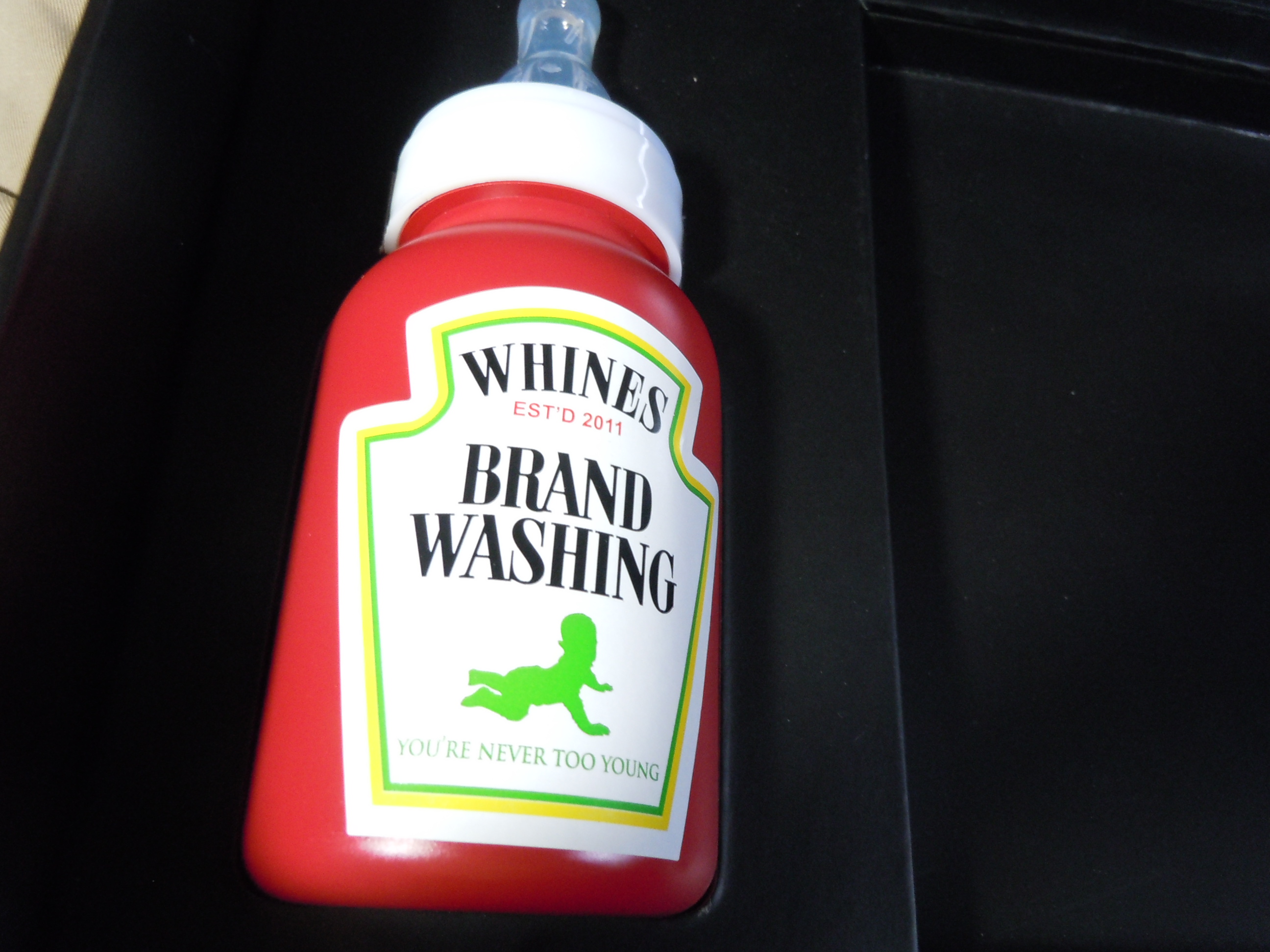
The press kit inside the slipcase inside the box on top of the outer boxFinally, inside the slipcase, another, very deluxe box.  The front cover answered the question on the slipcase. When I opened it, the inside cover had four panels of marketing copy, contact information, *and* a video player containing three video trailers and a screen about the size of an iPhone’s. Needless to say, the graphics on the whole thing were extremely professional. The main part of the box contained two cutouts: one held an advance review copy of a new book, Brandwashed, by Martin Lindstrom, and the other held a small red plastic infant bottle whose label, extremely reminiscent of the famous Heinz catsup bottle, declared,

“WHINES EST’D 2011 BRAND WASHING YOU’RE NEVER TOO YOUNG”

The two enclosures were topped with a custom plastic tray that had a cut out for the bottle and fit snugly but comfortably into the box.
I remembered that Lindstrom had personally e-mailed me two weeks earlier, asking if I’d be interested in reviewing his forthcoming book. He’d written,

Like you, I have long been a proponent of environmental responsibility and have sought ways to encourage others to take a more active role in making and keeping our communities more “green”. That is why I think you should take a careful look at the multi-million dollar world-of-mouth marketing experiment that I had funded and chronicled in Brandwashed. I wanted to study just how persuasive word-of-mouth marketing could be as pertaining to household decisions, and in the latter stages focused specifically on environmentally conscious products and services. The results were shocking!

I’d been impressed at the time that he not only sought me out but that he spoke directly to my key interest area: the intersection of marketing with the environment.

As book reviewers go, I’m pretty low on the food chain. Typically, I do one review a month, in this newsletter (whose circulation figures don’t exactly set the world on fire)—and then the reviews get posted on Amazon about a month later. To receive such an intricate package despite my low status in the book review world was a recognition that somebody, in this case a best-selling author and top consultant in my field, values my opinion enough to be sure he gets noticed—and that’s flattering.

I had a number of reactions to receiving this package, and as a marketer/environmentalist who educates other marketers and environmentalists, I’d like to share some of them with you. The insights you might gain from a look into my psyche may help you as you design your next campaign.

  1. Undeniably, it was effective. As it happened, I hadn’t yet picked out a book to review this month, and with half the month gone, I needed to start. Martin’s book didn’t even stop at the top of the pile; it went directly to my exercise bike, where I read while working out, and I started reading it that very night (see my review elsewhere in this issue).
  2. To make that impression cost quite a bit of money. I’m guessing the package cost at least $50 per copy to design, prepare, and send. Am I enough of an influencer to be worth that investment? It would be nice to think so, but I don’t know.
  3. Obviously, the campaign is reaching people who do have a great deal of influence. On October 6, less than 10 days after publication, the book not only has 41 reviews on Amazon, but the #1 and #2 slots on three subcategories for marketing books and an enviable overall rank of 283. His earlier book, Buyology, is also doing quite well at the moment, probably with a little help from Amazon’s “people who bought also bought” trick.
  4. While the marketer in me is quite impressed, the environmentalist part of my brain is appalled. This was a very resource-intensive effort involving unrecyclable mixed materials and weighing seven pounds. In tiny print on the back of the player box, it notes that you’re not supposed to throw this out in the trash and should return the box to the video player company for processing. Not a lot of reviewers will even see that note, and fewer still will go through the trouble to find a suitable box, address a label, and pay for the postage to return it. Reviewers get dozens of packages per day, and many cases, get them pre-opened by a mailroom employee. The slipcase and the two outer boxes can be recycled with my other cardboard, but the rest of it is problematic. This is especially ironic, given Lindstrom’s personal message to me.
  5. After experiencing this elaborate and expensive press kit, I am surprised by the book cover, which in my opinion is both unattractive and unimaginative. If a client came to me with this cover, I’d have advised a different concept.
  6. Targeting is key. This book was well-targeted to me, and Lindstrom’s personal message was even more targeted. Had I received a similar press kit for, let’s say, a book about Britney Spears’ hairstyle shenaningans, I would have been annoyed instead of intrigued, and the whole thing would have gone into the recycle bin without a second look.

How would you react if you received a package like this? Click on this link to tell me, or to make any other comments. Please tell me if I have permission to publish your comment publicly. I’m thinking of gathering the responses into a blog post (which is also an easy way for you to get a link from my site—just include your URL in the e-mail).


Friends Who Want to Help

The Best-Conceived JV I’ve Seen

Do you do Joint Ventures? As I hinted last month, I’m helping to orchestrate a particularly exciting one, involving celebrities, politicians, environmental education, kids, quilts and all sorts of other cool stuff that appeals to the media and will get you coverage and contacts. We’re planning ahead on this–want to get commitments this year for ramping up early next year and a launch that ties in with Earth Day next spring–but don’t wait to get involved. If you’d like to receive an invitation as soon as we’re ready, please use this link to tell me (and let me know if you think of yourself as more of a marketer, or more of an environmentalist).

Unfamiliar with Joint Ventures? Basically, we partner with you, you tell your own contacts (like the readers of your e-zine or blog), and if people make purchases from your link, you earn a commission.

30-minute No-Cost Consultation with Scott Cooney from Green Business Owner, and a Cool-Looking Sustainability Game, Too

Scott gave me one of these consultations, and I very much appreciated his fresh perspective. He’s also just developed a very spiffy-looking game on sustainability themes, set in Hawaiii. To get your consult, visit GreenBusinessOwner.com, and then click on the Consulting link on the top menu. For the game, go directly to this link.

Two Book-Publishing Conferences:

D’vorah Lansky’s Online Book Marketing Conference

Check out the amazing speaker line-up for the 3rd Annual Book Marketing Conference Online–I now almost all of them and can vouch for their good work. And this one has a series of free preview calls, too.

* Kathleen Gage: “Become an Online Bestselling Author in Today’s Crowded Author’s Market”
* Carolyn Howard-Johnson: “Your Awards: How to win them and then use them to set your book apart”
* Brian Jud: “Selling More Books, More Profitably to Non-Bookstore Buyers”
* Lynne Klippel: “Going Beyond the Book: Fast, Easy Product Creation for Authors”
* Jill Lublin: “Be the News”
* Connie Ragen Green: “How to Repurpose Your Existing Content to Become a Bestselling Author”
* Marnie Pehrson: “Using Social Media to Create a Buzz About Your Book”
* Penny Sansevieri: “Maximize and Monetize Social Media -3rd Annual Book Marketing Conference”
* Felicia J. Slattery: “How Authors Can Create a Signature Speech to Build Platform and Sell More Books”
* Dana Lynn Smith: “The Secrets to Planning a Profitable Virtual Book Tour”
* Steven E. Schmitt: “How I made millions by listening to my intuitive voice”
* Noah St. John: “Attract More Money Blueprint: Your Hidden Power for More Wealth and Happiness”
* Denise Wakeman: “The Secret to Author Blog Success: How to Dominate Your Niche with a Book Blog”

Get the details at: https://www.bookmarketingmadeeasy.com/center/idevaffiliate.php?id=139

Publishing Conference in Nevada Next Month

This is taken directly from a press release I received: PubWest, the leading trade association for small- and medium-sized book publishers, is pleased to announce the full agenda for the PubWest Conference 2011 in November. The programming includes notable keynotes by Len Riggio, Chairman of Barnes & Noble; Tyson Cornell of Rare Bird Lit; and Kevin Smokler, author of the forthcoming essay collection Practical Classics. Sessions include intensives on Digital Publishing and Creating EPUBS with Adobe InDesign CS5.5, Exploration and Discussion of the Chicago Manual of Style’s New 16th Edition with Alice Levine, Evaluating the Effectiveness of Social Marketing, Optimizing Digital Production Workflows, Improving Your Publishing Company’s Profitability, Product Line Branding and Permissions, “Green” Publishing, Faceoff between Traditional and New Social Media, Enhanced E-Books, Metadata and Discoverability, plus lively and interactive roundtables held by professionals in the industry.

Registration: www.pubwest.org/conference. More info: kent@pubwest.org

The Living Organization

Tough times call for better ideas – Packed with powerful insights, tools, and practices, this book is a potent resource for aspiring, emerging, and seasoned business leaders alike. Norman Wolfe reframes and broadens our understanding of how organizations can create better results. Every leader, every CEO, board member and senior executive will benefit from the practical guidance this book provides. The Living Organization – check it out: https://bit.ly/puW6nt

Hear & Meet Shel

October

  • Speaking at Bioneers-By-The-Bay, wonderful conference October 21-23 in New Bedford, MA, https://www.marioninstitute.org/connecting-for-change My talk is Sunday October 23: signing books at 12:30-1 p.m. at Bakers Books tables inside the Butterfly Exhibition Tent, then presenting Getting Buy-In: Building Stakeholder Consensus for Sustainability, at Bristol Community College, 800 Purchase St., Conference Room. Note: this is the very first time I’m giving this talk, aimed at activists, government leaders, and green business owners. Lots of good nitty-gritty stuff about how to analyze and reach your market.
  • October 28 and beyond, my interview on Good And Green Radio will be available at https://wgrnradio.com/archive-good-and-green-radio-with-susan-davis/
November
  • I’ll be walking the floor in the afternoon at the Green Expo Opportunity Fair in Springfield, MA, at the MassMutual Center. Let me know ahead if you’d like to meet there.
  • November 15, 8:00 pm ET/5 pm PT, January Jones interviews me: 818-431-8506
  • November 16, 7 pm ET/4 pm PT: Interviewed on Your15Minutes Radio’s “Brand This” with Shaun Walker and Reid Stone, www.your15minutesradio.com
  • November 17, 11 a.m. ET/8 am PT: Interviewed by Susan Rich on “Get Noticed Now.”
January
Remember-if you set me up an engagement, you could earn a generous commission.

Another Recommended Book: Brandwashed

Brandwashed: Tricks Companies Use to Manipulate Our Minds and Persuade Us to Buy, by Martin Lindstrom (Crown, division of Random House, 2011)

Both as a marketer and as a consumer, you want to understand the psychology of modern-day marketing (and especially the particular marketing subset called advertising). Without a clear picture of just how deeply manipulated we are, at a level not even dreamed of when Vance Packard wrote The Hidden Persuaders back in the 1950s, you will be defenseless against the continual assault on your wallet.

Martin Lindstrom, an industry insider who has helped big brands go deep into their consumers’ minds and come out the other end with fistfuls of money, turns his attention to explaining how these companies get inside your brains, and what they do once they get there.

While he certainly pays attention to the traditional buy triggers, like fear, sex, celebrity, spirituality, fear, and nostalgia—each of which gets its own chapter—the real news in this book is the evolution of companies’ knowledge about us, and how they manipulate every aspect of your “buyer experience,” through a huge range of tools, to create the desired effect: a ravenous, insatiable hunger for the company’s brand.

This well-written and well-researched book should give anyone pause. But perhaps the scariest part is how early it starts. Marketers have known for many years that buying habits and brand loyalties acquired in childhood can shape lifelong preferences. That’s why, for instance, computer companies value the elementary education market so highly.

But it starts much earlier than that. Literally, the music you hear, the smells you experience in the womb can influence your choices all through life. And peer pressure has been documented at 14 months old.

The positive side of this is that these sensual memories can help with things like stroke recovery. But the Big Brotherish part of it is disturbing. Add in such factors as the deliberate manipulation of fear to literally make us stupid and not only do you have a commercial marketer’s paradise, but also (here I’m extrapolating from Lindstrom) the easy ability to whip up patriotic fervor to justify evil actions by governments (think about the manufacture of anti-Jewish sentiment during the Holocaust, or anti-Muslim sentiment in the US following 9/11, with the media cheering on the crackdown in both cases).

Another key insight: when we encounter arousing images, we perceive ourselves as sexier. (This is what psychologists call “transference.”) No wonder so much of advertising features sultry women and hunky men. And according to his research, straight men are a major, if hidden, market that responds to those pictures of hunky men. Also, the male who is conscious of his own beauty and spends lavishly on personal care products/services is a hot new trend.

Celebrity marketing is related to this; we perceive ourselves as increasing our status and power when we read and watch those with high status and power—they are our idealized future selves. Celebs (including various royal families) feed into this and deliberately manage their personal brands very carefully.

Concerned about privacy? Basically, it no longer exists. Data mining is far more sophisticated now, and companies can create incredibly detailed profiles not just segment-by-segment, but person-by-person. They know who you are, what you wear, what you eat, where you work, where you are (if you use a cell phone), and how long you’ve spent on which web pages. Not only do we voluntarily reveal enormous amounts of information about ourselves to companies like Facebook and Google (and some companies have learned how to subvert the privacy safeguards and harvest this), but there’s plenty of data collection going on without our consent, too. And data mining companies sometimes require their customers to provide more data if they want the service.

But wait! There’s more!

  • Some products, notably in the cosmetics industry, do the opposite of what they promise, thus feeding more purchases because the wearer thinks, “I must not have put enough on.”
  • 60 percent of teens think they can buy their way to happiness with the right brands (and many of them will outright reject unbranded items)
  • While brands are seen as a path to self-esteem, knowingly buying a counterfeit lowers self-esteem
  • Nostalgia marketing has hooks back to our earliest childhood; we long for simpler times before we had grown up worries, and will welcome even products we ignored at the time
  • GPS-like devices on shopping carts allow stores to track individual movement patterns in the store—while digital price signage allows companies to actually change prices to reflect trends at different times of day
  • Receiving advice that seems to be expert shuts down our critical thinking, even if the expertise is weak or is really celebrity in disguise)—and word-of-mouth from a trusted friend or colleague *definitely* counts heavily

Lindstrom ends the book with a complex experiment he set up, giving a real family a mission to influence the buying habits of their friends.  The results are shocking; go read the book to learn what happened, and to learn many more startling tidbits than I had room to describe. (See, now I just implanted a suggestion to you. I’m not being paid in any way to recommend this book and am not using my Amazon affiliate code. But I’d love to see whether my self-perception as a trusted expert translates into sales that bear out Lindstrom’s hypothesis, despite my transparency about it —so if you buy the book on my say-so, please drop me a note: mailto:shel@frugalfun.com?subject=IBoughtBrandwashed .) Please tell me if I have permission to publish your comment publicly. I’m thinking of gathering the responses into a blog post (which is also an easy way for you to get a link from my site—just include your URL in the e-mail).

Current Issue: December 2010

**Holiday Offer: Do Your Shopping Here and Get Great Bonuses**

You know you’re going to make those New Year’s resolutions about working more *on* your business and less *in* your business. Here’s your chance to get some wonderful practical tools for yourself and for the entrepreneurs in your life:

These offers are good during the month of December. Buy just one copy of any of our award-winning marketing books directly from us, and get as a bonus a copy of my very practical e-book, Painless Green: 111 Tips to Help the Environment, Lower Your Carbon Footprint, Cut Your Budget, and Improve Your Quality of Life-With No Negative Impact on Your Lifestyle.

Which books qualify?

  • Guerrilla Marketing Goes Green: Winning Strategies to Improve Your Profits and Your Planet (with $2000 worth of bonuses)
  • Grassroots Marketing: Getting Noticed in a Noisy World (with the Missing Chapters e-book, covering Web 2.0/social media and other new developments
  • Grassroots Marketing for Authors and Publishers (just for people marketing books. Includes several hundred dollars worth of bonuses.)

Be sure to enter the coupon code: HolidayCode1 to get your free bonus!

Buy three or more shipped to the same address (mix and match titles or buy the same book for all your friends), and get both Painless Green AND my 280-page e-book on how to have fun cheaply, The Penny-Pinching Hedonist: How to Live Like Royalty With a Peasant’s Pocketbook.

Plus you still get the bonuses that already come with the books (for Guerrilla Marketing Goes Green , that’s already more than $2000 worth of goodies).

Be sure to enter the coupon code: HolidayCode2 to get all of your free bonuses!

To preview and purchase: visit https://www.frugalmarketing.com/cart/index.php?main_page=products_all

For more detailed previews of the individual books including the bonuses that they include, please visit https://shelhorowitz.com, where you’ll find links to all of them in the section called “Do-It-Yourself Resources.”

**BIG Announcement: Green And Profitable Column Now Available**

For more than 20 years, I’ve wanted to be a syndicated columnist, with one column appearing in dozens or hundreds of publications. I even packed up some samples and tried to get the attention of the big syndicates every now and then.

Well, I got tired of waiting. I decided that if I were ever going to fulfill this lifelong ambition, it would be on me to make it happen. I also decided that while there’s no shortage of political commentators of all stripes, there aren’t a lot of people talking about how to be green and profitable.

Since that’s the subject of two entire books I’ve written, plus most of my speaking and a good deal of my blogging and newslettering, I realized that I was uniquely suited to write such a column, and that I was probably going to have a much easier time marketing it than trying to sell yet another politics column. And indeed, I launched Green And Profitable in November and immediately picked up a newspaper here in Massachusetts and a website in Australia. My goal is to use this column to drive home the message that green IS profitable by landing 1000 publications to run the column by the end of 2012–so that the message is found all over and actually might have some impact in the world. 2 down, 998 to go :-). I’ve posted three sample columns at https://greenandprofitable.com/green-and-profitable-column/#sample

To get this properly launched, I’m offering an incredible price: for the first hundred media that sign up for the column, the price will be just $10 per article, guaranteed through the end of 2012. And I’m also offering individual subscriptions for your own use (not for republication), at an even more phenomenal price of $10 for unlimited six-month access. Wow!

If you read any magazine, newspaper, website, blog, or newsletter, or listen to any favorite radio shows or podcasts (there will be an audio version), I’d be delighted if you ask them run the column (once you ask, please send me an e-mail to shel at principledprofit.com, subject “I requested your column” or Tweet me @ShelHorowitz, and tell me the name of the publisher. If that publisher subscribes, I promise I will do something nice to you. Please direct your publisher contact to https://greenandprofitable.com/green-and-profitable-column/ — where I’ve put all sorts of material about why the column, how to run it, etc.

If you’d like to subscribe as an individual, without republication rights, please visit https://www.frugalmarketing.com/cart/index.php?main_page=product_info&cPath=82&products_id=233. And thank you so much!

Analysis of a Really Bad Book Query Letter (With Lessons for Non-Authors, Too)

Ever dream of getting a big New York publisher for your future best seller? Don’t do it like this—in fact, don’t send any kind of pitch letter that makes these mistakes:

M husband has a finished book and he is looking for a Book Agent or Book Publisher. His book is geared for young adults. He is a Highschool teacher and his students are chomping at the bit to read his book. We are sitting on a gold-mine! If you are interested, please leave your information so we can send you more information on the book! Thank you so much.

This was an actual query, submitted through a media query submission service. Let’s play a little game with this, just for fun. How many things can you find wrong with this post? Use the comment form to respond, and then scroll down to see my list (don’t cheat!)


Publishers are deluged with queries and are actively looking for reasons to say no. Any of the eight points below will probably trigger rejection. All of them together? This proposal is going nowhere, fast. Similarly, executives look for reasons to brush off sales pitches…customers of any kind want to be romanced, but this letter is more like the equivalent of a wolf-whistle on the street corner.

  1. Spelling, grammar, and punctuation count. I notice two typos (dropping the y in My and running high and school together into one non-existent word), one inappropriate hyphenation, and four inappropriate capitalizations.
  2. Writing style counts. This limp and wooden paragraph gives me no confidence in the author’s ability.
  3. I don’t even know if this is fiction or nonfiction, let alone the subject and genre. Tell me what the book is about, tell me your working title, get me interested.
  4. Young Adult, in the children’s book market, is a much younger reader than high school. She doesn’t know her terms and her audience, which means she doesn’t know the industry, which means the product is not likely to be salable.
  5. Don’t give me hype (gold-mine). Give me facts.
  6. What a great market analysis—NOT! His students are eager for the book. OK, let’s say he teaches five classes of 30 kids each, which would be a pretty big load but not out of the question. OK, so that’s a universe of 150 students per semester. If even 25 percent of the market actually buys (and that’s about 5 to 10x more than I’d guess), you’ve just sold a whopping six books. That won’t even pay for the cover design. I think this particular gold mine may be all played out. And no other markets are mentioned.
  7. What’s his name, what are his credentials, and why isn’t he writing his own letter?
  8. Finally, why submit this to a media pitch service that goes to experts across all genres, seeking publicity by answering reporters’ queries? The targeting is very poor. It would make a lot more sense to pitch a list of actual publishers, don’t you think?

And by the way, if you’re thinking of submitting a book proposal or query letter to an agent or publisher, a bit of expert help can make a huge difference. I offer critique services, rewriting, or writing from scratch. And I’ve sold to Wiley, Simon & Schuster, and Chelsea Green, as well as gotten nibbles for my clients from many other fine houses. For those authors better suited to self-publishing, I walk you through every step of the process and we come out the other end with something as good as books coming from major publishers.

Another Recommended Book: Good For Business

Good For Business: The Rise of the Conscious Corporation, by Andrew Benett, Cavas Gobhai, Ann O’Reilly, and Greg Welch (Palgrave Macmillan, 2009)

Reviewed by Shel Horowitz, primary author, Guerrilla Marketing Goes Green

If you ever doubted that corporate social and environmental responsibility play a role in business success, consider some of these stats:

  • In a survey of consumers across the U.S., France, and U.K., 74 percent of consumers believe businesses bear as much responsibility as governments for driving positive social change
  • 76 percent  take responsibility for avoiding products from unethical companies, and 63 percent have made purchase decisions based on company conduct
  • An astonishing 85 percent believe that companies need to stand for more than just profitability

All of these are taken from the appendix of Good For Business: The Rise of the Conscious Corporation, which ends with 11 pages of juicy stats. And there are plenty of important stats in the main text, too: such as:

  • The market for organic foods in the U.S. grew by nearly an order of magnitude in just eleven years, mushrooming from $3.6 billion in 1997 to $33 billion in 2008
  • Just the compact fluorescent light bulbs sold at Walmart kept 20 million metric tons of greenhouse gases out of the atmosphere—the same result as removing 700,000 cars from use
  • Reputation accounts for 75 percent of the difference between book value and market capitalization; in other words, good behavior translates into real dollars when a company is sold
  • On the aggregate, companies listed on the 100 Best Places to Work returned 14 percent a year on investment, compared with just 6 percent for the overall corporate economy
  • Tesco, the U.K. supermarket giant, built a store in 2008 that uses just 30% of the energy of a store built just two years earlier

Plenty more to this book than statistics, of course. Much of the text draws from four cornerstone concepts—corporations need to:

1. Be about more than profit.

2. Treat both employees and customers well

3. Champion sustainability

4. Respect the power of consumers

Case-study companies, including well-known examples like Marks & Spencer, Ben & Jerry’s, Nike, GE, Whole Foods—and many less-frequently cited examples, including not only companies but also nonprofits—are examined in light of these four criteria, with many specifics.

There is a long digression on mission statements, which the authors reinvent as a living, changing document they call a USOD (Useful Statement Of Direction). Were it up to me, I’d have edited that part down. But this one small negative is more than compensated by pearls of wisdom such as the way a Conscious Corporation turns transparency into advantage, even as old-style companies see it as a recipe for paranoia. (p. 186)

Hear and Meet

December

January

  • Speaking on Green and Ethical Food Marketing at the Sustainable Foods Summit, San Francisco on January 19, 2011. https://www.sustainablefoodssummit.com/
  • January 24, 2 pm ET/11 am PT, Guest on The Coach Is In Internet radio show.
February
  • If I can work out some logistics, I’ll be a panelist (not the same thing as a speaker, in this case) at Ken McArthur’s next JV Alert, Orlando, February 18-20. I’ve heard amazing things about these conferences, and am eager to experience it. If you’d like to go too, click here for the very impressive speaker lineup and registration link INSERT LINK
March
  • Social Media for Terrified Authors: How to Turn Scary Into Success: Wednesday, March 30, 2 pm ET/11 a.m. PT, with Shel Horowitz and book coach/social media maven Judy Cullins.
    * Have an impact on the three major social media networks in just minutes a day: control social media and keep it from controlling you
    * Understand how to spread your content around the Internet with just a couple of clicks: more ROI for less work
    * Turn social media connections into website traffic, book sales, and client gigs without spending any money to do it.
    *Increase your credibility as a savvy expert.
    *Define and find your book’s target audience on the big 3 social media marketing sites–and market directly to the exact people who can benefit from your book.
    * Get your website or blog pages highly ranked on Google and other search engines.

Just $19.95, and includes several valuable bonuses. Click INSERT to get all the details.

April
  • April 8-10 I plan to attend the National Conference on Media Reform, in Boston. I’ve attended two previous conferences and am always blown away.
  • Saturday, April 23rd, 2011 10 AM-4 PM, my wife and I will exhibit again at Amherst Sustainability Festival in downtown Amherst, MA
May
  • Once again, I’ll be attending Book Expo America, May 24-26 in New York City, and probably IBPA University May 22- 23
Recent Interviews You Can Listen To
Articles By Me

Domains for Sale

I have some excellent domain names that I don’t anticipate needing in the future. If you’ve been looking to start a business of your own or expand your existing business in a different direction, this may be just what you need. Interested in buying any (or all)? Drop me an offer at shel at principledprofit.com

  • RecessionBusterBooks.com
  • The-Perfect-Life.com
  • EarthConsciousMarketers.com
  • FrugalFun.info
  • GuerillaMarketingGoesGreen.com (note: Only one r. I’m keeping the 2-r)
  • PrincipledProfits.com

Friends Who Want to Help

Success Bug LevelUP Business Acceleration Program: an amazing learning community for business success with stellar faculty, assembled by Spike Humer (long-time chief strategist for Jay Abraham, who I consider one of the top business thinkers in the world today), my co-author Jay Conrad Levinson (the original Guerrilla Marketing man as well as the advertising legend who brought us such iconic campaigns as United’s Friendly Skies and the Marlboro Man), and my new friend Barry Plaskow who is coordinating the whole thing from his bases in the UK and Israel.  https://nanacast.com/vp/98574/38467

Janet Switzer’s How Experts Build Empires: What secret weapon do Jack Canfield and Mark Victor Hansen (Chicken Soup), Jay Abraham (see above), and Tony Robbins all credit as a huge factor in their success, worth many millions of dollars to each of them? A one-woman marketing and packaging strategic powerhouse named Janet Switzer. I heard Janet speak at a conference a few years ago and took a steady stream of notes as fast as I could bang them into my keyboard. I’ve also listened every chance I can to any teleseminar where she’s presenting. She thinks big, helps others see the big picture, but also knows how to get down and dirty with little tweaks that make a huge difference. And she co-authored The Success Principles—the one self-help book I recommend constantly–with Jack Canfield, which means she probably wrote the bulk of it. Normally, to get help from Janet, you need to buy into her very expensive mentoring program. But right now, she’s selling the ‘How Experts Build Empires Marketing Plan for only $97. Yeah, that may seem like a lot for an info product, but I have never known Janet to delivery anything less than enormous value. I would expect that you’ll get something worth many times more than the purchase price, as long as you implement even 1/10 of what she suggests. https://www.1shoppingcart.com/app/?af=1268266

Become a “Pay It Forward Angel” with radio host Dr. Pat Bacili—No Cost https://tinyurl.com/288y76d is the link for a huge giveaway with nothing to buy. Joining me in providing a gift are people like Nancy Juetten, Findhorn Press, and about 150 other luminaries. Some of the people working with Dr. Pat on other levels (for instance, hosting a program on her Transformation Radio Network) include the actress and mystic Shirley MacLaine, musicians Melissa Etheridge and Olivia Newton-John, and bestselling author Dr. Wayne Dyer.  She fully expects to transform the world through creating a giving culture, so you may as well start by looking at the amazing array of gifts to you when you sign up at no charge for her Transformation Community.

Karen Hudson and Lily Hills, radio show co-hosts of “The Goddess to Goddess Empower Hour~Inspirational Information for Women and the Divine Dudes that Love Them,” have just released their new book, A Feminine Manifesta.

I love seeing people like Gandhi and Nelson Mandela cited in a women’s self-help book! The integration of personal and political may be the single biggest contribution of modern feminism. Social/global/environmental change cannot be separated from personal empowerment and personal behavior.

A new book, The Feminine Manifesta, by Karen Hudson and Lily Hills (radio show co-hosts of “The Goddess to Goddess Empower Hour~Inspirational Information for Women and the Divine Dudes that Love Them”) makes the connection very nicely. Particularly if you haven’t read a lot of the personal empowerment/personal is political classics, this is a book you’ll want to read.

Particularly now, during the launch promotion when you get 25 wonderful gifts totaling more than $1500 in value, including my own 12 New Year’s Resolutions For a More Ethical, Ecological, Profitable, and Successful Business. Preview all the gifsts–and the book, of course, at https://www.afemininemanifesta.com/preview_bonus_gifts.html

Are you tired of rushing? Christine Louise Hohlbaum, author of The Power of Slow: 101 Ways to Save Time in Our 24/7 World, is giving you the gift of time this holiday season. When you purchase one or more copies of her book (as seen in O magazine, Redbook, on NPR and CNN.com), you will receive bonus gifts at no extra cost. The offer is only good for Tuesday, December 7th so mark your calendar!

Why is there power in slow? It is scientifically proven that slow is faster and fast is merely exhausting.

Christine’s 101 principles will help you establish a more positive relationship with time so you have more of it. If you want to live in state of time abundance versus time starvation, The Power of Slow is for you. And of course all your friends on your gift list, too! www.powerofslowbook.com

Give a Little, Get a Lot: The Unstoppable Foundation has an amazing event taking place right now where you have the opportunity to get cutting edge information from some of the world’s leading experts at 80% to 90% OFF discounts…with 100% of the money going to a charity that is educating children in Africa.  This is an opportunity to transform your life and the lives of thousands of children in Africa.  Find out more in the introduction video with the founder of the Unstoppable Foundation, Cynthia Kersey: https://www.unstoppablefoundation.org/

Hear & Meet Shel, August 2010

* Friday, August 6, 1:35 pm ET/10:30 a.m. PT (and Arizona time, which is where Hollis is), Hollis Chapman interviews me over Blog Talk Radio on Green Guerrilla Marketing, 30 minutes. https://getresponse.com/click.html?x=a62b&lc=HYWO&mc=m&s=ANhX&y=F&

* Friday, August 6, 4 pm ET/1 pm PT, Maureen Kedes from Vertex PR interviews me, also on Green marketing. https://www.voiceamerica.com/voiceamerica/vshow.aspx?sid=1409

* Friday, August 20 ,1-1:25 p.m., “Reaching the Green Consumer.” Boston GreenFest  (the entire event  takes place August 19-21, 2010). One of the cool things about this event will be a display of cars that traveled
100 miles (from Greenfield, MA, near me) on a single gallon of gas. https://getresponse.com/click.html?x=a62b&lc=HYWW&mc=m&s=ANhX&y=R&

* Tuesday, September 7, 1 pm ET/10 a.m. PT, Lillian Brummet interviews me on Conscious Discussions Radio, https://www.blogtalkradio.com/consciousdiscussions or (646) 478-4758

* Monday, September 20, live interview for https://createchatter.tv 9 pm ET/6 pm PT

* Tuesday, September 21, Ronda Del Boccio (The Story Lady) interviews me about Green marketing (90 minutes). Noon ET/9 a.m. PT. Listen in by calling 646-478-0823 or visiting https://www.BlogTalkRadio.com/jvqueen (it will be featured for a week).

* Monday, September 27, 8 pm ET/5 pm PT: Sandy Lawrence interviews me on the creating book marketing strategies we used for Guerrilla Marketing Goes Green. Info: gayla@perceptivemarketing.com

* Wednesday. September 29 at 5pm ET/2 pm PT, Dave Mathison from Be The Media interviews me about green guerrilla marketing (postponed from July). https://getresponse.com/click.html?x=a62b&lc=HYW0&mc=m&s=ANhX&y=9&

* October 2, I’m speaking at the second annual Self-Publishing Book Expo in New York City, https://getresponse.com/click.html?x=a62b&lc=HYWi&mc=m&s=ANhX&y=r&

* October 12 at 7 p.m. ET/4 p.m. PT: My third annual presentation to the MUSE Online Writers Conference. This time, Selling a Self-Published Book to a Traditional Publisher

* October 13, I’ll be interviewed again for the Guerrilla Marketing Association’s weekly calls–this time by Alexandru Israil from Romania, 7 p.m. ET/4 p.m. PT. Contact: alexandru.israil (at) gmail.com