Shel Horowitz’s Clean and Green Newsletter, October 2011
News Flash: I Was Inducted Into the National Environmental Hall of Fame
Read all about it and see a picture at https://greenandprofitable.com/i-was-inducted-into-the-national-environmental-hall-of-fame-today/ I hope to post a video next week, if the videographer sends me something I can use. Several dignitaries in attendance, too.
Contents of This Issue:
- A Marketing Ploy that Cut Through the Clutter
- Hear & Meet Shel
- Friends Who Want to Help
- Another Recommended Book: Brandwashed
A Marketing Ploy that Cut Through the Clutter
UPS dropped off a surprise package from Random House recently; it looked like a box that would be used to ship a case of books.
When I opened the box, I saw a smaller, unmarked, white box, shrinkwrapped and floating on a cushion of air-filled plastic bags. I cut the shrinkwrap, opened the box, and took out a black slipcase, unadorned except for a line of headline type saying “GUESS THE YOUNGEST AGE EVER TARGETED BY A MARKETER.” Just below and to the right, these words in a starburst: “Be the first to know with this fascinating sneak-peek.”
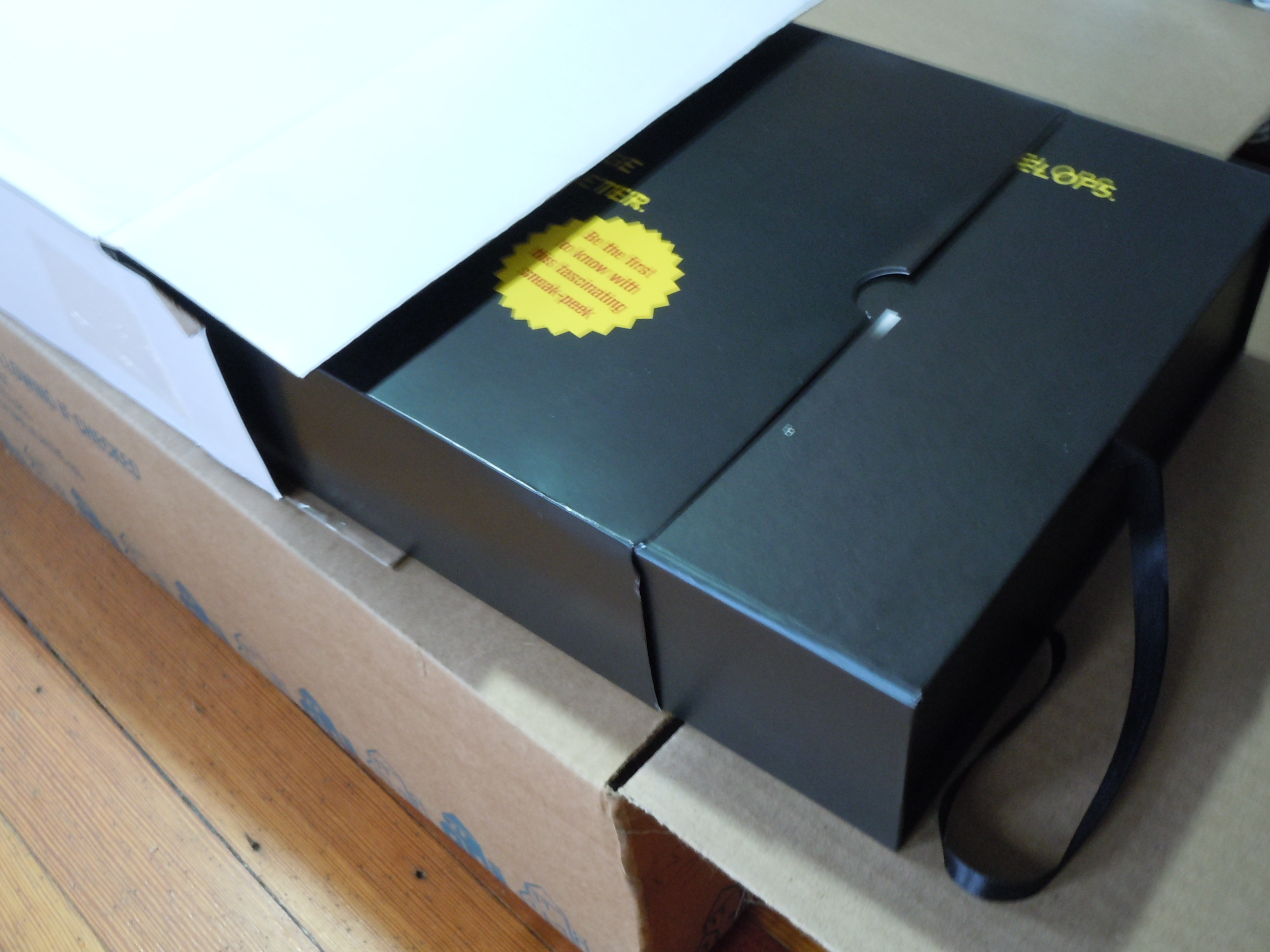 Finally, inside the slipcase, another, very deluxe box. The front cover answered the question on the slipcase. When I opened it, the inside cover had four panels of marketing copy, contact information, *and* a video player containing three video trailers and a screen about the size of an iPhone’s. Needless to say, the graphics on the whole thing were extremely professional. The main part of the box contained two cutouts: one held an advance review copy of a new book, Brandwashed, by Martin Lindstrom, and the other held a small red plastic infant bottle whose label, extremely reminiscent of the famous Heinz catsup bottle, declared,
“WHINES EST’D 2011 BRAND WASHING YOU’RE NEVER TOO YOUNG”
The two enclosures were topped with a custom plastic tray that had a cut out for the bottle and fit snugly but comfortably into the box.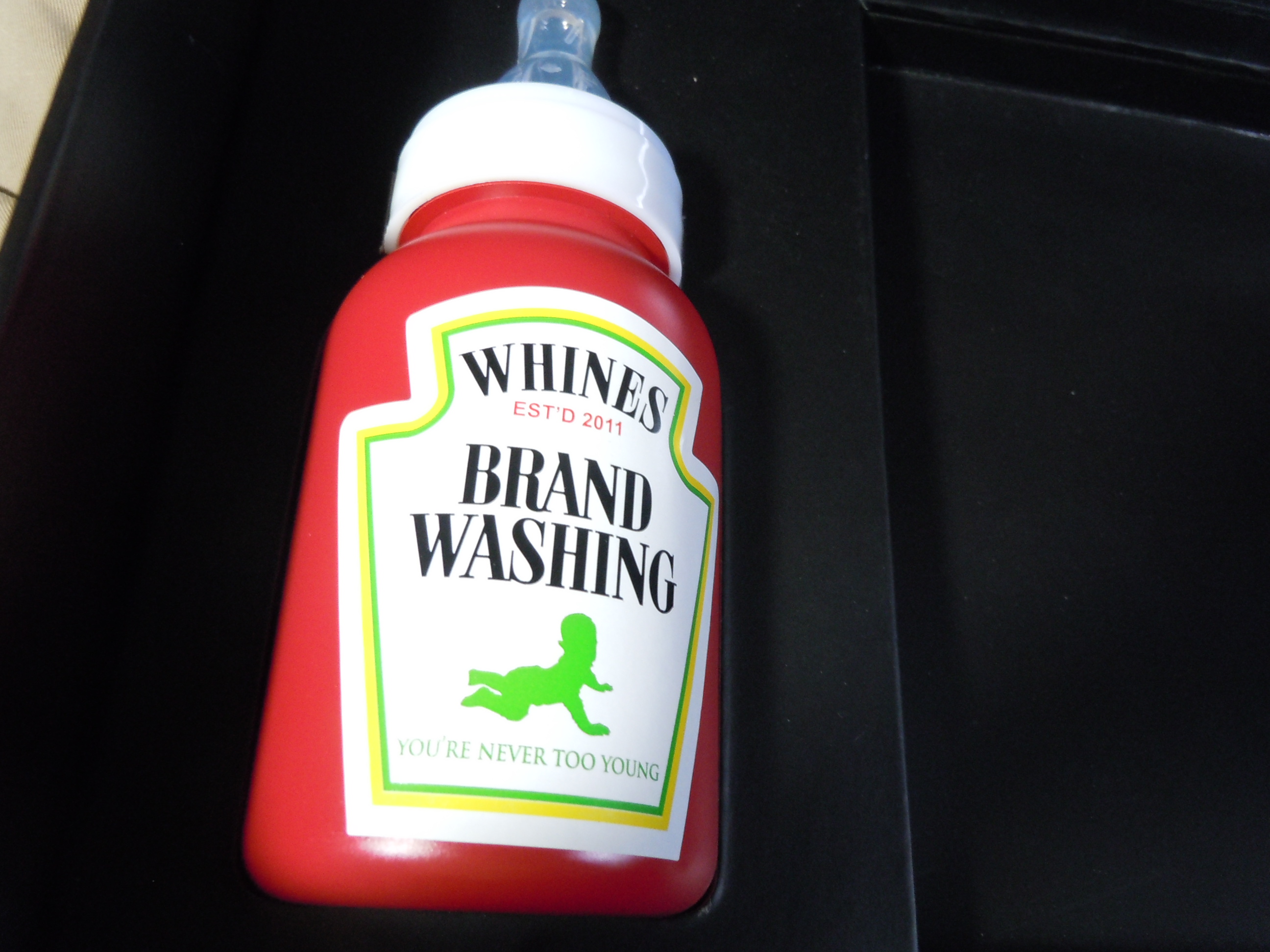
I remembered that Lindstrom had personally e-mailed me two weeks earlier, asking if I’d be interested in reviewing his forthcoming book. He’d written,
Like you, I have long been a proponent of environmental responsibility and have sought ways to encourage others to take a more active role in making and keeping our communities more “green”. That is why I think you should take a careful look at the multi-million dollar world-of-mouth marketing experiment that I had funded and chronicled in Brandwashed. I wanted to study just how persuasive word-of-mouth marketing could be as pertaining to household decisions, and in the latter stages focused specifically on environmentally conscious products and services. The results were shocking!
I’d been impressed at the time that he not only sought me out but that he spoke directly to my key interest area: the intersection of marketing with the environment.
As book reviewers go, I’m pretty low on the food chain. Typically, I do one review a month, in this newsletter (whose circulation figures don’t exactly set the world on fire)—and then the reviews get posted on Amazon about a month later. To receive such an intricate package despite my low status in the book review world was a recognition that somebody, in this case a best-selling author and top consultant in my field, values my opinion enough to be sure he gets noticed—and that’s flattering.
I had a number of reactions to receiving this package, and as a marketer/environmentalist who educates other marketers and environmentalists, I’d like to share some of them with you. The insights you might gain from a look into my psyche may help you as you design your next campaign.
- Undeniably, it was effective. As it happened, I hadn’t yet picked out a book to review this month, and with half the month gone, I needed to start. Martin’s book didn’t even stop at the top of the pile; it went directly to my exercise bike, where I read while working out, and I started reading it that very night (see my review elsewhere in this issue).
- To make that impression cost quite a bit of money. I’m guessing the package cost at least $50 per copy to design, prepare, and send. Am I enough of an influencer to be worth that investment? It would be nice to think so, but I don’t know.
- Obviously, the campaign is reaching people who do have a great deal of influence. On October 6, less than 10 days after publication, the book not only has 41 reviews on Amazon, but the #1 and #2 slots on three subcategories for marketing books and an enviable overall rank of 283. His earlier book, Buyology, is also doing quite well at the moment, probably with a little help from Amazon’s “people who bought also bought” trick.
- While the marketer in me is quite impressed, the environmentalist part of my brain is appalled. This was a very resource-intensive effort involving unrecyclable mixed materials and weighing seven pounds. In tiny print on the back of the player box, it notes that you’re not supposed to throw this out in the trash and should return the box to the video player company for processing. Not a lot of reviewers will even see that note, and fewer still will go through the trouble to find a suitable box, address a label, and pay for the postage to return it. Reviewers get dozens of packages per day, and many cases, get them pre-opened by a mailroom employee. The slipcase and the two outer boxes can be recycled with my other cardboard, but the rest of it is problematic. This is especially ironic, given Lindstrom’s personal message to me.
- After experiencing this elaborate and expensive press kit, I am surprised by the book cover, which in my opinion is both unattractive and unimaginative. If a client came to me with this cover, I’d have advised a different concept.
- Targeting is key. This book was well-targeted to me, and Lindstrom’s personal message was even more targeted. Had I received a similar press kit for, let’s say, a book about Britney Spears’ hairstyle shenaningans, I would have been annoyed instead of intrigued, and the whole thing would have gone into the recycle bin without a second look.
How would you react if you received a package like this? Click on this link to tell me, or to make any other comments. Please tell me if I have permission to publish your comment publicly. I’m thinking of gathering the responses into a blog post (which is also an easy way for you to get a link from my site—just include your URL in the e-mail).
Friends Who Want to Help
The Best-Conceived JV I’ve Seen
Do you do Joint Ventures? As I hinted last month, I’m helping to orchestrate a particularly exciting one, involving celebrities, politicians, environmental education, kids, quilts and all sorts of other cool stuff that appeals to the media and will get you coverage and contacts. We’re planning ahead on this–want to get commitments this year for ramping up early next year and a launch that ties in with Earth Day next spring–but don’t wait to get involved. If you’d like to receive an invitation as soon as we’re ready, please use this link to tell me (and let me know if you think of yourself as more of a marketer, or more of an environmentalist).
Unfamiliar with Joint Ventures? Basically, we partner with you, you tell your own contacts (like the readers of your e-zine or blog), and if people make purchases from your link, you earn a commission.
30-minute No-Cost Consultation with Scott Cooney from Green Business Owner, and a Cool-Looking Sustainability Game, Too
Scott gave me one of these consultations, and I very much appreciated his fresh perspective. He’s also just developed a very spiffy-looking game on sustainability themes, set in Hawaiii. To get your consult, visit GreenBusinessOwner.com, and then click on the Consulting link on the top menu. For the game, go directly to this link.
Two Book-Publishing Conferences:
D’vorah Lansky’s Online Book Marketing Conference
Check out the amazing speaker line-up for the 3rd Annual Book Marketing Conference Online–I now almost all of them and can vouch for their good work. And this one has a series of free preview calls, too.
* Kathleen Gage: “Become an Online Bestselling Author in Today’s Crowded Author’s Market”
* Carolyn Howard-Johnson: “Your Awards: How to win them and then use them to set your book apart”
* Brian Jud: “Selling More Books, More Profitably to Non-Bookstore Buyers”
* Lynne Klippel: “Going Beyond the Book: Fast, Easy Product Creation for Authors”
* Jill Lublin: “Be the News”
* Connie Ragen Green: “How to Repurpose Your Existing Content to Become a Bestselling Author”
* Marnie Pehrson: “Using Social Media to Create a Buzz About Your Book”
* Penny Sansevieri: “Maximize and Monetize Social Media -3rd Annual Book Marketing Conference”
* Felicia J. Slattery: “How Authors Can Create a Signature Speech to Build Platform and Sell More Books”
* Dana Lynn Smith: “The Secrets to Planning a Profitable Virtual Book Tour”
* Steven E. Schmitt: “How I made millions by listening to my intuitive voice”
* Noah St. John: “Attract More Money Blueprint: Your Hidden Power for More Wealth and Happiness”
* Denise Wakeman: “The Secret to Author Blog Success: How to Dominate Your Niche with a Book Blog”
Get the details at: https://www.bookmarketingmadeeasy.com/center/idevaffiliate.php?id=139
Publishing Conference in Nevada Next Month
This is taken directly from a press release I received: PubWest, the leading trade association for small- and medium-sized book publishers, is pleased to announce the full agenda for the PubWest Conference 2011 in November. The programming includes notable keynotes by Len Riggio, Chairman of Barnes & Noble; Tyson Cornell of Rare Bird Lit; and Kevin Smokler, author of the forthcoming essay collection Practical Classics. Sessions include intensives on Digital Publishing and Creating EPUBS with Adobe InDesign CS5.5, Exploration and Discussion of the Chicago Manual of Style’s New 16th Edition with Alice Levine, Evaluating the Effectiveness of Social Marketing, Optimizing Digital Production Workflows, Improving Your Publishing Company’s Profitability, Product Line Branding and Permissions, “Green” Publishing, Faceoff between Traditional and New Social Media, Enhanced E-Books, Metadata and Discoverability, plus lively and interactive roundtables held by professionals in the industry.
Registration: www.pubwest.org/conference. More info: kent@pubwest.org
The Living Organization
Tough times call for better ideas – Packed with powerful insights, tools, and practices, this book is a potent resource for aspiring, emerging, and seasoned business leaders alike. Norman Wolfe reframes and broadens our understanding of how organizations can create better results. Every leader, every CEO, board member and senior executive will benefit from the practical guidance this book provides. The Living Organization – check it out: https://bit.ly/puW6nt
Hear & Meet Shel
October
- Speaking at Bioneers-By-The-Bay, wonderful conference October 21-23 in New Bedford, MA, https://www.marioninstitute.
org/connecting-for-change My talk is Sunday October 23: signing books at 12:30-1 p.m. at Bakers Books tables inside the Butterfly Exhibition Tent, then presenting Getting Buy-In: Building Stakeholder Consensus for Sustainability, at Bristol Community College, 800 Purchase St., Conference Room. Note: this is the very first time I’m giving this talk, aimed at activists, government leaders, and green business owners. Lots of good nitty-gritty stuff about how to analyze and reach your market. - October 28 and beyond, my interview on Good And Green Radio will be available at https://wgrnradio.com/archive-
good-and-green-radio-with- susan-davis/
- I’ll be walking the floor in the afternoon at the Green Expo Opportunity Fair in Springfield, MA, at the MassMutual Center. Let me know ahead if you’d like to meet there.
- November 15, 8:00 pm ET/5 pm PT, January Jones interviews me: 818-431-8506
- November 16, 7 pm ET/4 pm PT: Interviewed on Your15Minutes Radio’s “Brand This” with Shaun Walker and Reid Stone, www.your15minutesradio.com
- November 17, 11 a.m. ET/8 am PT: Interviewed by Susan Rich on “Get Noticed Now.”
- 1/4/12: Visit https://bigamericangiveaway.
com/ – I’m that day’s Massachusetts sponsor, and I’ll have some cool stuff for you.
Another Recommended Book: Brandwashed
Brandwashed: Tricks Companies Use to Manipulate Our Minds and Persuade Us to Buy, by Martin Lindstrom (Crown, division of Random House, 2011)
Both as a marketer and as a consumer, you want to understand the psychology of modern-day marketing (and especially the particular marketing subset called advertising). Without a clear picture of just how deeply manipulated we are, at a level not even dreamed of when Vance Packard wrote The Hidden Persuaders back in the 1950s, you will be defenseless against the continual assault on your wallet.
Martin Lindstrom, an industry insider who has helped big brands go deep into their consumers’ minds and come out the other end with fistfuls of money, turns his attention to explaining how these companies get inside your brains, and what they do once they get there.
While he certainly pays attention to the traditional buy triggers, like fear, sex, celebrity, spirituality, fear, and nostalgia—each of which gets its own chapter—the real news in this book is the evolution of companies’ knowledge about us, and how they manipulate every aspect of your “buyer experience,” through a huge range of tools, to create the desired effect: a ravenous, insatiable hunger for the company’s brand.
This well-written and well-researched book should give anyone pause. But perhaps the scariest part is how early it starts. Marketers have known for many years that buying habits and brand loyalties acquired in childhood can shape lifelong preferences. That’s why, for instance, computer companies value the elementary education market so highly.
But it starts much earlier than that. Literally, the music you hear, the smells you experience in the womb can influence your choices all through life. And peer pressure has been documented at 14 months old.
The positive side of this is that these sensual memories can help with things like stroke recovery. But the Big Brotherish part of it is disturbing. Add in such factors as the deliberate manipulation of fear to literally make us stupid and not only do you have a commercial marketer’s paradise, but also (here I’m extrapolating from Lindstrom) the easy ability to whip up patriotic fervor to justify evil actions by governments (think about the manufacture of anti-Jewish sentiment during the Holocaust, or anti-Muslim sentiment in the US following 9/11, with the media cheering on the crackdown in both cases).
Another key insight: when we encounter arousing images, we perceive ourselves as sexier. (This is what psychologists call “transference.”) No wonder so much of advertising features sultry women and hunky men. And according to his research, straight men are a major, if hidden, market that responds to those pictures of hunky men. Also, the male who is conscious of his own beauty and spends lavishly on personal care products/services is a hot new trend.
Celebrity marketing is related to this; we perceive ourselves as increasing our status and power when we read and watch those with high status and power—they are our idealized future selves. Celebs (including various royal families) feed into this and deliberately manage their personal brands very carefully.
Concerned about privacy? Basically, it no longer exists. Data mining is far more sophisticated now, and companies can create incredibly detailed profiles not just segment-by-segment, but person-by-person. They know who you are, what you wear, what you eat, where you work, where you are (if you use a cell phone), and how long you’ve spent on which web pages. Not only do we voluntarily reveal enormous amounts of information about ourselves to companies like Facebook and Google (and some companies have learned how to subvert the privacy safeguards and harvest this), but there’s plenty of data collection going on without our consent, too. And data mining companies sometimes require their customers to provide more data if they want the service.
But wait! There’s more!
- Some products, notably in the cosmetics industry, do the opposite of what they promise, thus feeding more purchases because the wearer thinks, “I must not have put enough on.”
- 60 percent of teens think they can buy their way to happiness with the right brands (and many of them will outright reject unbranded items)
- While brands are seen as a path to self-esteem, knowingly buying a counterfeit lowers self-esteem
- Nostalgia marketing has hooks back to our earliest childhood; we long for simpler times before we had grown up worries, and will welcome even products we ignored at the time
- GPS-like devices on shopping carts allow stores to track individual movement patterns in the store—while digital price signage allows companies to actually change prices to reflect trends at different times of day
- Receiving advice that seems to be expert shuts down our critical thinking, even if the expertise is weak or is really celebrity in disguise)—and word-of-mouth from a trusted friend or colleague *definitely* counts heavily
Lindstrom ends the book with a complex experiment he set up, giving a real family a mission to influence the buying habits of their friends. The results are shocking; go read the book to learn what happened, and to learn many more startling tidbits than I had room to describe. (See, now I just implanted a suggestion to you. I’m not being paid in any way to recommend this book and am not using my Amazon affiliate code. But I’d love to see whether my self-perception as a trusted expert translates into sales that bear out Lindstrom’s hypothesis, despite my transparency about it —so if you buy the book on my say-so, please drop me a note: mailto:shel@frugalfun.com?subject=IBoughtBrandwashed .) Please tell me if I have permission to publish your comment publicly. I’m thinking of gathering the responses into a blog post (which is also an easy way for you to get a link from my site—just include your URL in the e-mail).